Welcome to Sue Quietly.
I'm so glad you are here tonight.
Find a comfortable position.
And Let your body settle into the surface beneath you.
Relax your shoulders.
Release any tension in your jaw.
And Soften the muscles around your eyes,
Brows and face.
Take a slow breath in through your nose.
And breathe out through your mouth.
With each steady breath.
The sounds of your day.
Begins to fade.
Into the background.
Now.
Let yourself drift into tonight's story.
Tanai.
We step softly into the garden.
Of a retired official household in Chang'an's eastern wards.
The autumn afternoon is.
Mild and clear.
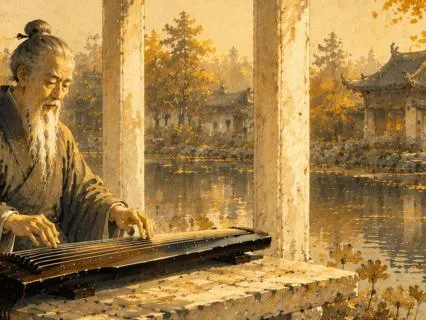
A retired official.
Sits at the stone table.
In his pavilion with the guqin.
A long wooden zither.
Seven silk strings before him.
Playing the piece.
He learned.
One he was.
20 years old.
The pavilion is small.
Four stone columns.
And a tiled roof.
Open on.
Sides.
Build over the corner.
Where the garden palm meets the garden's back wall.
He had it built.
15 years ago.
One he retained from his second posting.
The stone table at its center is all.
Oda Band.
To feel the air.
All a knob there.
The stone's surface.
Has a particular smoothness.
That is not cutting or polishing.
Way.
The way of hands and seasons.
And the guccin wooden spelly.
Please tune in.
Many.
Hundreds of times.
The garden around the pavilion.
The lotus palm.
Now,
In it.
Autumn State.
The leaf.
Browning at their edges.
The seat heads.
Dried above the water surface.
The ginkgo tree.
At that garden's corner.
Fully yellow.
The leave.
Having turned.
But not fallen.
A tree.
A solid yellow.
Above the palm.
The retired official is looking at the kitchen.
The peace is one of the all ones.
Flowing water.
Its origin.
Trace by Scholar.
To a Ching master.
Of the spring and autumn period.
To an ancient story of a playa.
Whose friend could hear.
Mountains and rivers in the music.
And who understood the player's heart through the music sound alone.
The pea's head.
I'll last at that late end by many centuries.
He landed at.
20.
In the study of his teacher.
In the two years.
He studied seriously.
Before the examinations took his attention away from music.
He learned,
Perhaps,
Twelve pieces.
In those years.
He remembers most of them.
He plays them differently now than he did before.
When he was 20 years old.
The fingers know the notes.
But the time has become slower.
The pulses.
Longer.
Is challenged less in the notes than in carrying forward the music's flowing character.
Allowing each note to unfold with the ease of water moving downstream.
He does not always play it the same way.
Some afternoons.
He lingers over the opening session.
On others,
He begins with the passage,
He has always loved most.
A piece.
Learned over 40 years ago.
No longer belongs entirely to this goal.
Today.
He is playing it from the beginning.
His hands are 62 years old.
He noticed them.
As he plays.
More than He noticed them at 20.
Or 30.
Or 40.
The skin has changed.
Dry.
The veins.
More visible.
At the back of each hand.
The knuckles more prominent.
When he extends his fingers.
Across the streams.
But the hands know what they are doing.
The right hand.
The plucking motions.
Each a specific angle and distance of finger movement.
The left hand.
Pressing the strings.
Along the instruments like a surface.
Sliding from position to position.
The sliding motion producing the characteristic of guching sound.
Notes that connect.
Rather than separate.
His hands play flowing water.
He watches them.
I see.
They are not entirely his.
The strings are his own.
Not the instrument's original strings.
Which would be.
30 years old.
But a set he put on four years ago.
Four years old silk strings.
They have settled.
The pitch holds better than it did.
1D when you.
The tone.
Has changed.
Nor brighter.
Nor darker exactly.
But more certain.
As if the silk having been under tension for years.
Knows its purpose and purpose.
Produce its sound.
Without effort.
He plucked the first string.
The lowest end.
Holds the note.
The know.
Sustain.
The autumn air of the garden.
Carries it out.
From the Brazilian.
Over the pawn.
Into the still afternoon.
He watches the notes of stain diminish.
Done.
He continues playing.
The air in the garden this afternoon.
Is the particular A of.
Clear autumn.
No call.
Mile.
The warmth of the afternoon sun.
Having accumulated in the stone of the pavilion.
And the pond's exposed surfaces.
Bot.
With an edge that the samae does not have.
The clear edge of autumn.
Which makes sound carry differently.
And makes the gucci notes more discreet.
In the stillness.
He has always played better in autumn.
He does not know.
If this is true or not.
This is simply that.
Autumn's quality of attention.
The quality of noticing things.
That would soon be.
Gone.
N.
Makes the playing feels more real.
The autumn air.
The nodes in it.
His hands.
Finding the peace.
Without.
His mind directing them.
The stone table and the guqin is important to the sound.
The guqin resonance.
Depends partly on what suffice it rests on.
A soft or absorptive surface.
Tampons there.
Vibration.
A hard dense surface like this stone.
Reflects the instrument sound differently from wood.
Giving the nodes a clarity he preferred.
He put the kuchin on this stone table for the first time 30 years ago.
Playing in a different house.
A different garden.
He brought the stone table with him through three different residences.
It is the table on which this instrument has always sounded best.
He plays.
The stone table,
And the instruments.
The instrument above the stove.
The autumn creeps afternoon.
Above both.
He enters there.
Second session.
In his teacher's transmission.
Flowing water was divided into seven sections.
The Second Wars.
Different from the first.
Where the first is.
Deliberate.
Each know,
Please,
Clearly.
The melodic line.
Simple and measured.
This again.
Has runs.
Passages of multiple notes.
Following each other quickly.
The right hand producing a cascade effect.
He manages this.
Cascade.
Nor as he did at 20.
At 20.
The cascade came more easily.
The fingers faster.
The technique.
Less considered.
Now his fingers negotiate the passage by a kind of patience.
Nor rushing.
Nor slowing.
Bots.
Finding exactly the temple.
At which his hands can produce each note clearly.
The cascade.
Please out.
He comes through it to a pause that follows.
He hauled the pulse.
Longer than he did at 20.
In the quiet that follows.
Memory seems closer than sound.
He hears the peace he learned at 20.
And the piece as he play it now.
Simultaneously.
Not in a way he could explain.
He is Naw.
Thinking about this.
Bots.
The hens,
Playing the notes of flowing water.
Carry the memory of the notes.
As they sounded.
42 years ago.
And The sound the instrument produces now in the garden pavilion is both the same piece.
And a different one.
His teacher told him.
You will play this piece all your life and It will never mean the same thing twice.
He was too young to understand this at 20.
He understands it now.
He plays the session he had always loved most.
The part he plays for himself rather than for any audience.
He looks up from the guqin for a moment.
The Ginkgo tree.
At the garden's corner.
Yellow.
The afternoon sun on it.
Making the yellow vivid.
A few leaves have fallen.
They are yellow ginkgo leaf.
On the palm surface,
Floating.
And on the garden path.
Below the tree.
The tree will be bare in two weeks.
He looks at it.
Then he looks back at his hands.
He plays the fifth section.
The music continues.
He enters the sixth section.
The afternoon light shift across the pond.
He plays on.
The seventh section ends.
The final note.
A harmony.
The string touched lightly.
Rather than pressed to the surface.
Producing the overtone.
Rather than the fundamental.
A note.
That is pure and high.
And fades quickly in the autumn air.
He let it fade completely.
Before lifting his hands.
Then he lifted his hands.
He sits before the silent instrument.
The garden is quiet around him.
The pond water sound.
The Ginkgo leaf.
If there is any win.
There is no win.
The distant sounds of the household afternoon.
He played flowing water through from beginning to end.
And so the retired official sits in his garden pavilion.
As the autumn afternoon begins its slow turn towards evening.
The guqin.
On the stone table before him.
The last node of the piece.
Fully faded.
Into the still air.
The gingko tree yellow.
At the garden's corner.
The lotus pond in its autumn brown.
The stone table.
Warm and other instruments.
N.
The peace flowing water he learned at 20 years old.
Have been played through again this afternoon.
S.
It will be played again in.
Other autumn afternoons fall.
However,
Many remain.
The world we visited tonight grows quiet now.
N.
You can simply rest here.
Comfortable and at ease.
Your mind can relax.
Your body can.
Soften.
If you are already drifting into sleep.
Allow yourself.
To sink a little deeper.
And if you are still awake.
Just listen.
To the quiet.
There is nothing more to do.
Nowhere else to be.
I'll be here whenever you need another peaceful moment like this.
Bot.
For now,
Sleep well.
Good night.