The Value of the Worthless Once a man came to see Zhuangzi and complained about a tree he owned.
It is huge,
He said,
It covers my whole yard.
It's very old and has been there for as long as anyone in the village can remember.
Yet it is an ugly old thing.
Its branches are so twisted and knotted that they are perfectly useless for timber.
The wood is so hard it resists all axes and saws and cannot even be used for firewood.
Hundreds of birds nest in it and all in all it is perfectly worthless.
Ah,
Answered Zhuangzi,
Perhaps this troublesome tree of yours has some worth after all.
But how can that be,
You old faker,
Cried the man.
Think on it this way,
Honorable sir,
Said the sage,
Lightly stroking his whiskers.
You say the tree is of no use as lumber.
It also cannot be chopped up for firewood.
Think then of how useful this has been for the tree.
It surely would never have attained its great height and size if it had been more useful to the carpenter or the woodcutter.
Why it would have been cut down long ago,
Would it not?
The trees that have straight true trunks or the ones that have easily cut limbs are never allowed to grow to maturity.
They,
By their very nature of usefulness,
Are killed very quickly and are not allowed to flourish into their true prime.
This tree of yours,
Did you not say it shielded the whole yard from the harsh sunlight?
Why yes,
Replied the man.
Well then,
Go and sit in its cool shade and rest from your labors.
Let your children climb and play in its crooked limbs.
And as for the birds,
Would they not build their nests somewhere else,
Perhaps in your roof,
If they did not have the tree to live in?
Besides,
Try to listen to their singing with a different ear,
And perhaps their music will begin to delight you.
So too,
My friend,
It is with men and women.
Those who would make ostentatious display of their great worth are all too quickly used up and thrown aside.
But those who appear useless in the eyes of the world are allowed to live out their lives in peace.
Thus,
They may be able to provide some small nourishment to those around them.
It is just this concept of worthlessness that marks Taoism as a unique philosophy.
But,
Says the Tao Te Ching,
Comes from what is there.
Usefulness comes from what is not there.
How different this way of thinking is from our modern world,
Where one's worth depends on how bright one is,
Or how attractive,
Or how much one is able to accomplish,
To produce.
In the face of this artificially high standard of worth,
Most people feel lacking.
Our schools,
Our businesses,
Our streets are filled with people who feel they do not measure up.
They do not feel they are worthy of love or respect,
Of happiness and good fortune.
Zhuangzi describes the ancient sages as people who,
Quote,
Did not mind being poor.
They took no pride in their achievements.
They made no plans.
Thus,
They could commit an error and not regret it.
They could succeed without being proud.
It is the intrinsic worthiness of being a human being,
In all its most sublime and most inarticulate,
And perhaps even ridiculous,
Aspects,
That gives us our worth,
Our special value.
To look for it in outside achievements or in superficial and glamorous ways misses the point altogether.
Our value as human beings,
As emotional beings,
As physical beings,
As spiritual beings,
Resides deep within us,
Down in the place we all share as children of Tao.
Zhuangzi also tells us about a hunchback man named Shu.
It seems the poor man was so deformed that his chin rested on his navel,
His shoulders rose up over his head,
His topknot pointed to the side,
His organs were shoved together and his thigh bones were in line with his hips.
But by washing clothes and sewing,
He was able to support himself.
Not content with that,
He also winnowed and sifted grain and was able to make enough to support ten people.
Also,
When soldiers appeared in his village to press the men into service,
They always passed over Shu.
When work gangs were being formed for public works,
He was exempt.
And lastly,
When the government gave out grain and wood to the needy,
He always got much more than anyone.
If this poor man,
Says Zhuangzi,
Was able to support himself so ably,
How much easier should it be for those of us whose deformities are those of the mind?
He then tells us about Ai Taito,
The ugliest man in his district.
He was said to be so ugly he would scare anyone under heaven,
Yet young women who saw him told their parents they would rather be his concubine than other men's wives.
As he always went along with whatever anyone else said,
He was never in position of leader or ruler over anyone else.
Though he never left his village and knew only what happened there,
Everyone regarded him highly.
The Duke of Lu heard about this remarkable man and,
Deciding he must find out his secret,
Summoned him to the court.
Indeed,
Ai Taito was extremely ugly.
And yet there was something about the man that he liked,
Even trusted.
After spending some time with him,
The Duke began giving Ai Taito more and more responsibility in his government.
At one point he offered him the position of chief minister.
Bashful,
Ai Taito hesitated,
As though he did not wish to take it.
The Duke became so ashamed of himself before this humble yet wise man that he gave him the entire government of his realm.
But in a short time,
Ai Taito disappeared,
Leaving the Duke bereft and alone.
Shu and Ai Taito,
Both deformed by the world's standards,
Yet so in sync with Tao,
Were not only able to live out their lives in peace and contentment,
But were able to inspire in others a feeling of trust and even love.
Could it be that they were able to realize the worthiness of the seeming worthless?
Lao-tzu says,
30 spokes share the wheel's hub.
It is the center hole that makes it useful.
Shaped clay into a vessel,
It is the space within it that makes it useful.
Therefore,
Profit comes from what is there,
Usefulness by what is not there.
In other words,
It is the empty space in a copper bowl that makes them useful.
If there were no space in them,
There would be nowhere to put our tea or soup.
In the same way,
If we do not make some space within ourselves,
There will be no place for new knowledge and spiritual experiences to lodge themselves.
We need to let go of our old selves,
Or at least those old parts of ourselves that leave no room for new insight and illumination to flow into.
We all want to be useful.
We all want to be thought of as worthy,
Of love,
Of respect,
Perhaps even of attention and riches.
We would like to think of ourselves as being useful to those around us,
Our families,
Our communities,
The people we work with.
But who actually measures usefulness?
Who is it that sets up the scales of worthiness?
Who decides who is worthy and who is not?
Taoism teaches us that each one of us,
Man,
Woman,
Child,
Black,
White,
Red,
Brown,
Or yellow is a unique and miraculous being,
And each of us deserves love,
Respect,
And the chance to express ourselves as ourselves,
In the most unique and natural way we can.
Only in this way can we personally determine our usefulness,
Our worthiness,
Our own special sense of who and what we are.
This is the age of the celebrity,
The superstar.
No longer is a person satisfied with being merely competent or experienced at what she or he does,
But now she must be the best,
The most famous,
The most successful,
The most highly regarded.
Lao Tzu,
After writing the Tao Te Ching,
One of the most sublime and articulate books ever written,
Disappeared.
He didn't stay around to become the famous author,
The great teacher,
The powerful guru or religious leader.
He did his work and left for the wilderness and was never heard from again.
Although he was a great teacher and philosopher,
Zhuangzi,
Too,
Preferred to remain a simple man.
He tells the story about Xu Yu,
A fellow of such great wisdom that Emperor Yao himself offered to step down from the Dragon Throne in his favor.
Xu Yu was so disgusted when he heard the offer that he not only refused,
But he immediately ran to the river to wash out his ears.
While he was there,
A boy came by,
Driving a team of oxen to the river to drink.
The boy asked Xu Yu why he was washing his ears out so thoroughly.
Xu Yu told him that the Emperor had offered to abdicate the throne to him,
Which made him feel so dirty he had to run right down to the river and wash out his ears.
Upon hearing this,
The boy started driving his oxen out of the water.
Xu Yu asked him why he was driving his animals out of the river when they hadn't finished drinking yet.
The boy replied,
The filth from your ears are dirtying the river water.
Do you think I want all that dirty water in my ox's mouth?
Taoism gives close attention to cycles.
Most times,
When one is ahead,
Only the next day to be behind.
One day everything goes well,
The next nothing works out.
One day you're famous,
Beloved by the world,
The next day you're a nobody.
This is natural,
Say the Taoists.
Life is full of change.
It encompasses each up and down and all two brief moments in between.
When we allow ourselves the space to be a nobody,
To be willing to experience the down as well as the up days,
We can come closest to being called men and women of Tao.
When we are willing to be worthless,
We become worthy.
As the ancient Achieved Ones explain,
It is only in emptying ourselves of our mental and emotional baggage that we will become fit to receive.
This concept is illustrated by the famous story of the highly educated and somewhat arrogant gentleman who comes to visit the renowned master so that the sage can show him a few things he may not yet know.
Upon entering the somewhat shabby temple where the Old One lives,
The self-satisfied one looks around with a patronizing gaze.
Obviously,
This old man is not very highly evolved if he lives in a tumble-down shack like this.
He has made up his mind to leave when suddenly an old man pops up right in front of him,
Startling him and causing him to take a few steps back.
Where did this guy come from,
He wonders.
One minute there was no one here and the next this strange guy pops up out of nowhere.
But he quickly gathers himself and bows obsequiously,
Though his heart really isn't in it,
But he wants the Old One to see he knows how the game is played.
The old man stands before him,
Saying nothing,
Yet fixing him with a gaze that tells him he is being measured quite deeply.
The old man frowns as if he knows that his guest is not all he pretends to be.
Then suddenly he speaks.
Please sit down and join me in some tea,
Esteemed sir,
He says,
Making his own bow to his guest,
Though not as deep as the one he had received.
His guest begins to feel a little ticked off at this,
But decides to let it go.
They sit and while the gentleman boasts about his education and recounts his accomplishments at great length,
The old man sits quietly waiting for the water to boil.
His guest is still going on and on,
Describing his many visions and explorations into the highest levels of spiritual cultivation he has attained in his long quest for enlightenment,
Which of course he feels that he has indeed achieved.
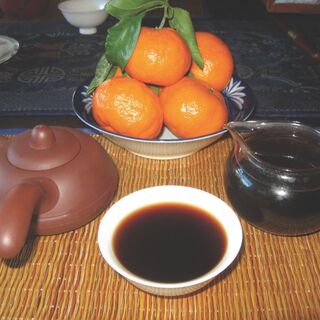
The old man fills a very small pot with an equally tiny bit of tea and pours hot water both into the pot and over it,
And then sits quietly again for it to steep.
Then he pours out this first steeping out into a bowl that is on the table for just this use.
The haughty guest is wondering why the old man is pouring out this perfectly good steeping of his undoubtedly expensive tea,
But decides not to question him about it.
Yet he goes on with his intermittable story of all the high-level gurus and lamas he has received patronage from.
The old man,
Though there is something about him that seems not so old upon closer inspection,
Fills the tiny teapot once again,
And then begins calmly filling his guest's teacup,
Smiling a little smile at his guest as if to say,
Yes,
Yes,
I hear and understand every word you are saying.
As the guest rambles on,
So too does the old man keep pouring tea into his cup until the tea overflows and begins running across the table and into the guest's lap.
Of course,
The tea is very hot,
And he is astounded that his lap is suddenly full of hot tea.
What are you doing,
You old dolt?
He shrieks,
Jumping up from his chair.
You're spilling tea everywhere.
Can't you see the cup is already full?
At this the old man stops pouring and sits back in his chair.
He is silent for a few moments and then begins to speak.
You sir,
Are like this full cup.
If I try to put anything into it,
It will surely overflow.
It is only when you empty your cup that you will be able to receive.
Unless you empty yourself of all your opinions,
Your ideas,
And your so-called accomplishments,
You will never truly experience the unlimited sense of Tao that is your true heritage and spiritual accomplishment.
And so the story goes.
The guest was at first very upset and begins to defend himself to this peculiar old man,
When suddenly,
Without knowing just what he is doing,
He sits himself down on his wet chair and begins to weep real tears of both sorrow and joy.
The old man's words,
For some strange reason,
Have spoken to him directly and deeply and he is ashamed of himself,
Ashamed at all the so-called accomplishments he had already attained,
At least in his own mind.
He feels embarrassed and ashamed,
Yet strangely joyful.
He felt he might be able to,
At last,
Let go of all he had accomplished in his many years of searching and relax into a state of not knowing and not being what Lao Tzu calls wu-wei.
At last he quiets down and picking up his teacup,
Smiles at the old one who is smiling back at him with a warm smile of acceptance and even love.
And lifting the cup of tea to his lips,
He feels it slide down to his belly where it feels warm and soothing.