Greetings.
Today we'll be exploring the transformative power of compassionately lowering the voice of our inner critic.
Let's begin.
Find a position or shape that feels comfortable for you.
You could sit with your back leaning against the support,
Or lie down with your knees up,
Feet flat,
Wider than hip width apart,
So that the knees are resting together.
Whatever you decide,
Take a moment to adjust your body in a way that feels supportive of your energy.
You may begin by orienting to the space around you,
Taking colors and textures and let your head move.
Look around you,
Look past your left shoulder with whatever range of motion that is available.
Pause in the center,
Slowly turn and look past your right shoulder.
You may choose to close your eyes or cast your gaze downward.
Allow your body to shift and settle in this moment.
Remember,
At any time throughout this practice,
You need to open your eyes or adjust your position.
Give yourself complete permission to honor your own needs.
Let's begin with a few diaphragmatic breathing.
If the breath is accessible,
You might explore taking a hand to your belly,
Or right below your ribcage.
Take a few deep breaths into the belly through the nose.
Invite the breath down so that you can feel the belly rise under your hands,
Filling your side body and your back body with breath.
You might imagine the breath filling the lungs like water filling a glass from the bottom up.
With a slightly open mouth,
Exhale and allow the belly to relax,
Moving back towards the spine.
Let your inhales or any other sensation be an invitation to fully arise.
Letting your exhale be an invitation to let go and soften.
Now see if you can allow the breath to fall into a natural rhythm.
With each inhale,
Feel yourself arriving.
With each exhale,
Feel the whole body soften.
Now relax your attention.
As Krista Neff,
A pioneer in the field of self-compassion defines it,
Self-compassion involves treating yourself with the same kindness and understanding that would offer a good friend.
It's about acknowledging our shared humanity and recognizing that imperfection is part of the human experience.
Tara Brach,
Another leading voice in mindfulness,
Describes self-compassion as a pathway to what she calls radical acceptance.
A way of embracing all parts of ourselves with love and understanding.
To illustrate the essence of compassion,
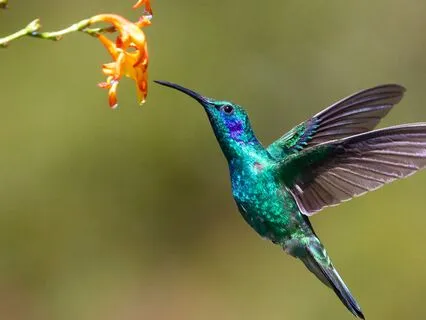
I'd like to share a powerful parable about the hummingbird and the burning forest.
And it goes like this.
Once upon a time,
Like all great stories begin,
A terrible fire broke out in a forest.
The entire forest was suddenly engulfed by a raging wildfire.
Frightened and confused,
All the forest creatures fled their homes and stood on the edge of the forest,
Watching the flames destroy their home.
They felt powerless and discouraged as they bemoaned the destruction of their homes.
All except one little hummingbird.
This particular hummingbird decided it would do something.
So it swooped into the nearest stream,
Collected a single drop of water in its beak,
And then flew back to the forest and dropped the water and the fire.
And it goes up and down,
Up and down,
As fast as it can.
In the meantime,
All the other forest creatures,
Much bigger,
Like the elephant with its big trunk that could bring much more water,
Stood watching in disbelief.
Some even tried to discourage the hummingbird.
And as they continued to discourage it,
The hummingbird turned to them without wasting any time or losing a beat,
But back and said,
I am doing the best I can.
And drop by drop,
The hummingbird continued.
Gradually,
The other forest creatures decided to join in.
The wise owl of intuition,
The strong bear of resilience,
And the playful lion cubs of joy.
Together,
The forest creatures created a chain of compassion,
Passing water from one stream to the fire.
Slowly but surely,
The flames begin to recede.
In this story,
Self-compassion is not just about an individual action.
Rather,
It's about rallying our inner resources.
It shows that transformation and self-love are an ongoing process,
Requiring patience,
Persistence,
And radical acceptance for all the versions of ourselves that show up in moments of suffering.
It also illustrates that no act of self-kindness is too small,
And that by consistently showing up for ourselves,
We can gradually transform our inner landscape from one of harsh criticism to one of nurturing growth.
And if you think about the forest like our internal landscape,
And the creatures of the forest,
They show up much like our emotions.
Shame,
Guilt,
Self-criticism,
And self-judgment.
They might show up as the roaring lion of self-doubt,
The circling vultures of negative self-talk,
The heavy bear of past regrets and trauma,
And the hissing snake of imposter syndrome.
These internal voices can make the fire of self-criticism seem unbeatable.
But the key message here is that we have the power to face them by resourcing ourselves.
By acknowledging these forest creatures as part of ourself,
Rather than running away from them,
We cultivate self-compassion.
The hummingbird's actions show that we can choose to respond to our inner critics with gentleness and determination.
And now,
Slowly and gently,
Return your awareness to your surroundings.
Once you're ready,
Open your eyes if they were closed,
Roll your wrists and ankles,
And stretch any part of your body that needs it.
Thank all versions of you for showing up in this moment,
Laws and all,
Beautifully stitched together,
That make you uniquely who you are.
Thank you for listening.