Good evening,
Dear ones,
And welcome to tonight's installment of Heidi,
So just taking some moments to make yourself comfortable in your bed,
Stretching out the arms overhead and stretching through the legs,
Pointing and flexing your toes,
Maybe giving them a little wiggle,
Relaxing down into your mattress,
Sinking deeply,
Deeply down,
Making your head comfortable on your pillow,
Setting yourself up nicely for a blissful night's sleep.
Maybe you would like to take a big yawn and starting to lengthen the breath.
It's time for you to rest,
To relax and enjoy a bedtime story.
Winter still continues.
Peter arrived punctually at school the next day.
He had brought his lunch with him in a bag,
For all the children that came from far away ate in school,
While the others went home.
In the evening,
Peter,
As usual,
Paid his visit to Heidi.
The minute he opened the door,
She ran up to him,
Saying,
Peter,
I have to tell you something.
Say it,
He replied.
You must learn to read now,
Said the child.
I have done it already.
Yes,
Peter,
But I don't mean it that way,
Heidi eagerly proceeded.
You must learn so that you really know how afterwards.
I can't,
Peter remarked.
Nobody believes you about that anymore and I won't either,
Heidi said.
When I was in Frankfurt,
Grandmamma told me that it wasn't true and that I shouldn't believe you.
Peter's astonishment was great.
I'll teach you,
For I know how,
And when you have learnt it,
You must read one or two songs to grandmother every day.
I shan't,
Grumbled the boy.
This refusal made Heidi very angry.
With flaming eyes,
She planted herself before the boy and said,
I'll tell you what will happen if you don't want to learn.
Your mother has often said that she'll send you to Frankfurt.
Clara showed me the terrible large boys' school there,
Where you'll have to go.
You must stay there until you are a man,
Peter.
You mustn't think that there is one kind teacher there.
No,
Indeed.
Cold shivers ran down Peter's back.
Yes,
You'll have to go there and when they find out that you can't read or even spell,
They'll laugh at you.
I'll do it,
I'll do it,
Said Peter.
Oh,
I am glad,
Peter.
Let us start right away.
Among the things that Clara had sent,
Heidi had found a little book with the A,
B,
C and some rhymes.
She had chosen this for the lessons.
Peter,
Having to spell the first rhyme,
Found great difficulty.
So,
Heidi said,
I'll read it to you,
Peter,
And then you'll be able to do it better.
Listen.
If A,
B,
C,
You do not know,
Before the school board,
You must go.
I won't go,
Said Peter,
Stubbornly.
Go where?
Before the court.
Hurry up then and learn the three letters,
Then you won't have to.
Peter,
Beginning again,
Repeated the three letters till Heidi said,
Now you know them.
Having observed the good result of the first rhyme,
She began to read again.
D,
E,
F,
You then must read,
Or of misfortune take good heed.
If H,
I,
J,
K are forgot,
Adversity is on the spot.
Who over L and M doth stumble,
Must pay a penance and feel humble.
There's trouble coming if you knew,
You'd quickly learn N,
O,
P,
Q.
If still you halt on R,
S,
T,
You'll suffer for it speedily.
Heidi,
Stopping,
Looked at Peter,
Who was so frightened by all these threats and mysterious horrors that he sat as still as a mouse.
Heidi's tender heart was touched and she said,
Comfortingly,
Don't be afraid,
Peter.
If you come to me every day,
You'll soon learn all the letters and then those things won't happen.
But come every day,
Even when it snows,
Promise?
Peter did so and departed.
Obeying Heidi's instructions,
He came daily to her for his lesson.
Sometimes the grandfather would sit in the room,
Smoking his pipe.
Often the corners of his mouth would twitch,
As if he could hardly keep from laughing.
He generally invited Peter to stay to supper afterwards,
Which liberally rewarded the boy for all his great exertions.
And thus the days passed by.
In all this time,
Peter had really made some progress,
Though the rhymes still gave him difficulty.
When they had come to you,
Heidi read,
Whoever mixes U and V will go where he won't want to be.
If W you still ignore,
Look at the rod beside the door.
Often Peter would growl and object to those measures.
But nevertheless,
He kept on learning and soon had but three letters left.
The next few days,
The following rhymes,
With their threats,
Made Peter more eager than ever.
If you the letter X forget,
For you no supper will be set.
If you still hesitate with Y,
For shame,
You'll run away and cry.
When Heidi read the last,
And he who makes his Z with blots,
Must journey to the Hottentots,
Peter sneered.
Nobody even knows where they are.
I am sure grandfather does,
Heidi retorted,
Jumping up.
Just wait one minute,
And I shall ask him.
He is over with the parson.
And with that she had opened the door.
Wait,
Shrieked Peter in great alarm,
For he saw himself already transported to those dreadful people.
What is the matter with you?
Said Heidi,
Standing still.
Nothing,
But stay here,
Heidi.
I'll learn,
He blubbered.
But Heidi,
Wanting to know something about the Hottentots herself,
Could only be kept back by piteous screams from Peter.
So,
At last,
They settled down again.
And before it was time to go,
Peter knew the last letter,
And had even begun to read syllables.
From this day on,
He progressed more quickly.
It was three weeks since Heidi had paid her last visit to the grandmother,
For much snow had fallen since.
One evening,
Peter,
Coming home,
Said triumphantly,
I can do it.
What is it you can do,
Peter?
Asked his mother eagerly.
I can read.
What?
Is it possible?
Did you hear it,
Grandmother?
Exclaimed Brigida.
The grandmother also was curious to learn how this had happened.
I must read a song now.
Heidi told me to,
Peter continued.
To the women's amazement,
Peter began.
After every verse,
His mother would exclaim,
Whoever would have thought it?
While the grandmother remained silent.
One day later,
When it happened that it was Peter's turn to read in school,
The teacher said,
Peter,
Must I pass you by again as usual?
Or do you want to try?
I shall not say to read,
But to stammer through a line.
Peter began and read three lines without stopping.
In dumb astonishment,
The teacher,
Putting down his book,
Looked at the boy.
What miracle has happened to you,
Peter?
For a long time I tried to teach you with all my patience,
And you were not even able to grasp the letters.
But now that I had given you up as hopeless,
You have not only learnt how to spell,
But even to read.
How did this happen,
Peter?
It was Heidi,
The boy replied.
In great amazement,
The teacher looked at the little girl.
Then the kind man continued.
I have noticed a great change in you,
Peter.
You used to stay away from school,
Sometimes more than a week.
And lately,
You have not even missed a day.
You have not even missed a day.
Who has brought about this change?
The uncle.
Every evening now,
Peter,
On his return home,
Read one song to his grandmother,
But never more.
To the frequent praises of Brigida,
The old woman once replied.
I am glad he has learnt something,
But nevertheless,
I am longing for the spring to come.
Then Heidi can visit me,
For when she reads,
The verses sound so different.
I cannot always follow Peter,
And the songs don't thrill me the way they do when Heidi says them.
And for no wonder,
For Peter would often leave out long and difficult words.
What did three or four words matter?
So it happened sometimes that there were hardly any nouns left in the hymns that Peter read.
News from distant friends.
May had come.
Warm sunshine was bathing the whole alp in glorious light.
And having melted the last snow,
Had brought the first spring flowers to the surface.
A merry spring wind was blowing,
Drying up the damp places in the shadow.
High above in the azure heaven,
The eagle floated peacefully.
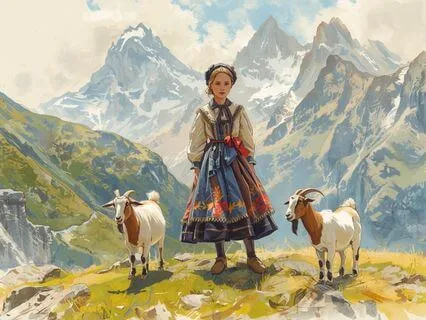
Heidi and her grandfather were back on the alp.
The child was so happy to be home again,
That she jumped about among the beloved objects.
Here,
She discovered a new spring bud.
And there,
She watched the gay little gnats and beetles that were swarming in the sun.
The grandfather was busy in his little shop,
And a sound of hammering and sawing could be heard.
Heidi had to go and see what the grandfather was making.
There,
Before the door,
Stood a neat new chair,
While the old man was busy making a second.
Oh,
I know what they are for,
Said Heidi gaily.
You are making them for Clara and Grandmama.
Oh,
But we need a third.
Or do you think that Miss Rottenmeier won't come perhaps?
I really don't know,
Said Grandfather.
But it is safer to have a chair for her,
If she should come.
Heidi,
Thoughtfully looking at the backless chairs,
Remarked,
Grandfather,
I don't think she would sit down on those.
Then we must invite her to sit down on the beautiful green lounge of grass,
Quietly answered the old man.
While Heidi was still wondering what the grandfather had meant,
Peter arrived,
Whistling and calling.
As usual,
Heidi was soon surrounded by the goats,
Who also seemed happy to be back on the Alp.
Peter,
Angrily pushing the goats aside,
Marched up to Heidi,
Thrusting a letter into her hand.
Did you get a letter for me on the pasture?
Heidi said,
Astonished.
No.
Where did it come from?
From my bag.
The letter had been given to Peter the previous evening,
Putting it in his lunch bag.
The boy had forgotten it there,
Till he opened his bag for dinner.
Heidi immediately recognised Clara's handwriting,
And bounding over to her Grandfather,
Exclaimed,
A letter has come from Clara.
Wouldn't you like me to read it to you,
Grandfather?
Heidi immediately read to her two listeners,
As follows.
As follows.
Dear Heidi,
We are all packed up and shall travel in two or three days.
Papa is leaving too,
But not with us,
For he has to go to Paris first.
The dear doctor visits us now every day,
And as soon as he opens the door,
He calls,
Away to the Alp,
For he can hardly wait for us to go,
If you only knew how he enjoyed being with you last fall.
He came nearly every day this winter to tell us all about you,
And the Grandfather,
And the mountains,
And the flowers he saw.
He said that it was so quiet,
In the pure,
Delicious air,
Away from towns and streets,
That everybody has to get well there.
He is much better himself since his visit,
And he seems younger and happier.
Oh,
How I look forward to it all.
The doctor's advice is that I shall go to Repats first,
For about six weeks,
And then I can go to live in the village,
And from there I shall come to see you every fine day.
Grandmama,
Who is coming with me,
Is looking forward to the trip too.
But just think,
Miss Rottenmeier does not want to go.
When Grandmama urges her,
She always declines politely.
I think Sebastian must have given her such a terrible description of the high rocks and fearful abysses,
That she is afraid.
I think he told her that it was not I think he told her that it was not safe for anybody,
And that only goats could climb such dreadful heights.
She used to be so eager to go to Switzerland,
But now neither Tanette nor she wants to take the risk.
I can hardly wait to see you again.
Goodbye,
Dear Heidi,
With much love from Grandmama.
I am your true friend,
Clara.
When Peter heard this,
He swung his rod to right and left.
Furiously driving the goats before him,
He bounded down the hill.
Heidi visited the grandmother the next day,
For she had to tell her the good news.
Sitting up in her corner,
The old woman was spinning as usual.
Her face looked sad,
For Peter had already announced the near visit of Heidi's friends,
And she dreaded the result.
After having poured out her full heart,
Heidi looked at the old woman.
What is it,
Grandmother?
Said the child.
Are you not glad?
Oh yes,
Heidi,
I am glad,
Because you are happy.
But Grandmother,
You seem so anxious.
Do you still think Miss Rottenmeier is coming?
Oh no,
Child,
It is nothing.
Give me your hand,
For I want to be sure you are still here.
I suppose it will be for the best,
Even if I shall not live to see the day.
Oh,
But then I would not care about this coming,
Said the child.
The grandmother had hardly slept all night,
For thinking of Clara's coming.
Would they take Heidi away from her,
Now that she was now that she was well and strong?
But for the sake of the child,
She resolved to be brave.
Heidi,
She said,
Please read me the song that begins with God will see to it.
Heidi immediately did,
As she was told.
She knew nearly all the grandmother's favourite hymns by now,
And always found them quickly.
That does me good,
Child,
The old woman said.
Already the expression of her face seemed happier and less troubled.
Please read it a few times over,
Child,
She entreated.
Thus evening came,
And when Heidi wandered homewards,
One twinkling star after another appeared in the sky.
Heidi stood still every few minutes,
Looking up to the firmament in wonder.
When she arrived home,
Her grandfather also was looking up to the stars,
Murmuring to himself,
What a wonderful month,
One day clearer than the other.
The herbs will be fine and strong this year.
The blossom month had passed,
And June,
With the long,
Long days,
Had come.
Quantities of flowers were blooming everywhere,
Filling the air with perfume.
The month was nearing its end,
When one morning,
Heidi came running out of the hut,
Where she had already completed her duties.
Suddenly,
She screamed so loud,
So loud,
That the grandfather hurriedly came out to see what had happened.
Grandfather,
Come here,
Look,
Look.
A strange procession was winding up the arm.
First marched two men,
Carrying an open sedan chair with a young girl in it,
Wrapped up in many shawls.
Then came a stately lady on horseback,
Who,
Talking with a young guide beside her,
Looked eagerly right and left.
Then,
An empty rolling chair,
Carried by a young fellow,
Was followed by a porter,
Who had so many covers,
Shawls and furs,
Piled up on his basket,
That they towered high above his head.
They are coming,
They are coming,
Cried Heidi in her joy,
And soon the party had arrived at the top.
Great was the happiness of the children at seeing each other again.
When Grandmama had descended from her horse,
She tenderly greeted Heidi first,
And then turned to the uncle,
Who had approached the group.
The two met like old friends.
They had heard so much about each other.
After the first words were exchanged,
The grandmother exclaimed,
My dear uncle,
What a wonderful residence you have.
Whoever would have thought it,
Kings would envy you here.
Oh,
And how well my Heidi is looking,
Just like a little rose,
A little rose.
She continued,
Drawing the child closely to her side,
And patting her cheeks.
What glory everywhere.
Clara,
What do you say to it all?
Clara,
Looking about her rapturously,
Cried,
Oh,
How wonderful,
How glorious.
I have never dreamt it could be as beautiful as this.
Oh,
Grandmama,
I wish I could stay here.
The uncle had busied himself in the meantime with getting Clara's rolling chair for her.
Then,
Going up to the girl,
He gently lifted her into her seat.
Putting some covers over her knees,
He tucked her feet in warmly.
It seemed as if the grandfather had done nothing else all his life than nurse lame people.
My dear uncle,
Said the grandmama,
Surprised.
Please tell me where you learned that,
For I shall send all the nurses I know there immediately.
The uncle smiled faintly while he replied,
It comes more from care than study.
His face became sad before his eyes had risen bygone times.
For that was the way he used to care for his poor,
Wounded captain,
Whom he had found in Sicily after a violent battle.
He alone had been allowed to nurse him.
Till his death.
And now,
He would take just as good care of poor,
Lame Clara.
When Clara had looked a long time at the cloudless sky above and all the rocky crags,
She said longingly,
I wish I could walk round the hut to the fir trees,
If I could only see all the things you told me so much about.
Heidi pushed with all her might,
And behold,
The chair rolled easily over the dry grass.
When they had come into the little growth,
Clara could not see her fill of those splendid trees that must have stood there so many,
Many years.
Although the people had changed and vanished,
They had remained the same,
Ever looking down into the valley.
When they passed the empty goat shed,
Clara said pitifully,
Oh,
Grandmama,
If I could only wait up here for Schwanley and Barley,
I am afraid I shan't see Peter and his goats if we have to go away so soon again.
Dear child,
Enjoy now what you can,
Said the Grandmama,
Who had followed.
Oh,
What wonderful flowers,
Exclaimed Clara again.
Whole bushes of exquisite red blossoms.
Oh,
If only I could pick some of those bluebells.
Heidi,
Immediately gathering a large bunch,
Put them in Clara's lap.
Clara,
This is really nothing in comparison with the many flowers in the pasture.
You must come up once and see them.
There are so many that the ground seems golden with them.
If you ever sit down among them,
You will feel as if you could never get up anymore.
It is so beautiful.
Oh,
Grandmama,
Do you think I can ever go up there?
Clara said with a wild longing in her eyes.
If I could only walk with you,
Heidi,
And climb round everywhere.
I'll push you,
Heidi said,
For comfort.
To show how easy it was,
She pushed the chair at such a rate that it would have tumbled down the mountain if the grandfather had not stopped it at the last moment.
It was time for dinner now.
The table was spread near the bench,
And soon everybody sat down.
The grandmother was so overcome by the view and the delicious wind that fanned her cheek that she remarked,
What a wondrous place this is.
What a wondrous place this is.
I have never seen its like.
But what do I see?
I think you are actually eating your second piece of cheese,
Clara.
Oh,
Grandmama,
It tastes better than all the things we get in Ragadas,
Replied the child,
Eagerly eating the savoury dish.
Don't stop.
Our mountain wind helps along where the cooking is faulty,
Contentedly said the old man.
During the meal,
The uncle and the grandmama had soon got into a lively conversation.
They seemed to agree on many things and understood each other like old friends.
A little later,
The grandmama looked over to the west.
We must soon start,
Clara,
For the sun is already low.
Our guides will be here shortly.
Clara's face had become sad,
And she entreated,
Oh,
Please let us stay here another hour or so.
We haven't even seen the hut yet.
I wish the day were twice as long.
The grandmama assented to Clara's wish to go inside.
When the rolling chair was found too broad for the door,
The uncle quietly lifted Clara in his strong arms and carried her in.
Grandmama was eagerly looking about her,
Glad to see everything so neat.
Then going up the little ladder to the hayloft,
She discovered Heidi's bed.
Is that your bed,
Heidi?
What a delicious perfume.
It must be a healthy place to sleep.
The grandfather,
With Clara,
Was coming up too,
With Heidi following.
Clara was perfectly entranced.
What a lovely place to sleep.
Oh,
Heidi,
You can look right up to the sky from your bed.
And what a good smell.
You can hear the fir trees roar here,
Can't you?
Oh,
I never saw a more delightful bedroom.
The uncle,
Looking at the old lady,
Said now,
I have an idea that it would give Clara new strength to stay up here with us a little while.
Of course,
I only mean if you did not object.
You have brought so many wraps that we can easily make a soft bed for Clara here.
My dear lady,
You can easily leave the care to me.
I'll undertake it gladly.
The children screamed for joy and grandmama's face was beaming.
What a fine man you are,
She burst out.
I was just thinking myself that a stay here would strengthen the child.
But then I thought of the care and trouble for you.
And now you have offered to do it as if it was nothing at all.
How can I thank you enough,
Uncle?
After shaking hands many times,
The two prepared Clara's bed,
Which,
Thanks to the old lady's precautions,
Was soon so soft that the hay could not be felt through at all.
The uncle had carried his new patient back to her rolling chair.
And there they found her sitting with Heidi beside her.
They were eagerly talking of their plans for the coming weeks.
When they were told that Clara might stay for a month or so,
Their faces beamed more than ever.
The guide with the horse and the carriers of the chair now appeared.
But the last two were not needed anymore and could be sent away.
When the grandmother got ready to leave,
Clara called gaily to her.
Oh,
Grandmama,
It won't be long,
For you must often come and see us.
While the uncle was leading the horse down the steep incline,
The grandmama told him she would go back to Regats,
For the door flea was too lonely for her.
She also promised to come back from time to time.
Before the grandfather had returned,
Peter came racing down to the hut with all his goats.
Seeing Heidi,
They ran up to her in haste.
And so Clara made the acquaintance of Schwanley and Barley and all the others.
Peter,
However,
Kept away,
Only sending furious looks at the two girls.
When they bade him goodnight,
He only ran away,
Beating the air with his stick.
The end of the joyous day had come.
The two children were both lying in their beds.
Oh,
Heidi,
Clara exclaimed.
I can see so many glittering stars,
And I feel as if we were driving in a high carriage straight into the sky.
Yes,
And do you know why,
Clara,
The stars twinkle so merrily,
Inquired Heidi.
No,
But tell me.
But tell me.
Because they know that God in heaven looks after us mortals and we never need to fear.
See,
They twinkle and show us how to be merry too.
But,
Clara,
We must not forget to pray to God and ask him to think of us and keep us safe.
Sitting up in bed,
They then said their evening prayer.
As soon as Heidi lay down,
She fell asleep.
But Clara could not sleep quite yet.
It was too wonderful to see the stars from her bed.
In truth,
She had never seen them before,
Because in Frankfurt,
All the blinds were always down long before the stars came out.
And at night,
She had never been outside the house.
She could hardly keep her eyes shut and had to open them again and again to watch the twinkling,
Glistening stars,
Till her eyes closed at last,
And she saw two big,
Glittering stars.
She saw two big,
Glittering stars in her dream.