Hello,
Dear ones,
And welcome to today's reading,
A Little Princess,
Chapter Eleven.
There were fine sunsets even in the square,
Sometimes.
One could only see parts of them,
However,
Between the chimneys and over the roots.
From the kitchen windows,
One could not see them at all,
And could only guess that they were going on,
Because the bricks looked warm and the air rosy or yellow for a while.
Or perhaps one saw a blazing glow strike a particular pane of glass somewhere.
There was,
However,
One place from which one could see all the splendour of them.
The piles of red or gold clouds in the west,
Or the purple ones,
Edged with dazzling brightness,
Or the little fleecy floating ones,
Tinged with rose colour,
And looking like flights of pink doves scurrying across the blue in a great hurry if there was a wind.
The place where one could see all this,
And seem at the same time to breathe a purer air,
Was,
Of course,
The attic window.
When the square suddenly seemed to begin to glow in an enchanted way,
And looked wonderful in spite of its sooty trees and railings,
Sarah knew something was going on in the sky,
And when it was at all possible to leave the kitchen without being misled or called back,
She invariably stole away and crept up the flights of stairs,
And,
Climbing on the old,
Old table,
Got her head and body as far out of the window as possible.
When she had accomplished this,
She always drew a long breath and looked all round her.
It used to seem as if she had all the sky and the world to herself.
No one else ever looked out of the other attics.
Generally,
The skylights were closed,
But even if they were propped open to admit air,
No one seemed to come near them.
And there Sarah would stand,
Sometimes turning her face upward to the blue,
Which seemed so friendly and near,
Just like a lovely bolted ceiling,
Sometimes watching the west,
And all the wonderful things that happened there.
The clouds melting or drifting or waiting softly to be changed pink or crimson or snow-white or purple or pale dove grey.
Sometimes they made islands or great mountains enclosing lakes of deep turquoise blue or liquid amber.
Sometimes dark headlands jutted into strange lost seas.
Sometimes slender strips of wonderful lands joined other wonderful lands together.
There were places where it seemed that one could run or climb or stand and wait to see what was coming next,
Until,
Perhaps,
As it all melted,
One could float away.
At least it seemed so to Sarah,
And nothing had ever been quite so beautiful to her as the things she saw as she stood on the table,
Her body half out of the skylight,
The sparrows twittering with sunset softness on the slates.
The sparrows always seemed to her to twitter with a sort of subdued softness,
Just when these marvels were going on.
There was such a sunset as this,
A few days after the Indian gentleman was brought to his new home,
And,
As it fortunately happened that the afternoon's work was done in the kitchen,
And nobody had ordered her to go anywhere or perform any task,
Sarah found it easier than usual to slip away and go upstairs.
She mounted her table and stood looking out.
It was a wonderful moment.
There were floods of molten gall covering the west,
As if a glorious tide was sweeping over the world.
A deep,
Rich,
Yellow light filled the air.
The birds flying across the tops of the houses showed quite black against it.
Oh,
It's a splendid one,
Said Sarah,
Softly to herself.
It makes me feel almost afraid,
As if something strange was just going to happen.
The splendid ones always make me feel like that.
She suddenly turned her head,
Because she heard a sound a few yards away from her.
It was an odd sound,
Like a strange little squeaking.
It came from the window of the next attic.
Someone had come to look at the sunset as she had.
There was a head and a part of a body emerging from the skylight,
And it was not the head or body of a little girl or a housemaid.
It was the picturesque,
White suave form and dark face gleaming eyes,
White turbaned head of the Indian manservant,
Alaska,
Sarah said to herself quickly.
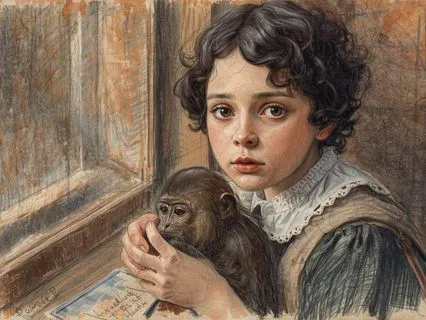
And the sound she had heard came from a small monkey he held in his arms,
As if he were fond of it,
And which was snuggling and chattering against his breast.
As Sarah looked toward him,
He looked toward her.
The first thing she thought was that his face looked sorrowful and homesick.
She felt absolutely sure he had come up to look at the sun,
Because he had seen it so seldom in England that he longed for the sight of it.
She looked at him interestedly for a second,
And then smiled across the slates.
She had learned to know how comforting a smile,
Even from a stranger,
May be.
Hers was evidently a pleasure to him.
His whole expression altered,
And he showed such gleaming white teeth as he smiled back,
That it was as if a light had been illuminated in his face.
The friendly look in Sarah's eyes was always very effective when people felt tired or dull.
It was perhaps in making his salute to her that he loosened his hold on the monkey.
He was an impish monkey,
And always ready for adventure,
And it is probable that the sight of a little girl excited him.
He suddenly broke loose,
Jumped on to the slates,
Ran across them chattering,
And actually leapt onto Sarah's shoulder,
And from there down into her attic broom.
It made her laugh and delighted her,
But she knew he must be restored to his master,
If the last scar was his master,
And she wondered how this was to be done.
Would he let her catch him,
Or would he be naughty and refuse to be caught,
And perhaps get away and run off over the roofs and be lost?
That would not do at all.
Perhaps he belonged to the Indian gentleman,
And the poor man was very fond of him.
She turned to the last scar,
Feeling glad that she remembered,
Still son of the Hindustani,
That she had learned when she had lived with her father.
She could make the man understand.
She spoke to him in the language that he knew.
Will he let me catch him,
She asked.
She thought she had never seen more surprise and delight than the face expressed when she spoke in his familiar tongue.
The truth was that the poor fellow felt as if his gods had intervened,
And the kind little voice came from heaven itself.
At once Sarah saw that he had been accustomed to European children.
He poured forth a flood of respectful thanks.
He was the servant of Missy Sahib.
The monkey was a good monkey and would not bite,
But unfortunately he was difficult to catch.
He would flee from one spot to another,
Like the lightning.
He was disobedient,
Though not evil.
Ram Dass knew him as if he were his child,
And Ram Dass he would sometimes obey,
But not always.
If Missy Sahib would permit Ram Dass,
He himself could cross the roof to her room,
Enter the windows,
And regain the unworthy little animal.
But he was evidently afraid Sarah might think he was taking a great liberty,
And perhaps would not let him come.
But Sarah gave him leave at once.
Can you get across,
She inquired.
In a moment,
He answered her.
Then come,
She said.
He is flying from side to side of the room as if he is frightened.
Ram Dass slipped through his attic window and crossed to hers,
As steadily and lightly as if he had walked on roofs all his life.
He slipped through the skylight and dropped upon his feet without a sound.
Then he turned to Sarah and salamed again.
The monkey saw him and uttered a little scream.
Ram Dass hastily took the precaution of shutting the skylight,
And then went in chase of him.
It was not a very long chase.
The monkey prolonged it a few minutes evidently for the mere fun of it.
But presently he sprang,
Chattering,
Onto Ram Dass's shoulder,
And sat there,
Chattering and clinging to his neck with a weird little skinny arm.
Ram Dass thanked Sarah profoundly.
She had seen that his quick eyes had taken in at a glance all the bare shabbiness of the room.
But he spoke to her as if he was speaking to the little daughter of a Rajah,
And pretended that he observed nothing.
He did not presume to remain more than a few moments after he had caught the monkey,
And those moments were given to further deepen his gratitude to her,
In return for her indulgence.
This little evil one,
He said,
Stroking the monkey,
Was,
In truth,
Not so evil as he seemed,
And his master,
Who was ill,
Was sometimes amused by him.
He would have been sad if his favourite monkey had run away and been lost.
Then he salamed once more,
And got through the skylight and across the slates again,
With as much agility as the monkey himself had displayed.
When he had gone,
Sarah stood in the middle of her attic,
And thought of many things his face and his manner had brought back to her.
The sight of his native costume,
And the profound reverence of his manner,
Stirred all her past memories.
It seemed a strange thing to remember that she,
The drudge whom the cook had said insulting things to only an hour ago,
Had only a few years ago been surrounded by people who all treated her as Ram Dass had treated her,
Who salamed when she went by,
Whose foreheads almost touched the ground when she spoke to them,
Who were her friends.
It was like a sort of dream.
It was all over,
And it could never come back.
It certainly seemed that there was no way in which any change could take place.
She knew what Miss Minchin intended that her future should be.
So long as she was too young to be used as a regular teacher,
She would be used as an errant girl and servant,
And yet expected to remember what she had learned,
And in some mysterious way,
To learn more.
The greater number of her evenings she was supposed to spend at study,
And at various indefinite intervals,
She was examined,
She knew she would have been severely punished if she had not advanced as was expected of her.
The truth,
Indeed,
Was that Miss Minchin knew that she was too anxious to learn,
To acquire teachers.
Give her books,
And she would devour them,
And end by knowing them by heart.
She might be trusted to be equal to teaching a good deal in the course of a few years.
This is what would happen.
When she was older,
She would be expected to drudge in the schoolroom,
As she drudged now in various parts of the house.
They would be obliged to give her more respectable clothes,
But they would be sure to be plain and ugly,
And make her look somehow like a servant.
That was all there seemed to be to look forward to,
And Sarah stood quite still for several minutes and thought it over.
Then a thought came back to her,
Which made the colour rise in her cheek,
And a spark light itself in her eyes.
She straightened her thin little body,
And lifted her head.
Whatever comes,
She said,
Cannot alter one thing.
If I am a princess in rags and tatters,
I can be a princess inside.
It would be easy to be a princess if I were dressed in clothes of gold,
But it is a great deal more of a triumph to be one all the time,
When no one knows it.
There was Mary Antoinette,
When she was in prison,
And her throne was gone,
And she had only a black gown on,
And her hair was white,
And they insulted her,
And called her widow-carpet.
She was a great deal more like a queen then,
Than when she had been happy and everything was so grand.
I liked her best then.
Those howling mobs of people did not frighten her.
She was stronger than they were,
Even when they cut her head off.
This was not a new thought,
But quite an old one by this time.
It had consoled her through many a bitter day,
And she had gone about the house with an expression in her face which Miss Minchin could not understand,
And which was a source of great annoyance to her,
As it seemed as if the child were mentally living a life which held her above the rest of the world.
It was as if she scarcely heard the rude and acid things said to her,
Or,
If she heard them,
Did not care for them at all.
Sometimes,
When she was in the midst of some harsh,
Domineering speech,
Miss Minchin would find the still,
Unchildish eyes fixed upon her,
With something like a proud smile in them.
At such times,
She did not know that Sarah was saying to herself,
You don't know that you are saying these things to a princess,
And that if I chose,
I could wave my hand and order you to execution.
I only spare you because I am a princess,
And you are a poor,
Stupid,
Unkind,
Vulgar old woman,
And don't know any better.
This used to interest and amuse her more than anything else,
And strange and fanciful as it was,
She found comfort in it,
And it was a good thing for her.
While the thought held possession of her,
She could not be made rude and malicious by the rudeness and malice of those about her.
A princess must be polite,
She said to herself,
And so when the servants,
Taking their tone from their mistress,
Were insolent and ordered her about,
She would hold her head erect and reply to them with a quaint civility which often made them stare at her.
She's got more airs and graces She's got more airs and graces than if she'd come from Buckingham Palace,
That young one,
Said the cook,
Chuckling a little sometimes.
I lose my temper with her often enough,
But I will say she never forgets her manners.
If you please,
Cook.
Will you be so kind,
Cook?
I beg your pardon,
Cook.
May I trouble you,
Cook?
She drops them about the kitchen as if they were nothing.
The morning after the interview with Ram Dass and his monkey,
Sarah was in the schoolroom with her small pupils.
Having finished giving them their lessons,
She was putting the French exercise books together and thinking,
As she did it,
Of the various things royal personages in disguise were called upon to do.
Alfred the Great,
For instance,
Burning the cakes and getting his ears boxed by the wife of the neat herd.
How frightened she must have been when she found out what she had done.
If Miss Minchin should find out that she,
Sarah,
Whose toes were almost sticking out of her boots,
Was a princess,
A real one.
The look in her eyes was exactly the look which Miss Minchin most disliked.
She would not have it.
She was quite near her and was so enraged that she actually flew at her and boxed her ears,
Exactly as the neat herd's wife had boxed King Alfred's.
It made Sarah start.
She wakened from her dream at the shop and,
Catching her breath,
Stood still for a second.
Then,
Not knowing she was going to do it,
She broke into a little laugh.
What are you laughing at?
Miss Minchin exclaimed.
It took Sarah a few seconds to control herself sufficiently to remember that she was a princess.
Her cheeks were red and smarting from the blows she had received.
I was thinking,
She answered.
Beg my pardon immediately,
Said Miss Minchin.
Sarah hesitated a second before she replied.
I will beg your pardon for laughing if it was rude,
She said,
But I won't beg your pardon for thinking.
What were you thinking?
Demanded Miss Minchin.
How dare you think?
Well,
What were you thinking?
Jessie tittered and she and Lavinia nudged each other in unison.
All the girls looked up from their books to listen.
Really,
It always interested them a little when Miss Minchin attacked Sarah.
Sarah always said something strange and never seemed the least bit frightened.
She was not in the least frightened now,
Though her boxed ears were scarlet and her eyes were as bright as stars.
I was thinking,
She answered,
Grandly and politely,
That you did not know what you were doing.
That I did not know what I was doing,
Miss Minchin fairly gasped.
Yes,
Said Sarah,
And I was thinking what would happen if I were a princess and you boxed my ears?
What I should do to you?
And I was thinking that if I were one,
You would never dare do it,
Whatever I said or did.
And I was thinking how surprised and frightened you would be if you suddenly found out.
She had imagined the future so clearly before her eyes that she spoke in a manner which had an effect even upon Miss Minchin.
It almost seemed,
For the moment,
To her narrow,
Unimaginative mind that there must be some real power hidden behind this candid daring.
What,
She exclaimed,
Found out what?
That I really was a princess,
Said Sarah,
And could do anything,
Anything I liked.
Every pair of eyes in the room widened to its full limit.
Lavinia leaned forward on her seat to look.
Go to your room this instant,
Cried Miss Minchin.
Leave the schoolroom.
Young ladies,
Attend to your lessons.
Sarah made a little bow.
Excuse me for laughing,
If it was impolite,
She said,
And walked out of the room,
Leaving Miss Minchin struggling with her rage and the girls whispering over their books.
Did you see her?
Did you see how strange she looked?
Jessie broke out.
I shouldn't be at all surprised if she did turn out to be something.
Suppose she should.