Risi,
The quiet crown of the forest.
Welcome,
My dear friends.
So let's take a slow breath with me.
Breathing in and breathing out.
And as you exhale,
Imagine you're stepping off a busy path for a moment into a shaded forest where the light is softer and the air smells like bark and rain,
And time moves at a kinder pace.
Today we're meeting a being that doesn't chase attention and it doesn't bloom in a rush.
It never shouts,
Instead it arrives quietly like a patient teacher.
It simply arrives.
Today we're talking about reishi mushroom,
An ancient symbol of steady,
Root-level healing and endurance.
I'm sharing this talk with you not from a medical perspective.
This is a connection and energetic one.
If you'd like to learn more about the medicinal purposes,
Please connect with a herbalist.
And having shared this,
Let's dive into it.
So reishi is a common name often used as gendorma lucidum and closely related to gendorma species.
In the wild,
It's usually a hard,
Shelf-like mushroom,
A conch,
That grows on hardwood trees or decaying wood.
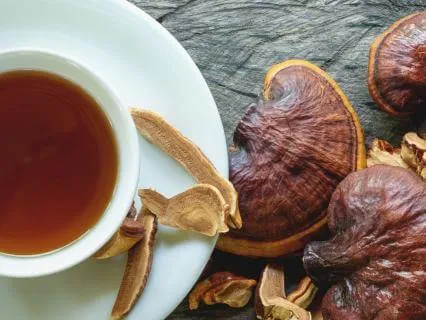
And one of its most striking features is it looks like reishi has this shiny,
Lacquered surface.
It's almost like being furnished by the forest itself,
A deep reddish-brown sometimes with lighter edges.
It can look unreal,
Like something carved or polished.
And it's not soft or snackable like grocery store mushrooms.
Reishi is woody and bitter,
More like bark than food.
And the bitterness matters spiritually,
Too,
And we'll come back to that.
So reishi traveled with humans for a very long time.
In China,
They're famously called lingchi and often translated as spirit plant or divine mushroom.
And has been revered in traditional cultures for centuries,
Appearing in art and poetry and stories connected to vitality and a long life.
In Japan,
It's called reishi or monotheque,
10,
000-year mushroom,
And in Korea,
You'll often hear yongshin,
And I apologize for my pronunciations.
Across these cultures,
Reishi becomes more than a fungus.
It becomes a symbol of endurance,
Spiritual refinement,
And longevity.
Not in a fleshy,
Eternal youthful way,
But in a deep-rooted way.
Reishi is often nicknamed to the mushroom of immortality.
So let's hold it with both hands.
In one side,
It's the legendary title passed through traditions and story.
And on the other hand,
It points to something profoundly useful for our lives.
Immortality,
In spiritual language,
Often means the part of you that doesn't break under pressure.
The part of you that returns to the center.
The part of you that outlasts a season of fear.
And the part of you that remembers what is real.
Reishi doesn't promise an easy,
Struggle-free existence.
Its message is to meet life's challenges with a steadiness and an unwavering spirit.
It teaches you can become steady enough to meet hardship without losing your spirit.
And when reishi shows up in our lives,
So when that happens,
It can happen when you're maybe on a walk,
Or maybe it shows up in a book,
Or in a conversation,
Or a dream.
Or maybe the word alone just won't leave you alone.
It's a sign that you're being invited to shift from pushing to listening,
From forcing to allowing,
From rushing to rooting,
From performing to being.
And reishi often shows up for people who've been caring too much for too long.
The ones who look fine on the outside,
But inside their spirit is asking for a quieter life.
Reishi is a helper for these things.
It helps,
For example,
With burnout and the long,
Slow kind of exhaustion.
Not the tiredness that a nap fixes,
But the tiredness that comes from living in survival mode for a very,
Very long time.
And reishi's message here is,
We rebuild from the roots,
Not from the mask.
Or the connection to a nervous system that is overloaded.
Reishi is not a hype mushroom.
It's a settling ally in the symbolic sense.
It guides you back into safety,
Into breath,
And slower thoughts.
Reishi also helps you with strengthening your boundaries.
Because reishi is literally a protective,
Woody form.
Firm,
Resilient,
Not easily pierced.
It is asking you questions like,
Where have you been saying yes,
But your body is saying no?
And reishi can help us with grief.
Transitioning from one place that we are in in life to going to another place where we are in life.
Reishi is often gross on dying or dead wood that's not dark.
That's kind of an alchemy into the teaching of the sacred circle.
That what ends becomes nourishment.
So ending a harsh chapter in our life becomes the nourishment for opening up a new chapter into our life.
And this is the season of change.
It's not a failure,
It's a compost,
It's a transition into something new with wisdom and guidance and support.
There are two interesting features,
Unique features to this beautiful being.
One is the lacquered shine,
The glossy surface,
Like a crown.
And so spiritually reishi is teaching dignity,
Not ego,
Not status.
In a way of,
I don't have to prove my worth,
I am here and I belong.
And then of course,
The other feature is the woody toughness.
It's not stubborn,
It's a devotion towards healing.
The kind of healing that builds you with a choice,
One,
An honest one,
An honest no,
One of earlier bedtime,
One of quiet mornings,
Then the one boundary that you keep.
There are lots of stories where reishi is being presented and there are so many legends about Lin Chi,
Reishi across East Asia,
And they often carry kind of the same heartbeat in one common kind of tale that kind of goes like this.
A humble person,
Sometimes a woodcutter,
A healer or a wanderer,
Goes on the journey into the mountains or for a search of something,
To save a loved one or to bring hope to a struggling village.
And they face storms and steep paths,
Wild animals and doubt and exhaustion.
And then when they stop grasping,
When they sit down and breathe and listen,
They notice a strange shining from an old tree.
They bring it back,
Not as a trophy,
But as a gift of devotion.
And that's where the miracle,
The offering the wisdom of the story comes.
It isn't just the mushroom,
It's the transformation of the seeker.
They return with humility,
They return with steadiness and a reference for life.
And why do these stories,
These legends,
These folklores being shared?
It's because they keep a community alive.
Patience over impatience,
Virtue over greed,
Reference over exploitation.
And the understanding that true medicine often requires a journey.
And they remind us that the forest gifts us those who walk with respect.
Reishi is widely used in traditional herbal systems and it's subject of modern research for its bioactive compounds such as the polyesterides,
I hope I pronounce that correctly,
And the titerpens,
Also hope I pronounce that correctly.
But it's not a magical cure of all.
It's a supplement that can interact with certain conditions that get supported to help healing.
So we honor Reishi spiritually without making medical promises.
We can let it be a teacher of endurance and restoration and still be sensible with our bodies and our health care.
If you want to turn this into a tender moment in where you are in your life,
Then just sit with it.
What does it want to share with you?
What is it that it wants to have you explore or wants you to take a journey on?
It's important to really find where the roots go in for you.
And let me share this short blessing with you.
I invite you just to imagine Reishi in the forest,
Shining quietly on a beautiful old tree.
And just embrace you with these words.
Not rushing or needing to be seen.
Not begging to be seen.
Just offering its presence.
May Reishi remind you,
You don't need to sprint your way into wholeness.
May you trust slow healing.
May you choose steady boundaries.
May your spirit remember its dignity.
May your life be transformed in ways that matter most.
Quietly,
Steadily,
With dignity and presence.
And may I say thank you for walking this path with me.
And may this lesson of Reishi travel with you beyond this moment.