Hello there,
Good morning,
Good afternoon,
Good evening,
Wherever you are.
I'm Ryan in Singapore,
Welcome to our mindfulness practice.
The topic today is the six pillars of mental health.
Usually I do five,
And as I've been living my life,
One sixth thing kind of showed up and I just wanted to discuss that and share it with you,
As well as maybe have you consider it in your own life.
So first of all,
Let's go ahead and go through what are the five original pillars of mental health that I came up with a few years ago.
And the idea here is,
You know,
Why do I call these the pillars of mental health?
Because there are things that you can do that don't necessarily appear to tie in directly with mental health.
So just some hopefully simple things that you can do that will have a positive effect on your mental health.
So the first one is meditate every day.
So this will help you,
This is,
You know,
One of the reasons that I'm here on Insight.
It's probably the reason,
It is the reason that I'm here on Insight Timer,
Is that I've been meditating every day since like 2017.
And I've seen a big impact on my life.
And the biggest impact is self awareness.
So learning about myself and learning what things have effect on me.
And so,
You know,
One of the ways that I was able to come up with these five things is through my mindfulness practice,
I became aware of myself.
And the sixth thing is no exception.
So everything kind of hinges on that.
So you know,
Don't take my word for what these pillars are and how they affect you.
Practice mindfulness,
Practice every day.
Do some meditation,
Whether it be five minutes,
10 minutes,
You know,
How much you meditate matters.
You know,
If you meditate 30 minutes every day,
It's going to have a bigger impact on your life than if you meditate 10 minutes a day.
That said,
Meditating zero minutes a day is significantly worse than meditating 10 minutes a day.
So pick something that's doable.
Don't go,
Well,
Oh,
Ryan said I have to,
You know,
If I really want the best benefit,
I need to meditate 30 minutes.
And then that's,
You know,
And that's not even true either.
Your mindfulness practice is going to guide you to find out what the right number is for you.
I know what the right amount length of time is for me,
What's doable,
And what is extremely effective.
So I always try and practice that amount of time for myself.
So number one,
Mindfulness,
Make sure to make time for your mindfulness practice.
Number two is eat well.
And actually,
Interestingly,
I had my trip to Jakarta recently,
I wasn't eating so well,
And I noticed that it did have some impact on my mood.
And that's,
You know,
I think that that's something that we sometimes overlook.
And you know,
Sugar has impacts on our brain and our mental health.
Even eating fried food can have some impact.
And again,
I'm not here to give you a diet plan.
But instead,
Use your mindfulness practice to do some experimentation.
Use your body like your science project.
See what happens when I cut out fried food in my life.
Does it make me,
Do I seem to be happier?
You know,
If I stop eating dessert for a month,
What happens?
Do I notice some kind of impact?
So use it as a,
Use it as this kind of science experiment.
Number three,
Exercise often.
So you,
And this one,
I think this one's extremely impactful for me.
I find that my mood and my mental health,
My attitude towards myself is significantly better when I'm exercising regularly.
And that it can be,
Yeah,
I mean,
I guess I don't need to say any more than that.
I think it's a lot easier for me to have a lot of negative,
Critical self-thoughts when I'm not exercising.
And you know,
I think,
You know,
I did,
What's it?
I did yoga,
Because of my trip,
I hadn't done yoga in over a week.
And I did my yoga practice on Monday for the first time in a while.
And I had a,
Just noticed a huge impact on my mood that day.
And it was quite easy to tie it to yoga and go,
Wow,
You know,
This practice had a strong impact on me.
And,
You know,
I think something else I can say about yoga in particular is that it's a little different from other exercises in that there's an additional mindfulness component to it if you do it the right way,
Let's say.
Okay,
So that's three,
Exercise enough.
Four,
Sleep enough.
This one,
You know what,
Why we sleep,
This book,
It says if you sleep less than seven hours a day,
You will have a noticeable impact.
That,
You know,
As a man,
You won't generate enough testosterone.
Your hormones won't be balanced well enough.
So,
And it doesn't matter who you are,
If you think that four hours of sleep is enough for me,
Or six hours of sleep is enough for me.
If you're getting any less than seven hours of sleep,
It's going to have an impact on you,
On your physical health,
And on your mood as well.
It's,
You know,
Certainly hormonal balance has an effect on our mental health.
Number five,
Hydrate.
Make sure you stay hydrated.
I know this one's,
This seems super easy to do,
But it's an easy one to forget.
Living in Singapore,
That's,
That was,
You know,
And I create,
I,
I made this list of five things before I moved here to Singapore.
And here,
I find it even more important.
I think the first two months that I was living here,
I was still drinking water the same way that I did when I was in Hong Kong.
And it became,
Well,
I guess it wasn't clear to me,
Because it took two months for me to figure it out.
I was tired all the time.
Why am I constantly tired?
And then I increased my water intake,
And sure enough,
That,
That helped the problem quite a lot.
And,
You know,
Being tired all the time,
Of course,
Is,
Is,
You know,
Makes our,
Our mood,
Has a strong impact on our mood as well.
So,
Okay,
So there we go.
I've done the five.
Now you're probably curious,
Well,
What's,
What's number six?
Sorry,
This is the Chinese,
Chinese symbol for six.
What's the sixth one?
Is,
Monitor your use of any conscious altering substances.
And,
And cut back,
Right?
Just like,
Just like choosing not to eat fried food.
In fact,
And I,
I wanted to,
To talk about this as,
As far as,
You know,
Consumption as well,
Because sugar actually does have some mind altering,
Some conscious alter,
Consciousness altering effect.
But,
You know,
I,
I suppose this really wasn't the key thing to think about.
Maybe more of,
Well,
Any substance that,
That affects the brain directly,
Right?
Any substance that,
That crosses into the blood brain barrier and has some effect on you,
And that includes caffeine.
On my meditation retreat in Thailand,
That was something that was forbidden,
Right?
We are not allowed to have caffeine,
And I was curious to see what I was like without caffeine,
And the first couple of days I,
I slept more.
That was a interesting impact.
But in general,
I think what I found without caffeine was that my,
Just my,
My energy level was more constant.
So once I got over the withdrawal symptoms of having no caffeine,
Which was probably two or three days,
I just found that my energy level maintained a more,
More constant level throughout the day.
And,
You know,
It's like,
Instead of using like puppet strings to bring me up and to pull me down,
I,
I'm actually relying on my body and my hormones to,
To do all of that.
So,
You know,
Caffeine,
And then of course other consciousness altering substances.
I know cannabis is legal in some countries now,
Including the,
Including the United States,
And some places,
You know,
Certainly be aware of how,
How these,
Well,
Especially if they have addictive properties,
And it doesn't have to be a physical addictive property.
It could be a psychologically addictive,
Right?
That the pleasure that comes from some of these,
You know,
Psychological or,
Or consciousness offering,
Altering substances.
And,
And that does include caffeine.
But of course it includes,
You know,
Things that maybe alter your consciousness more drastically,
Like,
Like alcohol and cannabis and,
You know,
Other,
Other things.
As well as even,
You know,
If you have attention deficit hyperactivity disorder,
The,
The,
The substances that you use to,
To keep that,
That under control,
You know.
And,
And again,
This is not a,
This is not,
By no means a talk that says,
Don't do what your doctor tells you to do.
This is a,
A bring mindfulness to every aspect of your life,
Including everything that you consume kind of talk.
So do be aware of how anything affects you.
And,
And I,
I think what,
What was the catalyst for me to talk about this subject today,
Was that while I was in Jakarta,
I suppose I back up a little bit,
Is that I,
I did have some alcohol use issues in my past.
I've talked about it,
But not,
Not for a while.
And so I quit drinking for quite a long time.
And now I,
I drink a little bit in moderation.
I'm still not entirely sure that that's a,
That's a wonderful idea.
And in Jakarta,
I had,
You know,
With some,
With some friends that like wine,
And I was,
Was drinking a few glasses of wine here and there.
And even coming back to Singapore,
I think my,
You know,
It altered my mood in a negative way.
And it made me less,
Or I should say,
I was less able to tackle just the,
The full catastrophe of my regular life.
Because,
And I,
And I believe that,
That have,
That drinking alcohol here and there,
Having a few glasses of wine the previous days had an impact on that.
And,
And again,
This is not like even getting drunk.
This is just a few glasses of wine.
I really think that alcohol is,
It's not my friend.
So,
Good awareness.
So let's,
Yeah,
Let's get into practice.
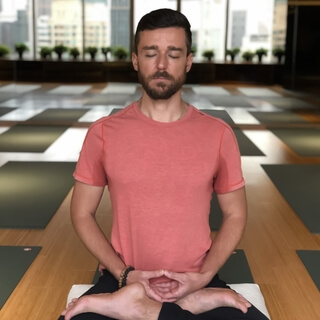
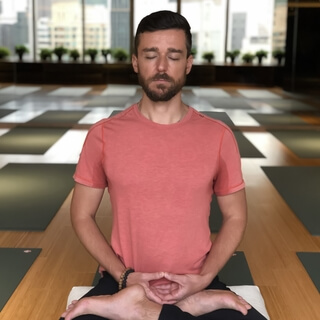
So I encourage you to sit up straight.
Today we're,
We're going to just be practicing mindfulness.
And the idea of why are we practicing mindfulness is so that you can really cultivate that kind of raw awareness.
To go,
Well,
What is happening right now?
How am I being affected by,
By everything?
My thoughts?
It's one of the reasons why we choose to practice in stillness.
See if you can keep your body still for this practice.
Notice your desires.
Notice your desire to move,
If that comes up.
Notice the physical sensations in the body.
So as we sit here,
Feel free to make a few little movements.
Roll the shoulders if you like.
Move the head around.
Stretch out the body.
Encourage a little bit of relaxation.
And then arriving in our still sitting posture.
Crown of the head towards the ceiling.
Chin is roughly parallel to the floor.
Eyes could be closed or if you choose to leave your eyes open at a gaze about 45 degrees downwards.
Hands on your knees or in your lap.
Arms and shoulders relaxed.
It's kind of hanging there by their own weight.
As you scan through your face,
Notice the eyebrows and the eyes.
Is there tension there?
Seeing if through awareness you can let go of that tension.
How about the jaw?
Are the teeth touching one another?
The top teeth and bottom teeth in contact?
If so,
Seeing if you can intentionally part your teeth.
Leaving your lips closed if you can.
Allowing your breath to go through the nostrils.
Your nose happens to be clear today.
Observing the shoulders.
Seeing if there's any tension there.
Noticing the upper back.
The lower back.
The abdomen.
What are the abdominal muscles like?
If your abdominal muscles are relaxed,
Then you will be able to feel your breath.
You'll feel the belly expanding as you breathe in.
Contracting as you breathe out.
Just following the breath there at the belly.
Expanding.
Contracting.
Breathing at your own pace.
And now let's shift awareness to the nostrils.
Can you feel the movement of air in and out of the nostrils as you're breathing?
And now if you like,
Let's shift the point of awareness between the nostrils and the belly.
So as we breathe in,
Paying attention at the nose,
The tip of the nose,
The nostrils,
The inside of the nose,
And following the airway down into the belly as the belly expands.
And then as we breathe out,
The belly contracting,
The air coming back up through the trachea,
Through the nose,
To the nostrils,
The tip of the nose.
And so,
Of course,
I'm giving these instructions slowly.
And you can feel free to follow them at the pace of your own breath.
So tip of the nose,
Nostrils,
Inside of the nose,
Through the sinuses,
The trachea,
Expansion of the lungs,
And then as the diaphragm moves down,
The expansion of the abdomen.
As you breathe out,
The contraction of the abdomen,
The lowering of the chest,
Air moving up through the trachea,
Through the sinuses,
Through the nose,
To the nostrils,
The upper lip or the tip of the nose.
So continuing as best you can to follow the breath in this way.
And as you try to be aware of breath,
You notice yourself wanting to control the breath.
You feel like maybe you're getting out of breath as you do it.
That's okay.
Just seeing if you can relax,
Let your body do the breathing as it almost always does,
Probably over 95% of the time,
Your body is breathing for you,
And you have no awareness of your breath whatsoever.
Can you instead just let your body breathe like it always does?
And you,
You're just the passive observer watching the tip of the nose,
The nostrils,
The inside of the nose,
The sinuses,
The trachea,
The lungs,
The abdomen.
The abdomen,
The lungs,
The trachea,
The sinuses,
The nose,
The nostrils,
The tip of the nose.
Continuing to work on your focus.
If your mind wanders,
Just gently letting go of whatever you were thinking about,
Gently guiding the mind back to observing the breath.
Keep it up,
You're doing great.
Less than a minute to go.
So use this last minute to keep your focus,
To keep cultivating your mindful awareness.
So congratulations,
You made it to the end of our practice,
And I'll close practice with three rings of the bell.
Thank you for practicing with me.
How'd it go today?
What did you do?
Did you notice as you did this?
Was it easy to stay focused?
Did you find your mind wandering?
What was coming up?
Did you find physical sensations?
Did you find thoughts or sounds distracting you?
Wish you all the best as you continue with your day,
And I'm gonna go start my day.
So be well,
Everyone,
Let's send our well wishes out to ourselves and each other before we go.
May I be happy and peaceful.
May everyone watching,
Listening,
Wherever you are,
I wish you all happiness and peace.
May all life,
Near or far,
Good or evil,
Human or non-human,
May we all be happy and peaceful.
Thanks,
Everyone.