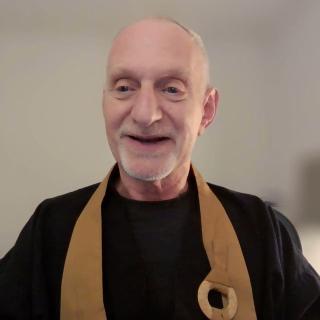
Tonight,
I'd like to talk about how jaded I've become.
How much my despair about what I see going on in the world has colored my vision of what is and who we all are.
Last week,
During my travels,
I spent some time on a small college campus in Minnesota.
And what I saw there was a complete dedication to the practice of kindness and generosity in a community that almost struck me as impossible.
I mean,
Here I am,
A Zen teacher,
Talking all the time about compassion and seeing it in action in this way was almost a shock because of how the news has taken over my vision of who we are to each other as human beings.
And I realized that we don't talk enough about generosity as one of the foundations of our practice.
In Buddhism,
Generosity is taught as the first of the six perfections,
The six paramitas,
That it is actually the foundation of our way,
Of our spiritual path.
And it's not just generosity as a kind of transaction of giving something to someone else,
But a profound spiritual practice of letting go,
Of recognizing our interconnection with all beings.
And Dogen,
The great Zen master,
Taught that generosity was a source of joy and delight,
That true generosity makes us feel wealthier through the act of sharing our own life with others.
But what about greed?
What about the opposite of generosity?
What about all the greedy impulses that I watch myself have all day long?
I notice arising in myself,
Moment after moment,
Wanting this,
Wanting that,
Wanting to be recognized,
Wanting to be praised,
Wanting to be included,
Wanting the last chocolate chip cookie on the plate.
It's everywhere.
And what does it mean if those impulses,
Those feelings arise in me all day long?
Isn't that the truth of who we are at bottom?
And especially as we see many,
Many instances of taking away from others,
Of stealing,
Of greediness,
How can we not feel that that's who we are deep down?
And so I even looked this up,
And I found that there was a survey almost 10 years ago now asking people,
Americans,
If they thought that we as a nation were greedy.
And 57% of Americans said,
Yes,
Americans are greedy.
And a much more recent survey,
Just a couple of years ago,
Asked people to rate the morality and the ethics of their fellow citizens.
And in the U.
S.
,
53% of us said,
You know,
We're all somewhat or very bad morally,
Including greed.
Only 7% of Canadians thought that their fellow citizens were somewhat or very bad morally,
But 53% of Americans.
But in fact,
When we look at what people actually do day-to-day,
Moment-to-moment with their neighbors,
It's not true.
It turns out we pay much more attention to the very small minority of people who steal,
Who cheat,
Who hoard,
Especially because many of these people find their way into public life,
And so they are given a lot of media attention.
But when scientists actually study us and how we behave,
They show that people do the right thing most of the time.
An example,
They did a study where they randomly chose people and had them find,
By accident,
A lost wallet.
And some of those wallets contained cash,
And some of those wallets did not.
And they asked other people to predict who was more likely to return the wallets,
The wallets that had cash in them or the wallets that were empty.
And everybody said,
Oh,
People won't return the wallets that have cash in them,
Or they'll keep the cash.
But in fact,
In this big experiment,
People in the U.
S.
Were more likely to return wallets that had cash in them,
With all the cash intact.
They were likely to do this all over the world,
But very much so in our own country.
So,
We are more moral,
We are more generous than I've come to believe.
And I needed to look into this because I was so startled at what I saw last week in my travels.
So what does Zen say about generosity?
Well,
First,
Zen teaches us that there's really no separation,
That we are completely intertwined with each other.
And so,
The one who gives,
The one who receives,
And the gift itself,
None of that is separate.
That if we give to someone else,
We are giving to ourselves.
And of course,
The best acts of generosity are free of expectation,
Of praise,
Or getting anything back.
But,
As the Dalai Lama is fond of saying,
The wise,
Selfish person takes care of other people,
Because there is no separation.
It does come back to us.
And what we know as a practical matter is that practicing generosity is an antidote to those greedy impulses,
To our stinginess,
To our delusion of self-sufficiency.
I can do it all by myself.
I don't need anything from others.
We can train the heart to relinquish our clinging to possessions,
To relinquish our clinging to status,
To the small self.
And of course,
Buddhism teaches that generosity is our true nature.
That when we awaken,
The more we awaken,
Compassion and giving flow naturally.
That we are far wealthier than we imagine.
That it's not just material things,
Food,
Clothing,
Medicine,
Money,
But that we can give to each other safety,
Protection,
Stability,
Calm.
We can share wisdom.
We teach each other the Dharma in our practice dialogues.
And simply by being fully present,
By listening,
By offering a smile,
We give to other people.
So then what do we do with the truth that we hold at the same time,
That we have greedy impulses,
That I worry about if I'm going to get enough?
What do we do with these self-centered thoughts and feelings?
And of course the answer is we practice with them.
That we don't make them go away.
They won't ever go away.
But that the practice,
As with everything,
Is to simply notice,
To pause.
And when we're lucky,
To choose not to act from that place of greed,
But to wait until the heart opens and we can act from a place of generosity.
What the ancient teachers and the modern teachers tell us over and over again is how good it feels to do the right and generous thing.
And that's what I saw last week.
So I visited a small college in Minnesota that I had never heard of before,
Gustavus Adolphus.
A very old college,
Well-respected.
And I was asked to come and spend some time there and do some teaching there.
And when you drive up to the main entrance of this college,
There is an enormous sign that says,
In big letters,
You belong here.
And then everywhere you go in this college,
There are posters and signs and works of art that express values.
Values like kindness,
Generosity,
Making the world a better place,
Respecting differences,
Inclusion of others.
And whenever I was walking on campus and I looked at all disoriented,
Someone would come up to me and say,
Can I help you find something?
It is simply in the DNA of this place.
They are teaching young people and faculty.
We are to be of service.
We are here to make the world better.
So I was invited to this college by the new president.
He had just come a few months before.
And when he arrived,
He happened to notice a small thing that the sports teams all ate in a little dining room.
The sports programs had a kind of buffet every noon,
And it was a kind of all-you-can-eat buffet,
And all the athletes gathered.
And what the college president learned by asking was that many students,
Not just the athletes,
But many students are poor and don't have enough money to buy food.
Even though this is a relatively well-off college and community,
That there are many people,
A high percentage of people,
Aren't sure they can eat every day.
And so he said,
We need to have this all-you-can-eat buffet for everybody.
And so we're going to open it up to every student,
Every faculty member,
Every staff member,
And everyone from the nearby town.
Anybody who wants to come and eat will come.
And I'm going to find the money to make sure this happens.
And so he did this.
And no one ever checks about whether you belong to the college.
No one ever checks who you are.
You just come.
You bring your friends and faculty and students and staff,
Eat there.
And people would come up to me throughout my visit and say,
We are so glad he came to be our president.
He looks for places to be kind.
And of course,
Everybody responds with kindness.
What was clear was that doing these small acts,
And this was a small act in the grand scheme of things,
But doing them over and over and finding places where it's needed created almost a kind of euphoria in this community where people were so happy to be part of it.
And what I realized was that I was feeling more joyful just watching what this kind of community was like and watching the way that small actions made such a difference in how people felt about each other and about being together.
And I realized that as we feel despair about what's going on in the world,
We are seeing a distorted view of human nature,
Which is Buddha nature.
And that by focusing on where we can be kind,
Where we can be generous,
We can bring joy to ourselves as well as others.
And so perhaps we can challenge ourselves tonight to think of a way we could be generous.
Could be tonight,
Could be tomorrow,
Could be to a loved one,
It could be to a stranger,
It could be,
As the bumper sticker says,
Committing a random act of kindness.
And to train ourselves to notice how it feels when we do that and to notice the antidote to much of the despair that we feel for the suffering in the state of the world.
So see if you can find a way to be generous.
Maybe give away something you really value,
Like your undivided attention.
The Buddha taught,
If you knew as I do the power of giving,
You would not let a single meal pass without sharing some of it.
He knew that if we train our hearts,
We get more and more joy out of giving and less and less joy out of keeping things for ourselves.
So let's see if we can,
As an antidote to despair,
Participate in the perfection of generosity.
Thank you.