Welcome to the Mindfulness Meditation Podcast presented by the Rubin Museum of Art.
We are a museum in Chelsea,
New York City that connects visitors to the art and ideas of the Himalayas and serves as a space for reflection and personal transformation.
I'm your host,
Tashi Chodron.
Every Thursday,
We present a meditation session inspired by a different artwork from the Rubin Museum's collection and led by a prominent meditation teacher from the New York area.
This podcast is a recording of our weekly in-person practice.
In the description for each episode,
You will find information about the theme for that week's session,
Including an image of the related artwork.
Our Mindfulness Meditation Podcast is presented in partnership with Sharon Salzberg and teachers from the New York Insight Meditation Center,
The Interdependence Project and Parabola magazine and supported by the Frederick P.
Lenz Foundation for American Buddhism.
And now,
Please enjoy your practice.
Good afternoon and welcome everyone.
Welcome to Mindfulness Meditation here at the Rubin Museum of Art.
My name is Tim McHenry.
I'm Deputy Executive Director here at this global hub for Himalayan art with a home base here in New York City.
The official greeting I should actually give to you is Kuzuzambo.
Kuzuzambo is the Dzongkha,
The Bhutanese greeting,
Instead of Tashi Delek,
Which is the Tibetan greeting,
Because the painting that we've chosen for you today is very relevant to the nation,
The sovereign nation and kingdom of Bhutan in the Himalayas,
And we'll touch base on that in a little while.
So what we do here,
If you're new to this session,
Is that we take inspiration from art in our collection and we show it for you on the screen,
And our teacher will then draw upon that painting for inspiration for her teaching and the meditation session that we prepare for you every week here at the Rubin.
So our teacher today is Elaine Rittles,
And we're delighted to have her back.
She's become quite a staple of these sessions here on a Thursday,
And she will give a short talk about the themes of the painting,
And then we'll sit for maybe 15 to 20 minutes.
So let's take a look at today's artwork and theme.
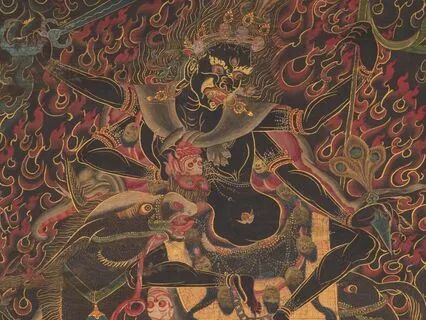
So I mentioned that this painting is called Palden Lamu a Dusoma,
And Palden Lamu is one of those protector deities.
She's seen riding a white-nosed donkey amidst a sort of field of flame and smoke,
And the fierceness of her visage and the armor and the weapons that she wields are to do what?
They are to clear our path to understand that the obstacles that we think we perceive in life are actually of our own making.
They're our lack of clarity.
And so she strives to establish balance in ourselves between,
Yes,
The compassion and wisdom we should be exercising,
But also realizing the confusion and clarity that we should be moving from.
And she is a protector deity of Bhutan with good reason,
Because in the very top section you can see here is the founder of Bhutan as a nation-state,
Shabdrong Nawang Namgyal,
And he's figured in many,
Many of the paintings that you will see in Bhutan,
Some of which we have on the second and fifth floor.
So Palden Lamo means glorious goddess,
And what's interesting about Bhutan as a nation is also that they also strive for a balance between progress and the tradition,
Between the sort of environmental impact that they can have and their constitutional monarchy.
It's all an exercise of Palden Lamo's insights into how we navigate our environment and our world,
And we're delighted that Elaine will be here to talk about some of those themes.
So what can I tell you about our teacher today,
Elaine Ritholf?
Other than that,
She's become a very fond regular here at Mindfulness Meditation here at the Rubin.
Well,
She's been practicing and studying the Dhamma since 1988,
And we had a conversation before now when she was a student and a book sort of almost fell off the shelf into her lap and it was about reincarnation,
And that sort of sent her off on a really interesting path,
But more on that later.
In addition to teaching Dhamma at New York Insight,
She is also a certified mindfulness-based stress reduction teacher and trainer,
And you know,
Her main mission in life is really to help students,
In fact all of us,
Integrate mindfulness into our daily lives because that's where it belongs,
That is what informs us,
That is what infuses our ability to cross the street in New York City safely or have that uncomfortable conversation with a partner.
And so we're really just grateful for Elaine's dedication to this life of teaching and sharing with us her understandings and how she's also personally managed to navigate many of the obstacles that we all confront in our daily lives.
So thank you,
Thank you Elaine,
And Elaine,
We now hand it over to your good wisdom,
Your compassion and wisdom in balance for us today.
Thank you so much.
Elaine Retholtz.
Thank you,
Tim,
For that wonderful introduction,
And just to say when he was describing that book I was in seventh or eighth grade when it fell off the shelf and set me wondering about a bunch of things.
Yeah,
I hope you're well.
Thank you for joining us on this beautiful May Thursday.
What struck me about this piece of artwork and why I chose to reflect on it was this idea of being a protector against inner and outer obstacles,
And while I'm not steeped in the Tibetan tradition and the early Buddhist Theravadan tradition that I practice in,
You know,
The Buddha in the Sutta,
The Four Ways or the Four Foundations of Mindfulness,
After each way that he described there's this frame about being mindful internally,
Being mindful externally,
Being mindful both internally and externally,
Seeing whatever it was,
Body,
Mind,
Breath,
Postures,
Activities,
Feeling tones,
Everything,
Mind states,
Seeing it arise and fall and being independent of everything in the world.
And so this idea of internal and external obstacles is something that most of us are familiar with in our practice and in our lives.
You know,
Just think of when you sit and practice,
And we'll be doing that soon,
You know,
The restlessness that arises,
Oh,
The seat is uncomfortable as she was sat over there,
This desire,
Aversion,
Oh,
When is she going to shut up and start guiding,
You know,
Whatever,
Falling asleep,
All of that,
We're familiar with these obstacles that arise.
They're all like children,
Offspring of,
You know,
Greed,
Aversion,
Ill will,
And of course confusion,
Delusion,
And we experience this,
Not just in our formal practice,
But if we're sitting and paying attention,
It's like,
Whoa,
What is that?
And we can start to see these obstacles.
And then the external obstacles,
I mean,
Tim was talking about crossing the street,
I mean,
There are many external obstacles.
In the Buddha's time,
He talked about things like snakes and tigers and shipwrecks and,
You know,
Kidnappers and things like that.
And here in 2024,
We can kind of say,
What are the external obstacles that some of it is what we're actually facing,
And just as in the Buddha's time,
Some of the obstacles are what we're anticipating and afraid of,
Right,
Which then becomes an internal obstacle of fear.
So I want to tell two stories,
One very humble in terms of my own practice,
And then a story that the Dalai Lama tells.
So I've been recently reflecting on my own practice,
And I started meditating in the 60s.
Honestly,
And if you come,
I've probably told this story before,
Because I thought it was a way to escape the chaos that was going on in my home.
If I just close my eyes,
Pay attention to my breath,
I don't have to deal with all of this.
And there was this stance of,
I'm okay,
But everything around me,
All these obstacles around me,
Is what's causing me harm,
Distress,
Dukkha,
The Buddha would say.
So this blame of my external circumstances,
Which in fact,
There were some challenging circumstances.
So then in the 80s,
When I started going on retreat,
I think that still continued,
This sense of,
You know,
Like,
I'd sit quietly and all of my thoughts would come up with everything that was wrong,
Either in the retreat center or in my life,
And everybody that was to blame,
Like blaming.
If only everything else I changed,
I'd be okay,
Right?
And then as I started to study,
Then I started to see how I was like a part of it,
You know,
That Tim was mentioning.
But then like I've returned the favor,
I started blaming everything on me.
Do you ever do that?
And as practice deepened,
I began to see that everything,
All of these obstacles and energies,
Is a result of conditions.
They're impersonal.
No,
I don't have a target on my back.
And nobody's,
I mean,
Maybe at times people do take aim,
But it's not like I'm the center of the universe.
And neither am I so important that I deserve to beat myself up in a way that I would never,
Ever relate to anybody else.
And so some compassion arose,
Which I'm cultivating,
You know,
Trying to cultivate when I recognize.
So the story that the Dalai Lama tells that is very meaningful to me and that I've probably mentioned here before,
Is that he recounts that after 1959,
A dear friend of his,
A monk,
Was imprisoned by the Chinese for like 17 or 18 years.
And sometime in the 80s,
They were reunited.
And in a conversation,
This monk,
Who was imprisoned by the Chinese for so long,
Said,
You know,
There were times that were very dangerous.
And the Dalai Lama had ideas,
As you might have ideas of,
You know,
What was that danger?
And what the monk said is,
I was in danger when I was at risk of almost losing my compassion for the Chinese,
For my captors.
And so what does that say about what protects us from internal as well as external obstacles,
Right?
I was,
The times I was in danger when I was,
Was when I was not when they were beating me,
Not when I didn't have enough to eat,
Not when it was really cold.
But when I almost lost my compassion,
When I was at risk of losing my compassion for my captors.
So it's,
It's interesting to me that this painting shows this deity to be so wrathful,
Because I think actually it does take some fierceness to be willing to,
To not succumb to those,
You know,
Hatred.
But also when I imagine another face of this,
It's,
It's really a face of kindness and compassion.
So I just,
I just wanted to offer that.
So let's,
Let's sit for a bit.
And as we arrive and turn our attention to this body that,
Your body that you're inhabiting,
Receiving it and feeling how it is,
Maybe a sense of pleasantness and maybe even joy to have this time in the middle of the day come together and pause.
There may be parts of the body right now that are a bit uncomfortable,
Maybe too cold,
Too warm,
Or whatever.
Can we just be present with kindness with it?
It's like this now.
Air conditioning is like this.
And reflecting perhaps on some external obstacle in your own life,
A particular worry or some environmental condition in your home,
Finances,
Just that brings stress.
Touching into,
Is it actually a current situation or is it a fear that this might arise?
It doesn't matter.
You don't have to get rid of it.
Just acknowledging.
And can you find that part in your heart that wishes for your own safety?
May I be at ease in the midst of this?
And can you find that part in your heart that wishes for your own safety?
And can you find that part in your heart that wishes for your own safety?
In the midst of this,
May I find my way to peace.
May I care about this pain,
This suffering,
This obstacle?
Just noting any response in your heart,
In your body.
And it may be that there's a clenching,
A part of you that's saying,
No,
Why should I care about this?
I don't want to.
And can we bring some softness to that?
Of course.
May I be at ease with this as well?
It's an interesting thing,
This practice we're cultivating,
Because this radical acceptance is not about approval.
Not saying things should be this way when they're unjust.
It's not saying,
Oh well,
There's nothing to be done,
This resignation.
May I be with this with kindness?
And I notice reactivity.
And I cultivate an intention to respond,
Not habitually,
Out of ill will and aversion and fear.
But as I sit,
Wishing for my own safety and well-being,
But as I sit wishing for my own well-being,
And I touch into caring and kindness and patience,
It's like this now.
And sensing into the people sitting closest to you and the sense of sitting together in sangha and community here,
In the sense that we don't know anyone else's internal struggles.
And yet,
May we all feel safe and protected from inner and outer harm,
These obstacles.
And we cultivate this deep wish for ourselves and each other.
May we,
Each and every one of us,
All of us,
Find ease in the midst of whatever struggle and sorrow is present,
Whatever confusion.
May we care about the struggles and stress that we each experience and care about each other and care for each other,
Perhaps.
May we find our way to peace,
To ease,
In our inner world,
In our hearts and minds,
And in the outer world as well.
And if it's true that every being,
We can focus on humans.
Really,
Each one of us has a struggle.
Each one of us faces internal and external obstacles.
And each one of us wants to be at ease.
Is it possible to extend these wishes to all beings everywhere without exception?
Noticing what arises.
For some,
This might be natural and there might feel like there's a connection to a flow.
You don't have to feel anything.
And for others,
There might be a catch,
Small or large.
Well,
But this person,
Whether it's somebody you know personally or somebody politically or globally,
Oh,
But this person.
Can we touch into any being that's actively doing harm?
The obstacles,
The confusion and delusion and not clear seeing that they're operating with,
May all beings everywhere be free from these internal obstacles of greed and ill will,
Of confusion.
May all beings everywhere see clearly and touch into the natural heart of compassion.
And noticing if challenges are arising in your mind and heart,
Perfectly fine to go to where it's easy,
Easier,
And to bring compassion to your own mind and heart.
May I be at ease with this.
Sometimes our,
If not Western,
Our New York City conditioned minds,
If we've been living here,
It's used to striving and project making and we recognize ill will in our hearts or restlessness or,
You know,
Any of these obstacles and we make it a project to uproot it.
We make it a project to uproot it and we bring the same energy to it,
Striving.
Ill will,
I hate that I feel this,
You know,
Whatever.
And what is it like instead to be the gardener that cultivates compassion and patience and kindness,
Equanimity?
And is it possible that cultivating this can actually crowd out the unskillful?
May all beings have peace within their hearts.
May all beings be at peace with each other.
May we all realize how we all belong to each other.
We all belong to each other,
Humans,
Animals,
Plants,
The earth.
May there be peace.
Thank you all for your practice.
Thank you,
Elaine,
For your gentle guidance.
I feel balanced.
I feel balanced.
That concludes this week's practice.
To support the Rubin and this meditation series,
We invite you to become a member at rubinmuseum.
Org slash membership.
And to stay up to date with the Rubin Museum's virtual and in-person offerings,
Sign up for a monthly newsletter at rubinmuseum.
Org slash e-news.
I am Tashi Chodron.
Thank you so much for listening.
Have a mindful day.