Welcome to the mindfulness meditation podcast presented by the Rubin Museum of Art.
We are a museum in Chelsea,
New York City that connects visitors to the art and ideas of the Himalayas and serves as a space for reflection and personal transformation.
I'm your host,
Dawn Eshelman.
Every Monday we present a meditation session inspired by a different artwork from the Rubin Museum's collection and led by a prominent meditation teacher from the New York area.
This podcast is a recording of our weekly practice currently held virtually.
In the description for each episode,
You will find information about the theme for that week's session,
Including an image of the related artwork.
Our mindfulness meditation podcast is presented in partnership with Sharon Salzberg and teachers from the New York Insight Meditation Center,
The Interdependence Project,
And Parabola Magazine.
And now,
Please enjoy your practice.
Hi,
Everyone.
Welcome to mindfulness meditation online with the Rubin Museum of Art.
My name is Dawn Eshelman.
So nice to be your host today.
For those of you who are new joining us,
We are a museum of Himalayan art and ideas in New York City.
So glad to have all of you join us for our weekly program where we combine art and meditation online.
So lovely to see you all popping up in the chat,
As always.
It's just really nice to see your names and see where you're joining from.
Lots of New York City today.
So thank you.
Thanks for chiming in and also letting us know how you're doing,
What's going on in your practice,
What you're thinking about.
We'll have time to dive into that a little bit later.
Today,
As we do every week,
We will look at an artwork that's from our collection that's inspired by our theme.
We're really having a rich month and few weeks diving into this theme of interdependence,
Understanding our interconnectivity and what that means for our practice.
We will hear a brief talk from our teacher today,
The wonderful Tracy Cochran,
And then we'll sit together for a short amount of time,
15 to 20 minutes for the meditation guided by Tracy.
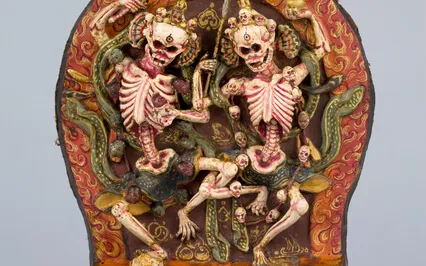
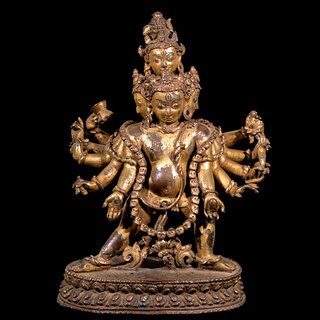
So we'll look again together here at this artwork.
This is Lords of the Chernal Ground.
And here we're reminded of a foundational Buddhist teaching,
Which is that death is a part of life,
Not separate from it.
And here we see two skeleton lords.
This is actually a brother and a sister animated by this ecstatic dance and laughter.
They are festive in their demeanor.
They're expressing the joy of being free from attachment.
And they are a brother and sister,
This male and female figure,
Interdependent here and illustrating also for us the interplay of the masculine and feminine and all beings.
And this garland around each of them,
A garland of freshly severed heads and their staffs,
Their tools,
They support this practice of the deity of Chakrasamvara and are revered here as powerful protectors of freedom.
So with that,
I will bring on our teacher today,
Tracy Cochran,
Who is a student and a teacher of meditation and spiritual practice for decades.
She's the founder of the Hudson River Sangha,
Which is virtual and open to all.
You can find out more about her and her offerings at TracyCochran.
Org.
In addition to teaching at the Rubin,
Tracy teaches mindfulness and mindful writing at the New York Insight Meditation Center in schools,
And you can find her all over the place.
She's also a writer and editorial director of Parabola,
A beautiful magazine,
A quarterly magazine that seeks to bring timeless spiritual wisdom to the burning questions of today.
So you can find out about those writings,
Podcasts and other details at Parabola.
Org.
Please welcome Tracy Cochran.
Hi,
Tracy.
Hi.
Hi,
Dawn.
Thank you for your presence here.
And I thought the best way to introduce the artwork and even some of the deeper teachings of Thich Nhat Hanh is by way of an Inuit story about the skeleton woman.
Speaking of interconnection and interbeing,
Because all of these great myths touch on truths that we have in common.
And in this Inuit story,
A fisherman threw out his net and hauled it in.
It was heavy with something,
And much to his horror,
It was a skeleton.
It was a skeleton of a woman all twisted and turned,
And his first impulse was to throw it back in the sea,
To flee from it,
To sink it as deep as he could.
And we can relate to that impulse when a painful feeling comes up,
A difficult emotion or thought or a sight that we don't want to see,
Reminding us of death and loss.
Our first impulse is to flee.
But this Inuit fisherman had a moment of mindfulness,
As Thich Nhat Hanh would define it,
Which was a moment of an energy,
Of feeling more present,
More able to see.
And to see that what he was doing in particular was fleeing,
Was having an attitude of avoidance and fear.
So seeing this,
He settled down enough to be able to take this net full of bones,
And it was a terrible burden at first,
Back to his little house,
His snow house.
And there,
According to this myth,
He tenderly and mindfully laid out the bones,
Carefully noting how they were connected,
Because everything is interconnected.
And as he worked,
He noticed something extraordinary happening,
This tangle and mass of bones,
That this sight he didn't want to see,
Was slowly,
Slowly coming back to life,
Until it became a real flesh and blood woman,
Beautiful and alive.
And they became friends,
Maybe more than friends.
This story touches something that Thich Nhat Hanh shared,
And also great teaching of his about interconnection.
He wrote in his journal,
The day his own mother died,
A great misfortune has come to me,
A great sorrow.
He couldn't stop grieving for a year.
His mother was dead,
And before she died,
We imagine he saw her decline,
Her illness,
Her failing,
Her diminishment,
Her loss of faculties,
And it filled him with sorrow.
And then one night,
He recounted,
He was sleeping alone in his little hermitage on a mountain top in Vietnam,
And his mother came back to him and sat with him.
He was dreaming,
He thought,
Just dreaming.
She was beautiful and young,
Was flowing here.
But then he awakened and went outside and looked up at the moon and looked at the palm of his own hand and realized it resembled his mother,
That this body he inhabited had come to him from his mother and his father and his grandparents and his ancestors.
And more than that,
His life was imbued with the love and presence of his mother.
He could not be separate from her.
So,
Again,
Beautiful little story,
But how do we actually access this in our moments of fear and despair and our moments of feeling like we want to run away,
Not just about things that have happened outside,
But our own painful feelings?
We so want to change them.
How can we be otherwise?
Like not Han taught from one of the core teachings of the Buddha,
In fact,
The teaching that the Buddha gave to his beloved disciple Ananda on practically the evening,
Maybe actually the evening of his own death,
The Buddha's own death.
That teaching is be an island unto yourself.
This doesn't mean to be cut off or shut down,
To flee.
It means bring your attention home to this body.
What do we do when something is too painful to bear first come home to the body and just breathe just for a moment?
And to not Han taught,
The Buddha is here in that very energy of sensation of presence,
That seeing,
That seeing that opens to allow for acceptance,
Accepting the whole of what's happening,
That seeing that shines is the Buddha.
We take refuge in Buddha,
Sangha,
Dharma.
That's here in us.
Buddha is mindfulness.
Dharma is just noticing sensation and breath.
In doing this,
We remember,
We can't help but remember that we inter-be,
As he would put it,
Air comes in,
Air goes out.
Sensation appears because the body has life.
It's given to us.
We take refuge in Sangha.
Sangha is remembering that every part of ourselves,
Every feeling,
Including our fear and our sorrow and our impulse to run away is welcome here,
Welcome.
So be an island,
Being an island unto ourself as Buddha taught,
As Thich Nhat Hanh taught.
As we can practice,
We begin to be able to see what Thich Nhat Hanh meant when he said,
I'm more than this body.
We begin to be able to see that the skeletons are also alive,
Alive in us.
Now let's sit together,
Let's sit together and see.
And we take a comfortable seat,
Very gently welcoming yourself to be present here with every part that appears today.
You could feel joy or sorrow or you might not know why you feel it could be a tangle.
Just let it be.
Welcome.
And notice that there's an attention here that can come to the sensation of being in a body.
You can attend to the rhythm of the breathing,
The weight of the feet on the floor,
The hands in the lap.
Just noticing without comment or judgment how it feels to be here today.
And notice that you can let everything be just as it is.
Let thinking happen and sensation of heat or cold or anything else you might sense or hear and just allow it to be seen and sensed by a light of awareness that doesn't judge you by an energy of mindfulness that accepts this loving kindness.
Congratulations.
And notice that when you get taken by thinking or dreaming or picturing,
You can gently come back again to the sensation of being present.
Noticing that this presence is open,
That it includes the body and beyond the body.
In presence,
Noticing that it's vibrant,
That it nurtures and supports you.
Not with words,
But with energy,
With a light of awareness that accepts,
With love,
With energy,
With love,
With love,
With love,
With love.
Something you you When you get lost in thinking just come home to the body to the rhythm of breathing to the sensation of being present you you Noticing that you are held in a light of awareness that is open kind you completely accepting you you you you Notice how it feels not to strive,
Not to do,
But just to rest in presence letting yourself be nourished and supported and lit up by a light of seeing that isn't thinking,
Judging,
Commenting,
But just receiving moving holding touching you just sink,
Let go of striving and sink into sensation into the body you you and notice that stillness can mean letting go of striving running doing just allowing yourself to be present you you and notice how it feels to be fully seen by an awareness that doesn't comment just sees just sustains and notice that there's an energy inside you that's also outside an energy of life of presence you you and notice how it feels to belong to life to be part of it to be beloved here every part every feeling acceptable worthy of interest and care you you you you you you thank you thank you thank you thank you that concludes this week's practice if you'd like to support the Rubin and this meditation series we invite you to become a member if you're looking for more inspiring content please check out our new podcast awaken hosted by Laurie Anderson the 10-part series features personal stories that explore the dynamic path to enlightenment and what it means to wake up now available wherever you listen to podcasts thank you for listening and thank you for practicing with us