Welcome to the mindfulness meditation podcast presented by the Rubin Museum of Art.
We are a museum in Chelsea,
New York City that connects visitors to the art and ideas of the Himalayas and serves as a space for reflection and personal transformation.
I'm your host,
Dawn Eshelman.
Every Monday we present a meditation session inspired by a different artwork from the Rubin Museum's collection and led by a prominent meditation teacher from the New York area.
This podcast is a recording of our weekly practice currently held virtually.
In the description for each episode,
You will find information about the theme for that week's session,
Including an image of the related artwork.
Our mindfulness meditation podcast is presented in partnership with Sharon Salzberg and teachers from the New York Insight Meditation Center,
The Interdependence Project,
And Parabola Magazine.
And now,
Please enjoy your practice.
Hello everybody.
So nice to be here with you today.
Welcome to mindfulness meditation online with the Rubin Museum of Art.
I'm Dawn Eshelman.
So happy to be here with you hosting.
And for those of you who are new,
We are a museum of Himalayan art and ideas in New York City,
The Rubin Museum of Art.
And so glad to have you joining us for this weekly program.
This is where we combine art and meditation online.
And inspired by our collection,
We take a look at a work of art together.
We'll hear a brief talk from our teacher.
Today we have the fabulous Sharon Salzberg.
She's back here with us.
And then we'll have a short sit together led by Sharon,
15 to 20 minutes.
Also today and throughout the month,
We are talking about the theme of healing.
Healing.
This is inspired by an exhibition I'll tell you a little more about in a moment called Healing Practices,
Which we just opened.
So let's take a look together at this beautiful artwork.
And we'll talk about what this means to us in terms of healing here.
Okay,
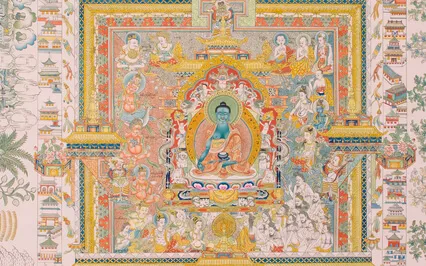
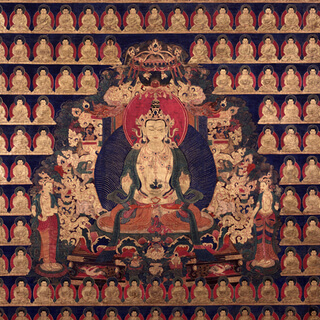
So here we see a beautiful tanka.
This is the Medicine Buddha Palace.
Look at all of that detail.
This painting is a rendition of the first painting of an important set of 79 medical tankas,
Scroll paintings that were created in Lhasa in Tibet in the late 17th century.
And this is a copy of one of those.
This is from Qinghai province in China.
And it was created in 2012 to 13.
These are pigments on cloth.
You'll see that we are looking at the structure.
We see a row of Buddhas across the top and script across the bottom.
And then we see what looks,
If you are familiar with looking at some of the art from our collection,
You might see that this is actually in the form of a mandala,
Right,
Or a palace.
And surrounding the palace,
We see incredible detail plants,
And this is actually four mountains.
The palace here that we see surrounded by four mountains,
Each of which offers a perfect environment for specific medicinal plants to grow and harbors various types of minerals,
Precious stones and springs with restorative waters,
Each associated with particular healing qualities and used in treatment.
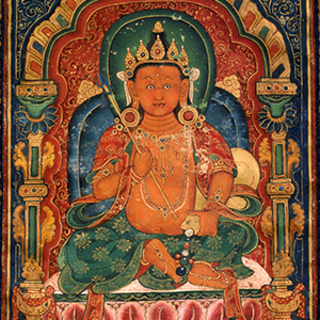
So at the very center,
You'll see the Medicine Buddha in blue here.
I actually pulled a slightly different copy of this painting just for its vibrancy and detail here.
You can see really at the center here we have the Medicine Buddha who is in the form of the teacher,
Rigpa Yeshe,
And is seen sharing wisdom and information about healing to four different groups of disciples.
This blue of the Medicine Buddha is very linked to the Medicine Buddha and if you come to the Healing Practices Exhibition,
You'll see a lot of blue.
And that is why.
So I am delighted to welcome our teacher today,
Sharon Salzberg,
Who's the co-founder of the Insight Meditation Society in Barre,
Massachusetts.
She has guided meditation retreats around the world for many years,
And her latest book is Real Change,
Mindfulness to Heal Ourselves and the World.
Also the author of Real Love,
Real Happiness,
So many really beautiful,
Useful books and tools for meditators of all different stages.
And we're grateful to Sharon and her participation on stage and virtually so much at the Rubin.
You can find out all about what she's doing at SharonSalzberg.
Com.
Hi,
Sharon.
Hi there,
And thank you for having me and for this beautiful gathering.
I always enjoy this chance to virtually come together with people from all over the world.
And hello to the person from London,
Where I feel like I was in London yesterday because I taught for London Insight,
The miracle of the internet.
So I don't know if you know how the art for the particular session gets chosen,
But Pema or someone from the Rubin Museum sends the speaker a few options and we get to choose amongst them.
And I chose this one because I love the medicine Buddha.
I love the idea of a blue Buddha.
And there was something about the depiction.
It seemed so gentle to me and I really was drawn to it in a lot of ways.
I've noticed the word healing being used a lot.
I find that interesting just as a kind of look at the cultural norm.
You know,
There are times when struggle is the most popular word or the idea of standing up for things and these are all very important.
And we seem to have entered a time where there's a yearning,
There's a longing for some kind of healing.
And so I think it's a perfect time to look at that concept and look at that possibility.
So the Buddha,
Of course,
Siddhartha Gautama was known as the great physician because basically what he did was a diagnostic session saying there's suffering in life.
There's a cause for it.
There's the possibility of it end and here's the way,
Here's the prescription.
And this is something that I think needs to be taken to heart that this is really about coming to a place of greater healing.
And anyone in the healthcare field knows that healing and cure are not necessarily the same term.
Of course,
As human beings,
You know,
With normal human feelings and longings and fears,
We want cure for conditions,
For situations,
For obstacles,
For dilemmas,
For prognoses.
You know,
We would like a cure and that's natural.
But some things we can affect,
Some things we can change,
Some things we can alter and some things are just outside of our immediate control.
What we can do is look at healing in the sense of wholeness,
Which is something that we can foster and we can help mold and help deepen no matter what is going on.
And we feel that sometimes in people.
It may not be something that is accepted very much in a kind of medical sense or,
You know,
When we're busy looking for a cure,
But it's there.
And I think of one example is this woman who was one of my most important teachers,
A woman named Dipa Ma,
Which is a nickname for Dipa's mother.
And Dipa Ma was living in Burma.
Her husband was in the civil service.
By this time in their marriage,
They had had three children.
Two of them had died,
You know,
Very tragically.
And her husband came home from work one day and wasn't feeling well.
And he died suddenly by that night.
And so she was completely grief-stricken and developed a heart condition.
She got into bed.
She couldn't get out of bed.
And she still had her daughter Dipa to raise,
But she couldn't function.
And the doctor came.
This is the part that I find kind of startling and unique.
The doctor came and said to her,
You're actually going to die of a broken heart unless you do something about your mind.
You should learn how to meditate.
And so she got up.
She got out of bed.
She went to the meditation center.
They said that she was so weak.
The meditation hall was a flight of stairs and she couldn't actually even walk up the stairs.
She had to crawl,
But she did.
And when she emerged,
There was a quality,
There was something that had happened within her where all of that grief and all of that pain had somehow been at least partially metabolized into compassion.
And she taught for many,
Many years after that.
She was a very powerful teacher.
She was very influential.
She was really strong,
Like a very determined woman.
And she had a massive healing presence.
It's like if you were with her and you confess something you had done,
She would just like take your hand and,
Okay,
Let's start again.
Let's begin again.
Somebody showed me a film the other day of her.
They made a film just like five minutes or so for taking different people,
Including me,
Like 40 years ago,
And putting our heads in her lap and just stroking,
Just stroking.
There was so much love.
And the thing I find so powerful about people who have been through a lot of suffering is when they have very little self-preoccupation and they're actually interested and caring about others.
It's like if you got off the train in Calcutta where she lived when we knew her and you went up into her room in what we would consider a tenement and she would really want to know,
How was your journey?
Do you need more tea?
Can I give you a biscuit?
And I used to look at her,
I used to look at various people I met there from different communities and think,
Boy,
If I'd been through what you'd been through,
I don't know if I'd care about anyone else's tea.
But there was something so whole within her,
So connected that she really understood that her suffering of course was real,
It was genuine,
And it was a part of being human.
There's so much fragility and change in just the course of a lifetime,
Even though we don't all suffer to the same degree.
And so that sense of being united,
Being at one,
Feeling connected,
Feeling whole,
Caring,
I think are the signs of a kind of healing.
And I'm just so taken with the doctor giving that advice and I thought,
Well,
I wish all doctors gave that kind of advice.
And meditation may not be the way for a particular person for sure,
But there's something often that can help us come back to that place of connection with all.
And that is really a tremendous healing.
And that's what I feel every time I look at a piece of art,
Like this very beautiful painting.
So let's sit together.
You can just be comfortable,
Close your eyes or not.
You can start by listening to sound.
I too am in New York City,
Maybe bringing you some sound.
And unless you are responsible for responding to the sound,
See if you can just let it wash through you.
You can come and go.
Bring your attention to the feeling of your body sitting,
Whatever sensations you discover.
And you can end anger when you feel uncomfortable.
Bring your attention to your hands and see if you can move from the more conceptual level like of fingers to the world of direct sensation.
Picking up,
Pulsing,
Throbbing,
Pressure,
Whatever it may be.
You don't have to name these things but feel them.
And bring your attention to the feeling of your breath,
Just the normal natural breath,
Wherever you feel it most distinctly.
The nostrils,
The chest or the abdomen.
You can find that place,
Bring your attention there and just rest.
See if you can feel one breath without concern for what's already gone by,
Without leaning forward for even the very next breath.
Just this one.
And if images or sounds or sensations or emotions should arise and they're not very strong,
If you can stay connected to the feeling of the breath,
Just let them flow on by.
Keep breathing,
Just one breath.
Something comes up and is strong,
See if you can recognize,
Oh,
This is what's happening right now.
Just joy,
This sorrow,
Whatever it might be,
Let's become predominant.
And recognize it in a balanced way without judging it,
Judging yourself.
Just acknowledging,
Oh,
This is what's happening right now.
And see if you can bring your attention back to the feeling of the breath.
And for all those perhaps many times you're just gone,
Lost in thought,
Spun out in a fantasy or you fall asleep,
Truly don't worry about it.
The moment you realize that,
That's the moment where we have the opportunity to practice letting go gently and beginning again,
Bringing your attention back to the feeling of the breath.
You you you you you you you you you you you you you you you you you you you you you you you you you you you you you you and when you feel ready you can open your eyes,
Or lift your gaze,
Then we'll end the meditation.
Thank you Sharon.
That That concludes this week's practice.
If you'd like to support the Rubin in this meditation series,
We invite you to become a member.
If you're looking for more inspiring content,
Please check out our new podcast Awaken,
Hosted by Laurie Anderson.
The 10-part series features personal stories that explore the dynamic path to enlightenment and what it means to wake up,
Now available wherever you listen to podcasts.
Thank you for listening,
And thank you for practicing with us.