Welcome to the Mindfulness Meditation Podcast presented by the Rubin Museum of Art.
We are a museum in Chelsea,
New York City that connects visitors to the art and ideas of the Himalayas and serves as a space for reflection and personal transformation.
I'm your host,
Tashi Chodron.
Every Monday,
We present a meditation session inspired by a different artwork from the Rubin Museum's collection and led by a prominent meditation teacher from the New York area.
This podcast is a recording of our weekly practice currently held virtually.
In the description for each episode,
You will find information about the theme for that week's session,
Including an image of the related artwork.
Our Mindfulness Meditation Podcast is presented in partnership with Sharon Salzberg and teachers from the New York Insight Meditation Center,
The Interdependence Project,
And Parabola Magazine,
And supported by the Frederick Lance Foundation for American Buddhism.
And now,
Please enjoy your practice.
Hello,
Everybody.
Tashi Delek.
And happy Lunar New Year,
The year of the rabbit.
Well,
Tibetan New Year is coming soon.
It's February 21st.
How nice we get to celebrate so many new years.
Welcome.
Welcome to Mindfulness Meditation Online with the Rubin Museum of Art.
I am Tashi Chodron,
And I'm happy to be your host today.
Wow.
So wonderful to see so many familiar names here,
Joining from all over,
From Upper West Side,
Brooklyn.
My goodness,
From San Francisco,
Lancaster,
Seattle,
And someone all the way from Switzerland.
How wonderful.
So those of you who are new,
We are a museum of Himalayan art and ideas in New York City,
And we are so glad to have all of you join us for our weekly program where we combine art and meditation online.
Inspired from our collection,
We will take a look at work of art from our collection.
We will hear a brief talk from our teacher.
And today,
We are so happy Sharon Salzberg is back.
And then we will have a short set,
15 to 20 minutes for the meditation guided by her.
We are still exploring on the theme of interconnectedness,
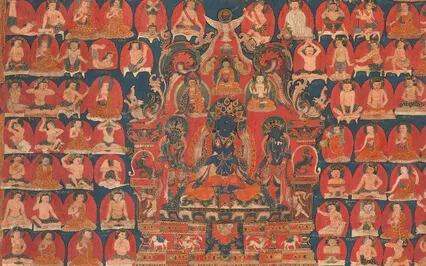
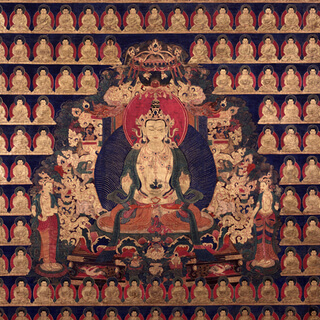
And the art connection for today's session is this beautiful Thangka of Vajradhara Buddha with 84 great adepts called Mahasiddhas.
In Tibetan,
He's known as Sanjay Dorjechang,
Origin Western Tibet,
Dated 15th century,
Mineral pigments on cloth,
About 36 into 24 inches,
Gift of the Shelley and Donald Rubin Foundation.
And the connection to the theme,
Interconnectedness through mind and activities,
This beautiful Thangka,
An elaborately crowned Vajradhara,
Primordial Buddha of tantric lineages,
Sits in the center of the composition surrounded by the 84 Mahasiddhas.
Maha in Sanskrit means great,
And Siddha means realized one.
Each of these adepts is engaged in a different activity and is identified by an inscription following the verse eulogy attributed to the Indian master Vajrasana.
An interesting feature of this painting is the large number of adepts shown in strenuous yogic poses.
Vajradhara is seated on an elaborate throne with white pillars and adorned with multicolored scrolling sea monster tails known as Makara.
Such features identify it as art of the ancient kingdom of Gyugye in Western Tibet.
Now,
If you look all the way on the bottom of this Thangka painting,
On the right,
Bottom right,
Are four deities,
As you see here.
They are yellow Jambala,
And Jambala is prosperity or wealth deity,
Then Chaturbhuja Mahakala,
Panjarnatha Mahakala,
And Brahmarupa Mahakala.
Now,
At the bottom center are seven monks kneeling in a group.
These seven represent the first Tibetans to be ordained as monks by the Abbot Shantarakshita in the 8th century at the time of Samye Monastery was built.
Now,
Let's bring on our teacher for today.
Our teacher is Sharon Salzberg.
Sharon,
Co-founder of the Insight Meditation Society in Barry,
Massachusetts,
Has guided meditation retreats worldwide since 1974.
Her latest book is Real Change,
Mindfulness to Heal Ourselves and the World.
Sharon is also the author of several publications,
Including the New York Times bestseller Real Happiness,
The Power of Meditation,
Faith,
Trusting,
Your Own Deepest Experience,
Loving Kindness,
The Revolutionary Art of Happiness,
And Real Love,
The Art of Mindful Connection.
While running her own podcast,
The Metta Hour,
And interviewing 100-plus influential voices in meditation and mindfulness movements,
Sharon has regularly contributed to many on-stage conversations at the Rubin.
Sharon,
Thank you so much for being here.
Yeah,
Well,
Thank you so much.
It's so funny.
It's a powerful feeling of connection,
Even without any visuals.
For those of you participating,
I am in Barry,
Massachusetts at the moment.
Getting on two or three hours ago,
We got a power outage.
We had a big snowstorm,
And then suddenly there's no power,
So no internet.
I really couldn't figure that I could join via audio,
But here I am.
It worked.
I'm so delighted to be able to do that.
It's such a favorite topic of mine as well.
Many of you have heard me talk about my favorite reflection,
Which we could do for a few moments together now,
And then I'll speak a little bit more,
And then we'll sit.
But if you could just,
Sitting quietly,
You don't have to be formal about it.
Close your eyes or not,
Whatever you like.
Just see who comes to mind as having played any role at all in your participating here right now.
You're listening to this.
You're practicing.
Just see who comes up.
Maybe they're taking care of things right now at home,
So you have the time.
You have some leisure time.
Or maybe long ago,
They read you a poem or told you about their meditation practice or told you about the museum.
Just see who arises.
I went to India myself,
Lo these many years ago,
As a college student.
I went on an independent study program to go to India and study meditation.
Whenever I do this reflection,
As one example,
I think of the Board of Regents of the State of New York,
Which gave me a scholarship,
Which is how I was able to go to college.
And it was because I was in that particular college that I got to go to India.
So that's a big reason why I'm here right now.
So many aspects of life,
Every moment is really a confluence of connections and relationships.
And we live on many levels at once,
I think.
And that's why I like that reflection.
It's just,
It's right there.
Another way,
Sometimes described when you're looking at interconnection is if you just go out,
Say,
To a garden somewhere or forest,
Look at a tree.
On one level,
And it is a true level,
We see a tree.
It's a seemingly singular entity that's just there.
But another level,
We can sense the nature of the soil that is nourishing the tree and everything that affects the quality and the nature of that soil.
Like the rainfall.
And we know now so much affects the quality of the rainfall from very far away.
We can look at the tree and understand it too is a network of relationships,
Connections.
There's some fascinating research now about ways trees communicate with one another through these networks of mushrooms and other things.
They protect one another and they give information to one another,
Like danger afoot.
They preserve resources in order to share with those who are most troubled,
Things like that.
So we can look at the tree and see a tree.
And that's also true.
And yet we can also look at the tree and see all these relationships and connections and all of that.
That is also true and much less commonly thought of or included.
Do we want to keep looking at it as a tree?
Yes,
We do.
Because what if you want to build a tree house,
For example?
And yet we miss so much when that is the only level on which we are perceiving reality.
When we are not tuning into interconnection and ways that relationship is really the nature of everything,
Then we're kind of stuck.
We reify,
We solidify,
We isolate,
We feel isolated.
We miss the truth of change and its dynamism and sense of possibility and creativity.
The most powerful thing for me about contemplating interconnection is that it's simply true.
It's not something fancy or sentimental or something we're trying to superimpose on a different reality.
It happens to be the truth of things,
Often missed or discounted or disregarded.
But it is the truth of things and that's why it's so powerful to begin to reflect on it.
I'm sure many of you have heard me say that going into an organization or a company to teach,
My favorite question just about to ask people is about how many other people need to be doing their job well for you to do your job well.
Because as much as we might feel siloed and separate and apart,
The truth is we're counting on other people and other people are counting on us.
It's a dynamic,
It's a relationship,
It's movement,
It's slow.
That's actually the truth of things.
I was talking to some time ago,
An intense,
Intense consciousness of COVID in a pandemic time.
I was talking to a physician who was the head of a medical practice,
A large medical practice in the hospital.
And he said,
You know who I have an increased appreciation for?
He went on to say the cleaning staff.
And I felt,
Well,
Yeah,
Let's think about that for a moment.
And when I use that question with people,
Mostly it's very illuminating for people.
Occasionally it doesn't seem to have much impact.
And then I just go on to say,
Okay,
Do you work outside the home?
What mode of transportation are you counting on?
And who repairs it?
Who operates it?
If you work inside the home online,
Needless to say,
We're very dependent on many conditions and so on.
And if that doesn't resonate,
Did you eat today?
And do you grow all your own food?
What if you don't?
We're just part of networks.
And if we understand that reality,
It's a very ready step to a kind of natural and really boundless compassion.
One of my favorite illustrations or interconnection comes from Bob Thurman,
Who until recently was a professor of Buddhist studies at Columbia University.
And he used this commonly as an illustration.
He said,
It's very New York too,
Which is why I like it.
He said,
Imagine you are on a subway and these Martians come and they zap the subway cars.
Those of you who are there are going to be together forever.
So what do you do?
Somebody's hungry,
You feed them.
Somebody's freaking out,
You try to calm them down.
Not because you necessarily like them,
But guess what?
You're going to be together forever.
And it was tremendous truth in that.
So rather than thinking of it as something excessively spiritual or removed from the reality of day-to-day life,
We find it in day-to-day life all the time.
Many disciplines show us the truth of interconnection,
Science,
Economics,
Epidemiology,
Certainly environmental studies.
And just looking at the nature of our day and understanding that illusion of being all alone and so apart is an illusion.
So the heart's response to that is the power of compassion.
Okay,
So let's sit together.
You can sit comfortably,
Close your eyes if you're not,
Just be at ease.
You can start by listening to sound,
Whether the sound of my voice or other sounds.
It's a way of relaxing deep inside,
Allowing your experience to come and go.
And of course we like certain sounds and we don't like others,
But we don't have to chase after them to hold on or push away.
Just let them come,
Let them go.
And bring your attention to the feeling of your body sitting,
Whatever sensations you discover.
See if you can feel the earth supporting you,
Feel space touching you,
Rather than conceiving this as an action,
Like picking up your finger and poking it in the air.
Realize space is already touching us,
It's always touching us.
Bring your attention to your hands and see if you can move from the more conceptual level,
Like the fingers,
To the worlds of direct sensation,
Picking up throbbing,
Pulsing,
Pressure,
Heat,
Cold,
Whatever it might be.
You don't have to name these things,
But feel them.
Bring your attention to the feeling of your breath,
Just the normal natural breath,
Wherever you feel it most distinctly.
That may be the nostrils or the chest or the abdomen.
You can find that place,
Bring your attention there and just rest.
See if you can feel one breath without concern for what's already gone by,
Without leaning forward,
Even to the very next breath.
Just this one.
If you like,
You can use a quiet mental notation of in,
Out,
Or rising,
Falling,
To help support the awareness of the breath,
But very quiet.
So your attention is really going to feeling the breath,
One breath at a time.
And if images or sounds or sensations or emotions should arise,
But they're not very strong,
You can stay connected to the feeling of the breath.
Just let them flow on by.
You're breathing.
Just one breath.
Something comes up that is strong,
It pulls you away,
You get lost in thought,
All entangled in a fantasy,
Or you fall asleep.
Truly,
Don't worry about it.
You realize you've been gone,
You're distracted.
Very gently let go.
And with a lot of kindness towards yourself,
See if you can begin again.
Just bring your attention back to the feeling of the breath.
No blame,
No judgment,
Just letting go and starting over.
No matter how far afield your attention may wander,
But for however long,
We can always,
Always begin again.
So that's hardening.
Let the letting go be as gentle as you can make it.
And starting again,
Just being clear.
It's okay.
You haven't failed.
It's all right.
That's the process.
And when you feel ready,
You can open your eyes or lift your gaze and we'll end the meditation.
I do.
That concludes this week's practice.
If you would like to support The Rubin and this meditation series,
We invite you to become a member of The Rubin.
If you're looking for more inspiring content,
Please check out our other podcast,
Awaken,
Which uses R to explore the dynamic paths to enlightenment and what it means to wake up.
Season two,
Hosted by Raveena Arora is out now and explores the transformative power of emotions using a mandala as a guide.
Available wherever you listen to podcasts.
Thank you for listening.
Have a mindful day.