Welcome to the Mindfulness Meditation Podcast presented by the Rubin Museum of Art.
We are a museum in Chelsea,
New York City that connects visitors to the art and ideas of the Himalayas and serves as a space for reflection and personal transformation.
I'm your host,
Tashi Chodron.
Every Thursday,
We present a meditation session inspired by a different artwork from the Rubin Museum's collection and led by a prominent meditation teacher from the New York area.
This podcast is a recording of our weekly in-person practice.
In the description for each episode,
You will find information about the theme for that week's session,
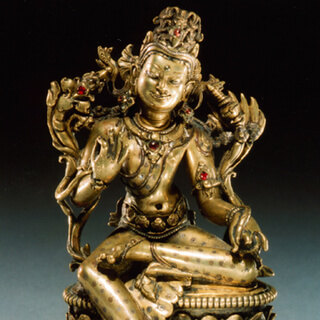
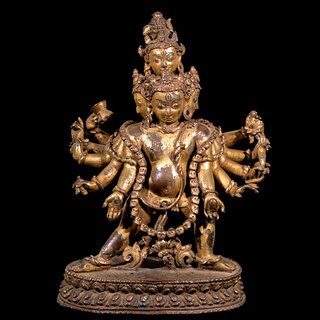
Including an image of the related artwork.
Our Mindfulness Meditation Podcast is presented in partnership with Sharon Salzberg and teachers from the New York Inside Meditation Center,
The Interdependence Project and Parabola magazine and supported by the Frederic P.
Lenz Foundation for American Buddhism.
And now,
Please enjoy your practice.
Good afternoon and thank you for joining us here at the Rubin Museum for Mindfulness Meditation.
My name is Tim McHenry.
I'm Executive Deputy Director here at the museum and Mindfulness Meditation is just an emanation of many of the activities we do here at the Rubin and we sort of see ourselves at this point as a global hub for Himalayan art with a home base in the foothills of Chelsea,
Right?
So,
And art and its interpretation are our mission and we're really honored and delighted to be able to welcome back Gaitro Rinpoche to the museum.
This is his third official visit and we're thrilled and honored that he is here to guide us in this meditation today based on a work of art.
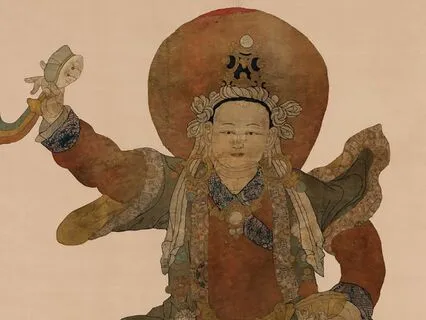
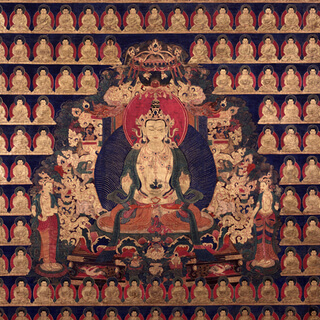
And there's one magnificent piece on the fifth floor that we want to share with you today and it is of Lodon Chokse,
Which is an emanation of Padmasambhava,
Who has a sort of reputation of bringing and really ensconcing Buddhism in Tibet through somewhat magical means.
And what's remarkable about this particular work is that it's not a painting.
It is applique silk that is,
While life-size,
Just a small fragment of a much larger banner that would have been unfurled from a hilltop down into the valley.
Padmasambhava has also a very significant role in the lineage that our teacher holds.
Gaitro Chigbe Rinpoche is the son of the famed and renowned Tertön,
The treasure revealer,
Rabjam Rinpoche.
And a treasure revealer,
If you are not familiar with that term,
Is somebody who has a transmission from the teachings that were seeded into the sacred landscape of Tibet and surrounding regions by Padmasambhava and are revealed to them in some form,
Whether they be in a dream or a vision.
And these reinterpretations of the teachings really enables the adaptation of Buddhism to flourish in the society when it's needed.
And so these are time capsules of teachings,
If you will,
That are sort of discovered in place in situ.
And Rinpoche is,
As I say,
The son of a Tertön,
A treasure revealer.
And he is from the Ripa lineage.
And what is,
I think,
Really,
Really something important to note about his role in society is that he really embodies that idea,
That concept of compassion in action,
Because he is so socially engaged with the meaningful changes to society where he finds them.
Having been born in India within the refugee community,
He saw what those communities needed most and that was clean,
Potable water,
For example.
So he initiated something called the Pure Water Project,
Vital for life,
Vital for health,
Vital for sustainability.
He's worked on projects to prevent the spread of malaria in these societies.
And he continues to oversee the Ripa monasteries in Nepal and in India.
So we have here a teacher in our midst who espouses the understanding of change.
We have on our walls an example of a work of art that is but a fragment of the whole.
And this is all about perception,
Perceiving that what we see is but a small section of anything that we might call reality.
And appreciating and accepting that there's a much larger fit to our reality than we can ever perceive is that essence of the teaching.
And we're delighted that Rinpoche is here to guide us,
Not only in that teaching,
But also in a meditation.
Rinpoche,
Thank you for being back at the Rubin to guide us in this tumultuous world that we live in.
Thank you.
Thank you,
Tim.
And thank you for welcoming back to Rubin.
It's a pleasure.
Also to be speaking here today about meditation at the backdrop of Northern Choksi,
Which is incredible.
Thangka work,
As well as what it represents,
Is something very important to the entire Himalayan region,
Himalayan culture.
Northern Choksi,
As you heard from him,
Padmasambhava in different aspect,
Represents also what is called brilliant mind.
So it means pacifying intellectual madness.
So it's a very incredible picture and symbolism to that.
Now today's topic is about acceptance and the meditation that will follow with that,
Which is now commonly known as mindfulness meditation.
I just want to say that at the core of this meditation,
Whether it is mindfulness or different type of meditation,
There can be the mantra-based meditation,
Deity-based meditation,
Prayer is also meditation.
There are all different kinds of meditation.
The core of this meditation or mindfulness basically means that the core of our being is fundamentally sound and healthy and good.
That's the important thing in all meditation.
Otherwise,
Every meditation is just a tool,
A technique,
A method.
But what it invokes in us is our own fundamental goodness.
And that's important thing to touch on regardless of whatever methods we follow in meditation.
So then coming to the acceptance as a meditation.
Basically what acceptance really means is the mind of economity.
It has two aspects to work with.
One when we work with others in society or people or situations.
One when we work within ourselves.
There are a lot of things that we have to work within ourselves in order to create a sense of economity within ourselves.
So the actual meaning of the acceptance has to really work on the meaning of economity,
The easiness within ourselves,
In our own being,
In our body,
In our feelings,
In our emotions and that constant struggle to change,
That constant struggle to control.
Those are things that we go through in everyday life.
So acceptance is really about how we basically feel within ourselves in terms of our basic goodness basically.
So a sense of economity is a real,
How to say,
Experience that one would achieve through the practice of acceptance.
Now when we talk about loving kindness and compassion,
This is a very important practice in meditation as maybe many of you are aware and maybe you're already doing this practice.
The first thing to understand when we engage ourselves in the practice of loving kindness and compassion is to arrive at the sense of economity.
Without arriving at the sense of economity,
We cannot actually practice loving kindness or compassion because that will become a partial or biased sense of loving kindness or compassion.
So this kind of impartial sense of loving kindness or compassion is based very much on the ability to understand the economity.
So one way that we always practice is having a common sense,
A common ground.
Meditation for that matter should never be complicated because we already are complicated in our lives,
In our ways of things.
So the less complicated things in meditation,
Much better you can achieve a result with.
So here what I mean by uncomplicated is to have understanding of a common ground,
Common sense.
This common sense,
Common ground is vital as a connection between you and me,
Between everyone.
So we all share a common ground that fundamentally,
Basically wanting to be physically healthy,
Mentally happy.
It's not complicated to understand.
Physically healthy,
Mentally happy,
Every one of us is seeking that regardless of our differences in our culture,
In our religion,
In our races and education and wealth and whatnot.
And if we can touch for a brief moment on this fact,
Then we arrive at a point of a common ground that we are not different from each other.
Acceptance begins from the power of understanding that we are same.
Loving kindness,
Compassion begins again on the basis of the sameness.
Whenever a spiritual journey,
Whenever a meditation for that purpose begins on the ground of difference,
It cannot really become a wholesome approach.
So if we really talk about acceptance,
It's about coming to accept,
Coming to understand that we beyond our superficialities are all the same in the wanting to be physically healthy and happy.
Now because we are,
We have this conscious or unconscious desire,
Simple desire to be healthy and happy,
That clearly shows that our own basic being,
Fundamental being isn't negative at all.
Someone who just wishes to be healthy and happy cannot be considered a bad person.
Then thinking about that,
It should arrive at a feeling level,
Not thinking only.
Every meditation,
Whatever techniques you follow should ultimately arrive at the feeling level because feeling brings experience.
Experience in the nowness,
Experience in the meditation is profoundly connected to the feeling in the nowness.
If our meditation becomes just a mental game,
It does not allow our hearts to open,
It doesn't bring that profound sense of feeling and then it fails to actually connect to the situation.
Feelings normally don't lie,
Mind lies all the time.
So if you are true about acceptance,
It has to be on the basis of feeling,
Touching on the ground of economity and before we start to work with situations.
Now acceptance again doesn't mean perfection,
Acceptance doesn't mean running away or being inactive.
Acceptance also means you're ready to work with situations.
Acceptance means really seeing things as workable.
That needs courage,
Enormous courage.
So when we talk about acceptance,
It also means courage,
Strength.
So today I want to guide you through a short meditation of acceptance,
Being in the present moment and to work mainly with one's own self,
One's own body,
One's own feelings,
Emotions,
Whatever it is,
Let it be.
Being sincere,
Being honest,
Creating an enormous sense of opening space where one can truly work with one's own situations,
Not being judgmental at all.
So are you ready?
You may take a few deep breathing in and out just to make yourself comfortable and relaxed and free from any preoccupation.
As you breathe in,
Breathe in awareness in the whole of the body,
In the sitting posture,
In the present moment.
You may direct your attention or awareness in each part of the body,
In the sitting posture,
In the present moment.
Notice how you feel in each part of the attention you're giving,
From the tip of your toes to your feet,
To the knees,
To the back,
Shoulders,
Head,
In the front.
Breathe in awareness in each part of the sitting posture in the body.
Notice any tension,
Gently accepting with kindness.
Breathe in fully,
Gently.
As you breathe in,
Breathe in awareness in the whole of your body,
In the sitting posture,
In the present moment,
Fully accepting in the nowness.
Now gently direct your attention,
Bring to your mind's imagination a picture of your loving self.
It can be from now or from your childhood,
An image of your most loving self.
Feel this image of your loving self in the heart of loving kindness.
Gently feel the image of your loving self without judging,
Then gently as you inhale,
Bring the image inside to your heart.
Embrace in your loving kindness,
Fully embrace your loving self,
That image,
Fully into your heart of loving kindness,
Completely embrace it fully,
Without judging,
This is me.
Embrace fully in your heart of loving kindness,
Never to let go.
As you continue to embrace yourself in the heart of loving kindness,
You may gently use the phrase,
May I be healthy,
May I be happy.
You may choose to use any phrases that come to your mind.
Embrace fully in the heart of loving kindness,
Without judging,
Completely open,
Accepting in the present moment,
May I be healthy,
May I be happy.
You may now exchange in your place with someone else,
Someone that you have trouble with or someone that you love so much,
Maybe our mother.
As you breathe in awareness,
Bring to your mind's imagination,
Most joyful picture of your mother,
Smiling at you.
Feel your mother from the heart with loving kindness,
Without judging,
Feel her profoundly in the heart of your loving kindness,
Yes,
This is my mother,
I am her child.
As you breathe in gently with awareness,
Bring your mother into your heart,
Embrace her fully in the heart of your loving kindness,
Feel her profoundly,
Accept her fully in the heart of loving kindness,
Embrace her,
May my mother be healthy,
May my mother be happy.
As you embrace her lovingly in your heart,
Fully open and accepting,
And now take a deep breath with a sustained awareness,
And as you breathe out gently,
Open your eyes and let go and relax,
Okay?
Thank you.
Gajal Jigme Rinpoche,
And Rinpoche,
Thank you again so much for your teaching and being here,
It's a great privilege.
Thank you.
Thank you.
That concludes this week's practice.
To support the Rubin and this meditation series,
We invite you to become a member at rubinmuseum.
Org slash membership.
If you are looking for more inspiring content,
Please check out our other podcast,
Awaken,
Which uses art to explore the dynamic paths to enlightenment and what it means to wake up.
Season 2,
Hosted by Raveena Arora,
Is out now and explores the transformative power of emotions using a mandala as a guide,
Available wherever you listen to podcasts.
And to stay up to date with the Rubin Museum's virtual and in-person offerings,
Sign up for a monthly newsletter at rubinmuseum.
Org slash enews.
I am Tashi Chodron,
Thank you so much for listening,
Have a mindful day.