Welcome to the mindfulness meditation podcast presented by the Rubin Museum of Art.
We are a museum in Chelsea,
New York City that connects visitors to the art and ideas of the Himalayas and serves as a space for reflection and personal transformation.
I'm your host,
Dawn Eshelman.
Every Monday we present a meditation session inspired by a different artwork from the Rubin Museum's collection and led by a prominent meditation teacher from the New York area.
This podcast is a recording of our weekly practice currently held virtually.
In the description for each episode,
You will find information about the theme for that week's session,
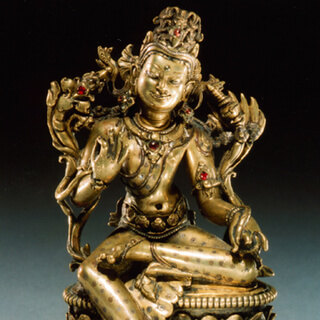
Including an image of the related artwork.
Our mindfulness meditation podcast is presented in partnership with Sharon Salzberg and teachers from the New York Insight Meditation Center,
The Interdependence Project,
And Parabola Magazine.
And now,
Please enjoy your practice.
Hi,
Everybody.
Welcome to mindfulness meditation online with the Rubin Museum of Art.
I'm Dawn Eshelman.
We are a museum of Himalayan art and ideas in New York City,
As many of you know.
And we're so glad to have all of you join us for this weekly program where we combine art and meditation online.
So it is February,
The first day of February,
And we're talking about love this month because why not?
Why not just take the reins back from that kind of hallmark version of what love is or what we're told love is and really think about how we want to define it,
How we want to define it in terms of love of a partner,
Love of another human being,
Love of ourselves,
Love of strangers,
Just how we're contextualizing that word also within our meditation practice.
We'll look at an object and we'll do that in just a moment.
Then we'll hear a brief talk from our wonderful teacher,
Rebecca Lee,
And then we'll sit together 15,
20 minutes guided by Rebecca.
Okay,
So we will take a look now at the object.
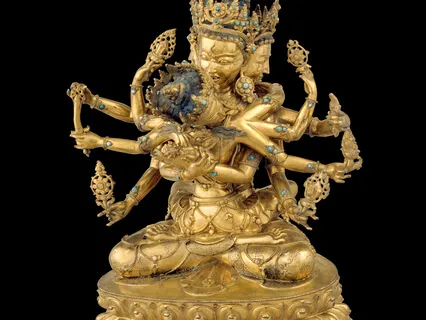
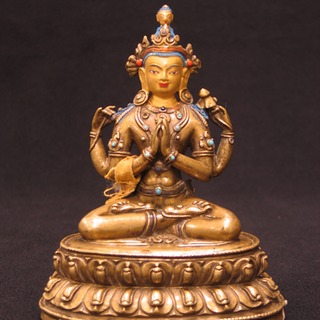
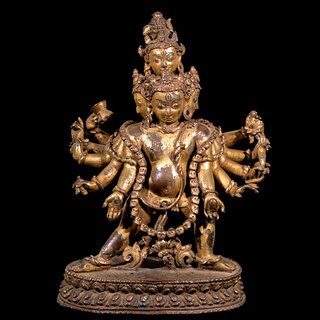
We are looking at a beautiful sculpture from the 1400s in Tibet.
This is Guhyasamaja,
Buddhist deity.
And Guhyasamaja is one of the main tantric deities who is the focus of the contemplative esoteric practice in the Geluk tradition.
So this couple,
This is Guhyasamaja and consort in this intimate embrace.
Each of them has three heads and six arms.
Their hands are crossed in front of each other's chest.
They hold ritual objects that include a sword with flames and a wheel.
They're seated on this beautiful lotus throne that reminds us of enlightenment.
And I know that for many folks new to tantric art,
It's really the sexual element that seems to jump out and be most prominent here.
But in fact,
When you spend some time with the practice and the objects,
You learn about the symbolism of what is going on here.
And in fact,
These two deities represent this enlightened nature.
They represent the union of two qualities,
Wisdom and compassion.
And these two qualities,
When they come in balance,
Are really what opens up to enlightenment.
And so within this context of love this month,
We're bringing this to you to really celebrate the beautiful idea of the masculine and feminine that lives within each of us and the wisdom and compassion that is available to each of us and the power of what can happen when those things are in balance.
So happy to have Rebecca Lee here.
Dr.
Rebecca Lee is a Dharma heir in the lineage of Chan Master Sheng Yan.
She's the founder and guiding teacher of the Chan Dharma community.
And she started practicing with Master Sheng Yan in the 90s and served as his translator until his passing in 2009.
And she later trained with and received this full Dharma transmission from one of his Dharma heirs,
Dr.
Simon Child in 2016.
You can find out all about her teaching,
Lectures,
Retreats at rebeccalee.
Org.
She's also a sociology professor at the College of New Jersey,
Where she also serves as faculty director of the Allen-Dolly Center for the Study of Social Justice.
And she has a new book,
Allow Joy into Our Hearts,
Chan Practice in Uncertain Times.
Please welcome Rebecca Lee.
Hi.
Hi.
Thank you,
Dawn.
It's so wonderful to be here with everyone.
And this very snowy day,
I'm looking out of my window with these icicles hanging off my roof.
So it's a beautiful day to be practicing with everyone.
And thank you for your lovely introduction of the of today's artwork.
And I chose this artwork,
Not because I know anything about Tibetan art.
But I thought,
Not only is this a very beautiful statue,
But also sort of helps us see that very often when we look at many other Buddhist statues,
You see someone who was just like sitting here,
Very calm,
And feel like there's like no emotion there.
And you might feel that,
Oh,
Being a Buddhist practitioner is about just being removed from love.
And in fact,
What it is,
Is that when we truly connect with ourselves through the practice,
We uncover our limitless capacity for love.
And so I thought this statue in its wonderful way,
Express that,
That beautiful balance,
And with this energy.
And the month of February,
I was asking Dawn,
Is it because of the,
You know,
Valentine's Day that we have the theme of love?
And of course,
Usually we have this very narrow idea about love.
And in our practice,
Love is not just for romantic love,
But also love for our parents,
Our children,
Ourselves,
Our co worker,
Anyone in our life,
And even love for someone with whom we don't get along.
And so that is our cultivation.
And as I was thinking about today's practice,
It reminded me of an experience I had many years ago before I started practicing Buddhism.
And I want to share it with you.
I was with a boyfriend I had a long time ago,
Not my current husband.
And you might be able to relate to that.
So it's one of those days that I was just kind of like grumpy and mad at him.
I couldn't even remember for what.
And so we were having lunch,
And he was just sitting across me and eating.
And just my mind was just sort of very agitated,
Upset,
Well for unknown reason.
And out of the blue,
I was able to just be there.
And I could see him as he was,
And I could still see it in my mind now that this person was just sitting there innocently enjoying his food.
And it was very endearing,
Not,
And it's just because of the innocence of this person,
This full human being,
Being right there in front of me.
And I could remember the feeling of this affection,
This love.
That that is not conditional.
That is does not depend on him apologizing for whatever he did wrong or something.
It was just like,
Ah,
He's here.
And I'm sharing this story with you because it made a really deep impression in my mind.
I still remember that moment very,
Very clearly.
And I realized what's interesting is that he hasn't done anything different.
He was just there eating his lunch.
And it was something in my mind that shifted that I now now I know what happened was that I connected with the present moment in that moment.
And I was fully there with him right there in front of me.
Of course,
I did not know at that time.
I just remembered that experience distinctly.
And without the practice at that time yet,
I didn't really know how to access this capacity to to love someone just as he is.
And it's not until I discovered Buddhist practice,
Buddhist meditation,
That I understand what was happening.
So when we engage in meditation,
What we are doing is to train our mind to be fully here,
To learn to work with our mind,
To connect,
To stay with the present moment.
And in the process,
We allow our agitated mind to settle down.
And as the agitated mind of wanting this to be different and nitpicking ourselves,
Nitpicking the present moment,
Nitpicking the person in front of us sort of dissipates,
Then we can be fully here,
And we gain some clarity.
And at the same time,
We reconnect with our natural capacity to love unconditionally.
That is how we are naturally to be able to fully connect and love ourselves and other people right here in front of us.
And somewhere along the line,
We kind of lose that we forget that we didn't lose that we lose,
We lose contact with our natural capacity to love unconditionally.
And very often it happens when our mind is agitated,
When our mind is agitated,
Then when we're suffering,
We lose contact with this natural capacity to love unconditionally.
And when that happens,
Very often you might have experienced that many times,
Is that we fall into the unhelpful habits,
Our unhelpful habits of mind that causes us a lot of suffering.
And when it comes to love,
You might have experienced that and then I want to talk about it a little bit more,
Is that instead of our natural capacity to love unconditionally,
We got stuck with our habits of conditional love,
Making a love conditional on something.
One way or the other,
We are preoccupied with this idea,
This belief that we can't love this person or ourselves.
We can't,
I can't,
Until something until something soft,
Something is fixed,
We may not even know what it is.
Sometimes we may believe there's one thing that needs to be solved.
So we are convinced that this this is the case.
So when we get into this mode of thinking,
Our mind is tense and narrow,
Instead of holding an open heart,
There might be good intention underlying it wanting to improve things,
Change things for the better.
But ultimately,
This mode of thinking is,
Results in more suffering in ourselves,
When we make our love conditional,
And it causes suffering for others.
And it is not in accordance with wisdom and compassion.
So I will describe it a little bit,
Maybe you can resonate with you.
And you can understand what I'm talking about.
This this habit is,
We will,
We will notice that we are convinced that something is wrong,
Either with the person that we,
We believe we can't love or with ourselves.
And they are keeping us from loving.
And this habit,
This habit of conditional love,
Often is learned from our conditioning,
Maybe from our upbringing,
From we may not even know exactly how it was formed,
Where it came from,
Or we may know,
We may be able to hear that voice in our mind.
And it sort of like shows up as some variation of,
I withhold love or affection,
Until you do X,
Y,
And Z.
Maybe like that can be all kinds of things.
It may be until you get good grades,
Until,
Until you lose weight,
Until you meet my expectation,
Until maybe you stop smoking,
Drinking,
Doing drugs,
Or until you're perfect,
You often say that to ourselves until we stop being bad,
Whatever that is,
And that may be some kind of moving target.
So these are the conditions that we set in our mind for us to deserve love for other people to deserve our love.
And what happens is that this habit causes a lot of pain in us.
We might believe that in our way of thinking that withholding our love will motivate someone to improve or do something good for them.
And very often it's counterproductive.
And even when it works,
Even when it seems to be bringing some kind of change,
Actually cause incredible amount of anxiety.
I have met a lot of college students that I've worked with,
Very,
Very good students,
And are petrified by any kind of failure,
Because failure is so high stake,
They have been conditioned into believing that they are no longer lovable,
If they do not fulfill these conditions.
And so they become paralyzed,
Paralyzed.
And so even though we think this is helping them,
It is counterproductive.
And meanwhile,
It's causing a lot of pain in us.
It's very painful,
When what we're doing is to go against our natural tendency to love and fully connect with ourselves,
Or fully connect with another human being,
Especially with someone we really want to love.
We are blocking this love from fully flowing from our heart from fully opening our heart.
This is how we want to be how we are naturally.
So with the stability and clarity of mind from meditative practice,
Then we are more likely to be able to notice this habit,
This habit of conditional love,
Making our love conditional on something we noticed this habit showing up.
And with our clarity,
That we cultivate from meditation,
We are more able to remember to come back to the present moment,
To connect with our bodily sensations,
Maybe we're walking and also bodily sensations of our breathing.
And we can remember that we can choose,
We can choose in this moment to stop,
To stop allowing these conditions to hold our love hostage,
To block our love from freely flowing.
And we can choose to allow our natural capacity to love to operate right here right now,
By being fully present here,
Loving this person as she is right here right now.
No string attached,
Just love.
And we are all capable of doing that.
And our meditation practice helped us help us train our mind to remember to reconnect with this natural capacity of unconditional love.
So let's do a period of meditation practice to learn how to engage in the cultivation of stability and clarity of mind so that we can reconnect with this capacity to love fully more and more often.
So we will set up our body in a comfortable posture,
Allowing the lower back to fall into its natural curvature so that the body is relaxed,
Supported by our skeletal structure,
The way the body is designed to do,
Minimizing the use of muscles,
Allowing the body to relax and the mind to relax.
And we begin,
Feel the relaxation of the top of the head,
And feel the relaxation spread to the forehead,
Directly experience the subtle sensations of our forehead,
Relaxing,
Allowing the tension to melt away.
And feel the relaxation spread to the eyeballs and eye muscles.
We hold a lot of tension in these muscles in our daily life,
From all the judging,
Comparing,
And right here,
Right now,
There is no need to do that.
And we can give these muscles a vacation,
Allow,
Allow the tension to melt away.
And feel the relaxation spread to the facial muscles.
Check to see if we're holding tension in these muscles by habit,
Perhaps from holding a facial expression for the world to see.
And feel the relaxation spread to the entire head.
Feel the relaxation spread down the neck muscles,
Directly experience the subtle sensations of these muscles softening,
Like melting butter,
As we allow,
Allow the tension to melt away.
And feel the relaxation spread down to the shoulder muscles,
Down the arms,
To the forearms,
And all the way to the fingertips.
And feel the relaxation spread to the chest area.
We hold a lot of tension in this area by habit,
Maybe from anxiety,
Worry,
Sadness,
Grief.
Right here,
Right now,
We can give them a rest and allow,
Allow the tension to melt away.
And feel the relaxation spread down the torso,
All the way to the lower abdomen,
Trusting that the skeletal structure can hold up the body.
There's no need to tense up these lower abdominal muscles.
We can give them a vacation and allow,
Allow the tension to melt away.
And feel the relaxation spread to the upper back,
Directly experience the subtle sensations of the muscles between the shoulder blades,
Softening as we allow,
Allow the tension to melt away,
And feel the relaxation spread down the back and all the way down to the lower back and down to the buttocks,
Where we can feel the sensations of the body sitting on this chair or cushion,
And feel the relaxation spread down the legs and all the way down to the toes.
And feel the relaxation of the entire body sitting right here,
Right now,
Clearly aware of the subtle changing sensations of the body,
Breathing,
Sitting right here,
Moment after moment.
And if we notice the mind drifting off,
No problem.
Make use of that as an opportunity to practice,
Remembering to reconnect with the sensations of the body sitting,
Breathing right here.
No problem.
We notice thoughts coming through,
That too is part of the present moment.
We allow,
Allow it to be here with thoughts,
Memories,
Feelings.
We allow,
Allow them to be fully heard and felt.
It's a way for us to be fully present with ourselves.
It is a way to practice unconditional love.
And when these thoughts and feelings are heard,
They will move on on their own.
There's no need to chase them away.
Moment after moment.
Stay with this clear awareness,
The experience of this body-mind.
And when these thoughts and feelings are heard,
They will move on to the next level.
Be enacting yourself within a wish position.
You you.
.
.
.
.
.
Maintain this clear awareness as we transition from stillness to motion.
Even when we move our hand or body,
We maintain this clear awareness of the changing sensations of the body moving.
You you you