Welcome to the mindfulness meditation podcast.
I'm your host,
Dawn Eshelman.
Every Wednesday at the Rubin Museum of Art in Chelsea,
We present a meditation session led by a prominent meditation teacher from the New York area.
This podcast is a recording of our weekly practice.
If you would like to join us in person,
Please visit our website at rubinmuseum.
Org slash meditation.
We are proud to be partnering with Sharon Salzberg and teachers from the New York Insight Meditation Center.
In the description for each episode,
You will find information about the theme for that week's session,
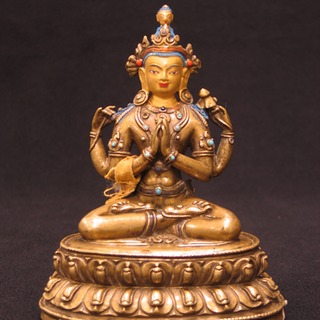
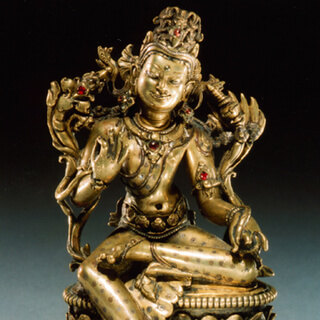
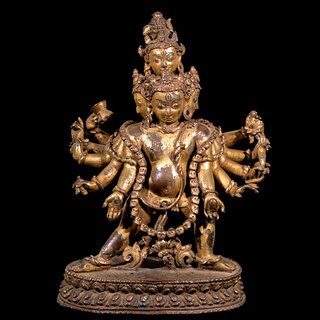
Including an image of a related artwork chosen from the Rubin Museum's permanent collection.
And now,
Please enjoy your practice.
Good afternoon,
Everybody.
Welcome.
Welcome to the Rubin Museum of Art and to our weekly mindfulness meditation practice.
My name is Dawn Eshelman.
Great to have you all here and also welcome to folks listening on our podcast.
We do podcasts,
All of these,
For free.
You can find them on our website.
If you ever miss a session or you just need a quick little free meditation,
They're there.
So we've been talking all month about power and we are having actually a year-long conversation about power here at the museum through the lens of our collection and some really interesting exhibitions upstairs.
And power that we're kind of defining here is something that is within us and between us and that's our jumping off point.
So this month we've taken a look at a lot of different expressions of power through our collection and different artworks and also different perspectives on what power means to a meditation practice.
And today we'll hear another perspective from Kimberly Brown,
Who's here with us.
But first we'll take a little bit of a closer look here at this figure that has been looming in front of you as you have entered.
And this is a really interesting one artistically,
Which I'll get into in a second.
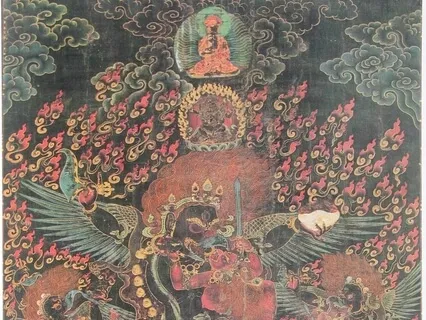
This figure is Kakamora Karma Mahakala.
Mahakala is a wrathful protector deity,
A wrathful emanation of Shiva from Hinduism.
And you know we've talked about wrathful protectors many times here,
The fact that they are just as important as peaceful emanations and that they have a really important purpose and that protective energy is fierce and incisive and really useful as a form of power when it is intentional and not reactive.
Mahakala I think is so interesting as this emanation of Shiva who is really the creator and transformer of the universe.
You know,
A little bit of power there for you.
But from a visual and artistic point of view here,
We're looking at what is known as a black painting.
So this is a black background and on it we have very many colors for traditionally what a black painting usually looks like.
It's usually a little bit more monochromatic or a couple of different shades.
But here we have all kinds of colors and all kinds of detail and symbolism to unpack.
So we'll just look at a couple things here.
But then of course you know that you can join Jeremy outside of the theater when we are finished here and he'll take you up to the galleries for a closer and a more in-depth look.
And there's just so much coding and symbolism to unpack.
So we see the central figure,
Mahakala,
He actually has a raven's head and a red hat.
And this and some other elements here let us know that in fact this is a Bhutanese painting.
Mahakala was very popular in Bhutanese practices of Buddhism and the red hat notes that he is of the Drukpa Kagyu tradition.
And there is above him a teacher,
It's hard to see right now,
Who also has that red hat.
So just some symbolism there.
I think the ring of skulls around his neck here is echoed here on either side by figures that have similar beautiful necklaces.
And of course there's this consort that's right in the middle here,
This bright red figure.
And then we have the raven's wings kind of coming out on either side.
And this is all surrounded by this red and yellow flickering flame.
So it's just an unusually wide palette of colors and very vibrant to see and gives this kind of palpable sense and experience of visual power.
So Kimberly Brown is here with us today and it's great to have you back,
Kimberly.
She's the executive director of the Interdependence Project and a graduate of its meditation teacher training program.
She leads mindfulness and compassion classes,
Workshops and retreats.
And she studied American and Tibetan Buddhism and practices loving kindness meditation.
Her teaching methods integrate depth psychology,
Compassion training and traditional Buddhist techniques as a means to help everyone reconnect to their inherent clarity and openness.
Please welcome her back,
Kimberly Brown.
Hi everyone.
Thanks for coming out on such a cold afternoon.
Before we begin,
It's possible that some of you are a little disappointed that Sharon Salzberg is not here today.
And I have to tell you,
I too am a little disappointed that Sharon Salzberg is not here today.
She is a dear benefactor and mentor to me and one of my main teachers.
So today at the end of our practice,
We'll dedicate our efforts here today to her recovery.
So this raven-headed Mahakala.
I'm not familiar with the kind with ravens on their head,
But I've seen many times the Mahakalas that look like fierce monsters and they have six or eight arms.
I was upstairs in the shrine room,
The Tibetan Shrine Room last month.
And there's at least one,
Maybe two big,
Black,
Scary Mahakalas.
My friend said,
Are those evil demons?
I said,
Well,
They're beneficial demons,
Right?
They have the same power and the same fierceness and the same strength as what maybe here in the West we would consider evil.
And yet they're great bodhisattvas.
And so their intention is to benefit us.
As Don said,
They're manifestations of the same deities that you'll see throughout this museum and throughout.
I know it as Tibetan iconography.
There's green Tara and there's Avalokitesvara and Chenrezig is what the Tibetan name for the god of compassion and wisdom.
And these are kind of the other side of the coin,
If you will,
The head and the tail,
The wisdom and the compassion of the same qualities.
Mahakala is,
As a bodhisattva,
What he brings and what Dharma protectors bring is a balance.
They balance out compassion and patience and calm abiding with energy,
With fierceness,
With power,
With mindfulness,
Right?
Persistence,
Okay?
These are all very powerful qualities and they're necessary for our practice.
If you study in the Tibetan tradition,
You'll be given different deities sometimes to practice with.
They're called Yidams,
Y-I-D-A-M,
Yidam.
Mahakala is a type of Yidam and all of the deities I just mentioned.
And it's very important to remember for each of us that all of these qualities that we talk about,
They're not outside of you.
Each one of us have all of these qualities and to look upon these paintings,
These artworks as metaphors for our own mindstream,
Right?
And each one of us need to have confidence and energy,
Diligence,
Right,
To practice,
To practice cutting through what are called obscurations to our clear mind.
Those obscurations are anger,
Hatred,
Ignorance,
Right,
Greediness.
And another aspect of using these deities and using these powers that we have is to cultivate our intentions,
Which we talked about here last month.
And these intentions lead us to manifest our own power,
The human power that each one of us have,
Right?
That power is for us to orient our actions,
Our words,
Our behaviors in ways that benefit ourselves and others and ways that don't harm ourselves and others.
The Rubin Museum has a theme of power within and between.
And the power that each one of us have is compassion and wisdom and love.
They're really the same.
You can't separate any of those qualities.
And each of us have the ability to cultivate that and practice that.
When I first came to study Buddhism,
In a lot of the texts,
They talk about the wish-fulfilling gem.
If you go upstairs in the galleries,
You'll probably see some Buddhas and they hold this,
It looks like a big egg or a big round vase or something.
They hold it in their hands right above their belly,
Between their heart and the belly.
And that's the wish-fulfilling gem.
And when I first learned of it,
It seemed sort of contradictory to what I knew of Buddhism.
There's not a lot of greed in Buddhism.
And there's an idea that we want what we have,
What we are mindful of.
So it puzzled me until I understood and learned that the wish-fulfilling gem is a metaphor for our own hearts,
Our own heart-minds,
And that each one of us actually possess this.
I don't call myself a spiritual teacher,
And I actually have no belief in any sort of God or anything outside of us.
I have a deep faith and a deep belief that each human being has these qualities that we can cultivate and develop.
And part of my work is helping and encouraging people to manifest their own power,
Because in spiritual communities,
Religious communities,
There's a tendency for people to want to give up their power to other people,
People who seem smarter or more special or idealized,
Right?
Because maybe we give up our power by wanting other people to tell us what's right and wrong,
What's ethical,
Instead of using our own wisdom.
We also go to special people to offer prayers and blessings.
And all of us,
Each person here,
Has enough power and wisdom and compassion to use these tools and develop them and be your own moral authority,
Also offer blessings to yourself and everyone that you come in contact with,
Right,
To cultivate your intention and to create auspicious actions.
There was a story I was told a long time ago,
I guess by,
I think it's a Zen story.
An ordinary woman goes to visit her very wealthy friend.
She stays at her enormously wonderful estate.
While she's there,
Her wealthy friend gives her servant a precious emerald.
She says,
Please,
Sew this jewel into my friend's clothing.
And the wealthy woman wanted to do this because she knew her friend would never accept such a valuable gift.
So the servant did this and sewed it into the ordinary woman's clothes.
Ordinary woman left after a few days and as what happens sometimes in life,
They lost touch and they didn't see each other for a long time,
These two friends.
One day in the marketplace,
The wealthy woman saw her friend and she was begging and destitute.
And she ran to her and said,
Don't you know,
You have a priceless jewel in your clothes on you.
You possess it.
Of course,
The woman checked her clothes and she did have it.
And that's each one of us.
So we are going to today practice this power of loving kindness,
Of compassion,
And we're going to also bring our confidence,
Our own Mahakala into our practice.
Right?
The confidence to,
You know,
We tell people,
Sit up straight,
Stand up.
That's what we're saying in your practice too.
The great teacher tends in Palmo,
She says that we are,
God's acting like monkeys.
God's acting like monkeys.
So these enums encourage us to remember our wish fulfilling gem,
Our potential and manifest it through practice,
Through energy.
So today in practicing loving kindness,
We're going to practice just for three beings.
We can practice for ourselves,
Someone dear to us.
And we'll also then practice for this group.
As many of us will practice with our eyes closed,
Before we take our meditation seat,
I encourage all of you to take a look around you.
Take a look at all the faces in this room,
Different ages and genders and colors.
And take everyone into your practice with you.
So you can go ahead and take a position that's comfortable.
If you're feeling sleepy today,
I suggest you keep your eyes open or you can stand up.
You can go ahead and just take a few conscious breaths.
Maybe three.
Noticing where you are.
You're here at the Rubin Museum.
You may have come here from home or work,
School,
Responsibilities.
Just letting yourself be here.
Noticing your feet,
Your seat,
Your belly.
Allowing sound to enter your ears.
Taking a moment to allow your intention to arise.
Your intention is that which brought you here.
You could be doing anything here in New York City,
But you've chosen on a very cold afternoon to join a group of people and practice kindness,
Clarity,
Mindfulness.
Really thank yourself.
Create that very special intention.
Bringing your attention to your feet,
Your seat,
Your belly.
Relaxing your shoulder blades.
Relaxing the back of your head.
Relaxing your forehead,
Your cheeks and your jaw.
Allowing sound to enter your ears.
Noticing your feet,
Your seat,
Your belly.
Bringing your attention to your shoulder blades,
The back of your head,
Your forehead,
Your cheeks,
Your jaw.
Allowing sound to enter your ears.
Resting your attention on your heart center,
The center of your chest.
And allowing a sense of yourself to arise.
Now you could visualize looking at yourself in a mirror.
You could see yourself as a child.
You could just have a sense of your presence.
And offering loving kindness.
May I be filled with loving kindness.
May I be free from fear.
May I be safe.
May I be healthy.
May I be filled with loving kindness.
May I be free from fear.
May I be safe.
May I be healthy.
May I be filled with loving kindness.
May I be free from fear.
May I be safe.
May I be healthy.
And taking a moment to continue silently offering these phrases to yourself so you're giving yourself a gift.
And feel the —.
.
.
.
.
.
.
.
.
.
.
.
.
.
.
.
.
.
.
.
.
.
.
.
.
.
.
.
.
.
.
.
.
.