Welcome to the Mindfulness Meditation Podcast.
I'm your host,
Dawn Eshelman.
Every Wednesday at the Rubin Museum of Art in Chelsea,
We present a meditation session led by a prominent meditation teacher from the New York area.
This podcast is a recording of our weekly practice.
If you would like to join us in person,
Please visit our website at rubinmuseum.
Org slash meditation.
We are proud to be partnering with Sharon Salzberg and teachers from the New York Insight Meditation Center.
The series is supported in part by the Hamera Foundation.
In the description for each episode,
You will find information about the theme for that week's session,
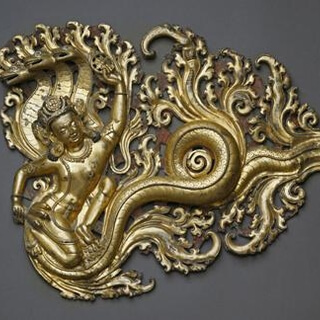
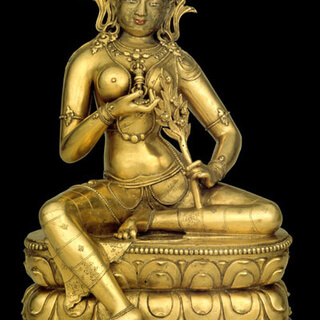
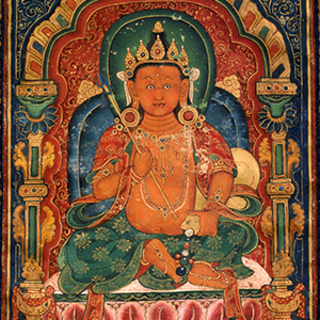
Including an image of a related artwork chosen from the Rubin Museum's permanent collection.
And now,
Please enjoy your practice.
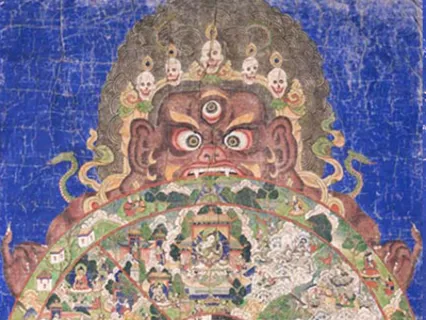
If you have spent a little time in the Rubin Museum's galleries or you have knowledge through experience or other resources about Himalayan art,
This image behind me here will probably be familiar to you.
This is kind of one of the most iconic and commonly known images in the landscape of Tibetan Buddhist art,
And it's called the Wheel of Life,
Also known as the Wheel of Existence,
Or the Wheel of Samsara.
And this depicts a concept that is very central to Tibetan Buddhism,
Which is this idea of birth and rebirth,
And that through karma,
We are reborn into different realms of existence through the path of our karma.
And there's a lot to digest here.
In fact,
We could talk for hours about this artwork.
I'm going to give you just the basics,
And then I highly recommend,
If you have the time,
That you join Jeremy right outside the theater after our program today.
He'll take you up to the galleries for a kind of a closer look.
There's a lot of detail here.
It's really quite amazing,
And a little more discussion about what we're looking at here.
But I'll just point out kind of the structure of what's going on here.
And the innermost circle pictures the three,
What are considered the three poisons,
And these are depicted by a snake,
A rooster,
And a hog or a pig.
Fear,
Ignorance,
And desire is what they represent.
And these are considered to be the three things that really take us away from our path towards enlightenment.
Then there's a half black and half white circle right around that.
And that depicts the sort of descent and ascent that is possible within these realms.
So the human figures that are doing dishonorable things or meritorious things that kind of propel them around this circle.
And then outside of that,
The kind of the largest chunk there is the depiction of the six realms of existence.
So we have the gods and the demigods.
Interesting to note,
Gods are not considered fully enlightened beings here.
In fact,
It's the hardest fall you can take when you're a god.
You just have that,
You know,
And you perhaps may think a lot of yourself as a god.
You have a far fall to go if that happens.
The human realm,
Which is considered where the most possibility lies in terms of enlightenment,
The hungry ghosts,
The animal realm,
And the hell realm at the bottom.
But I think what's really interesting to remember is that you'll always see in each and every realm the depiction of a Buddha and that represents the ability for one to gain enlightenment no matter what realm they're currently living in.
And then outside of that,
The thin ring around the edge.
This is the 12 links of dependent origination and that explains how one moves through these realms.
And then finally,
This pretty terrifying creature holding everything in his grasp here is the Lord of Death,
Yama.
So it's heavy,
It's dark,
And it's meant to be because what I really want to tell you about this today during this month that we're speaking about ritual is that this object can play an important part in the ritual of a practitioner who is entering a shrine room.
In fact,
In most shrine rooms,
This object here is painted in this sort of vestibule,
The entryway before one goes into the shrine room.
And it's meant to be a kind of ritual of waking up,
Of kind of shocking the viewer into remembering what's at stake here and really calling them into this action of being present and entering this devotional space with intention.
And as we've been talking about ritual this month,
That's been something that's really come up,
That ritual,
You know,
Whether religious or secular can be almost any kind of action as long as it's done with presence and intention.
So delighted to have Tracy Cochran back with us.
She's going to talk to us a little bit more about ritual and this object.
Tracy is a writer and the editorial director of the quarterly magazine Parabola,
Which can be found online at parabola.
Org and also upstairs in the shop.
And she's been a student of meditation and other spiritual practices for many years and a teacher as well.
In addition to the Rubin,
She currently teaches at New York Insight and every Sunday at Hudson River Sangha in Tarrytown.
Her writings and teaching schedule can be found online via parabola on Facebook,
Twitter and tracycochran.
Org.
Please give her a warm welcome back.
Tracy Cochran.
Well this is a heavy image indeed.
And I found myself when I walked in here today,
I saw a projected so large.
I wish I'd been given a little Buddha or some bells or something to talk about,
Not something quite so big and daunting.
Because one thing I do know about rituals is that they're always connected to a bigger story.
And you're looking at the bigger story.
And woe to anyone who came in here today for just a little bit of relaxation.
A little bit of secular mindfulness.
Because now the cat is out of the bag.
It's easy to feel lost in the face of this.
Like I wonder if anyone here would like to venture a guess about which way they're headed on any given day.
Would anyone like to commit?
We're not used to thinking of the cosmology.
And when I looked at this image,
Because I was raised in the West,
I kept thinking of this sentence which I bet you've heard too.
In the middle of the journey of our life,
I found myself in a dark wood where the straight way was lost.
And the words are by Dante.
And the narrator was describing one night in 1300.
But I can relate.
Because one time I was lost in the woods.
I don't know if you've ever had the experience,
But it's pretty incredible.
And I was at Yosemite National Park.
And night was falling.
And I was supposed to be babysitting my two young nephews.
And we went deeper and deeper and deeper into these shadowy tall trees.
And every step of the way,
My nephews were chanting lions and tigers and bears.
Oh my,
I'm not kidding.
Lions and tigers and bears.
Oh my.
And they thought this was just a riot.
And I felt that at any moment,
An actual lion,
Mountain lion or bear could come lunging out of the trees at me.
And I now when Dante wrote,
His narrator Dante was 35,
Which was middle aged in medieval terms.
And when this happened to me,
I was in my early 30s,
I think.
Not middle aged,
But I felt it that night.
I felt the whole weight of my life and every single misguided,
Stupid thing,
In my opinion,
Stupid thing that I'd ever done that had brought me to this terrible reckoning to be lost in the woods.
How could I have done this?
Not just to myself,
But to these innocent little kids.
So I went on,
What else can you do?
You keep going.
And eventually,
I found my way back.
I got to a shuttle bus,
Which is the way it worked at Yosemite.
And I went back to where my family was staying.
And my brother-in-law stormed past me in a fury and grabbed his children.
And you could hardly blame him.
But standing right behind him was my mother,
Who was looking at me with a mixture of compassion and amusement.
And she said something I'll never forget.
She said,
Honey,
You look like you could use a drink.
And I could.
So I remember sitting with her on the terrace of this kind of cocktail bar in the towering forest at Yosemite.
And she just kept looking at me with love and amusement.
And all these decades later,
I remember that her presence,
Not words like words from a book of wisdom,
But a presence that didn't exclude anything.
She knew I had a terrible sense of direction.
It had been a problem for her since I was born.
She would always try to put a bracelet on my right wrist to teach me right from left.
But she was loving and accepting the whole catastrophe,
As some people have called it,
The whole of me.
So when I was thinking about this great wheel and thinking Dante was given a guide that was sent from heaven by his beloved Beatrice.
And this great guide,
Virgil,
Sent him,
Took him down into the depths,
Into hell,
And then up the mountain to heaven.
He had to experience the whole of reality before he could ascend and know freedom.
And I realized that this little bit of presence that we gain when we sit is no small thing.
Just sitting here,
You come in here today,
Maybe you don't expect much.
You just want a respite,
A little bit of calm.
But somehow when you let yourself relax,
Let go,
Bring your attention home,
Sometimes you can feel the loving presence I felt that night when I was sitting with my mother.
You have a feeling of accompaniment,
Accompaniment that lights your way.
And Henry Dayton Thoreau,
A great American writer,
Said,
Not until we're lost do we begin to find ourselves.
Not until we've lost the world.
And you know what that means.
And you can lose the world in any number of ways.
You can have money problems,
You can have health problems,
You can have problems with your children or your work,
Something that separates you from the world in your view.
Something that cuts you off from the great scale of possibility,
From the fullness of your humanity.
But it's exactly there when you've lost the world,
When you've lost your sense of connection to wholeness,
That the path begins.
Because as Thoreau continues,
That's when you begin to know who you are and where you are and the infinite extent of your relations.
When you feel lost,
You take the next breath and you notice what's around you.
You certainly do when you're lost in the woods.
And you have a feeling for what matters.
And it's not your stories about who you think you are.
Those tend to disappear.
All your fictions about how your life will go.
And you begin to have a feeling for the scale of being here.
That you're here on an earth surrounded by mystery.
What can help you?
Love,
Kindness,
A willingness to sit down and be still and see what comes and meet it without judgment.
A willingness to let go.
And today is the Jewish day of atonement.
Some of you might know that.
And I remember many years ago in Brooklyn coming upon a group of Orthodox Jews throwing bread in the water.
And I had never seen this before.
And I,
You know,
I'm not actually Jewish.
Though I found out from ancestry.
Com I'm 1% Jewish.
So I'm celebrating today.
And I knew what it meant in my body,
In my heart.
It was a gesture of relinquishing and offering and letting go.
Which is what we do when we sit too.
And I looked up the word atonement and it means at one meant.
At one meant.
It really does.
I'm not making this up.
It's extraordinary.
To be at one.
We allow ourselves to be seen.
As we are.
We offer ourselves to be seen.
We let go of our fear and our sense of separation.
And we rejoin a greater wholeness.
A greater world.
So let's sit.
And we notice the feet and the back and the way our head rests on our neck.
And we let ourselves be here.
Just as we are.
Accepting everything that happens to be present today.
You might feel lost or separate or in pain or at peace.
Accepting everything that's here.
Without judging and without running away.
We let ourselves be.
We take our place in life.
Surrounded by mystery.
And we let the attention come back to the breath.
Without seeking to change it in any way we just notice in-breath and out-breath.
And the sensation of being in a body.
And we notice sensations,
Sounds,
Thoughts.
And we let everything be.
With no judgment.
And we come home to the breath and the body and the present moment.
Noticing that the movement of coming home isn't separate from a movement of letting go.
We let go of thinking and come home to the present.
And notice that there's light inside you.
An energy of life.
A vibration.
And we let everything be.
And we let the light come back to us.
And we let the light come back to us.
And we let the light come back to us.
And we let the light come back to us.
And we let the light come back to us.
And we let the light come back to us.
And we let the light come back to us.
When you find yourself lost in thought or feeling,
Gently come home to the body and the breath and this moment.
Noticing how it feels to be seen without judgment.
And we let everything be.
And we let everything come back to us.
And we let the light come back to us.
And we let the light come back to us.
And we let the light come back to us.
As we begin to relax,
We soften.
This separation between inside and outside begins to soften and become porous.
We begin to remember that we're alive and supported by life.
We're connected to it.
We're connected to it.
We're connected to it.
Noticing how it feels to let go of thinking and come home to the body and the moment.
We're connected to it.
We're connected to it.
We're connected to it.
Notice that when we come home to the body,
It's not shutting down but joining something greater,
A greater life.
The present.
The present.
The present.
The present.
Noticing how it feels to come home,
To be welcomed into a shared world.
The present.
The present.
Noticing how it feels to be completely accepted when you stray and when you come home.
Seen by a light of attention that doesn't judge.
That's loving,
Responsive.
That's loving,
Responsive.
That's loving,
Responsive.
There's a light of attention inside us that can be with what is and let go.
That's loving,
Responsive.
That's loving,
Responsive.
That's loving,
Responsive.
Noticing that there's a presence that we can come home to that can guide us.
That's loving,
Responsive.
Thank you.
That concludes this week's practice.
If you'd like to attend in person,
Please check out our website,
Rubinmuseum.
Org slash meditation to learn more.
Sessions are free to Rubin Museum members,
Just one of the many benefits of membership.
Thank you for listening.
Have a mindful day.