In this video,
We'll practice sleeping dogs.
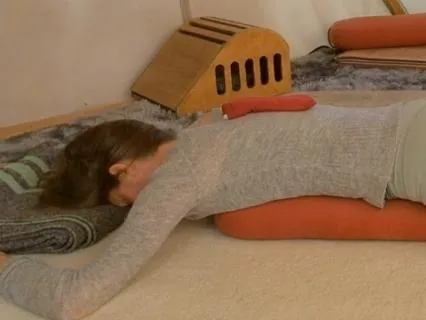
Pose where you lie face down over a bolster with your upper body supported.
And for me,
It really helps me to bring my attention inwards and notice the movement of the breath and relaxation in the back of the body.
If you don't have a bolster,
You can use blocks with a blanket or two or three folded blankets placed on top of each other like this.
Make sure that it's an elevated area that is about the size of a bolster and it is comfortable to lie on.
If you do have a bolster you can place it lengthwise in front of you.
You can place a small folded towel or another blanket at the top end behind the bolster on the ground.
This will comfortably support your forehead when you lie down.
And for me,
I don't like the sensation of the stretch on the top of my feet.
So I always like to place a roll around ankle height to relieve the stretch sensation.
You can also.
.
.
Cover the floor to prevent the pressure of your knees into the ground.
Then you can bring yourself to lie face down on the bolster.
Your knees are apart,
A little bit wider than the bolster.
So that the knees and the lower legs are resting on the ground or on your rolled up blanket.
And the whole upper body,
Including the breastbone,
Is fully supported by the bolster or by the blankets,
Depending on what setup you use.
But make sure that your throat is completely free and that there's no pressure there so that you can breathe freely and with ease and it feels comfortable.
Your head will gently bend forwards as your forehead rests on the towel or on the blanket.
So don't fold that up too thick so that you create a curve in your neck.
But really see if you can keep your neck long.
You can choose to relax your arms forward on the floor.
Or alongside the body.
If you place them alongside your body,
You'll notice that your shoulders will be floating in the air.
So make sure that you place a block or something below your shoulders so that they are also fully supported.
If your elbows are uncomfortable you can also place a blanket below the elbows if the floor feels too hard.
A little bit of weight can also help your body to let go.
Like a little weight of a heavy blanket or of eye pillows or even of a meditation pillow.
So just see if you want to play around with that.
If you have eye pillows or sandbags or any form of weight that you can comfortably place on your back,
On your lower back.
Between your shoulder blades.
Just any place or any area that you would like to bring your attention to.
Here I show you where to place it on the lower back.
Or on the area between the shoulder blades.
And this little bit of weight can just help you to bring your awareness to those areas.
And by bringing your awareness there,
That can help to release tensions and to relax better.
So with this setup you can find out and figure out what you need or do not need today.
Be completely comfortable here.
But really make sure that you fully support your whole body,
That there's no joints that are floating in the air.
And that there's no areas of pressure that are uncomfortable.
The idea of this practice.
Is to be.
.
.
Fully supported physically.
So that we can start tuning in to the more subtle sensations that our body is giving us.
We're working here with the nervous system.
And the more your nervous system can relax.
The better your body will be able to release tensions because it feels safe to do so.
And that's why the support is so important.
If there's no support,
Your body needs to work,
To hold on,
To keep things in place.
And in that sense will be less able.
Are not able to let go.
So whenever you're in doubt,
As you're making yourself comfortable.
Add something to your support.
To make you feel more comfortable.
And as you find your position here.
Just really take your time to settle in.
Feel the support that you've given yourself.
And allow your body So slowly with each exhalation sink into that.
Feel your body breathe here in this place.
A rising sensation of the inhalation.
The falling sensation of the exhalation.
As you inhale.
Relaxation as you exhale.
And as you're in this face down posture,
Notice how there's space at the back of the body to breathe into.
The front of the body is receiving pressure from the blankets or the bolsters that you're on.
But the back of the body has space to move.
So notice the back of the body.
The space you have there to breathe.
And sends the breath in the back of the body.
Notice how that feels.
Maybe you feel the shoulder blades.
Move away from each other as you inhale.
Maybe you feel the ribs and the back of the body.
Rise up and expand as you inhale.
You feel.
Like a widening sensation around the lower back and the sacrum.
As you inhale.
Just notice what you can feel.
What you can sense.
As you are in this shape.
In this posture.
For this time.
Feeling your body breathe itself.
Nothing for you to do,
To change.
And allow your body to do what it does best.
It's taking care of itself.
To the best of its capacity.
In Ayurveda,
We always say that everything we eat.
.
.
And the things we experience and our emotions all need to be digested.
It's not just a food.
Here in these practices restorative yoga can give yourself and your body this time.
To digest all that still needs to be digested.
As you lie here,
Your body breathing itself.
You in this pace of not doing.
Your body can get to what it still needed to do.
Which might not make this practice a very peaceful one.
Or maybe it is.
But it's a great indication of where you're at in this moment.
If more of this kind of practice would be beneficial for you.
I'm just being a witness to what is happening in this moment.
Without having to control it,
Interfere.
To change.
Just being present for it.
Just being here now.
Then you slowly bring your awareness back to your body.
To this moment.
Space you're in.
Feeling your body supported by the support you've given yourself.
And slowly start inviting small movements into your body.
Waking it up a bit.
Whenever you're ready,
You can place your hands below your shoulders.
Slowly push yourself back into a child's pose.
Or if that's uncomfortable for you.
Find a seated position.
That is comfortable for you.
Keeping your awareness.
Towards your body,
Towards your breath.
Towards the changing of your shape you're in,
Your movement of your breath.
Trying to Keep cultivating that.
Quietness.
That you've been practicing in this moment.
Then if you're in child's pose,
Find yourself to a seated position.
Just take a moment.
To sense what this practice has done for you.
How does it feel?
Take a moment.
To practice sleeping dogs.
To notice how your body is doing.
Was this a useful practice for you?