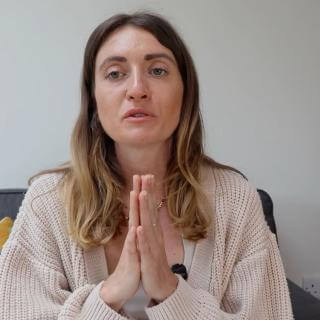
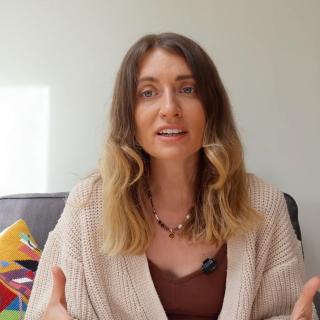
Hi and welcome to this yin yoga practice for healthy hips.
My name is Rachel and I'm going to be your guide today through this practice.
If you're new to Yen,
Yin is a great practice to work into the connective tissues.
Now these connective tissues,
They can be hard to reach and they often can make us feel quite stiff and unflexible if we don't work with these traditional asana practice.
Really focuses on stretching the muscle tissue.
But today we're going to go working into that deep connective tissue,
Especially in this troublesome area for many,
Which is the hips.
So we'll be holding it for around two to five minutes for each pose.
With yin it is quite nice to have some props so Grab yourself some blocks if you want.
You can use books.
We don't have to have these.
I'll be offering adjustments without them.
And of course,
If you want a pillow and a blanket,
Please do.
But we can do a lot of this without the props today.
I would really encourage you through this practice to focus on the attention of the breath.
You want to be sending your breath towards the parts of the body that you're stretching.
That helps to send more oxygen to these parts of the body,
Which in turn helps to open up these areas even more.
So do focus on your breath.
And remember that if you need to come out of it,
Back out of it.
But do try to sit with the discomfort.
The discomfort is what we want.
We want a little bit of tingling,
Maybe a little bit of numbness.
It's fine.
But any sharp pain,
Please come out.
So without further ado,
Let's get started.
So we're going to start on our backs today.
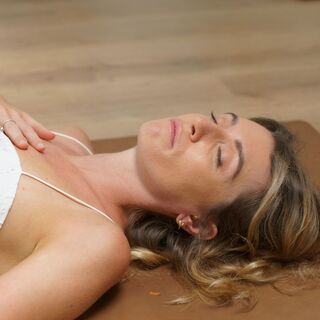
So we're going to come into a reclined butterfly position.
So when we're on our backs,
You can take your big toes together,
Your palms of your feet,
So your soles of your feet can be touching.
You can take a bolster to the sacrum and lay down.
But today I'm just going to come back onto the floor.
You can take your palms facing upwards in front of you.
Palms facing upwards to the side.
Just a nice bit of external rotation there with your knees coming out towards the side.
Option to take blocks and just rest them underneath the tops of your knees if your knees are quite tight.
And we're going to be breathing in for about five minutes.
So just breathing in.
And breathing out.
Breathe in deeply here.
And just allowing yourself to melt into the earth.
Allowing yourself to really just surrender to gravity.
Not trying to be anywhere.
Not trying to do anything.
To simply be.
We spend a lot of our lives in autopilot.
Moving from thing to thing without bringing any awareness to how our body is.
Helpful he's feeling.
And that's really the beauty of a yin practice.
It's an observational practice.
Observing how the body is feeling.
But that mindful awareness and non-criticism.
Remembering to breathe.
Breathing.
That yoking of the breath.
And the bunny in our yoga practice.
Breathing in and breathing out.
You might find over time that you start to notice that your body softens a little bit more.
So you might find that your body is still holding tension.
Wear in your body.
Are you holding and maybe it's in awe?
Cho,
Maybe it's in your.
Forehead,
Your wrists,
Your shoulders.
Notice if you soften tension in that part of the body.
Does this have an effect?
On the stretch Breathing in,
I'm breathing out.
You might want to just invite some yawns in.
Maybe just rolling your jaw around or drawing your tongue around your mouth if your jaw is holding tension.
Remembering,
Inhale,
Exhale,
You soften in and a little bit more.
With our ear and it's nice just to come towards that edge,
Not going past it.
When we go past our edge,
When we go to our maximum capacity.
We don't get there safely and we often overstretch and we might signal to our nervous system.
This isn't a nice place for me to be in.
So the next time we come into it,
We end up feeling stiffer than before.
Our body has a slight resistance to it.
This is such a beautiful practice.
And just like any yoga practice,
It should be non-competitive.
It's non-performative.
It's just our awareness of your body.
Breathing in and breathing out.
That final big breath here,
Breathing in.
And I'm breathing out and I'm just gently drawing the knees up towards each other,
Taking on tops of the knees now.
So you're taking the tops of the knees and I just want you to roll from side to side,
Massaging through the lower spine.
And then just ever so gently make some nice gentle openings with the hips,
Just placing the hands on the knees and drawing the knees out to the outer edges of the mat.
And then coming back in again.
Just imagining that he would be stirring a big pot of liquid.
Amazing.
Freely hair.
Drawing in and out.
Drawing out.
If you're going quickly,
Can you slow this down?
And then taking this the other way.
And then taking behind the backs of your legs,
Just ever so slightly,
Walking and rolling a few times,
Really keeping this gentle because we're not doing anything but a yin practice.
And then we're going to come on to.
Our tabletop position.
Just for a moment,
We're going to take a few cat cows.
So just inhaling.
Dropping the belly.
Exhaling,
Scooping,
Rounding,
Pushing the mat away,
Spreading wide through the fingers,
Knees,
Hip width apart and just moving here.
Dropping that belly.
Shoulders draw back and then rounding,
Pushing into the angry cat,
Protracting through the shoulders here.
And we're going to take our right,
So we're going to step it towards the top of the mat on the right side.
So you're coming into this.
Like a dragon position so we're coming into our dragon so it could be called lizard Or in the end,
It's called a dragon pose.
So I'm going to just come into this.
You can frame that right foot.
Your right foot is towards the outer side of the right side of the mat.
And then you're going to frame the inside of that foot with your hands.
You can come up onto your blocks.
Option to take blocks,
Option to take a pillow and just lie down on that pillow.
In the head for around three minutes.
So breathing in.
Sinking the weight forward and breathing out.
Breathing in and breathing out and we're opening up now into the psoas.
So the left psoas here is really opening into the right groin.
And our psoas muscle,
Our psoas is.
.
.
Really?
Gets really stiff from too much sitting.
And it gets really stiff from too much exercise.
So our yin practice is that sweet balance.
Because it's just really passively.
Getting into it.
Reading in.
And breathing out.
Breathing and and breathing out.
And just enjoying this,
Really closing down the eyes,
Withdrawing from the external world and focusing.
Your breath to that part of the body.
T.
Bye.
And remembering that this is a deep stretch.
Be kind to yourself.
But also try not to come out of it.
Try not to just get.
.
.
Do it and come out.
Just stay with it.
The more you do it.
The more you'll notice your body is more flexible.
And the more you notice your mind becomes stronger and more flexible.
Breathing in.
And breathing out.
We've got about a minute here still.
Breathing in.
And breathing out Breathing in.
And breathing out.
Breathing in.
I'm breathing out.
Nearly there.
And.
.
.
And then breathing out and then just coming up.
Onto that all fours position.
I just want you to.
Just like many lengths and through that right leg,
Just pulse it because it's been quite deep.
And just maybe take any intuitive movement that feels nice.
Maybe coming down onto your heels.
Maybe stretching through the toes.
Then we're going to take a really nice stretch into the hips here.
So you want to be on your left knee.
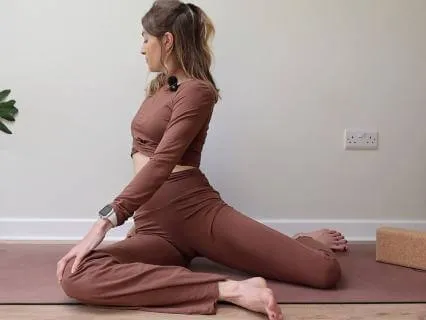
Your right knee is going to turn and you're going to come into this gate pose position.
Your left knee and your right toes are going to be in line with each other.
And we're just going to stretch here into this nice going stretch.
You can be on your toes.
You can be tucked on your toes of your left foot.
Or you can come down onto We were left.
For it.
And you can stretch out that right leg long to the side of the mat.
And then we're just going to walk our fingertips down towards.
The earth and you're just going to surrender here so we're really stretching into that inner side now breathing in I'm breathing out.
I'm gonna be here for around a minute.
Option to stay here,
Option to come up here.
You can have your toes on the knife edge.
Do try to keep them flat on the floor.
You'll feel a nicer lengthening here.
Breathing in.
And breathing out.
Breathing in.
And breathing out.
Breathing in.
And breathing out.
And then coming up,
And then we're going to take that on the other side.
So you're going to come onto your hands and knees again.
And then option now to step that.
You're going to have to step that left foot forward because that's the pose we're coming into but there's an option so you're coming into that low dragon so your left foot is towards the outer side of the left mat you're going to either come onto your blocks taking them to the inside of your leg you can come down onto your forearms you can stay in your hands you can take a pillow underneath And again,
We're just going to be here for around three minutes.
To really settle into her.
Your right knee is down this time.
Sending the hips forward.
And then we're lengthening and stretching that right so as.
And into the left groin.
And outer hip here.
Breathing in and breathing out.
Breathing in.
And breathing out Breathe in.
And breathing out.
Keep with it.
I know it's hard.
Breathing in.
And breathing out.
Keeping those breaths really deep.
Sending that wave forward.
Stretching into you.
That very tight.
Out of the body for lots of us my brain.
But you don't want to be going to your maximum.
You want to be heading towards that Goldilocks position.
So that just right position for you just to be comfortable.
As comfortable as you can get and you know that you don't want it to be too easy otherwise.
We won't feel anything.
Deep breath in.
And then we're going to just come up and then you can take that left leg behind you and you can just pulse through that left leg again.
Making any intuitive movement,
Maybe sending your weight forward.
Maybe he's ending your way back with.
And then we're gonna come and we're gonna face the front.
So the long edge of your mat.
And we'll be on our right knee this time.
And you're going to extend that left leg out to the side.
So you're coming into that low gait like position here.
So you can be tucked on your right toes.
You get the added benefit of a nice fire toes there.
Or you can come flat onto that right foot.
And then you're going to send your weight down towards your heel.
Shuffle that left leg long,
Flex the left foot or it can be grounded onto the earth.
And then just walk your fingertips forward here,
Coming into that really nice stretch.
We're going to be here for around a minute.
You can come up here if that feels more comfortable for you.
Remembering to listen to your body.
Breathing in.
And breathing out.
Focus on that breath.
Breathing in.
And breathing out.
Breathing in I'm breathing out.
And then coming up through centre.
Coming onto your knees.
We're going to take a nice stretch called Gombokasana,
So cow phrase position.
Working into the outer region of the hips here.
So equally this can be quite a tight area so be mindful of this in yourself and there are options so extending both legs long and then you can take your right foot over your left leg,
Flexing through your left leg.
If you want to stay here,
You can and you can simply drop your knee so it's resting on that left leg.
In a sort of triangle diamond-like position.
Or you can take foot expressions that you're going to stack both of your knees on top of each other.
Your knees are stacked,
Right knee on top of left.
And you can push down into your feet,
Lift your bum off the floor and sink your hips and your sit bones back down a little more.
I'm just initially staying here for a few deep breaths.
We'll take three deep breaths here.
In this upright position,
Breathing in.
And breathing out.
Breathe in.
And breathing out.
Breathing in and breathing out and then we'll just walk our fingertips forward now.
Palms can be pressed onto the abs,
Sending the weight back towards the sit bones here.
Breathing in.
And breathing out and this is quite a deep area to stretch.
We're going to be here for around two minutes.
Breathing in.
And breathing out.
Breathing in.
And breathing out.
Sending that breath.
To the parts of the body.
And then just coming up slowly.
And then you can just windscreen with your legs from side to side.
We're going to take that on the other side now.
So you're going to take that left foot over the top of the right leg.
You can extend through that right foot,
Keeping it flexed.
Or you can take it underneath and stack on top of yourself,
Coming into that Gumbha Kastner position.
So if you're in that full extension of Gumbha Kastner,
You can press down into the feet,
Lift the sit bones off the floor and send the hip bones towards the earth here.
So really deep stretch.
We'll stay here for a few moments.
Variation,
Breathing in.
I'm breathing out Breathing in.
And writing down.
Option to stay here or option to fold.
So I'm going to fold down and I'm going to make sure my both of my knees are stacked on top of each other as best they can.
And I'm going to fold down and you don't have to have a flat back here.
You can just round towards the earth and we're going to stay here for around two minutes.
So enjoy it.
Even if it's not comfortable,
Just know.
That you're really getting into that deep.
Connective tissue which is really stubborn.
And that the more we do this,
The more we'll feel flexibility within our lives.
And the more we'll find flexibility in our bodies.
And the more patience and understanding we bring.
With this into our lives.
Yin has been a really great teacher for me to slow down.
To listen to my body.
But also to sit with the uncomfortable things and not just rush out of them.
And yin can be quite a confronting practice for lots of us because we're not used to being still.
We're not used to not doing a lot.
We used to constantly doing.
And it actually requires us to be loveful.
And in that sense is a very mindful practice.
Breathing in.
And breathing out.
Breathing in.
And breathing out.
Last couple of breaths here.
Breathing in.
And breathing out.
And two more big breaths breathing and Breathing out one little big breath.
Breathing in and breathing out and then just coming up through to centre.
Windscreen working those legs from side to side.
And then in this windscreen wiping position,
We're going to come into a deer pose.
So you're going to drop that left knee.
Over towards the long edge of the mat so you're coming into this really nice deer post position so sort of figure four if you like,
With the legs.
And then that left leg is in front.
And then you're just going to take your right hand to the outer edge of that left knee and just take your left fingertips behind you and just come into a nice twist here.
Sitting upright and really twisting through the centre of the body with the shoulders following after.
Breathing in.
And breathing out.
Breathing in.
And breathing out.
One more breath here.
Breathing in.
Breathing out.
And then we can simply just bring the legs into centre and we're going to take that on the other side.
So you're going to take that right leg so it is long and it's parallel with either the top of the mat or the side of the mat.
That left foot comes out to the side so you're in that deer-like position.
And you can just make sure your feet are flexed here.
And then you're going to take your hand,
You're going to take your left hand to the outer side of that right knee and just come into a nice twist,
Drawing the right shoulder back,
Coming up onto the right fingertips.
And breathing in,
Breathing in.
I'm breathing out.
Breathing in And breathing out one more breath here.
Breathing in.
And breathing out and then coming through to centre.
And we're just going to take a nice final resting pose for a few moments.
There's always the option for you to extend your resting pose.
So.
.
.
You can extend it by however long you want.
This is your practice.
And then just rolling back onto your spine.
I'm going to stay in a constructive rest pose today because I feel like it's helpful for my spine today.
Palms can be facing up towards the scarlet for receiving.
And just allow yourself to reconnect with your body.
We can add to your deep breathing.
I invite you just to watch the mind.
What is the mind doing?
How is the mind behaving?
Just observing with non criticism.
Perhaps it's different to how you started this practice.
That is the beauty of yoga.
It helps us to watch the thoughts.
To move through the discomfort.
To end in more present.
As John Kabat-Zinn once said,
You can't stop the waves,
But you can learn how to surf.
And the beauty of our yoga practice is it allows us to learn to surf.
The things of the heart.
Whose life is trajectory of these ups and downs.
But it's what we do in these moments is the practices that we draw on.
The mindsets that we have.
Allow us to.
Actually work through these things rather than.
Push away.
Become too involved with the mind.
And you can stay here for a few more moments.
And just extending.
That's Shavasana Outwards.
I really encourage you to keep that long.
And doing much out of it.
It's often the hardest but the most difficult part of a practice.
And then just rolling onto either side if you are coming with me.
And then coming up into a comfortable position.
And then just drawing your hands into your heart center,
Into Undarne Mudra.
And just taking a moment to reconnect with yourself.
With your practice.
Maybe setting an intention,
A sound culprit for how you would like to move.
For the rest of your day.
In both your body,
Your mind and your spirit.
Thank you for practicing.
Namaste.