Thanks for joining us here on Pretty Spiritual where we're attempting the unthinkable about how to navigate this messy,
Beautiful,
Imperfect life with spiritual tools,
What,
Principles,
And our own personal stories.
So we're not experts,
We're not religious,
We're definitely silly.
We're honest,
Real,
And willing to share.
So join us as we connect,
Bond,
And grow together.
Hey everybody.
Yay,
Hooray.
Hi friends.
Welcome back to Pretty Spiritual.
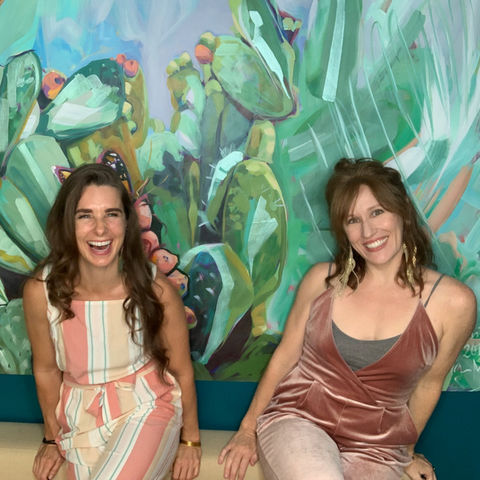
I'm Annie and to my left is Pony.
Hey y'all,
I'm Lindsay Pony.
And to my right is Ella.
Hi,
I'm Ella.
And we're so glad that you're with us today because we are going to talk about money.
Oh my gosh.
We can do this everyone.
Yes.
We're going to talk about money.
Okay.
Okay,
Thanks Pony.
Just on a personal note,
I have a very real sense that I will always be bad with money.
I have had this topic on the slate for two months now and every time it's my turn I say,
Actually I'm going to change the topic.
Please,
Yes,
Let's just continue to change the topic.
Because I love to share when I have a solution and I don't really feel like I have a solution yet.
I don't do this alone and Ella and Lindsay probably will bring something else to the table.
But I'm really in myself about it and I think I have to fix it and I am not considering spiritual tools.
So today we're going to talk about having a relationship with money and bringing in spiritual tools.
Weird.
Gross.
This can be done.
This is a beginning.
Pony's just carrying the whole show today.
It's great.
Thank you Pony.
Pony,
Pony.
So I thought we could zero in on how we think about money,
The challenges that we face internally,
The challenges we face in relationships with others due to how we relate to money,
And the spiritual tools that we're trying to use to have a healthy relationship with money and as a result the people around us.
So at the core,
Money is just a social agreement,
A type of currency we use to obtain goods or services.
So why can it feel so murky,
Shameful,
Confusing,
And dangerous?
Let's dive in.
Pony,
Why don't you start us off and talk about what your relationship with money is like?
Okay.
Yay.
Thanks everybody.
I know no one wants to talk about this.
Head in the sand.
Head in the sand.
Seems like a good strategy.
I can say that first off,
I really want to talk about what a privilege this is to be able to even be able to have money to look at.
I think that's really,
Really important.
And no matter what,
I know for all of us,
Luckily here,
We have a roof over our head.
We're getting to do like a passion project,
Which costs money.
I buy a coffee when I want a coffee.
And I think it's what really helps me to even begin to look at money and what's going on is to get really honest about it.
And I wanted to start there.
And of course,
Obviously I could go on.
I understand that abundance is here in more ways than one,
But when I come from my scarcity mentality and my poverty mentality,
Then there is nothing available for me.
I can't get into gratitude and I can't get into action of what's actually here.
And where I would like to start is I would like to reverse engineer this and go way,
Way back to when I was a child and look at this,
What a therapist brought up to me,
Which is what is your emotional relationship to money?
And I remember because I was having all these problems with money and I was doing a lot of very interesting things to manage,
Control,
And do anything except save or look at what was actually here.
So when he talked about my emotional relationship to money,
That was something that had never crossed my mind.
So when I go back to the very beginning,
I see the examples that were put there before me.
How did my family of origin deal with money?
And even just that was really hard for me to look at.
I can say that I remember being really young and one of my jobs was to throw the bills away.
And I bring that up not as in judgment or that that was wrong,
But that that is information for me to use about how I handle things today.
And that started a habit of not looking at money,
Not knowing how to deal with money,
Not being taught about money,
Not being taught about taxes.
These are things that are going on for everyone.
I want to talk about for me,
What a lot of people don't talk about,
Which is student debt,
Which is a very cultural thing that we have going on right now.
I'm not going to get into all the politics about that,
But what I can say is that I took out loans when I was 18 years old that they put in my lap,
Took them out.
I was a child.
I never paid them.
I was never going to pay them.
Cut to me being maybe 35 and it was time.
Not only had I gained,
I think like $18,
000 for not paying because it was just compounding interest.
So they were small loans that then was all compounding interest.
I tried every way to like go through Navy and all these other places and like do the income based repayment program.
I did so much mental math,
But I was never willing to look at what it would actually take for me to pay off and save and what that would look like.
I was paralyzed by fear.
I was drowning in shame.
My best way to handle that was I'm not going to pay this.
I'm never going to pay it in 25 years.
They'll forgive it for me.
Having that carried around with me was really heavy and I am really,
Really grateful that I became willing.
I found some awareness to start looking at that and that I had someone who walked me through how to begin to look at what was here and how to begin sorting that out and I can't wait to tell you more when we get into the tools section of how to do that.
Wow.
Thanks,
Pony.
I just want to say that I paid off all of my debt for that,
Which I was never going to pay.
So it is possible.
That is amazing.
It's so helpful because I'm still of the opinion that,
Shh,
Don't tell FAFSA,
But like I'm secretly never going to pay them the money.
I'll never have it.
So thank you.
Who knows?
I'm right here with you and who knows?
I totally,
I can't believe it myself because it was never going to happen and I have to say it out loud because I did do that.
You did it.
I remember.
It should be done.
Yeah,
You all helped me.
On that note,
Miss Ella,
Do you want to share with us about your relationship with money?
I was saying this out loud before we started recording and Lindsay suggested that I say it while we were recording.
So I'm having a lot of physical pain and I made an appointment to go see a massage therapist today for a massage and I secretly don't believe I deserve it or have enough money to pay for it.
So it's alive and well.
The thing that I was thinking about when Lindsay was talking is that everyone pays and for me that's this very basic principle of life and responsibility.
I pay a price that isn't in dollars when I try to find a way to avoid paying for something.
I've had a number of experiences with that where I see,
I see quote unquote shortcuts that people are taking that look really appealing.
Maybe I could do this other kind of job that probably wouldn't feel great emotionally or all these other ways to do but look,
I would get all this money and then over time I've watched what it's,
I've observed this for myself and seen what it's like for other people when we pay in something else.
We pay with our self-esteem,
We pay with our attitudes,
We pay with our integrity,
We pay with all of these things that are really,
Really,
Really expensive.
They're just not measured in dollars and so that's a really helpful place for me to orient myself right now because all I want to do is spend money to soothe myself.
Like Lindsay was talking about,
I had a different model as a child but what my money model looked like was you have to suffer to earn your keep and money is a reward for enduring the suffering.
If you're going to spend money on yourself,
The appropriate response is guilt.
So it was like this really complicated kind of messy thing to make sense of for me so I grew up using shopping as an escape,
Using spending money as an escape but then there was this guilt and ultimately this very corrosive shame attached to it and so it turned into a cycle for me where I'm spending money to self-soothe but in so doing I'm causing myself a huge amount of shame and a huge amount of anxiety which then requires more self-soothing and then I'm spending more money to self-soothe.
I mean it's the addictive cycle applied to money,
You know,
Like any of us who have experienced addiction or compulsion can relate to that.
It's a really,
Really harmful cycle.
What happens for me when I'm spending like that is that the things in my life that are actually self-esteem building and integrity producing ways that I could be spending money end up feeling optional,
End up feeling unaffordable.
So like,
You know,
I'll buy a designer purse but spending money on groceries,
No thank you,
You know,
Or like I will,
I'll spend money to get my nails done but then I don't really have enough money to go see my therapist,
You know.
So like all these ways where because of this fundamental mis-prioritization and this broken core belief that says,
You know,
Spending money is a shortcut to self-worth but actually it's a shortcut to shame.
I actually get integrity by spending money on taking real care of myself,
Like actually helping myself feel well physically by,
You know,
Buying healthy food to eat,
By going to therapy,
By seeing my nutritionist,
By buying all these herbs and supplements I take for chronic health problems.
Like there are these ways that I can really support my integrity with money but all of those end up feeling unaffordable and optional if I have this orientation of spending money to self-soothe with false refuges,
Let's call it that.
So I'm not sure I'll have so many tools but we'll see what I talk about when we get there.
This is the question mark episode.
I would just like to say that just talking about this and bringing in our people and beginning to look at that is a huge tool.
We don't just come to the table with all of the answers.
It's just not how it works and so I just want to commend us all for one,
If you're listening and you even touched on this episode,
Like wow,
Congratulations to touch on something that says money.
And for all of us for just showing up and being okay with,
You know,
We don't have the answers.
This feels like a really big problem.
It's messy over here.
Here we are.
Thank you,
Pony.
Thank you,
Girls,
So much for sharing and Pony,
Thank you for touching on privilege because it really is a privilege to worry about money in the way that I do.
Not everybody has their basic needs met and that the worries that I have aren't centered on survival and so it's important to acknowledge that that's a really real thing for a lot of people.
So for me personally,
For so long,
I've had the story that I'm good with words and bad with numbers and the truth is that words were easy and numbers were more challenging and I didn't really want to do the hard work to learn how to do numbers.
Money also felt like this magical thing.
You know,
It was either there or it wasn't and this is when I would have a job and accounts and all these things but it just kind of felt like it was this thing that would come and go and I don't know how to keep track of it.
You know,
This sort of helpless approach and not a practical tool that I could master,
Right?
Not just this thing that there's an easy way to navigate.
That said,
My parents really tried to teach me how to have a healthy relationship with money but honestly always been hazy for me and that's no one's responsibility but mine and so my solution for a lot of life was to keep my money world small so that I didn't have to figure it out.
I don't mean that I didn't try to earn money,
Which I did,
But I didn't have a credit card until I was 30.
I'm like,
That's a solution.
You just don't have a credit card instead of trying to figure out how to read a credit card statement.
I'm still riding that wave.
Wow.
I know.
Once I stopped drinking,
I remember I met this man and I wasn't yet a writer and he said he was a writer and he hadn't been drinking for five years and he said,
But I spent all my savings and he said I had all this money in savings and I spent it all and I was just like,
I never want to be like him and at about three years into this spiritual journey,
I was like,
I am just like this dude.
I was a writer.
I had had a lot of money in savings.
I had burned through it all and I was just like,
What happened?
What happened?
Relatedly,
And unbeknownst to me,
I was having a mental health crisis,
But on top of that,
The money shame was real.
I accrued $10,
000 a credit card debt,
First credit card debt in my life and I was so overwhelmed and I was just thick in avoidance.
Well,
Surely if I just pretend it's not there,
Like I heard both you girls say,
It'll just go away and apparently that's not how it works and I got help paying that off,
But then I would do that cycle again.
And also coupled with this and coupled with the haziness is this pattern of helplessness that I have around money where historically I would be in relationships where people would have to rescue me financially,
My partner,
You know,
And when it was like I would create this helplessness in myself,
I've repeated that in various ways and maybe it's not so extreme now,
But I still do it and it causes problems because I don't quite know how to be a full,
Fully step into my relationship with money and I'm always needing help with it.
And I have a weird way of ceding power to somebody else if they're rescuing me financially.
Like I feel like my worth is kind of tied up in what I earn or what I don't earn and so I have a hard time speaking up and it's just like a lot of really strange ideas around something like I said in the intro that is really just this social agreement between goods and services,
But I've attached all this stuff to it like power dynamics and relationships,
My personality,
My worth,
Whether I'm good at something or bad at something.
And so just recently I've really started to look at this and I will talk about that in the tools department.
Yay,
Annie,
I related so much to all of that and thank you for putting words to that.
Whatever it is that like unconscious subconscious negotiation we do where subtext.
Yeah.
That's a lot to look at.
So with all of our little mini stories,
Now we're going to talk about what we are trying to do to navigate this or maybe improve our relationships with money.
What about you,
Pony?
Hey,
Some of the tools that I think are really necessary for beginning to look at money and where we're at step one is really just to become willing to look.
That's where we put down the,
It's not there.
I'm never going to pay it.
All of those strategies,
We put those down,
We bring awareness to that and then we become willing to look.
For me,
That requires meditation and my meditation practice,
Which can be as simple as even just three minutes in the morning to quiet things down and drop into my body so that my mind isn't running the show of what's important because otherwise I'm just in that fear state of I get in the fear state,
I get paralyzed and it actually has me spending more money because I'm not looking at what's going out.
Not only do we need the awareness piece,
But we also need,
And this is like the metaphysical stuff,
Right?
We also need the clarity piece.
The clarity for me is to set a goal.
What do I want to do here?
If I've been able to come to terms with money feels weird or I,
Whatever it is,
The beginning,
The clarity is set a goal.
Maybe you want to actually look at your student debt.
Maybe you want to look at your credit card debt.
How to begin to even do that.
Do you actually want to start paying on your school loans?
Do you want to save for retirement?
That's like what I,
Right now,
That's my goal for next year is that I have got to start saving in ways that are completely for my future self.
I am so into instant gratification.
My practical tool now,
Moving out of the spirit realm and coming into this physical realm right here,
Right now,
Is to print out your last month's statement.
Print it all out and highlight everything that you spent that was a want.
So we have to separate what is a want and what is an actual need and start framing things in that way.
Because just like when we're talking about privilege,
We start saying,
Well,
I deserve this or this is because this or this is for,
Maybe we can't even see that the reason that we're spending is because we're trying to cope or deal with a feeling.
Separating the want and the need is very important.
Once you highlight everything that is a want,
Add all the wants up.
Be surprised.
As you probably will be when you see how much you are spending and now you're going to take half of that total,
So you're just going to split the wants in half of whatever that total is and you're going to save that.
That's just one simple,
Easy goal that's totally attainable because these are things that you're just spending that aren't actually needs.
So you could take half of that.
You can help yourself get there by saying,
Okay,
These are all wants.
Some of the ways that I've done this for myself is anything that is upkeep or like female must do to look and be attractive,
I'm trying to take away.
I'm not getting my nails done anymore.
I don't do waxing anymore.
I'm a mammal.
I am hairy.
And those things are like actually really hard.
But I did the adding up of the money.
When you see if you get a coffee every day,
How much that is for the month,
It is a huge amount of money.
It's really important to look at what's going out.
What is a want?
What is a need?
And then to start saving for that.
So it's the awareness,
Being able to look at this,
It's clarity of setting a goal and then actually looking at your priorities and then to again,
Just make a start,
Even if it's a tiny amount of savings,
That's a good way to begin.
Oh,
And the last little piece that I just wanted to say was that the first savings account that I ever started was because I honestly believed that I needed a boob job.
Hashtag priorities.
Okay.
And so if we just want to do this wasn't that long ago.
It was actually like eight years ago.
That's all in time.
Well,
Yeah.
Yeah,
Dang it.
My very generous grandparents on my dad's side let me know when I was like 14 years old that they were putting money away for me to fix my nose.
Which I haven't claimed that yet,
But maybe I couldn't spend it on something else.
Like boobs.
Your face is so perfect.
I'm disgusted.
Okay,
There's my money stuff.
Thank you so much,
Pony.
Thanks,
Pounds.
What about you,
Ella?
The place I want to start is to remind myself,
And if people are out there who work like me,
Then you can relate to this,
That in areas where I'm afraid to look directly at my behavior or attitudes,
I get this idea that vagueness is safety.
And vagueness is safety is a lie.
That all the avoidant and denial-prone parts of myself are like repeating,
But it doesn't actually work.
And vagueness causes me huge anxiety.
It causes me a lot of fear.
And the worst part about it is that instead of having parameters,
The vagueness allows the fear and the anxiety to be the biggest thing,
To grow and grow and grow and grow.
I love the idea of bringing awareness to spending,
And the first way that I started doing this,
God,
Years ago is,
And I still do it,
I track all my spending.
And so every time I spend money,
I have a note in my phone and I write it down.
And so I have this very active way of looking at what I'm spending.
That has been just a really helpful first step in combating vagueness.
There's this language of letting go,
Which is a book we all love and appreciate very much.
And I'm going to read this entry.
It's from February 5th.
It's called Financial Responsibility.
She says,
We are responsible for ourselves financially.
What a frightening grown-up thought that is for many of us,
Taking responsibility for money and our financial affairs.
For many of us,
Handing over responsibility for our financial affairs has been a part of the codependent trade-off in our relationships.
Again,
That thing that Annie was mentioning that I definitely relate to.
Some of our emotional dependency on others,
On this tight tie that binds us to others,
Not in love,
But in need and desperation,
Is directly related to financial dependency.
Our fears and reluctance to take responsibility for our financial affairs can be a barrier to the freedom we're seeking in recovery.
Financial responsibility is an attitude.
Money goes out to pay for necessities and luxuries.
Money must come in in order to go out.
How much needs to come in to equal that which is going out?
Part of being alive means learning to handle money.
Even if we have a healthy contract with someone that allows us to depend on him or her for money,
We still need to understand how money works.
We still need to adopt an attitude of financial responsibility for ourselves.
Even if we have a contract with someone else to provide for our financial needs,
We need to understand the workings of the money earned and spent in our life.
And here's the best part,
Worst part.
Self-esteem will increase when we increase our sense of being financially responsible for ourselves.
We can start where we are with what we have today.
And I just,
I love everything she's talking about because I really relate to that codependent framework for relationships that keeps me stuck,
Keeps me in fear,
And keeps me dependent in unhealthy ways on other human beings.
I also really appreciate that we can start with our attitudes because the idea of taking financial responsibility for myself seems like a really,
Really bad call.
On the best day,
Stupid.
And on the worst day,
Stupid and really dangerous.
You know,
Like,
I won't have enough,
I won't be taken care of.
That attitude really shifts for me when I adopt an attitude of responsibility.
And one way that I can think of this happening is that I got a bill from my healthcare provider for $800 after a migraine treatment that I received.
And I freaked out.
I did a lot of crying.
I did some yelling.
And eventually,
I got to this place where I was like,
Hey,
Thanks,
Universe.
This is happening for my benefit.
I really practiced that attitude.
This is the universe conspiring for my benefit.
If not taking financial responsibility for myself is hurting me,
Here's the universe making it less of an option to keep doing that.
Here's the universe saying,
Here's a really clear-cut way that you can prioritize spending money on taking care of yourself rather than harming yourself for supposed self-soothing.
And so if I can try on that attitude,
It really,
Really helps me to combat the fear and the scarcity that come up around it.
It helps me feel safe just trying for today instead of,
You know,
Financial planning definitely has its place.
But for me,
I can get really,
That planning can turn into kind of a frenzy in my brain and I really need something practical and day-to-day that will just help me try right now.
And the other quick tools I have are to look at my motives,
Ask myself,
Is this self-care or self-harm?
If I'm buying another turquoise necklace,
Chances are it's self-harm.
If I'm buying something to take care of my body or my mind or my spirit,
Chances are that self-care.
I try to pause when I want to buy something.
I ask myself,
What do I think I'm going to get for this?
Like what emotional booby trap is happening right now?
What do I think I'm going to get from having this thing that is a lie?
And then if I need to buy it anyway,
Which sometimes happens,
What is it like to refuse to pick up shame and instead to,
In a lighthearted way,
Just own it?
Yeah,
I thought I had enough turquoise jewelry,
But I guess not.
I really love turquoise.
I just want all the turquoise in the world.
If I could put it in my bathtub and soak in it forever,
I probably would do that.
Maybe that's my secret goal.
At the end of the day,
The thing that I really need the most,
It's become really apparent to me in my life,
Is forgiveness for being a human,
For being imperfect,
For being messy,
For not having it all together,
For not having all the answers.
And any way that I can forgive myself for quote unquote doing it wrong is a solution.
And if I can live with a forgiving attitude,
Chances are I'm not going to need to check out and self-soothe in harmful ways.
So thank you,
Ella.
Thank you,
Ladies,
For these tools.
My tools are frighteningly similar.
Full body squash blossom?
Nice.
So the first part was just noticing when I'm sticking my head in the sand.
Oh my God,
I love to pretend that things aren't happening.
I talked about that credit card debt and I knew it was happening.
I knew it was there,
But I just wouldn't look at it.
And this was probably about five years ago and it has been resolved,
But the crux of it was just pretending it wasn't going on and just being terrified.
Part of it is just coming out of denial,
Which isn't easy to do.
You can't just be like,
Hey,
Come out of denial.
Hey you.
So the things that both of you have talked about of like looking at it and as you're sharing,
I'm like,
OK,
I have a tool for myself.
I need to look at my bank accounts every day.
Right now,
I'm going to make this little promise to everybody.
I'm going to do it for one month.
I'm not going to do something in my head like I'm doing this now forever.
And then,
Of course,
I don't follow through and then and then I give up.
So I'm just going to say I'm going to set a timer on my phone or an alarm.
And once every day I'm going to look at my accounts.
And so for me,
That's part of the tool is just looking at what's happening,
Being present with it and like we have all been talking about is coming to understand that it's just a thing to get to understand like that reading out ahead from financial responsibility.
My part is to be cognizant of what's happening.
Money is changing for me.
I was talking about those older patterns that I had where I'd be very helpless and then I have someone who was kind of rescuing me financially,
But also just I was being submissive in unhealthy codependent relationships.
And I realized I was bringing that into my current relationship where it didn't need to be because the foundation is a healthy relationship.
And so I would make a mistake around money,
Around the credit card,
And I would get really cringey and weird and submissive.
And how confusing is that for someone who's not in part of an unhealthy codependent relationship?
What's going on?
Yeah.
So I had to just with professional help with my therapist and also some of these tools that Pony was talking about,
Prayer and meditation,
I started to realize that I could just say I made a mistake and that making a mistake doesn't mean that I'm fundamentally bad.
And I had that really mixed up where I'm like,
Oh,
If I do something wrong,
I'm bad and therefore everything's bad instead of just saying I made a mistake.
Here's how I can resolve it.
That's been a practice for me.
But also,
I kept trying and trying.
And you guys,
I don't know what it is,
But I really do haze over when I,
Pony's,
Your suggestion for printing out a credit card bill was so great.
And I have spent so many times printing them out and my brain just kind of melts down.
And I realized I need help.
I can't do it by myself.
And I don't mean that like I can't do it.
I have a shutdown and I need help.
And I found a financial coach.
And it's so cool because we have a shared Google Sheet and I print out my credit card and we do a shared screen phone call once or twice a month and we read through it together.
And it's so she speaks in this kindest,
Simplest language.
And it's very nonjudgmental and there's nothing loaded in it because she's not emotionally attached to my spending.
And she can just talk to me about what the numbers mean because I don't have a spending problem.
I just have a I don't know what's happening problem,
Which I guess is also a spending problem,
One could say.
So that has been my tool is getting help and just knowing that I am.
And so over the years I've tried.
You need a budget.
I've tried mint.
I've tried creating my spreadsheets and I can't I just every time I fall apart and then every time that happened,
I'd get more and more mad at myself.
And I'm like,
Wow,
What a great financial investment in myself to pay X amount of money to this person who's really good at this,
Who can teach me how to do it.
And she keeps repeating stuff like you're going to get to the point where this is really second nature for you and money's not going to be confusing.
She's like,
This is going to be simple and clear.
It's going to be helpful.
She's like,
You're not going to need me in a year,
You know,
And it's really like she's like,
I'm building you a foundation so you know how to do this yourself.
And the thing that I've also this is my last tool that I've thought about while we are all talking is I really think I have to figure this out by myself,
Even with asking for help from the financial coach.
I'm still like,
This is me.
This is an anti problem.
It's going to be an anti fix.
And that's the end of the story.
What if there was actually higher power in this concept of money?
And that still feels really weird to me.
And I'm just going to say that out loud because what if before I look at money every day,
I said a prayer and what if I was like,
I'm going to take these steps,
But it's not actually up to me to figure it out,
Which seems counterintuitive when it comes to money and figures.
That I don't figure it out.
But what if I just take the action steps?
So those are my tools.
They're a little hazy,
As is my relationship with money.
I want to thank you girls for sharing with us.
And for sharing with everybody.
Pleasure my treasures.
We want to hear what money looks like in your life.
So get in touch with us.
Definitely you can get in touch with us at www dot pretty spiritual podcast.
Com our wonderfully curated website.
There's a say hi tab.
We have a tools page with all that great stuff that quote Ella just read will be on there and also all our other episodes.
So much.
So so many free,
Wonderful tools and resources there for you.
Yes.
Come check us out on Instagram.
Use your social media for good and go to healthy stuff.
I started following some money management.
Oh,
Smart.
Wow.
Oh,
Yep.
Really good stuff.
I'm just doing mental health stuff on my Instagram.
I recommend.
What are we talking about next week?
Now this is very exciting because this all goes hand in hand.
Obviously.
Oh,
Good.
We are going to play the ever never ending blame game.
Oh,
Blame.
It's coming at you.
Thanks,
Pony.
Thanks,
Ella.
Thank you all so much.
We love you.
We love you.