I think if we could,
If we had the ability,
If we could review past lives,
There are a couple of ways we would see this samsaric experience.
I think we could see it as the most fantastic adventure on one level.
On another level we would see it as the most horrible ordeal,
Depending what happened in various lives.
Some people have some doubts about teachings on karma and rebirth,
Develop an interest in Lord Buddha's teachings because they want to be peaceful.
That is wonderful.
We all aspire to be peaceful.
Belief in karma and rebirth is part of what Lord Buddha explains as a skillful view.
So it's something that is helpful,
Perhaps not completely necessary.
If we give ourselves to exploring the meditation methods,
Seeing if they work,
I think that people will find that they do.
But in terms of maintaining a diligent effort over a long period of time with the kind of energy and consistency that we need to have some kind of a breakthrough,
Then you need a strong quality of faith and a commitment to this understanding of cause and effect.
Deep quality of resolve.
So that deep quality of resolve has to come from several things,
I believe.
It has to come from the fact that there's some weariness,
An intuitive sense that we've been at this conditioned experience of life for a very long time.
That gives a sense of weariness to some people who have that.
But then also a faith in your potential,
That intuitive sense that you have that you're capable of much more.
Life can be more rewarding than this.
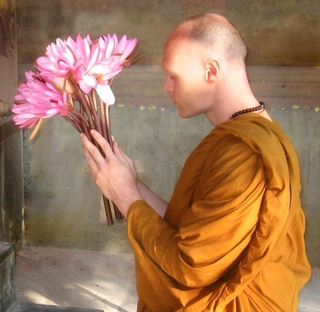
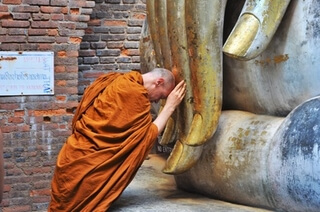
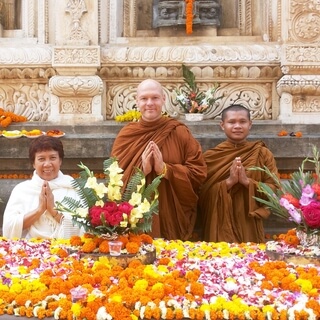
I'm just kind of looking at the shrine we've made behind us,
Thinking of some of the stories of the Noble Sangha,
Part of our refuge.
And Ajahn Anand,
When he was about seven,
His mom would take him to the temple on the lunar observance days.
And he would get tears in his eyes and his hair and the hairs would stand up on end when he would see Buddha statues.
And he didn't know why.
And there's a song that they would sing at school,
As a kind of a folk song in praise of the Buddha,
The Dharma and the Sangha.
And all of his hairs would go on end and tears would run down his face.
And he would ask his friends when we sing this song,
Does this happen to you?
And then I know.
So we can see with examples like this,
Quality of faith and loving gratitude,
Devotion came into that life from somewhere else,
Previous life.
Even more extreme or pertinent than that example,
As we're told by the mother of the Dalai Lama.
She didn't know that the consciousness in her womb was a reincarnated Lama.
She was a poor villager,
A farmer,
Some remote part of eastern Tibet.
But she could hear the baby inside her reciting mantras from very early on.
And she could hear this,
Om Manipami Om Manipami Om Manipami Om Manipami Om Manipami Om Manipami Om Manipami Remarkable.
So apparently the Dalai Lama,
Even in between births,
Is keeping up his meditation objects.
Wonderful.
I met Sister Dupankara in America many years ago,
Burmese nun.
Before she was a nun,
Apparently she used to get woken up.
If I remember correctly,
Every night she was woken up.
And apparently it was the devas who would not let her sleep until she had recited the Dhammacakasuta.
After she'd got up,
Recited the Dhammacakasuta,
They'd let her go back to sleep.
So one hears these stories,
Remarkable stories.
I was reading recently the life story of Mechigal,
An extraordinary good kamma from the age of 13.
Lumpur Sao,
Who was the teacher of Lumpur Man,
Coming through the very village where she lived.
I think she was 14 when Lumpur Man passed through,
Spending the rainy season retreat just a couple of kilometers from the village.
The villagers going over and visiting the monks on the lunar observance days and listening to Dhammataks.
Mechigal was very shy,
But Lumpur Sao had seen special abilities and encouraged her to meditate.
Lumpur Man encouraged her to meditate.
The very first time she meditated,
She did buddho with faith and conviction for about 15 minutes.
And then her mind converged in samadhi.
She said she experienced it as if the mind fell into a deep cool well.
There was no perception of the body or the more ordinary levels of mental consciousness.
And then she came out of some samadhi and she had vision.
She saw her own corpse as if it was in front of her.
And she saw her own funeral.
She saw Lumpur Man at the funeral tapping the body and as the flesh and the sinews and the muscles,
All these things fell away.
All that was left were the bones.
And Lumpur Man told her in this vision,
There will be rebirth.
There will be,
You will come conscious again.
Causes for rebirth had not yet been undone.
So Mechigal came out of this experience at dawn.
That was the first time she meditated as a 15 year old girl.
You can see that this kind of experience has to be conditioned by past practice.
She was a humble villager.
So even that experience,
She didn't recognize it for what it was.
She was ashamed.
She thought she fell asleep and had a strange dream.
Even though she was in sitting posture the whole time.
When she told Lumpur Man,
Lumpur Man laughed.
He said that was not a dream.
It's a very good experience of the mind,
Latent wisdom,
Teaching the mind.
So that again,
Something that was cultivated in the past,
Ripening the very first time she meditates,
Amazing.
Then you also see Mechigal wanted to become a nun and her father didn't let her.
So she actually gave up practice for 20 years before she was able to come back to it and the marriage was difficult.
So this samsaric experience,
Everyone has their share of dukkha.
Even I met a woman a couple of years ago at an Andhagiri.
A friend of hers told me that she can remember her past life as a princess in Burma.
This lady studies Avidamba.
I only met this lady once but I liked her.
Anyway,
She at that time we had a muddy,
Potholed road,
Steep,
Narrow,
Deep holes.
Anyway,
She drove up this road in her Mercedes Benz and she got to the top and she came out.
She had these two very earthy,
Down-to-earth funny friends but she had little slippers with diamantes and although she was wearing white,
Everything was lacy somehow.
She set up this row of offerings and everything had a bow and crystals and I asked her,
Is it true?
You can remember your past life as a princess?
She said,
Who told you that?
I said,
Your friend told me.
She said,
Yes I can.
I said,
What was it like?
She said,
It was a dukkha,
Ajahn.
I said,
Why was it a dukkha?
She said,
It was like being a bird in a golden cage,
Dressed beautifully,
Looking beautiful but you couldn't do anything that she wanted to when she wanted to.
So this fantasy that you have that we have,
You could be born royal,
You could be a celebrity that you'll be happy.
Ask people who are royal what's it like?
I say,
It's awful.
Don't even think about it.
So even if Prince Charming finds Cinderella after her pumpkin is a pumpkin again,
Marries her,
She ends up a bird in a gold cage.
So,
Masara,
This conditioned realm of rebirth,
It only gets so good.
And as I was saying,
If we could see all the things we've been,
All of the wonderful adventures you've had in heaven,
Or as wealthy human beings with great opportunities,
Quite an adventure.
You can see all of the ordeals,
The children who died young,
The partners that betrayed you,
The business ventures that failed,
Diseases that struck you down,
These things.
People who develop the ability to see these things usually get a sense for wanting to be liberated quickly.
Because the mind has a potential to be liberated.
It can be purified.
The nature of the mind is that it can be purified of hatred and delusion.
It can be liberated from every type of suffering.
Lord Buddha explains Nibbana as unshakable peace.
So what is it that exists after the mind is liberated?
It's an interesting question.
Lord Buddha says he can't really describe it in terms of,
It's usually described as a negation.
It's a lack of suffering.
It's an unceasing quality of peace.
So that's everybody's nature.
Dhamma,
Another word for Dhamma is nature.
That's your nature at heart,
Or the nature of your heart.
In Thai they use the word heart and mind.
They go together.
Chit Chai,
The Chitta,
The Chai.
So the nature of the Chitta is that quality of knowing Buddha nature or Buddha potential that can be purified so that delusion falls away.
And that what is left is something that experiences,
Obviously mental,
Some aspect of mind that experiences unshakable peace.
So we're all very interested in that and whether people believe in rebirth the same.
Still most people are interested in experiencing a deeper quality of peace.
One of the reasons I encourage people to embrace the belief in rebirth is that this confidence that you've gained that whatever you put into practice now,
If you don't see the results straight away,
That those results are definitely coming.
So that's a very encouraging way to understand your effort.
When you think of Mechi Gow,
Having her profound Samadhi experience and her profound nimitta into the nature of bodies.
On the very first time she meditated as a 14 or 15 year old girl,
You see that she was getting the results of past efforts.
And even though another 20 years went by,
Obviously that experience gave her great faith in the value of practice.
She actually wanted to meditate.
Lumpur Man had told her she has such a dynamic mind.
Lumpur Man said,
Don't meditate until another teacher comes along.
He told her another teacher will come along who can teach you.
And he did.
It was Ajahn Mahabuwa.
Ajahn Man had seen that if she practiced by herself,
Because her mind was so dynamic,
She was prone to all these visions and traveling through other realms,
That she could get lost or she could come deluded by the power of her own mind.
So obviously a lot of practice.
And when things came together for her later,
They came together wonderfully.
She believed that she was an Arahant before she left this conditioned world.
So if we believe in Kamra,
We believe in rebirth.
We understand we've already done quite a bit of practice because you wouldn't meet opportunities to do retreats.
You wouldn't know about the BSV.
We wouldn't have each other as spiritual friends without having put quite a bit into your practice already.
That's another affirming,
Encouraging reflection,
Practice which has already been accomplished.
It's not the case that it's completely hopeless and we have to start from scratch.
Already a lot has been done.
So when we open up to that,
There's a sense of optimism and a sense of appreciation for the goodness that's already there,
Which is a very different experience for judging oneself for what one hasn't accomplished yet,
Which can be very painful.
So as we're on meditation retreat,
We'll talk a little bit about the five hindrances.
These are qualities that affect the mind,
Untrained minds almost constantly.
And when we allow these energies to invade the mind,
Fill up the mind,
And believe them,
This is what's been dragging us around samsara.
It's part of the reason I wanted to have an epic samsaric introduction to the talk.
If we don't recognize a hindrance as a hindrance,
The Lord Buddha describes them as being robbers,
Bandits,
Phenomena that steal away the peacefulness from your mind,
Which is inherently peaceful.
Sajjan Chah also gives these similes of the mind being like the leaf,
But these winds blow the leaf around.
But the leaf itself is still.
If it isn't,
If there isn't a wind,
The leaf is still.
First one is essential craving.
So when you come to sit,
And then there's the other thing you'd like to do.
And that can also be going to have a lie down,
Going to have a rest.
The coffee,
The cake,
Whatever the food,
The sexual fantasy,
Things that come up the mind gets infatuated with this idea that something sensual would be better than this.
And if you can't go and do it,
Then you might get lost in a fantasy about it.
If you can see this as a hindrance,
Craving for something,
And detach from it,
Establish your mindfulness on a neutral object.
When it falls away,
And if you're with your breath meditation,
You'll experience a quality of peace and tranquility which is superior and more rewarding to the sensual craving,
The thing that you are craving for.
So this is,
We need to have enough patient endurance,
Commitment and determination to bear with these things until they cease and then notice.
You'll see the more you meditate that a peaceful mind is superior.
The second hindrance is this craving not for,
Sometimes called ill will.
The way I see it though,
It's all of the irritations and aversions,
Anger and ill will.
So it's the same craving energy.
If you look at the Four Noble Truths,
Talking about the cause of suffering is three types of craving.
That's again Lord Buddha,
I see him as if he's on top of a mountain and we're all trying to climb that mountain and he can see exactly how he got there and he knows all of the paths up the mountain and he's trying to explain it to us in a way which is simple so we understand.
This is simple.
Because of craving,
Three kinds of craving,
Deludedly,
We attach,
We attach and we suffer.
So the craving for and then the craving not for.
If in your meditation you have knee pain as most people do,
Shoulder pain,
Back pain,
Do a little experiment,
Contemplate,
Observe.
When you're mindful of the pain as pain and you know it is an unpleasant feeling,
When there's enough integrity in the mind to just be with that,
With some uprightness,
When you don't add the pain of aversion,
You might be able to see that actually the mind can have experience of rapture and tranquility,
Peace,
Coexisting with that pain.
The pain can be extraordinary but the part of the mind which knows that with some detachment isn't suffering.
As soon as you have aversion to the knee pain,
Have a look.
Do you suffer?
And the cause of suffering is craving for and not for.
It's not the case that if you just get rid of all painful phenomena that you won't suffer.
You can't get rid of painful phenomena.
All of it.
There's always something like the princess.
Even the devas as a result of their merit they might have a pleasant lifetime but we're told that as they approach death,
The body which has not had an odor suddenly smells,
The clothes which have been radiant fade,
The body which hasn't had pain suddenly gets racked with pain and the friends of the devas who so rarely see anything unpleasant,
Apparently they flee.
So the poor old deva smelling in pain,
Wilting,
Fading and then the friends reject you too.
So you're able to avoid coarse pain for a while but then it all comes crashing in at the end.
So this is not a refuge.
You see that it's not that in getting yourself away from suffering as much as possible,
That's not the true end of suffering.
The true end of suffering comes from seeing unpleasant feeling as unpleasant feeling,
Knowing it with mindfulness,
Letting go of one's attachment to things.
This has the potential to purify a mind of its craving and then any number of painful experiences can be born with.
You think of those wandering monks that came through where Mechi Gao was.
Lung Fum Man he came with 60 followers apparently.
They were living in caves under cliff overhangs,
Under trees,
So walking all day in the hot sun,
Eating not very nutritious food.
And so in terms of physical hardship they're practicing a lot of austerity but it said that Mechi Gao said and the whole village noticed the radiance of those monks and the happiness,
The serenity,
The even tempered.
They weren't all coming in grumpy and angry complaining about how much they were suffering.
They knew how to contemplate these things,
Patiently endure these things.
Lord Buddha explains that patient endurance is the supreme incinerator of defilement.
It doesn't feel like that necessarily.
You might feel that you're supremely incinerating but what you don't recognize is it's the defilements that are being incinerated and that which knows these things as they are when they cease in the mind because their nature is to arise,
Stay for some time and cease.
And if we don't pick them up,
Lay the causes for their future arriving by craving for and not for,
They cease and you can purify your mind to the point where they don't arise again these defilements.
Mind can become aloof from.
So learning about craving for,
Craving not for and try not to pick it up.
We understand okay it's a result of past craving.
It's inevitable.
There's going to be desires coming up,
Aversions coming up but see them as a hindrance.
Don't believe the story.
Don't believe the lie under the story.
You get this thing you'll be happy.
No.
You get rid of that thing you'll be happy.
No.
You get that thing you'll be happy for a few seconds.
You want something else.
You get rid of something there'll be something else to get rid of just a few seconds later.
Don't believe it.
You have to train in that which know these things as they are impermanent,
Conditioned phenomena,
Not self.
We have to have a refuge in our own hearts.
So the first two hindrances,
A lot,
We experience a lot of that in our minds,
New meditators.
It gets more refined as well as you start to experience peaceful mind states and there's the craving for peace which is a more refined chilesa and somewhat inevitable.
We have to aspire to be peaceful,
Aspire to be liberated but many people have the experience that they have a finally have a peaceful sit and then spend the rest of the retreat trying to have it again,
Trying to have it again,
Trying to have it again.
It doesn't happen.
So we have to be very wary.
It's like lay the causes without expectation,
Without grasping.
We have to have the aspiration without the aspiration.
Without the aspiration you won't come to do the meditation.
Once you're on the cushion you just have to apply yourself to the task.
If you crave for the peace it won't come.
Even when the mind's becoming peaceful and you suddenly you want more.
A little bit of greed jumps on and you find,
Oh my mind has withdrawn from peacefulness.
That's a wonderful teacher.
You can see that craving is a harmful thing.
Sometimes they get the order mixed up.
Doesn't matter.
It's just knowing them.
I know we have restlessness,
Doubt,
Sleepiness.
Which one comes next?
Let's go for sleepiness because I've noticed quite a few people nodding in the morning.
Sleep.
Human beings need sleep.
Do we need eight hours?
The Buddha says four.
The Buddha says that the bhikkhus should sleep four hours a day.
Perhaps the bhikkhu is in the Buddha's day.
But it's interesting that he says that.
So what that's pointing to is if a mind has some samadhi and if a being is capable of resting in meditation then obviously you don't need as much sleep.
And also one's immune system.
I think some of those functions that occur while we're sleeping.
If we have a peaceful mind,
If we train ourselves to have a peaceful mind,
Some of the things that occur during sleep can occur while you're sitting there.
Your own immune system gets a better function.
Body is cleaning up the mess,
Cleaning up all the free radicals.
So what is genuine sleepiness and what is sloth and torpor?
Dullness,
Hindrance.
It's very interesting.
I think one of the reasons many people know Anand Chah was still alive.
He used to make the monks stay up all night once a week.
So these days it's become only on the special days.
There was a difference of course when Anand Chah was still alive because he was leading the practice and also when you were doing this he was spreading loving kindness.
So there's a great deal of encouragement and it's not as,
Well it seems harder if you're not doing it with an arahant.
But he must have had good reason for it and so what you'll see,
I've attended these occasions on many occasions training at one Anand Chah the first few years and what you'll see is this monks will be nodding.
You'll see a lot of that.
But then the very same monk you might see half an hour later like this and so and then the one that was like that an hour ago is.
But then two hours later he's like that.
And so what I think Anand Chah was forcing the monks to become mindful of is the fact that even the most heavy dull sleepiness can dissipate,
Evaporate in a moment and what remains is some pristine steadfast clarity.
And so when you have that experience of having gone through,
Gone past drowsiness hundreds of times then you don't believe it in the same way.
Or as most beings sleepiness comes in dullness comes in there's hardly any question,
Oh I need to sleep I'm so tired.
And of course that's what cats and dogs do and so giving into that too much is not a good thing.
Okay go and have another nap.
We have cats at the monastery they seem to sleep about 20 hours a day and I suspect that they were not very well behaved monastics in past lives.
Everybody likes them they get a lot of affection and get very well fed.
Maybe when they were monks or nuns they had a big meal and had a big nap.
I don't know that I just suspect that.
So anyway working with dullness what do you do?
There are various things you can do is actually it's feelings.
There are feelings there,
Mental feelings.
So that dull feeling is a feeling.
It's a mental feeling,
Drowsy feeling.
It's a feeling and so you have to rely on something else.
It's a robber,
It's a bandit,
It's gonna steal your peacefulness if you let it.
But if you rely on mindfulness and wisdom investigate it.
Where is the feeling?
The dullness and heaviness in the head.
So know that,
Feel that,
Really feel it and is that the heaviness in the body.
So be aware of that.
Give the mindfulness some a field of reference where it can apply that direct knowing to know the sleepiness,
The dullness,
The heaviness.
What you might find is in knowing these things as feelings being really determined to know the feelings of dullness hindrance that mind wakes up.
It's been given a task and applying the mindfulness,
Applying the mindfulness,
Applying the mindfulness the mind wakes up.
Drowsiness is gone and it's really important to notice you see you thought you needed to sleep but you didn't.
You needed to be more mindful.
So obviously there's a middle way but when we're on retreat we can get determined to investigate and put up a bit more of a struggle than our cats and our dogs do.
Restlessness and agitation and remorse is another one.
So one of the reasons the sealer is so strongly recommended and so important is that when we break the precept we have things to feel remorse about.
And if we keep the precepts impeccably there's not that much to feel bad about actually.
You have this beautiful quality of virtue that you can rejoice in that upholds your mind.
But we all make mistakes and we all have defilement.
We all act on defilement because we're not enlightened yet.
So rather than beating oneself up when these remorse comes up or worry we have to acknowledge faults and then we have to forgive ourselves.
So we have to forgive the past.
We'll be talking a bit more about forgiveness later in the retreat as well.
It's very important.
Something that takes away energy from the mind is when you hold on to a grudge towards yourself.
Get some kind of fixed perception judging yourself as being bad because of the various mistakes you made.
It's very harmful.
This takes a lot of energy away from your clarity.
So of course we make mistakes because we're deluded.
That was talking this morning that even the Bodhisatta,
Before he was a Bodhisatta,
He wasn't any different to us and had greed,
Hatred and delusion.
It was just his exceptional compassion and incredible determination that he became this incredible Buddha,
These beautiful qualities.
But he started with defilements and he started by making mistakes.
And he learned from them and he learned,
He made a commitment to do unskillful things less and less and to do skillful things more and more.
And then we see what the results are.
Do good,
Avoid harm,
Purify the mind,
Teaching of all Buddhas.
When we practice that,
It's the path to becoming an Arahant or a Buddha.
Beautiful,
Wonderful.
So stepping back from the story,
Even if you've got something to be worried about,
Even if you've got something to have remorse about,
Seeing it as a hindrance.
Sometimes you can wrestle with these things a bit and say,
Okay,
You're worried,
But how about we don't worry about it now?
How about we worry about it after retreat?
Go back to worrying later and just kind of experiment.
Can you say,
Okay,
Similar with,
Especially when you've thought these thoughts many,
Many,
Many times,
I sometimes say to myself,
If I did something wrong or I'm upset with somebody or something and the thought comes back and I'm very familiar with it,
If it keeps coming back and it won't go away,
I start to count it.
Practicing my mindfulness of like,
I really wish I didn't do that 10.
Yeah,
I wish I didn't do that 11.
I feel so bad about that 12.
And at a certain point I say to myself,
Okay,
So since you felt bad about it and wish you didn't do that a hundred times now,
Don't have to keep thinking that.
And it's just kind of finding ways to take some space.
And I'm really worried about that 10.
What am I going to do with 11?
And just kind of like communicate to your mind that you get it,
You heard it,
You heard it the first 10 times.
You don't have to keep thinking the same obsessive neurotic thought and give yourself a break.
So you're going to see it as worry,
See it as anxiety,
See it as remorse.
With regards to restlessness,
This is why Buddhist monks and nuns are always encouraging people to try to simplify their lives and not be lost too much in distracting activities.
Because when you live a very busy life,
And if you are very distracted,
It feeds restless energy.
And so when you come to try to be still,
The mind is,
This mind is used to doing all these things.
It's very difficult to be still.
And then it gets tired from that,
Falls asleep.
And so talk about this often in the breath meditation,
Try to bring in fresh energy and breathe through these energies that are in the mind,
Ventilate them.
Breathing out,
Trying to put things down.
And as I was saying earlier,
Ajahn Chah said 50% of practices and knowing what you want to let go of and trying to let go and not being able to.
It's a really wonderful reflection,
Observation and teaching Ajahn Chah that gives us,
Of course,
To be optimistic because we need to understand that it's in that,
It's in that seeing the thing that you need to let go and wanting to,
That is what conditions the capacity to be able to later.
But it's like the grip is very tight.
But in massaging that with clear knowing,
Seeing the drawbacks,
The dangers,
Seeing that it's not worth it,
That grip is loosening,
Loosening,
Loosening.
And then conditioned by today's efforts tomorrow,
Connect things to go.
So don't feel that in trying to let things go and not being able to that nothing's being accomplished.
Laying the causes,
The foundation for being able to let go.
It's good to have confidence in that.
Ajahn Chah has obviously got a lot of experience with that when he's saying this is 50% of practice,
That meant for him too.
And yet he was an Arahant.
So obviously,
His trying to let go became being able to let go,
He's letting and he says this often,
You want to be peaceful a little bit,
Let go a little bit.
If you want to be very peaceful,
Let go a lot.
If you want to be completely peaceful,
Let go completely.
But that's conditioned by seeing what we need to let go of and trying,
Sometimes succeeding,
Sometimes failing.
But at least seeing that as part of the process that is ongoing,
Deepening,
And that every effort in this vein will bring benefit.
The last hindrance is doubt.
So this can be very harmful because if we believe it,
You see,
You doubt,
You know I doubt,
Maybe the Buddha didn't know what he was talking about.
Maybe Ajahn Chah doesn't know what he's talking about.
Maybe this method isn't right for me.
I don't know about this retreat.
Maybe I made a mistake and if you believe this series of thoughts,
You're out the door.
You didn't see doubt as doubt.
And it's like,
Well,
If you look at Lord Buddha's teachings,
I'm sure you'll find one that,
Among that bookshelf of teachings,
I'm sure you'll find one that you can't really doubt.
The wisdom is so,
The logic and the wisdom,
The methods,
The strategy,
The whole approach is so,
There has to be some teachings which are irrefutable,
Brilliant,
Compelling.
It's like,
Well,
The Buddha really knew what he was talking about.
And even if Ajahn Chah doesn't know what he's talking about,
If you can see your doubt as doubt and see that clearly and let go of it,
You can be peaceful.
So trust the Buddha.
Even if you don't trust Ajahn Chah.
Buddha is saying these five hindrances are robbers,
They're bandits.
When you see them clearly,
Your mind will be peaceful.
Doubting one's own abilities.
This is very debilitating.
So what I was talking about before,
We're going to go,
We'll be doing some forgiveness practice because many modern people judge themselves critically and you do this very often.
It becomes a kind of a withholding of loving-kindness.
And then when you withhold the loving-kindness,
You actually have something else in its place.
You're actually holding onto ill will directed at the self.
It's very painful.
When you're holding onto ill will directed at the self,
When you're withholding loving-kindness from the self,
You're not going to believe that you have any special ability or potential.
Kind of sneering at the self with some kind of contempt.
This is not going to give very good results.
This is not going to be conducive to your confidence in your abilities.
So basically,
Regardless of who you think you are,
Lord Buddha explains to us that we're not our bodies and minds.
We think we are.
That's delusion.
Ultimately we're not.
And so if the Buddha had the potential to be liberated,
His mind could be purified.
If all of the Arahants had the nature where their minds could be purified,
And all of the disciples of all of the Arahants,
We're talking about millions of beings,
Tens of millions of beings,
Hundreds of millions of beings who have practiced right mindfulness,
Right concentration,
Seeing things clearly as they are,
Their minds have been liberated.
If that's the nature of bodies and minds,
Minds can be purified of their ignorance and delusion,
That's the nature of your mind too.
Irrefutable.
That's a fact.
So wrestle with these things a bit.
And sometimes there's some benefit to making positive affirmations.
I make,
Often say that in the metta practice,
Lovingly accepting things as they are as the beginning of the metta practice,
As a way to drop the ill will and allow the metta of acceptance and then generating the good will from that foundation of acceptance,
Unconditional love.
Then if you have metta for yourself,
Then you can allow that you have an extraordinary potential and don't believe the doubts.
So Umpur Chah had a lot of doubts as he was practicing.
Ajahn Anand told me he had a lot of doubts.
Even with Ajahn Chah as a teacher,
Ajahn Anand had many doubts.
And he said the benefit of having many doubts is that when you investigate your doubts and you keep applying the methods,
You know for yourself what works and you develop a breadth of wisdom which becomes your gift to other people.
Ajahn Chah was able to teach many different types of people from many walks of life.
Now his teaching is spreading around the world and many,
Many thousands of his books now being spread around China in the Chinese language.
So you see the breadth of his wisdom coming from the breadth of his wisdom coming from practicing with his doubts and overcoming them and developing great confidence and great wisdom,
Great understanding.
So try to see these things as a hindrance and then try to.
.
.
The thing is not believing them.
That's when you see it as a hindrance,
You don't believe it like you did before.
You don't allow it to invade the mind and take all of the peacefulness and all of the clarity.
You say,
Okay,
That's a desire.
Okay,
That's an irritation.
That's an aversion.
Okay,
There's some dumbness.
Know that is a mental feeling.
Okay,
There's some erroneousness and worry.
Just see that as a hindrance.
Don't get sucked in.
It's like this spinning,
Spinning,
Spinning energy,
Isn't it?
The mind just gets sucked into it.
It's like a whirlpool.
So don't get sucked into it.
Step back and see it.
Okay,
I'm not going there.
And breathe a bit more deeply and feel the body.
Kind of use this mindfulness practice to see the hindrance as a hindrance and place the awareness in knowing the body as a body,
Knowing physical feelings as physical feelings.
Try to see these mind objects as mind objects.
If you can separate from the hindrance,
See it clearly as a hindrance,
Be with your meditation object,
Then the result will be a sense of clarity,
Sense of peace.
The mind becomes more radiant,
More bright,
And then you see,
Oh,
This is what the robbers have been taking away.
This is what the bandits have been taking away.
This is the nature of mind when it's not clouded,
Not diluted.
So a few more days of this retreat,
You're going to have a lot of opportunities to see these,
And I encourage you just to try to see them clearly.
Patently endure,
Incinerate the defilements,
And enjoy the cool spaces that open up,
As I'm sure they will,
If you just keep on going.
I offer this for your reflection.
Ashram,
Ashram,
Ashram.
Excuse me,
Ajahn.
Yes?
In the Kalam Sutra,
Buddha told Kala,
Kala,
Don't believe what I say,
Go and investigate.
Yes.
So wasn't he casting doubt or promoting doubt?
No,
He was saying take responsibility and put forth an effort and investigate.
He wasn't saying believe your doubt,
He was saying know for yourself through practice.
Yeah.
So he wasn't saying.
.
.
He said if something is doubtful,
You can doubt it.
If you don't know if something's doubtful,
If something's plausible,
Then investigate and know for yourself.
I think that's how I understand the teaching is know for yourself.
So hearing the teachings,
Go and investigate them,
Go and apply them.
And you see,
Is a thought impermanent?
Is a feeling impermanent?
Is there a self in the bones?
Is there a self in the kidney,
In the liver,
In the blood?
Can you find it?
The way I see it is when you get a teaching,
Apply it.
If it seems plausible,
You investigate it and then you really give yourself to it.
So overcome your doubt.
But he was addressing ancient Indians who,
You know,
With these Vedic texts,
It's pretty amazing that this blue god said this to this elephant head god and this monkey flew and you have to believe this.
This god was having a fight with that god and you're told these stories and it's always baffling to me.
I'm thinking,
My goodness,
If that's the way the gods behave,
What hope is there?
But so,
You know,
He was addressing that kind of a culture where I'm not saying that the Hindu texts don't have great symbolism and that there's not wonderful meaning within that.
I'm sure there is,
But you do need someone to explain them.
And so he's saying know for yourself whether something,
He's saying not to believe something just because your parents told it to you or your priest told it to you.
Believe it when it makes sense and then when it does make sense then practice it until you realize it.
Not just recite it as a text or a puja or,
You know,
Actually investigate it.
Speaking to a Sri Lankan man yesterday who,
As he falls asleep for 20 years,
He says,
Anichang dukha nga naftang,
Anichang dukha nga naftang.
And I asked him,
To actually investigate it.
He says,
No,
No,
No,
I just say it.
Well,
In terms of mantras,
It's wonderful.
But he was turning 79 in a few days.
And I was saying,
How about you notice the cessation of the breath,
Notice the cessation,
Notice the cessation.
As you say,
Anichang,
Anichang,
Anichang,
Actually notice it.
You go for a walk in the park,
Notice the leaves falling.
When you hear that another friend died,
Anichang,
Anichang,
Actually bring it in and not just use it as a mantra.
So that's how I understand it.
Have a session of walking now.