Shugendo is all about a style of meditation that could change how you relate to all the busyness and urbanity of life.
It's called Shugendo and if you've ever felt burnt out,
If you've ever felt shut down or like the walls of the city are closing in around you,
You're going to want to hear this because Shugendo can bring you deep felt peace and harmony and a connection with nature.
I've taught meditation to people all around the world who've tried every other technique and they still felt like they were drowning in their own skin.
I want to show you what I showed them,
Something different and today it is Shugendo.
It's something old,
Something rooted in mud,
Sweat,
Mountains,
Reverence.
Shugendo isn't some wellness fad that you'll find at spas,
It wasn't made for social media and you won't hear many influencers talking about it but it is beautiful.
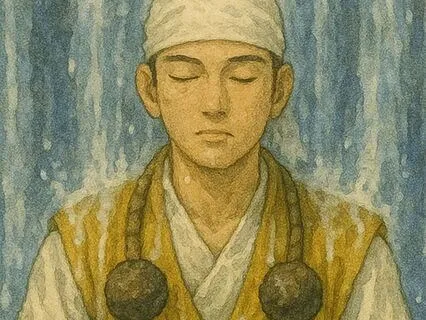
It is the practice of the Yamabushi,
Japanese mountain monks who spend their lives in nature seeking enlightenment and such a lifestyle seems almost magical today at a time when so many of us feel cut off,
Numb in our own skin,
Out of rhythm with the earth,
Unsure of who we really are.
Yes,
The path of the Yamabushi offers something radical,
A way to come back home to our true nature through the body,
Through the land,
Through lived experience.
So we're talking about Shugendo,
An ecocentric meditation framework.
Shugendo means the path of training and testing.
It's a syncretic spiritual path that blends Shinto,
The indigenous spiritual tradition of Japan,
With Taoist and esoteric Buddhist beliefs to create something wild and something elemental.
At the heart of Shugendo is a deep respect for nature.
Not nature as scenery but as something alive,
Not something pretty to walk through on a lovely summer's day but something with presence.
Every mountain has a spirit,
Every waterfall has its own energy,
The trees are watching,
The stones remember,
You're not alone in the forest because the forest is with you.
Such is the relationship between Yamabushi and nature and it isn't a gentle relationship.
In Shugendo,
Nature isn't there to soothe you,
It's there to challenge you,
To reflect your mind back at you.
That's why practitioners don't just go for a walk,
They undergo Nibyo Shogyo,
Which is a kind of pilgrimage as well as a confrontation with nature.
Let me paint you a picture.
You climb a sacred mountain,
Not to feel peaceful but to feel everything,
To be stripped of ego,
Of expectation,
Of the noise that's been living in your head so many years.
The mountain becomes your mirror and it doesn't lie.
You come down different,
Not because you've reached the top but because along the climb something broke open in you.
Because when you're out there,
There's nothing to distract you.
There's no phone,
There's no noise,
There's no one validating your progress,
Telling you you're doing well.
It's just your body,
Your breath,
The trail and every fear,
Every doubt,
Every old story you've been telling yourself,
It all comes up.
You can't hide from it.
The mountain reflects back who you are when there's nothing left to perform.
When you're tired,
When your legs are shaking,
When you're angry at the rain or the cold or at yourself,
That's when the mirror shows you not the curated version of you but the raw version,
The truth.
But it isn't cruel,
It's not punishing you,
It's honest.
The silence out there on the mountain is clean,
The kind of clean that scrapes you raw and somehow makes you feel more alive than you have ever felt before.
That is what Shigendo offers,
Not escape but revelation,
Not peace without pain but the kind of peace that comes after the breakdown.
That's why the mountain matters,
Not because it's tall or beautiful but because along that weary walk the mountain tells you the truth.
So let's talk about the practice because Shigendo isn't just philosophy,
It's something you do and it isn't soft,
It's not about getting cozy with your thoughts,
It's physical,
It's embodied,
It's confrontation in the best way.
One of the core practices is called Nibyu Shugyo,
That's the pilgrimage training.
You hike through the mountains but it's not sightseeing,
It's ritual movement.
Each step is a vow,
Each climb a kind of purification.
You're not trying to conquer the mountain,
You're letting it confront you.
You walk until your breath becomes a prayer,
Until the body becomes honest.
Then there's Tikigyo,
The waterfall practice.
This is where practitioners stand beneath freezing mountain water,
Letting it crash down on their heads and their bodies.
It's a form of discipline,
Yes,
But beyond that it's a way to dissolve.
You let the cold break your ego,
Your resistance,
Your thoughts.
The water strips you,
You meet yourself in the shock,
In the surrender.
And then there's chanting done in a rhythm with the body,
The breath and the landscape.
It's not just about sound,
It's about frequency.
You chant to harmonize yourself with the natural world,
To shift the nervous system out of fear or disconnection.
These are not the glossy mantras that you might hear on wellness playlists on Spotify.
No,
These chants are ancient,
Earthy,
They rumble through your ribs.
This is not a practice you do to feel good,
It is a practice you do to get real,
To become aligned,
To come down from your head and into your body,
Into the wild,
Into the truth.
And that's what I love about it.
Even if you never set foot on a sacred mountain in Japan,
The essence of Shujendo is still available to you.
So let's talk about how you can practice Shujendo without actually going to Mount Fuji.
So how can you practice the deep spiritual art of Shujendo?
Start by finding nature,
Even in its smallest forms,
A park,
A river trail,
A patch of trees in the city.
Go there with intention.
Don't bring your phone,
Bring presence.
Walk in silence,
Breathe in rhythm with your steps.
Notice everything,
The rustle of the leaves,
The sound of your own exhale,
The feel of sunlight through the branches.
You can also adapt Shujendo rituals such as Mizuji.
A cold shower in the morning can become a sacred practice if done with the right mindset.
Breathe deeply,
Let the discomfort wake you up.
Say a simple chant or affirmation with each breath.
Let the cold become your teacher.
And finally,
Set regular pilgrimages,
Long walks or hikes done with full attention.
No distractions,
Just you and the land.
When the walk becomes hard,
Stay with it.
Let it show you something inside.
That's the modern version of Shujendo.
Not escape,
But encounter.
Not comfort,
But contact.
And what should you expect?
Should you choose to embrace this more challenging form of meditative lifestyle?
When you walk your version of the mountain,
When you turn your cold shower into a ritual,
When you meet your own discomfort with devotion,
What happens then?
Well,
First your nervous system starts to recalibrate,
Not through avoidance,
Not through numbing,
But through honest exposure.
This kind of practice teaches you and your body that you can handle intensity.
That it doesn't need to shut down.
You don't need to stop every time something gets loud or something gets difficult or something gets uncomfortable or uncertain.
You will learn how to stay amongst the discomfort.
You'll stop outsourcing your calm to perfect environments or soothing playlists.
You will build it from within.
You'll learn that when the environment is uncomfortable,
You can still be at peace.
You'll also reconnect with nature.
Even if it's just a patch of sky between skyscrapers,
You begin to feel part of the world again.
Not like some anxious mind floating above your body,
But like an animal with its feet on the ground and breath in your lungs.
You feel alive.
And maybe most important,
You stop seeing discomfort as a sign that something is wrong.
You start seeing it as a threshold,
A place to listen deeper,
A place where transformation begins.
That's the real gift of this path.
Not bliss,
Not perfection,
But a kind of a rootedness that can carry you through anything.
If this spoke to something in you,
If you've been craving a practice that doesn't ask you to bypass the hard parts,
But to walk through them with faith,
Then try Shujendo.
Make it your own.
Choose something simple,
But something uncomfortable and do that uncomfortable thing in a peaceful way.
Then you train yourself not to be calm when everything's oh so pretty,
But to be calm amongst the grit of life.
I hope you've enjoyed this episode and this introduction to Shujendo meditation.
Please leave me a comment,
Like and subscribe.