Well,
Hello,
Paul Cullors here,
Greetings and welcome.
And the topic of today's contemplative meditation is going to be pranic breathing.
So the pranic breathing is really quite a beautiful practice in its simplicity and it's versatile and applicable to many different kinds of benefits and situations such as enhancing health,
Spiritual growth,
Calming and relaxing,
Energizing and more.
The pranic breathing is really a combination between the pranayama practices of the Indian yoga and some of the ideas in Chinese Qigong practice.
So as always,
I'd like us to take a seated position,
Nice and comfortable with your back straight,
Sitting on the floor or sitting in a chair with the chest a little bit up and the shoulders slightly back.
And we're going to begin just by relaxing,
Resting the face,
Relaxing the eyes,
Releasing tension in the jaw and generally releasing tension throughout the body.
So as in the previous meditations,
We just emphasize the exhalation a little bit to release residual tension in the body.
So then I'd like us to bring our attention to the breath and just notice the breath as we come more into the observer mind,
Be present-minded here and now and just watch the flow of breath in and the flow of breath out.
All right,
So now what I'd like to do next is just introduce the movements of the hands and the arms.
So I'd like us to just place the arms and hands round about the belly button level,
Maybe the solar plexus level,
With the palms up as if you were holding a basket.
Now when we breathe in,
We're going to be moving the hands and arms out to the sides and then at the top of the exhalation,
As we move towards the top of the exhalation,
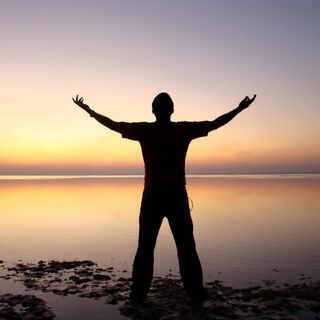
We're going to be lifting the arms up,
Raising the hands up and it's really important to lift the chest as well.
When you've finished your exhalation,
You reverse it and place the palms down like a big sweeping arc and breathe out.
And here the important key is to keep the chest lifted as long as possible.
So we breathe out,
Breathe out,
Breathe out with the chest lifted and then the very last part of the exhalation,
We're going to close the chest down.
So the importance of keeping the chest lifted as we exhale means that we can control the exhalation properly.
The inhalation is really an expanding movement from the belly to the middle floating ribs to the top chest as we breathe in.
So we feel an expansion in those three areas and then as we breathe out,
We keep the chest lifted,
Breathe out,
Breathe out,
Breathe out and the very last part we can close the chest down.
So let's put everything together a second time now.
As if you're holding a basket,
The palms up,
Hands comfortable in front of you,
Relaxed.
We want the arms and the body to be nice and relaxed and then a slow,
Smooth,
Steady inhalation,
Expanding the hands and the arms out to the side and then starting to lift the hands up above the head eventually,
Taking the chest with you,
Expanding the ribs and lifting the chest.
When you finish that long,
Slow,
Steady inhalation,
Then to reverse it,
Palms down and slow,
Steady exhalation all the way,
Keeping the chest lifted as long as possible until the last few moments when you come back to where you started.
And that is the essence of what we're going to do physically.
Keep it easy and comfortable,
No forcing,
Natural and keep the elbows and the wrists very relaxed.
You almost want a cooked spaghetti kind of feeling,
Very loose,
Very relaxed,
Very empty.
So there's a coordination that happens between the movement of the hands and the inhalation,
Arms and then a coordination of the descending of the hands and arms as we exhale.
What we do with our tension is also important.
So as I take that long,
Slow,
Smooth,
Steady inhalation,
I'm going to be moving my attention from below the feet down in the earth up through the legs,
Up through the body,
Up the top of the head,
Above the head,
Up into the sky a little bit.
And then as I do the exhalation,
I'm going to reverse that and take my attention down from the sky,
Above,
Through the top of the head,
Down through the body,
Down through the legs,
Back into the earth below.
So our attention forms something of a loop.
As we breathe in,
We loop up from the earth to the heavens.
And as we breathe out,
We loop down from the heavens through the body,
Back to the earth.
And this is a fantastic second step.
So we can try that a second time.
As we do a long,
Slow,
Smooth,
Steady inhalation,
Expanding the hands and arms out to the side and lifting up,
I move my attention from the earth up through the legs and the body,
Up the top of the head,
Into the heavens above.
And at the apex,
I reverse the hands facing down and breathe out,
Slow,
Smooth and steady,
Elbows slightly bent,
Wrists slightly bent,
Take the attention through the top of the head,
Through the body,
Legs and back into the earth.
This is pretty much the essence of the practice.
I would just say that we could add one small detail in,
That we can move our attention in a figure of eight,
Which is like an infinity sign.
And the point in between the upper and the lower lobes of that infinity sign,
Or the eight,
We can place in the body at the perineum.
Perineum is a meeting point for all the major meridians in the body,
The energy channels,
And is an extremely important energy center for the physical body.
So on that in-breath,
Long,
Slow,
Smooth and steady,
I'm going to loop down into the earth,
Up through the perineum point,
Right up to the skies.
And then on the exhalation,
I'm going to reverse it and come down in a loop through the top of the head,
Swapping over at the perineum point and looping down.
And looping down into the earth again,
And all the way back up to the perineum.
So we can actually begin and end the practice at the perineum.
And so this is the introduction to the pranic breathing.
Keep it simple,
Keep it easy,
Keep it comfortable,
No forcing.
And practice for at least 10 minutes in the morning,
And if possible,
10 minutes in the evening.
And try to do daily to establish the practice.
There are many applications ahead that we can use this for,
And we shall be doing so in further meditations and contemplations.
As a base practice,
It's an extremely healthy,
Energy enhancing,
Harmonizing practice,
Earth and heavens and man in the Jigong tradition.
I trust you've enjoyed,
Benefited,
And I wish you well.
Have a lovely day further,
And I look forward to continuing tomorrow.
Rich blessings,
Namaste.