Greetings,
Friends.
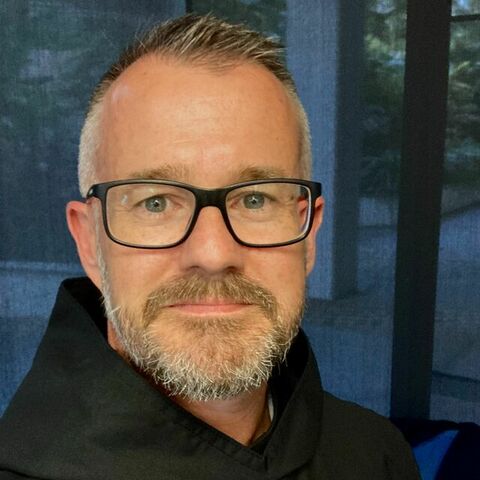
This is Mark Lardman,
Also known as Brother Frederick James,
Your friendly neighborhood monk in dogs.
Welcome to our ongoing series,
Abiding in Colossians,
As we consider the concept of abiding in Christ through the lens of Paul's letter to the church in Colossae.
So over the past few days,
We've seen our attention moving around and inward.
We began by noticing what's already growing within us,
And then we learned to value steadiness over pressure.
Then we widened that vision a bit to see reality held together from within.
We trusted that reconciliation runs deeper than fragmentation.
And then yesterday,
We arrived at that quiet but profound recognition that the mystery isn't distant.
It is within us,
Christ in you,
The hope of glory.
So today,
As we continue in Paul's letter and move into chapter two,
You'll see the language shift a little once more.
But today,
We're not going to go upward or outward or even further inward.
Now we're going to start a movement downward into the soil,
Into the roots.
So as we prepare to hear the words of Paul in Colossians chapter two,
I invite you just to make yourself still,
To breathe deeply in and out,
To allow your shoulders to soften,
Your jaw to unclench.
Let your body seep into the chair you're in or even feel the weight being held by the floor beneath you.
As we turn our attention through the ears of our heart to Colossians chapter two,
Verses one through verse seven.
Paul writes,
I'm saying this so that no one may deceive you with plausible arguments.
For though I am absent in body,
Yet I am with you in spirit and I rejoice to see your morale and the firmness of your faith in Christ.
As you therefore have received Christ Jesus the Lord,
Continue to live your lives in him,
Rooted and built up in him and established in the faith,
Just as you were taught,
Abounding in thanksgiving.
Now I love this as someone who works in spiritual formation and spiritual direction because Paul writes with words here that carry the feel of slow,
Steady formation.
He speaks of being rooted,
Built up and established.
And you'll notice that these words aren't words we usually associate with speed or urgency.
This isn't transformation that happens quick.
These are words of slow growth,
Steady,
Patient,
Deliberate growth.
And I'd like to think that these words matter more and are far more weightier than perhaps we give them credit for.
Because most of us have learned to live as though growth has to be fast in order for it to be meaningful.
We want quick results and visible progress and clear milestones.
If you're a teacher,
You'll know that in recent years more and more the students don't seem to want to learn as much as they want to know how to get the test passed.
How do I get the best grade?
Let's just get that,
Give me the bits I need to know and let's keep going forward.
We seem to imagine that transformation happens suddenly through breakthrough moments and decisive actions or dramatic change.
But Paul's language here of rootedness suggests something incredibly different.
Something that our modern world doesn't seem to go with really.
That growth is slow,
That it's often hidden,
That it goes unnoticed until much later.
Again,
If you think about the natural world,
You know that roots don't grow in the open air.
I mean,
We see them,
But predominantly the root systems are below the surface,
Completely out of sight and away from attention.
And yet it's those hidden roots that determine whether a tree is going to stand and live or if a tree might fall or die.
What we see above the ground,
The branches,
The leaves,
The fruit,
All those things depends entirely on what happens below ground.
When there's no roots,
The growth becomes fragile.
Anything that causes movement up above the surface can make the plant incredibly unstable.
Strength becomes very temporary when those roots aren't in place.
So Paul's invitation here isn't to make growth go faster,
But to see growth go deeper.
To allow life to sink downward before it stretches upward.
To trust formation.
Formation that is not immediately visible.
And I hope this speaks directly to a possible tension that you feel in your spiritual life.
Particularly if you feel like it's not going anywhere or that you haven't seen any progress.
We want to see it.
Progress,
Clarity,
Evidence that something's changing.
And when we don't see signs of that,
We think that there's something wrong.
We assume that we're failing or that growth has stopped.
But rootedness doesn't always feel like progress.
Sometimes it just feels like waiting.
Like remaining in place.
Like continuing without visible reward.
But quite possibly this is where the deepest formation occurs.
In those slow,
Hidden moments where everything's working beneath the surface.
Now Paul speaks here of being rooted in Christ.
So this isn't something that we do in a moment of decision.
This is a continuing and ongoing process.
Rootedness isn't achieved once and for all.
It deepens over time,
Layer by layer,
Season by season.
Not through pressure,
But through persistence.
Through remaining.
Through,
You guessed it,
Abiding.
And this is where the contrast between being rooted and being driven becomes very clear.
Because in the driven life,
We try and move things quickly.
But often everything's shallow.
We're always reacting or pursuing the next result and measuring success by the speed in which it's happened.
But a rooted life,
Well that moves differently.
It moves slowly,
Steadily,
Quietly and with patience.
And that's not because it lacks purpose at all,
But because it trusts the process of growth.
Being driven often produces exhaustion.
But being rooted produces endurance.
And maybe many of us recognize the difference.
We know what it feels like to be driven,
Pushed,
Moved on by expectation,
Responsibility or fear of falling behind.
Always moving,
Always striving.
But rootedness,
That feels different.
Rootedness feels stable and grounded and connected.
Less frantic,
Less hurried,
More at peace with the pace of growth.
And this passage we've read from Colossians today also speaks of being built up and established.
And these are building words,
They're architectural words,
Engineering words.
They suggest structure and foundation and strength over time.
Careful formation again.
And this is where trust becomes essential.
Trust in that slow growth and trusting that that slow growth isn't weak growth.
Trust that the unseen formation isn't wasted time,
But that stability is what matters here more than speed.
Because abiding,
Living with awareness of presence isn't dramatic.
It's steady.
It's persistent.
It's like roots moving through soil.
And maybe one of the greatest changes that we can make to our spiritual lives is to realize the need for visible progress.
To let that go.
And to trust that growth is happening even when we can't measure it,
When we can't see it,
When it feels slow.
So the invitation today is to settle downward.
To allow yourself to imagine roots.
Not reaching up,
But descending.
Not striving towards height,
But seeking depth.
At some point in your day today,
You might stop and picture roots extending downward from where you stand.
Quietly,
Patiently,
Finding their way through the soil.
Not forcing themselves down or rushing,
But just growing,
Deepening.
And with this picture,
Ask yourself the question,
Where in my life am I being invited to deepen rather than hurry?
Now this isn't a question of ceasing our growing or abandoning effort altogether.
But it's to trust the slow work of formation in our life.
To trust that depth is something that matters more than speed.
And to trust that the life that lasts is built beneath the surface long before it ever becomes visible above the ground.
Because abiding doesn't make us faster.
What it does is it makes us deeper.
By rooted presence.
Steady,
Grounded,
Established.
One layer at a time.
As we abide in Christ.
And may grace,
Peace and love be with you in that deepening today and every day.
Amen.
Until tomorrow my friend,
Peace be with you.