Hello friends,
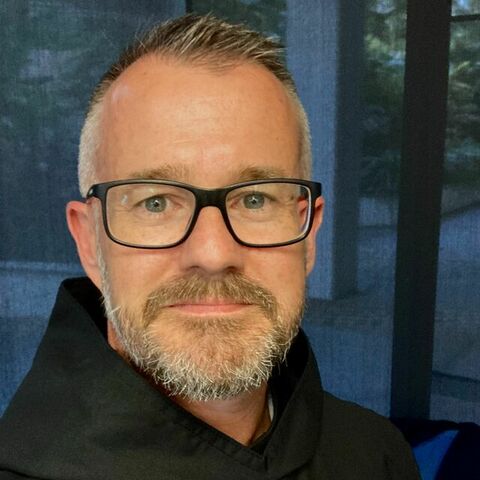
This is Mark Gladman,
Also known as Brother Frederick James,
Your friendly neighborhood monk in dogs.
Welcome.
To another installment of our series,
Look Again.
Now today,
We're going to continue on.
From what we were talking about yesterday when we were talking about the myth of having to find our purpose or vocation and make sure that that's all right before we can move forward.
So today we're going to challenge the idea of God's will.
As control.
So if vocation and purpose isn't about finding some sort of hidden blueprint and plan,
Then I'd like to suggest today that maybe God isn't standing over our lives with one set of perfect instructions.
Maybe God isn't trying to control our lives but trying to give it back to us.
So let's start with a question.
How much of your life do you think God is trying to control?
Or which bits,
Your job,
Your relationship,
Where you live,
What you eat,
What you wear,
The opportunities you accept or decline,
The words you say or not say,
The decisions that you make.
Because for a lot of us,
I think underneath that is a picture of God as some kind of divine manager.
And this God has a plan and knows the correct answers and knows where we should go and what we should do.
Our job is to figure that out.
And so we constantly ask,
God,
What do you want me to do?
Now,
There is nothing wrong.
With asking for guidance.
Please don't hear that,
But I think sometimes.
.
.
Beneath that question is something else.
And nets.
Fear.
Because I think when we ask that question,
God,
What do you want me to do?
What we're really asking sometimes is,
God,
Please tell me the right answer so I don't mess this up.
And so I think maybe we've confused being guided by God with being controlled by God,
And those are not the same.
The same thing.
To chew on this a little bit,
Let's go back to the story of creation.
God creates human beings,
And God gives them a script,
A detailed instruction manual,
And shows them what their perfectly mapped-out future looks like.
That's not the story,
Right?
That doesn't happen.
What God does is gives the first humans something much more,
I'll use the word,
Dangerous.
And that's freedom.
He gives the first humans capacity to choose,
To name,
To create,
To cultivate,
To participate.
And from the very beginning,
This freedom comes with risk.
We know that because we know the story.
Because.
.
.
Love without freedom.
Isn't love.
If I control you completely,
I might get obedience,
But I'm not going to get love.
Love requires the possibility of someone saying no.
And I think that's one of the most amazing things about God.
God seems willing to risk relationship.
Think about Jesus.
He calls people,
Invites people,
Teaches people.
Asks people questions,
But what should stun us as we read the text is the number of times where he lets people walk away.
Like the story of the rich young ruler.
At the end of that conversation.
About sell everything you have and follow me.
It says,
And the rich young ruler walked away.
And Jesus doesn't chase him down.
Because to chase him down.
.
.
Would override his freedom to walk away.
Have a look at the disciples,
They misunderstand Jesus repeatedly.
But Jesus doesn't program them or try to align their thinking.
He stays with them.
He teaches them.
He challenges them.
He invites them.
But they have to respond.
And I think that's closer.
To what God's will.
Is actually life.
It's not divine control,
It's divine invitation.
It's God.
Saying,
Come with me,
Not do this.
But come along with,
Follow me.
It's a very,
Very different image.
Control says there is only one acceptable outcome,
But love says hey.
Let's walk together and see what happens.
And if God was so controlling,
God would want certainty out of us.
It's relationship,
Right?
And relationship requires trust.
But I think that's why we.
.
.
Struggle with freedom.
Because freedom.
.
.
When you think about it,
Honestly,
Everyone says,
Oh,
Yes,
I want freedom.
But freedom is frightening.
It's much easier.
If someone tells us exactly what to do.
Because then if things go wrong,
I can blame someone else.
And we all know those people.
Who will have something in their head and they will go around to everybody else and ask them what they think.
They'll talk to experts,
They'll talk to friends,
They'll Google it.
Until they find someone who agrees with them so that then they can do it because they want something to blame if something goes belly up.
But true freedom.
Means taking responsibility and choosing and listening and paying attention and accepting that sometimes we are going to make mistakes.
And here's the thing.
What if God.
.
.
Isn't as fragile as we think God seems to be.
What do I mean by that?
Well,
Let me pose the question another way.
What if you can't accidentally destroy God's purposes because you took the wrong job in 2024?
Or made the wrong decision on who to be with when you were 26 years old.
You know,
What if you didn't permanently derail your destiny because you married the wrong person or moved to the wrong city or studied the wrong degree or.
.
.
Made a decision that you regret now.
Now,
Obviously our choices matter.
Some choices profoundly shape our lives.
They can cause pain.
Some choices do need repairing.
But I think there's a grace that's bigger than the idea that one wrong turn means you're finished.
Because if God can only work with you when you make perfect decisions,
Then none of us are in very good shape at all,
Are we?
But I'd like to suggest to you that even in the Ark of Scripture,
We see a very different story.
A God who keeps working with human beings who make absolutely terrible decisions.
Abraham,
Jacob,
Moses,
David,
Peter,
Paul.
Not as a pattern,
Are they all men?
Ladies?
But you see what I mean,
Right?
Over and over again,
These are people who get it wrong.
And over and over again.
The story keeps going.
God is not waiting for you to execute a flawless plan.
I think God knows that God's working with an actual human being,
You.
And you're here,
With your freedom,
And your limitations,
And your mistakes,
And your hopes,
And your.
.
.
Weirdly complicated history.
And that means.
That we really should stop imagining God's will as a single,
I mean,
It's like a tightrope stretched over our lives,
Is sometimes I think the illustration might be.
You know,
You're walking this tightrope of your life and wrong step it,
You know,
Miss,
Lose balance,
And that's it.
You fall and you miss God's plan.
I don't think it's like that at all.
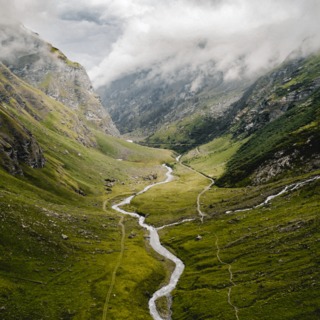
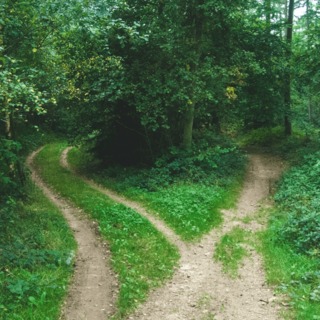
I think God's will is more like a beautiful landscape.
You go bushwalking,
For instance,
And there's lots of paths.
And some are going to be smart ones to take.
And some are going to be crazy ones to take.
And some are going to give you beauty.
And some are going to be hard and possibly some are going to be painful.
And you know what?
God can meet us on every single one of them.
And it doesn't mean that every path is equally good or equally easy.
It just means that God isn't absent from us.
Even if we're on the totally wrong path,
And even if we wander off the path and get lost.
In fact,
I think some of the most important things we ever learn happen because we took the wrong road.
Or wandered off the path altogether.
And be very careful listening to what I'm saying here.
This is not God causing everything.
God doesn't make everything.
Your path painful.
Please don't hear me saying that.
Not everything painful is in God's plan or anything like that.
But I will say this,
Nothing is wasted when it's placed in the hands of love.
God can work with the broken pieces.
God can work with the painful pieces.
God can meet you.
In the detour and can create something new from everything that we thought we'd absolutely messed up and ruined.
I think that's why Jesus asks questions all the time,
Like,
What do you want?
Who do you say I am?
What are you looking for?
Do you want to be made well?
All the questions that we chewed on.
A couple of series ago,
And if you haven't listened to those,
Go back and have a listen to that series about the questions Jesus asked.
And you'll see that there,
That Jesus doesn't walk up to someone and give them instructions.
He invites them into awareness.
I think that's because God didn't want humans to be like robots who receive divine commands.
And I think it's more about God trying to form us into the person who's capable of wisdom.
And there's a very,
Very important difference there.
A child needs to be told exactly what to do.
But maturity means learning how to discern,
How to recognize what's good and what's harmful,
How to listen,
How to love,
How to choose.
So I don't think spiritual maturity.
.
.
Is a case of becoming better at asking God to make every decision for you.
I think it's about becoming the kind of person who can make decisions with.
God.
So not independently,
But interdependently,
Collaboratively.
We don't ask God,
Tell me exactly what to do,
But we ask God,
Help me become wise enough to know how to love here or move here or act here.
In many ways,
To go back to that word I used before,
This is a much more dangerous prayer as well.
Because sometimes God's not going to give you an answer and will give you the responsibility.
And that's the gift.
If you can see it like that.
Your life.
Isn't happening.
While you're sitting around waiting for instructions,
Your life happens.
When you're participating in something,
When you get to create,
And choose,
And risk,
And begin,
And end,
And stay,
And leave,
And love,
And build,
And make mistakes,
And learn,
And begin again.
God!
Doesn't sit on the sidelines watching this grading you and ranking you and holding up a sign later that says 6.
5.
God is present in all of that.
With you in all of those actions but also inviting you,
Accompanying you.
Calling you gently towards life and towards love.
And towards freedom.
And I think that's part of what Jesus meant when he said,
I've come that they may have life.
You know,
This is not about having this life that's perfectly controlled.
Risk-free in any way,
No,
But life,
Abundant life.
An abundant life requires us to act,
To participate.
Next time you're facing a decision.
You don't need to ask the impossible question,
Which is God,
Which is the one perfect answer.
Instead ask the question,
What do I know?
What's wise here?
What's loving here?
What am I afraid of?
What would courage look like?
Who will this decision affect?
Where do I sense life?
And then make a decision.
Make it prayerfully.
And make it humbly.
And make it knowing that you may not get everything right.
But also know this,
That your life is not so fragile at one wrong decision.
Can place you beyond the reach of God.
Because grace.
And so,
Again,
I don't think God's standing there at some point,
Either immediately on the sidelines or at the end of the road or something,
Ready to ask,
Did you correctly guess the plan or not?
I think the question that is going to be asked is,
Did you learn how to love?
And did you learn how to live?
Because I think God's desire.
Is not to control every detail of your life.
But to set you free.
To become fully alive.
For as Jesus said,
The thief comes,
So steal,
To kill and destroy,
But I have come so you may have life.
And life in abundance.
All we need to do.
.
.
Is look again.
And may grace,
Peace and love be with you as you do today and always.
Till tomorrow,
Friends.
Peace.
Be with you.