Greetings friends,
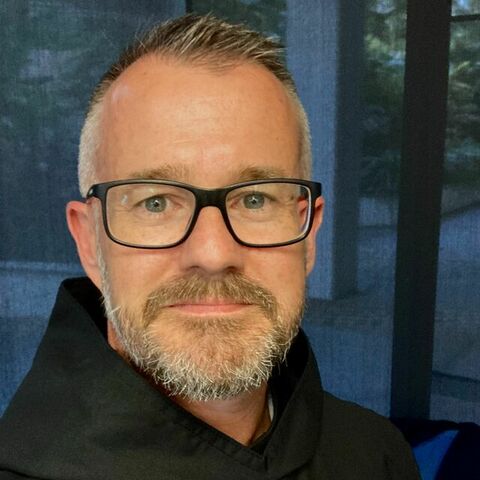
This is Mark Ludman,
Also known as Brother Frederick James,
Your friendly neighbourhood monk in docks.
Welcome back to the way home.
So far in our journey we've encountered people who have wandered,
The prodigal son left home,
The Lost sheep?
Became separated from the flock.
And the disciples on the road to Emmaus had walked away in disappointment.
Each time we've looked at these characters we've discovered something beautiful about the God who calls us home.
And today we meet,
Or for probably a lot of you,
Re-meet,
Peter.
Now,
Peter knows.
What it means to fail.
He knows what it means to break promises after he's made promises and he knows what it means to say I'll never leave you and then hours later.
Deny that he even knows who Jesus is.
And I'd like to think that for all Peter is,
Or all Peter didn't sort of measure up to be,
That's why.
.
.
His story is so important to us.
All of us know what it feels like to carry something that we wish we could undo,
Something we said,
A decision we made,
Something we messed up.
That moment when.
.
.
We weren't the person that we wanted to be.
And sometimes.
.
.
I think the hardest journey home is the journey back to ourselves,
After we've disappointed ourselves like that.
Today's story tells us that even in those moments,
God's waiting.
But rather than most of us think,
It's not God waiting to discipline us or shame us,
But to restore us.
So I invite you to settle into this time of prayer.
To still yourself,
To allow your mind.
And your heart and your body.
To be fully present and come into alignment together.
Take a slow deep breath in.
And out.
And to allow yourself to be fully and wholly here.
Let's pray together.
Jesus,
You know our failures.
You know the things we regret.
You know the moments when we have been less courageous or less loving or less faithful than we hope to be.
Meet us.
In those places.
Teach us that failure isn't the end of the story and help us discover,
As did Peter.
That your love meets us even on the other side of the worst moments we could imagine.
Amen.
Now the story we'll be focusing on today is one that I have done before,
Perhaps a number of times that you have heard,
But I want you to understand that one of the things that I do in the work that I do.
Is help people get deeper into the text and sometimes that means seeing similar texts over and over again.
And each time seeing it with fresh eyes and seeing something new.
That's therein.
That's what we're doing today.
With the Gospel of John Chapter 21.
Now it's a lengthy chapter.
So like we did with the Amaya story,
We will.
.
.
Truncate a little bit.
Please feel free to spend some time reflecting.
On John chapter 21.
Perhaps read it and come back again to the audio and listen through and see if it adds any more depth than I hope you find here.
So the story happens after the resurrection.
When Jesus appears to his disciples beside the Sea of Galilee.
They'd gone out fishing and caught nothing.
And at dawn,
A man stands on the shore.
They don't recognise him.
He tells them to cast their nets on the other side and suddenly the nets are filled with fish and That's when one of the disciples realizes it's the Lord,
And Peter is the first one to jump in the water and come ashore.
And that's when they see something that I don't think any of them were expecting.
There's a charcoal fire,
There's fish cooking and bread.
Jesus had prepared breakfast for them.
Then after they had eaten,
Jesus turns to Peter and he asks,
Simon,
Son of John,
Do you love me?
And Peter answers,
Yes,
Lord,
You know that I love you.
And then Jesus asks him again and again,
Three times,
And then Jesus says,
Follow me.
Now like I often say.
.
.
When a gospel writer puts something in the text,
It's probably there for a reason.
And so quite often we miss details that are there on purpose.
And this passage is one of those.
John tells us,
That Jesus has prepared a charcoal fire.
Now it's a very fine detail but it's not accidental.
The last time Peter stood beside a charcoal fire was on the night Jesus was arrested.
Peter stood there warming himself.
And that's where someone recognized him.
You're one of the disciples.
And Peter said,
No,
I'm not.
And then again,
You are one of them.
And again,
No I'm not.
And a third time,
You must be one of his disciples.
And Peter denied it again,
Three times.
Now,
After the resurrection,
Jesus creates another charcoal fire.
And he brings Peter back to the place of his deepest failure.
Now,
When you look at it like that,
You might think,
Well,
Was Jesus rubbing it in?
Well,
Hold on.
Because I think you'll see that what Jesus was doing here was something very different because this time Peter's not alone.
Next to the fire.
Jesus.
He's there with him this time.
Now maybe take a moment to think about your own charcoal fires,
The places where in your memory you still carry the warmth of regret.
Places you'd rather avoid,
Conversations,
Relationships,
Decisions,
A mistake,
Something you said,
Something you did,
Something you failed to do.
Maybe there's a moment that you still wish you could go back and change.
Allow that to just come into your mind for a moment and Acknowledge it there.
Now something important happens at the fire.
Jesus hasn't created a charcoal fire just so that Peter can get this knowledge again.
And then kick in by saying,
Now Peter,
We need to have a bit of a conversation about what went down.
What he's done on this fire.
Is cooked pita breakfast.
Now think about that for a moment.
Breakfast,
Bread,
Fish,
A fire,
A meal,
Company.
Jesus meets Peter?
Through hospitality.
And I think there's something important in that,
Before any conversation happens about Peter and what happened.
There's food.
This communion.
There's a meal.
Jesus knows that Peter doesn't need humiliation because he knows that Peter's carrying regret and shame enough.
He understands what Peter needs in this moment.
Is love and maybe today you need to hear that too.
You may have spent a great deal of your life trying to become better,
To overcome your weaknesses,
To correct your mistakes,
To prove that you're worthy of someone or of even God.
And maybe there's moments when Jesus simply wants to sit you down.
Stop.
And have you received to be fed?
Imagine yourself sitting beside that fire.
It's warm.
And Jesus passes you a plate.
And honored is the.
.
.
Some bread,
Some warm bread and some cooked fish.
There's no words,
No tests.
Just the presence of Jesus looking at you with love and maybe the only thing that's said with a smile is eat.
Let yourself be cared for.
Now we all know there were three questions.
That Jesus asks Peter,
Simon,
Son of John,
Do you love me?
Peter says,
Yes,
Lord,
You know that I love you.
And then again,
Do you love me?
And again,
Yes Lord,
You know that I love you.
And then a third time,
Do you love me?
Three questions,
Three answers,
Three opportunities to speak love,
Where three times a couple of nights ago,
Peter had spoken denial.
What's Jesus doing here?
Well,
I don't think what Jesus is doing.
He's trying to erase what happened.
He knows he can't.
But what he can do is transform it.
So he doesn't pretend the three denials happened.
He kind of acknowledges them here,
If you think carefully about it.
But he gives Peter three new opportunities,
Three new moments in which to say yes.
And I think this is a beautiful picture of what forgiveness often can look like.
When things have happened,
It's kind of silly to think that we can erase that,
To pretend that it never happened and that there's no wounds there anymore.
We can't rewrite history,
But.
.
.
We can allow love to enter the place.
Where the wound occurred.
And maybe there's places in your life where you need a new yes.
Maybe you once said yes to something and then you walked away.
Maybe you failed someone you loved.
Maybe you abandoned something important.
Maybe you stopped believing in yourself.
Maybe you stopped believing in God.
And maybe Jesus isn't asking you to undo the past and undo what happened because we know we can't do that.
It's unrealistic,
But maybe we can.
Jesus is asking,
Can you say yes now?
Yes to love.
Yes to beginning again.
Yes to forgiveness.
Yes to trust.
Yes to life.
So take a moment and imagine Jesus looking at you.
With love and hear the question.
Do you love me?
And don't be concerned about finding the perfect answer or even any answer.
Just notice what your heart wants to say and hear the depth in the heart of God in the question.
There's something else important about this conversation.
Jesus forgives Peter,
Yes,
But he also entrusts him with something.
Each time it's feed my sheep or feed my lambs.
So,
The person who has failed.
In Jesus' eyes,
Is still called.
This disciple who denied Jesus outright,
The one who was possibly one of the closest to him of at least three.
He's still given a mission.
So Peter's failure hasn't disqualified him at all.
In fact,
It might be the experience of failure.
That'll make him a more compassionate shepherd because Peter now knows what it means to need mercy.
He knows what it means to be restored.
And also to be loved when you've not lived up to your own expectations.
Sometimes the places where we've been broken become the places through which compassion can flow.
Folly is painful,
Yes,
But because grace can redeem us.
Even the things that we wish had never happened.
Something good can come.
And maybe this is the message you need to carry out of our time together today.
You're more than your worst moment.
You're more than the mistake you made,
More than the relationship that failed,
Or the opportunity that you missed,
Or the words you wish you'd never spoken.
More than the version of yourself you regret,
Your failure.
May be part of your story but it doesn't have to become the title of your story or the rest of your story.
Peter's story could have ended with denial,
But it didn't.
Because Jesus returned to him and called him forward.
Now come once again to the shore in your mind,
The fires burning,
The morning lights beginning to spread across the water.
The other disciples are nearby,
You're sitting with Jesus and he looks at you.
And he asks,
Do you love me?
And you answer,
And he asks again,
Do you love me?
And you answer.
And once more,
Do you love me?
New answer.
And now hear what comes next.
Jesus says,
Follow me.
It's an invitation to move forwards.
So Jesus doesn't leave Peter staring at the fire of his failure.
He invites him to step into a brand new future.
And maybe this is what coming home sometimes means.
It means allowing Jesus to meet us at the very place where we thought we'd lost our right to belong.
It means discovering that grace doesn't ask us to become innocent.
But it does ask us to become available.
Available to love,
And to serve,
And to begin again.
Jesus.
Knows that Peter couldn't go back and change the night that he denied him.
And Jesus knows that neither can we change everything.
In our past,
But we can decide what happens next.
We can allow grace to write another chapter.
We can return.
We can say yes.
And we can follow.
So as we prepare to finish,
Just bring to mind.
.
.
One thing you regret.
Hold it gently.
And now imagine placing it beside the fire.
Don't pretend it never happened.
But just place it there.
And hear God say to your heart.
I know.
I know what happened.
I know why you're hurting.
I know the person you wish you had been.
And I still love you.
And then hear the final invitation.
After all of this,
The look of love and the words,
Follow me.
Take a slow breath in.
And their art.
Friend,
You don't have to go back and become the person you were before you failed.
You can go forward as the person that grace is making you now.
And so we pray.
God,
Meet us beside the fires of our regret.
Where we've denied,
Restore us.
Where we've failed,
Forgive us.
Where we've lost faith in ourselves,
Remind us that you have not lost faith in us.
Give us the courage to receive your mercy.
The humility to begin again.
And when you ask,
Do you love me?
Teach us to say yes.
And then give us the courage to hear what comes next.
Follow me.
And may grace,
Peace and love hold us,
Restore us and carry us forward today and always.
Thank you for being with me today.
In this episode of The Y Harm.
Remember that your failure may be part of your story,
But it doesn't have to be the end of your story.
The God who meets you at the place of your greatest regret is also the God who stands ready to lead you into your next beginning.
The way home is sometimes a road of forgiveness,
And sometimes it begins beside a fire,
With breakfast,
And the discovery that you are still loved.
Until tomorrow.
Bye for now.