Hello friends,
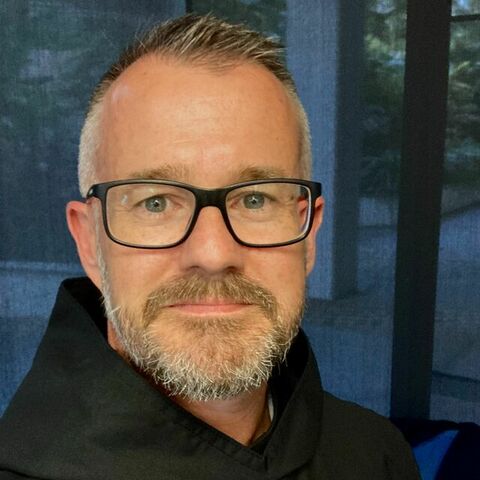
This is Mark Gladman,
Also known as Brother Frederick James,
Your friendly neighbourhood monk in dogs.
Welcome to day one of our series,
God Is.
As we begin to both define and undefine.
How we understand what God may or may not be.
It's important that we bring ourselves fully into this moment and allow ourselves to be open.
To new ideas and possibilities beyond the walls that we've put up often around our definitions and understandings of God.
So let's start just by stilling ourself,
Becoming fully present in this moment.
Feel the weight of your body on the chair,
Your feet,
On the ground.
Be aware of your presence in your physical space.
Take a nice deep breath in.
And out.
And as your breathing settles.
We ask the Spirit to open our minds,
Our ears and our hearts today.
Because we're gonna start in a bit of a weird place.
As we begin a series about.
Today I want us to contemplate the idea that God is not God.
A thing which.
.
.
To some may sound almost heretical.
Because if God's not a thing.
.
.
Then what is God,
Right?
But let's sit with this question for a moment,
Because I think we often begin our thinking about God with the assumption Well,
It's an assumption we don't really realise we're making.
It goes a bit like this,
There's a universe,
There's stars and planets and trees and people and animals and atoms and galaxies and somewhere in all of that,
And maybe beyond it,
There's God.
In other words,
God is another reality.
A bigger reality,
An invisible reality.
A supernatural reality?
It's a reality we can't see.
But it's a reality that exists alongside all the things we can see,
All the other realities.
So then we imagine God as being.
A bit like the biggest,
Most powerful.
Even imaginable.
Of all those things.
Except today I'm going to suggest to you that that's not really God.
That's just a very big thing.
And I'm wondering whether God is not.
A very big thing.
And here's the problem with making God the biggest thing.
Imagine the universe is a big room and there's objects everywhere,
Chairs,
Tables,
People.
You know,
You've got windows and then you've got the galaxy and electrons and thoughts and mountains.
And then in the corner we put God,
Except God is invisible and much,
Much bigger than everything else.
God may even fill the whole room.
But God is still in the room and that's the problem.
We've made God into an object,
A supernatural object maybe,
But still an object.
Something that exists alongside everything else.
And the problem with that is that if God is just another being.
.
.
Then God needs an explanation as well.
Where did this being come from?
Why does this being exist?
What makes God,
God?
And all of a sudden we've got a bigger version of the same problem we started with.
And then in the Christian tradition.
There's a stranger idea.
That God isn't just one more thing that exists.
God is the reason anything exists at all.
And this is where theology,
Our understanding of God,
Can start to sound a little bit abstract,
But stay with me.
Imagine for a moment that absolutely everything disappeared,
That suddenly there were no stars or planets or trees or people or atoms or space or time or universe,
Just nothing.
What would be left.
Because if God were just another object within reality,
The answer would be nothing.
God would disappear along with everything else.
But if God is the source of being itself.
That's different.
Because then God isn't one thing among other things.
But God's the mystery.
Upon which every other thing depends,
Which means that God isn't somewhere.
God is the reason there is.
Are somewhere.
God isn't alive.
God's the reason there is life.
God isn't present with us,
But God is the ground of presence itself,
And suddenly where is God?
Becomes a very different question.
And this is why the Christian mystical tradition can speak about God in Weird Ways.
Augustine speaks about God as closer than we are to ourselves.
Paul,
Standing in Athens,
Said of God,
In God we live and move and have our being.
And that's a really interesting thought to hold.
In Him we live.
God as the reality within which we already exist.
Which means that the spiritual life.
.
.
Is about waking up to the God in whom we already are.
But we've got to be careful if God's present in everything.
It can be really all and everything is God,
But that's not quite what I'm talking about here.
The tree.
You,
The ocean,
The universe,
None of that is God,
Yet none of those things exist independently.
Of God.
So there is a distinction between God and creation.
But there's not necessarily a separation between God and creation in the way that we imagine it.
Creation is radically,
Radically dependent.
Upon God.
Held in being,
Received.
Gift.
This is one of those places where Christianity becomes both more mysterious and more beautiful when we stop imagining God as a supernatural person floating somewhere above the clouds.
And then.
.
.
Well,
This is why the Christian claim about Jesus is so extraordinary,
Because if God's not a thing somewhere else.
.
.
But the very source and ground of reality.
Then what does that mean when Christians say,
The word became?
Flesh?
What does it mean for the source of all being to enter being in such a radically particular way with a body and a voice?
In a village.
With a mother.
And gathered around other people at a particular time.
Jesus.
It doesn't take us away from the physical world,
But takes us deeper into it.
Bread.
Wine.
Water,
Mud,
Touch,
Tears,
Sweat,
Laughter,
Death,
Resurrection.
And so the Christian God is revealed within creation.
And I think that's one of the first things we need to relearn.
Contrary to how many people understand it,
Matter.
Is not the opposite of God.
Ordinary isn't the opposite of sacred.
Your body isn't the opposite of spirit.
The world isn't somewhere God has abandoned.
The world exists in God.
And you might ask,
Well,
So what?
If this is even remotely true,
It changes prayer,
For instance.
Prayer isn't sending a message to a distant deity,
But.
.
.
Prayer becomes about attention.
Kind of awareness.
And awakening.
It changes spirituality.
Because if God isn't hidden.
.
.
And gone hasn't gone away.
Then the truth is we've forgotten how to see.
It also changes how we encounter other people because the person in front of me.
Isn't standing outside of God,
They exist within the mystery of God,
Just like I do.
It also adjusts how we encounter creation.
Sure,
A tree's not divine,
But.
.
.
Maybe it's impossible to encounter a tree without encountering something that exists because of God.
And is also within God's sustaining presence.
It also changes how we encounter ourselves.
Because you don't have to manufacture and drum up God's presence in your life.
You don't have to convince God to come closer.
You don't have to make yourself worthy enough.
God is already here,
Friends.
Which means.
.
.
That the first movement,
The first prayer of the spiritual life isn't God please come but God please help me notice.
So today.
.
.
Don't try to find God.
Instead,
Find yourself some time to sit somewhere ordinary,
Look around you and ask the question,
What would change if I stopped imagining God as somewhere else?
What would change if suddenly God weren't an object somewhere else in space and time?
But was space and time itself.
As the theologian Paul Tillich put it,
That God was the ground of all beings.
God is not a thing.
But God is the mystery in whom all things live.
And I think that's a much more beautiful place for us to begin.
And so my grace,
Peace and love be with us as we sit with these questions today.
Until tomorrow friends,
Grace and peace be with you.