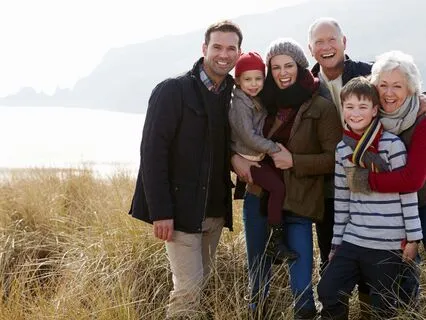
Family of origin.
It seems to be something that's relevant for all of us no matter what age.
We still have some energy around our family of origin.
So I thought today we could look at some of the conditioning that happens and some of the ways that we might be troubled or still feeling the effect of childhood.
As we're doing this,
Just to remain aware of your body,
Your breath.
There's really no right or wrong answers in an inquiry.
Some of the ways that we feel so much satisfaction and joy in life is through relationships and it's also the source of great harm and great distress.
I always find that getting specific is helpful.
So today we start with families of origin.
Some of the families that were around when I was growing up.
If you're younger,
You probably won't remember some of them.
It's a Brady bunch.
We have happy days with the Fonz,
The Fresh Prince of Bel-Air.
More recently,
This is us,
The family at Schitt's Creek,
Kilmore Girls.
The point that I'm bringing up here though is that we have a feeling like we're part of these families and it's a little bit different now that we can binge watch them on Netflix,
But that actually might make it even more compelling.
We have these ideas about what's a family like and it might be that your family was more like the Adams family than the Partridge family.
The Partridge family,
This idealized version of this happy middle-class family where everybody's in a certain amount of challenges,
But basically the family unit comes together.
We have some from the 50s and 60s,
Father knows best.
Modern family,
We're starting to see a few queer characters come in.
The Fosters,
Two lesbian parents of foster kids.
TV families set the tone for what's ideal,
But also it reflects the change in composition of our families.
All in the Family with Archie Bunker,
It shows push against conditioning and let us see our conditioning.
What was your situation with your family?
Was it reflected on TV?
Was it reflected in popular culture when you were growing up or in your earlier adult years?
That has a big impact on how we feel about being normal.
Heteronormativity is so strong.
Two parents,
A mom and a dad,
2.
1 kids.
We just feel like there's something wrong with this if we don't fit in with that.
Heartland is a TV show about a ranch family filmed in a place where I used to live in southern Alberta.
Especially after I moved from Alberta to Nova Scotia,
I would turn it on and I would be eating my meal while they were eating a meal.
There's something seductive about that.
It feels like you're part of the family.
I'm not saying that that's wrong.
I'm just pointing out that that is.
When we connect with these families,
It's a safe environment for us to experience frustration that they feel and it always has a happy ending.
They always come back into connection even when something difficult happens.
And that is not something that happens in all of our lives,
In our real personal life.
Conditioning is in our animal body,
Our mammal body.
It's in our predictive brain,
Our nervous system.
It's our ideas about what should be and what's normal and what's right.
It operates below our conscious awareness.
So a lot of the times if conditioning is working well,
We don't even realize that we have it.
Conditioning around parents.
The husband,
Dad,
Protector,
Hero is the male ideal.
The mother is your first friend,
Your best friend,
Your forever friend is the ideal.
Was that your situation?
It wasn't mine.
Let's sit with that for a bit.
What was your conditioning around what the family should be?
And what was the actual situation in your family?
And then how did you explain that to yourself?
We'll take a moment here so you can kind of sink into that.
What was your experience?
I think for most of us,
We could say either not at all or mostly not.
Some people are going to say,
Well,
You know,
It was pretty close,
But it's never that idealized version.
That's actually not how relationships work.
And how did you explain that to yourself?
And if you think back,
Were you aware that your family wasn't the same as what you were seeing on TV?
Or maybe it wasn't the same as your friends' families.
Maybe it was very much like your families.
What was your experience of that when you were in grade school,
Like grade two or three or something?
Because before we go to school,
We don't really know that there's anything else possible.
Or before we start to see that on TV.
What was it like for you early in grade school?
What was it like later on,
Maybe as you're a teenager?
And when did you become aware that your experience didn't match what it was supposed to be?
So when I was a teenager,
I felt very isolated,
Like I was completely on my own.
I couldn't take any problems I had to my parents.
And I didn't know that everybody didn't feel that way.
That was my experience.
And I just thought everybody was like that.
So I didn't realize that was a problem until much later.
That's not how everybody felt.
They felt known by their parents.
They felt they could take what was going on to their parents and get some support.
At least some people did.
I think it's helpful for us to know who we were influenced by and what kind of ideas there were there.
And almost all the shows were white families until a bit later.
Let's move into some inquiry.
Our conditioned beliefs.
If you had an experience with neglect or abuse in your family,
You might have included that there was something wrong with you.
You were in that situation.
Many times children internalize the belief that bad things happen to us because we're bad.
If your family looks pretty normal,
And everybody else seemed happy,
But you didn't feel happy.
Again,
We probably internalize that as it's my fault.
I didn't fit in because there's something wrong with me.
Especially if you're in a family of high achievers,
And you weren't.
Many of us felt ashamed and powerless and really alone.
So whatever your conditioned beliefs are that are coming to mind now,
See them as beliefs.
If we had even one person,
A grandparent,
A teacher,
A neighbor's parent,
Who wasn't like that with us,
Who did see us,
Or who did see our value,
Then that made a huge difference.
It opened up this possibility.
Although the conditioning was probably still pretty strong.
When you're looking at those beliefs,
There's something wrong with me.
If it's helpful,
Put the words up onto the wall on the other side of the room.
Just have a look at those words.
There's something wrong with me.
Or what would those words be for you?
I don't fit in.
I'm bad.
And as you're looking at the words,
Notice there's something going on in our body.
We have a response to those words.
So you might notice the sensations and energy in your body.
You might have started holding your breath.
So we could take a deeper breath.
And when we put those words over there,
Or maybe it's an image that represents that for you,
We can notice that that is a thought that I'm having.
So this is part of the way we heal through this inquiry.
We notice what is the image or the words and that is over there on the wall.
Our brain is looking at it.
And then we can put a frame around it.
And then we can see there's space on the outside of the frame.
There's space between me and the frame.
Even if it doesn't feel supercharged for you right now,
See if you could come up with some words,
Put those into the frame.
And look at them.
Notice the sensation in your body.
I've got some going on in my heart area.
Take a breath.
And then take your eyes around the empty space on the outside.
But take your eyes physically around the empty space.
A couple of times in one direction,
A couple of times in the other direction.
And then look back into the frame.
Notice what you feel like in your body now,
If it's the same,
If it's different.
So it might bring up really specific,
Like shame associated with not having a father when it's presented as the norm.
Some of our situations were very difficult.
As you're looking at those words,
Let's see how we could come to some freedom from that conditioning.
Reverse inquiry is where we say something that we wish was true and it's not completely true.
And the reason we say that is to elicit what are the arguments against that?
What are the unconscious beliefs that are still holding on around that?
A reverse inquiry might be,
I am free from shame and conditioning around my childhood family.
Let those words drop in.
I'm free from conditioning and shame around my childhood family.
That's probably not completely true for anybody.
It's probably partly true.
All of us here are doing work on ourselves.
Take a few breaths.
My parents and society,
Either way,
We were fed this idealized version that wasn't true.
My parents and society,
Not me,
Were responsible for my childhood family life and for this conditioning that I've been brought up with.
And that might elicit that belief that children have that whatever's going on is our fault.
We can't afford to see that it's not us because that takes away any possibility that we could change it.
As adults,
Often we can look back and say,
You know,
I can see my parents were really struggling.
There was addiction,
There was financial pressure,
There was mental illness,
There was all kinds of things going on.
For me,
My mother hated me.
She hated me.
She hated being trapped in the house as a housewife.
And she treated us as well as she could,
But she wasn't happy.
All of these different things that we take on as,
Well,
If my parents don't love me,
If they don't want to know who I am,
I must not be worthy.
There must be something wrong with me.
When we say something that my parents and society,
Not me,
Were responsible for the conditions of my childhood and my family life.
You might run into a,
Well,
That's not true.
There's something wrong with me.
And then let's look into how you know that.
How do you know there's something wrong with you?
Might be,
Well,
I'm a failure.
I should have been smarter.
I was always fighting against whatever was going on.
I should have just shut up.
What are those beliefs?
That's how we might bring forward.
What was it that was actually,
Or that is actually now keeping us stuck in this?
The things we learn in childhood tend to stick.
One of the things about doing these is that we can always come back to it.
Something really went,
Whoa,
Yeah,
I can see I'm still,
There's something in me that still believes that.
Then that might be helpful to do a little bit more inquiry around.
Take another couple of minutes now.
What feels unfinished?
Yeah,
I can see that I still have some feeling around that.
And then if you were to think about someone else in your life who might have a similar belief,
Do you feel the same way about them?
If you have a child or a friend or somebody who you know has some of those similar beliefs,
And you were sitting down with them and they said,
You know,
What happened to me was my fault.
I should have been better.
I was a bad kid.
What would you say to that person?
And then say it in your mind.
Well,
That's not true.
I can see the goodness in you.
You were in a difficult situation where you were being neglected or abused,
Where you didn't feel like you were part of your family.
I feel so much compassion for you.
What a difficult situation that was to be living in.
And let yourself feel that.
If that is what you would say to that other person,
This person who you love and respect and value,
See if you could listen to that in your own heart as well.
Yes,
I had a difficult time as a child.
I don't have to blame my parents.
Maybe they were really having a struggle as well.
As an adult,
We can get to the point where we can be more clear,
Perhaps,
About what happened.
And we can come into this compassionate relationship with ourselves.
We can see,
I hardened up against myself because I didn't know that I was okay.
I didn't know that it wasn't my fault.
I didn't know that so many other people had similar experiences.
When we have unsafe people around us or when we don't fit the norm,
There's a lot of assumptions that everybody's heterosexual.
Everybody is comfortable with the gender they were assigned.
Everybody should be athletic and intelligent and outgoing.
Everybody should be.
There's so many ways that we're shamed and pressured in our society and in our families.
And then it carries forward into our life as an adult.
That's what we're trying to see.
What is it that's lingering?
So let's just let some positive thoughts come in.
You could say that to your younger self,
If you have a sense of an age of your younger self who would really need to hear this.
I was not bad then and I'm not bad now.
I know my own basic goodness.
We might have some habits or survival responses that we did that seemed to make things more intense or made it worse.
And that does not mean anything about our own basic goodness.
It just means that we had some responses that we were doing to try to make it through okay.
For me,
When I look back at my teen years,
It was pretty chaotic.
There was a lot of drugs,
And different ways I was trying to make it through.
And that's not who I am.
Those are some actions that I took for survival.
As we're just finishing off this inquiry,
I know my own basic goodness.
Let yourself feel that.
Offer yourself your kindness,
Your respect,
Your attention.
And there might be a lot of grief that comes up or anger.
That should not have been the way it was.
And yet it was.
So we can't give people a free pass.
And we also can't hold people to a standard of care and attention that they weren't capable of.
And it doesn't mean anything about I have to have them in my life.
I have to forgive them.
I'm not a fan of forgiveness,
Actually.
I'm more of a fan of,
Let's look at this and see if we can come to a better understanding and come to more kindness for ourselves.
And from that,
All kinds of things might flow.
We might set really strong boundaries.
It might result.
We don't have to plan that ahead.
The most important part is to bring ourselves into our own heart and to really see I am worthy.
I don't have to stand on my head to be included in my own heart.
This takes courage to do a practice like this.
Let it settle.
Notice what you feel.
Let yourself be kind.