Hi,
And welcome to this diaphragmatic breathing practice.
In this practice,
We will learn how to improve the way we breathe on a daily basis,
And at the same time calm our nervous system.
If you have done my previous breath awareness practice,
Maybe have become more familiar with your day-to-day breathing pattern,
You can now start to correct any dysfunctional breathing habits.
One of those being breathing into your chest rather than into your belly.
We want to be engaging the diaphragm,
Which is the primary breathing muscle located just below the lungs when we breathe.
This will not only stimulate your vagus nerve,
Which activates the relaxation response of your nervous system,
But it will also reduce anxiety,
Lower your heart rate,
Blood pressure,
Your spinal stabilisation,
As well as oxygen uptake in the blood.
So let's get started with the practice.
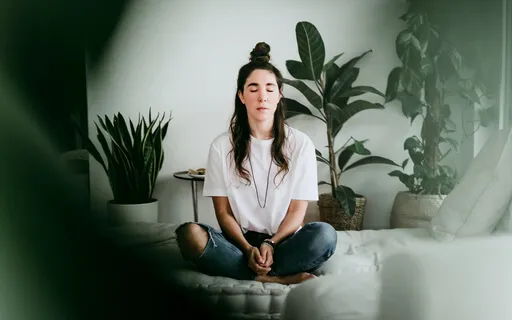
You can find a comfortable place to sit,
Making sure that your spine is straight,
That you lower your shoulders,
Relaxing your jaw,
Your forehead,
Starting with a deep breath in through your nose,
Holding at the top,
And then releasing with a sigh out of your mouth.
Do this two more times,
Breathing in through your nose,
Holding at the top,
And then releasing,
Breathing in,
Holding.
And now start tuning your attention inwards,
Scanning your body for any physical tension,
Any emotions,
Heaviness,
Pulling,
Pushing,
Discomfort,
Noticing whether your mind is busy or still.
Now you can bring your attention to your breath without changing anything yet.
Just noticing how you're breathing in this moment.
Seeing what is moving as you breathe,
Maybe your belly,
Maybe your chest.
Are you breathing fast?
Are you breathing slow?
Maybe feeling the air at your nostrils.
And if you want to,
You can now place your hands on your belly.
Maybe your palms are making contact with your lower ribs.
And beginning now to really send your breath as you breathe down into your belly.
So we're inhaling,
Exhaling all through the nose.
And as we inhale,
We want to really feel our belly expanding,
The diaphragm moving down,
Ribs coming out.
And as we exhale,
The belly comes back in.
And we keep that going,
Breathing in,
Belly expands,
Breathing out,
Belly moves back in.
Feeling the movement of your belly against your hands,
The movement of your lower ribs moving out and moving back in.
Always breathing in and out through the nose,
Breathing calmly and really sending the breath down deep into the belly.
There might also be movement in your chest,
But the movement originates in your belly.
Breathing in,
Belly expands,
And breathing out,
Belly contracts.
And as you breathe deep into your belly,
You are sending signals to your body,
To your brain that you can relax,
That you can rest.
With each breath into your belly,
You're activating the vagus nerve,
Which is responsible for that relaxation response,
The moving into the parasympathetic nervous system.
Keep sending the breath down into the belly and feeling that expansion with the inhale,
Belly expands,
Ribs expand.
And then as you exhale,
Everything moves back in.
Breathing in,
Everything moves out,
Breathing out,
Everything moves back in.
Breathing in and out of your nose,
Sending the breath right down.
Breathing calmly,
Breathing effortlessly.
Breathing deeply into the belly,
Using your diaphragm to breathe.
Having more space in your lungs and improving your respiratory capacity.
Inhaling,
Belly expands.
Breathing barely moves back in.
And now you can come back to a natural breath,
Still breathing through your nose,
But letting your breath do whatever it wants.
And just noticing how you feel,
Noticing if anything has shifted for you.
Maybe you feel a little calmer,
A little more spacious inside.
And slowly bringing your attention back into the room.
Taking a inhale through your nose,
Holding at the top and releasing.
Slowly bringing your attention back into the room.
And whenever you're ready,
Opening your eyes.
Thank you so much for joining me.
Keep coming back to your breath.
And I hope to breathe with you again soon.