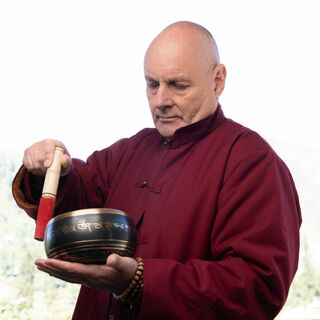
This episode is called Buddha's Last Words and it's the final part of the Buddha Dharma series.
All compounded things in the world are changeable.
They're not lasting.
Work hard to gain your own liberation.
Practice diligently.
These are Buddha's last words and the first part reminds us that all compounded things are impermanent.
If we keep this in mind,
We'll not get attached to things,
Which in turn will help to reduce our suffering and the suffering of others around us.
The second part,
Which for me is the most interesting,
Says we should work towards our own liberation.
Here the word liberation means an end to our suffering.
This means we have to look within,
Take responsibility for our own actions and do the hard work ourselves.
It doesn't say liberation can be found outside of us,
So we shouldn't blame karma for what is happening in our lives or hand our liberation over to some guru.
I believe we need teachers to help us along the path,
But ultimately we have to decide ourselves what path suits us best and which parts of Buddhism we decide to follow.
It doesn't mean we have to take on other people's culture or superstitions.
We also must decide how much time we devote to that path.
The ball is in our court and absolutely no one can end their suffering but ourselves.
The final part says that we should practice diligently.
It's a very little benefit to simply understand Buddha's teachings intellectually.
They have to be practiced with great effort.
We have to firstly understand the power of the three poisons,
That is clinging desire,
Aversion and attachment and delusion.
Then we need to ensure our minds are not clouded by these three poisons.
That's our starting point and something we need to be aware of throughout this path.
We need to fully understand the four noble truths and implement them into our lives.
This is a lifetime's work and not something to be taken lightly.
The eightfold path,
Which is the fourth of the truths,
Is something we need to constantly ensure we are following.
Meditation is an extremely important part of Buddhism and I would encourage you to learn and practice each day.
Mindfulness is also important.
Even though the word has been totally misused of late,
The four foundations of mindfulness are important to understand and practice.
There are many things in our lives that can bring us suffering and Buddha pinpointed eight of them in the teaching called the Eight Wordly Concerns.
Again,
It's important to ensure we're not being led astray by these concerns.
Compassion is important in all religions and Buddhism is no exception,
But Buddhism does not just talk about that.
In the four immeasurables,
Buddha spoke about equanimity,
Kind-heartedness,
Compassion,
And open-hearted joy.
All of these help us break down the barriers we erect between different types of people.
One of the most difficult to understand,
But without doubt,
One of the most important,
Is the concept of non-self.
We spend so much of our time building our identities,
So find it difficult to appreciate that there is no solid,
Permanent,
And independent self.
I would encourage you to visit this teaching regularly so you can slowly understand its importance.
I wish you all the best on your Buddhist journey and I really hope that these 14 teachings have helped you in some small way.
I'll leave the last word to Buddha.
I say to you that these teachings of which I have direct knowledge and which I have made known to you,
These you should thoroughly learn,
Cultivate,
Develop,
And frequently practice that the life of purity may be established and may long endure for the welfare and happiness of the multitude,
Out of compassion for the world,
For the benefit,
Well-being,
And happiness of all beings.