Hey,
This is Colin from the Bell Center,
And today we're going to bring the focus of our meditation into the body.
So,
Of course,
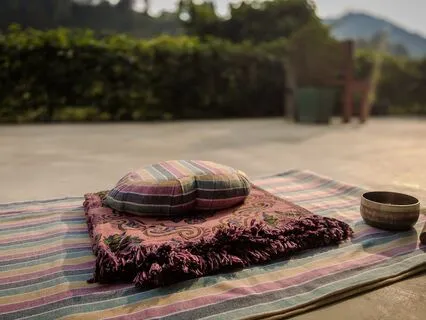
Beginning by setting up our mindful seat,
First part of bodily awareness is knowing how and where you're sitting in space.
So just checking in with the parts of the body,
Maybe starting down with the feet,
Feeling them grounded in the floor or on the leg,
However you have them set up.
Feeling the knees being a bit lower than the hips,
And then just working your awareness up the body,
Making sure the shoulders are relaxed,
Making sure the spine is extended,
And then bringing our way into stillness,
Getting any last adjustments out of the way and finding stillness.
Now,
The body is such a beautiful object of meditation because there's so much going on.
We have so many nerves,
All connected through our nervous system,
Our brain down into our spine and all of our extremities,
And they're constantly giving us signals,
Internal and external,
Little things that we can feel.
You probably notice this,
And our object for this meditation is to just tune in on a little bit of a deeper level to those physical sensations that are always there,
Always changing,
Just allow our awareness to rest,
Allow ourselves to become the observer.
So we're gonna start by doing what we call a body scan.
It's a very simple process of moving the awareness across the body.
You can almost think of it as like the awareness is kind of a laser scanning through the body.
And as we do this,
We're just going to notice whatever we notice in terms of physical sensation.
So we'll start up at the top of the head.
You're just gonna very slowly start to work your way down,
Maybe coming down across the face,
Into the neck,
And the shoulders,
Forward in the chest,
And then to the upper back,
Lower back,
Around to the abdomen region,
Into the hips,
Down lower into the legs,
The knees,
And coming all the way down to the feet.
Very good.
So once again,
This is a relatively quick body scan.
We're trying first,
And as you do this,
I just want you to notice what's there.
Try not to move.
Try not to think about,
Oh,
I feel sore here,
Or where's this sensation coming from.
The whole point here is we're trying not to react.
We're trying just to notice what's there.
So let's try it again,
Starting up at the top of the head,
Maybe a tiny bit slower this time,
Going down through the front of the face,
Feeling into the eye sockets,
Down to the nose area,
The ears,
The lips,
Front of the neck,
Back of the neck,
Shoulders.
Maybe just taking a moment here to circle your awareness around the shoulders here,
From the collarbone in the front around to the edge and to the upper back.
Usually,
We can detect decent amount of sensation here in the shoulders.
We tend to hold a lot of tension,
Not worrying too much.
Whatever you come across in your investigation,
You're just watching.
And then slowly bringing it down to the abdominal region,
Stomach,
Maybe pausing here for a moment and noticing how the breath causes the stomach to rise and fall.
Maybe noticing the lower back.
Can you feel the breath in the lower back as well?
Good.
And then coming down into the hips,
Another place we love to store tension,
Not worrying about anything you feel there,
Just allowing it to be.
And then coming down lower into the legs,
Knees,
Calves,
And then down to the feet.
And we'll stay on the feet for a moment.
You're going to start on the left side of your left foot and see if you can count your toes,
Starting with the little toe,
Working your way over to the big toe on the left side.
See if you can notice each individual toe without any movement here,
No moving.
If you can't,
Three of your toes feel like one.
It's totally normal,
Just seeing how many can you feel individually.
And moving over to the other foot,
Starting with the big toe on the right foot,
Counting the toes over.
Very interesting exercise to understand how our sensory equipment is working at this moment,
How aware our mind can become of the body.
Very good.
And then we're just going to see if we can feel the whole body at once.
A nice way to do this is to almost feel as if the body is getting a bit heavy without any movement.
See if you can shift your focus to that force of gravity that's constantly pushing down on you,
Even though we often don't even notice.
Force of gravity making the body feel heavy.
You might notice some new sensation arising as you do this,
Just noticing it.
Very good.
The stillness,
Stillness of body in meditation is very important because the body is directly linked to the mind.
So the more stillness we can find in all of our meditations through the body,
The easier it will be to find stillness in the mind.
You'll notice that oftentimes when the mind starts to produce a lot of thoughts,
The body will instinctively respond with scratching an itch or shifting your position a little bit.
This is totally normal.
It's just an interesting thing to notice,
This mind body connection prevalent in every moment.
So then from here,
We'll just take one deep breath together to release any tension that might have built up during this focused period,
Just inhaling the air nice and slow and deep.
Then exhale,
Releasing that air.
And as you release it,
Just tuning into the body,
Feeling the muscles relax during the exhale.
Very nice.
And finishing our practice as we always do with a little bit of gratitude,
Perhaps bringing the hands together,
Really feeling that connection between the palms as they touch all little nerves,
Senses in those palms.
And today,
I want you to just let something come to mind that you want to be grateful of that maybe is something you usually take for granted.
Something very small could be as simple as having access to clean drinking water,
Or healthy food,
Or having a connection with your family if that's something you have.
Something simple and obvious that isn't normally appreciated.
Just allow the awareness to go there.
Have some nice feelings to arise around the object of your gratitude.
Thank you for practicing.