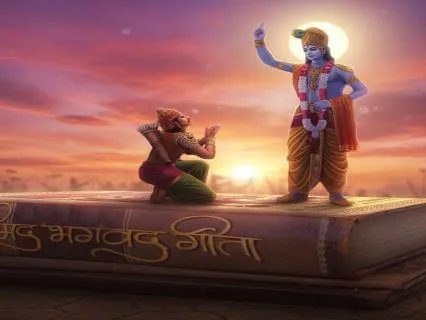
So today we are reading from the Bhagavad Gita.
The Bhagavad Gita is a discussion between Krishna and Arjuna.
And Krishna is essentially giving Arjuna a different way of looking at life.
You know,
There are those moments in our life where we're ready to hear something new.
It's funny,
That's how I feel right now.
There's something opening for me that I'm ready to hear something new.
I'm ready to change.
It's funny,
I was doing yoga yesterday and my knees have been a problem for a while.
So I kept asking my body,
Why are my knees so struggling?
And the answer was,
It's time for a change.
You know,
It's time to turn in a different direction.
Or my feet are going in one direction,
But the rest of my body is still going in another,
Which is like twerking my knee.
So it's interesting when we're ready to actually hear something new or ready to let go of an old idea or an old set of ideas.
This is the conversation that Krishna is having with Arjuna.
So let's dive in.
So today we are looking at.
Chapter 2.
Verse 45.
The scriptures dwell in duality.
Be beyond all opposites,
Arjuna.
Anchored in the reel.
And free from all thoughts of wealth and comfort.
The scriptures dwell in duality.
Be beyond all opposites,
Arjuna.
Anchored in the reel.
And free.
From all thoughts of wealth and comfort.
What does that mean to you?
What do you hear when you hear that?
Or are there certain words that come up?
When you re-hear something and it instantly goes.
.
.
Oh.
Or even an emoji.
But no more than three.
Why do we need to be away from thoughts of wealth and comfort?
That's a great question.
We will dive into that.
Be free from the material world.
Interesting,
My version talks about the three gunas quite different than yours.
I will read another one.
That's like that.
I thought I'm in trouble.
Reminds me of trusting in the journey,
Being okay with uncertainty.
Be beyond all opposites,
Pretty deep.
Okay,
I'm gonna read another version of this.
Maharishi Mahesh Yogi's version.
The Veda's concern is with the three gunas.
Be without the three Gunas,
O Arjuna.
Freed from duality.
Ever firm in purity.
Independent of possessions.
Possessed of the self.
Let's do one more version.
This is Paramahansa Yogananda's version.
The Vedas are concerned with the three universal qualities or Gunas.
Or Juneau.
Free thyself from the triple qualities and from the pairs of opposites.
Ever calm.
Harboring no thoughts of receiving and keeping.
Become thou settled in the self.
Totally different,
Eh?
And not different.
I'll explain what's going on here,
Why they're all so different.
Releasing judgment and attachment to outcomes.
It reminds me of the quote by William Hutchison Murray.
Until one is committed,
There is hesitancy.
The chance to draw back.
Always in effectiveness.
Concerning all acts of initiative and creation.
There is one elementary truth.
The ignorance of which kills countless ideas and splendid plans.
That the moment when definitely.
Commits oneself.
Then providence moves too.
Oh,
I love that.
Kind of like once you decide something,
The universe conspires to help you.
I don't understand duality.
All right,
You guys ready?
So there's kind of four or three sections of this that we're going to look at.
So in Stephen Mitchell's version,
The first part,
All he says is,
The scriptures dwell in duality.
But a closer translation actually means.
The Veda's concern is with the three Gunas.
And then Paramahansa Yogananda goes on to say,
Let go of the gunas.
But not only let go of them,
Let go of the dualities within them.
So first question,
What are the GUNAs?
So GUNAs,
G-U-N-A-S.
The Gunas are Sattva,
Raja.
And Thomas.
And if you imagine.
All the judgment you've ever had about anything.
They can fall into these three gunas.
Sattva.
Sattvic.
Sattvic.
So sattva is purity.
So in yoga circles they'll say,
You must eat a sattvic diet.
It must be light and full of life and you must have sattvic thoughts which are pure and of the light and you must live a sattvic lifestyle.
Think of every religious text,
How much they talk about that.
This is the life.
This is the pure life.
So then there are also aspects of our lives that are considered rajas,
Like r-a-j-a-s,
Rajas.
And interestingly,
It's often considered a negative,
Because in a lot of teachings,
Sattva,
That is the only thing.
It's just the light.
You can tell I have a little bit of a.
.
.
Little catty about it because I I really think it's not good for us to always be judging ourselves like you have to be perfect you have to be of the light you have to be you know close to God all that stuff or else there's something wrong with you and I think that's part of why I'm so drawn to Tantra and not from a hedonistic place.
But from a All things matter.
The dark days matter too,
And the depressed days,
And the frustrated days,
And anger matters.
I always think there's something weird when a teaching's like,
No,
You must always be like the Buddha.
You must always do the right thing.
There's always something amok for me there,
So.
Anyway,
If you hear a little bit of an edge in me about that,
I just want to share my bias.
So rajas in its best form is passion.
It's excitement.
It's,
I'm going to write a new book.
I'm going to visit,
I'm going to visit Spain.
I'm going to.
Try that new job.
Woo-hoo!
That's rajas,
Right?
That's like,
Yeah!
And then there's tamas.
Now,
Tamas is generally considered quite negative.
It isn't.
But when you hear about something,
You think,
Oh,
You should not eat tamasic food.
And so similarly,
Look at food.
So tamas is like stagnancy,
Heaviness.
Like,
That's Thomas.
So again,
This is how I've often heard the Gunas described.
Sattvic food is vegetables,
Fruit,
Water,
Herbal tea.
Rajasic food is spicy food and food that is,
You know,
Hard on your system or it or on the positive,
It can stimulate digestion,
Right?
It could be garlic or onions and things like that or spices.
So it can also be good.
Tamasic food.
Heavy food that weighs you down and clogs your liver.
This is sort of how it seems.
But what Paramahansa Yogananda is talking about is that within each of those,
Is a duality.
Is kind of a positive and negative.
So let's look at Thomas.
Tamas,
Its positive aspect,
Is that when we cultivate tamas,
Or do things that are tamasic in our life,
They create great stability.
It's the heaviness,
The ballast.
It's what very often when someone is lost in space and they're doing a million things and they're kind of,
You know,
Completely like a kite without a string.
They need some Thomas.
They need that,
In Ayurveda,
Like that kapha energy,
That gives them roots.
That lets them sit still for a while.
So Thomas can be very positive that it gives us grounding.
But what happens if we stay there too long?
And it isn't balanced with other influences?
It can become laziness.
It can become.
Like inertia.
That we don't ever move again.
We can become attached.
This is where the comfort comes in,
Right?
No,
No,
I'm comfortable where I am.
I don't want anything new.
I don't want anything to change.
And now we have attachment.
To that stability.
We have attachment to the security and suddenly some aspects of who we are go offline.
And we don't go for the walk.
And we don't exercise our bodies.
So that's the duality of Thomas.
Yes,
We need security.
But if we stay there too long without any other influence?
It can turn into stagnancy.
So that's a duality.
Rajas.
The positive side of Rajas?
It's excitement.
It's newness.
It's reading a new book.
It's writing a new book.
It's learning a new course.
It's having a new relationship.
It's having a new job.
It's moving your house.
It's whatever.
It's change.
But if we get stuck in that nature,
What if we just are,
We are so attached to new things,
Because it's always about attachment.
No,
No,
No.
And what if you believe that?
Change is good and you always have to have new things and blah,
Blah,
Blah.
What does that look like in relationships?
Suddenly,
Are you perpetually needing the new?
Person?
I want a new opportunity.
I want to kiss someone new.
I want to have sex with someone new.
And you can never actually relax into and experience the positive parts of Thomas.
Or maybe you always,
You're always wanting to be stimulated with new,
New,
New,
New,
New,
New,
New.
So now all of a sudden your monkey mind is crazy.
Like you cannot relax because I don't want to relax.
I'm attached to being hyper-stimulated.
I'm attached to the feeling inside of me.
I love being excited.
I love having a million thoughts.
I love having a million things.
You know what I mean?
And so suddenly,
Now you're hyperactive.
Now you're not even capable of staying with one thing.
You're not capable of actually finishing projects,
Finishing jobs.
So there's the duality of Rajas.
It's good.
Until it's not.
Similarly,
Sattva.
Sattva is a good thing.
It's healthy to have clear thoughts.
It's healthy to feel lightness inside.
It's healthy to fresh vegetables.
And think new thoughts,
And it's good.
But what happens as soon as.
You become attached to that.
No,
No,
No,
I am a Yogi.
I am a tantrica.
I am above such things.
I don't think things like that.
I don't get angry.
I'm always of a spiritual nature.
Again,
You can hear my very catty bias in what I'm saying.
This is where we end up with these,
You know,
It becomes part of our ego.
And what if one day.
You're angry.
I'm not angry.
I'm above being angry.
And this goes into the second part of this.
That we have to live in the real world.
So the second line,
The first line.
The scriptures dwell in duality.
And then he says,
Be beyond all the opposites,
Arjuna.
Anchor in the real.
What is real?
Is none of those things.
Not the positive or negative sattva,
Positive or negative raja,
Positive or negative tamas.
You're just who you are.
Some days were sad.
Some days it's easy to feel connected to nature.
Some days we're tired and we need to rest.
That's reality.
But when we become attached.
To any of those six aspects,
And we can be attached to all six.
We're in trouble.
What if we're attached to always being of,
Quote,
Pure mind?
What happens in our life if we're attached to that?
Not only do we suffer,
Because we suffer.
Because you're not allowed to actually experience being human.
You've attached yourself to some ideal that you read in a book.
And you don't get to live.
And your effect on other people?
Will we become insufferable?
And it doesn't matter whether it's because we study the Vedas and we're all into yoga,
Or we study the Bible and we're all into Christianity,
Or we study the Quran and we're all into Islam.
It doesn't matter.
As soon as we become,
Ah,
I am one with God and nothing can.
Ugh.
We are literally of no earthly good,
Not to ourselves or anyone else.
Being attached to that.
Is very different than experiencing it.
We all have moments.
You know,
Like we were talking earlier,
You know,
I've recently become a grandmother.
When that little baby,
That little six week old baby,
I hold him to my chest.
I don't need anything.
To tell me what that feels like.
I just feel lightness and purity and divinity.
I don't need an attachment to it.
You can go for a walk in the woods and your whole spirit is lifted.
There's no attachment to it.
It's just life.
These ideas are just a map so that we can understand all the different aspects of what it is to be human.
But we're not supposed to be attached to any of them.
Similarly,
You know,
We spoke about if I'm attached to Rajas,
That I that my identity is caught up in that.
You know,
And I personally can super relate to that because I love doing a million things and I want to be considered,
You know,
Interesting and wild and intelligent and whatever,
Right?
But if I become attached to that,
Everything goes wrong.
And ironically,
The flow stops.
Nothing interesting happens.
I can't write the book.
I can't do,
You know what I mean?
Like it's the attachment is the problem.
And similarly with Thomas.
What if we become attached to security?
What if we become attached to not wanting to change?
How long do we stay?
In that job.
That is killing us?
How long do we stay in that relationship that is killing us?
How long do we stay with habits that are harming us every day.
And this can be anything.
This can be being too sedentary.
Or working out to the point that you destroy your body.
It can be our thoughts.
I talk to people who aren't there in my head.
You know,
If I'm struggling with something,
I will place that person I'm struggling with in my brain and just start having arguments with them in my head all the time.
I don't do it intentionally.
It's not like I sit down and go,
Okay,
I'm going to have a conscious.
It's not like that.
It's happening almost out of my subconscious.
And I find myself all of a sudden thinking,
Katrina,
What are you doing?
Why are you getting so mad?
What are you doing?
So it's interesting to notice that What if?
I don't want to do that anymore.
This is a habit my brain has developed over decades.
And I'm comfortable with it.
Somehow.
Having arguments with people in my head makes me feel safe.
Or maybe it makes me feel smart,
Or maybe it makes me feel righteous.
But I think it actually causes a lot of inflammation in my system.
My body,
My mind,
My emotions.
I don't think it's good for me.
So it's an interesting thing to not be attached to the habits of our life.
And so that's what he's saying.
We even sometimes have to be careful of the scriptures.
Because they're so caught up in what's right and what's wrong and what people do and what you shouldn't do.
So the second part,
Or the next part,
He talks about being beyond.
Being beyond the opposites.
So I was thinking about.
.
.
A really interesting sadhana.
A sadhana is a practice that we do daily.
For spiritual growth.
And it's a daily practice.
And we choose a sadhana because it's difficult.
And it's difficult because there's something amok inside that we want to straighten out.
So let's say,
For example,
For one week.
We thought,
Okay,
For one week.
I am going to live beyond the opposites.
I'm going to not think about whether something is good or bad.
Or right or wrong.
And I'm just going to live in what is.
What does that feel like to you?
I'd love for you to share in the chat.
Someone was to say to you for one week.
I want you to live and watch your thoughts and as soon as you're thinking that something is right or wrong,
Or good or bad.
You're going to let that thought go.
And that can be a thought about you,
Something you have done.
Or are doing or will do.
Or other people.
What would that feel like?
We feel free.
And to know there's no right or wrong answer here.
A relief.
Tedious.
Awareness.
Magic.
Relief.
Relieving,
Exciting,
Curious.
Isn't that interesting?
That it's a relief?
Like they're overwhelming.
You know,
Freeing magic awareness.
And the tedious is real.
Because it's in our,
It's everywhere.
It's social media,
It's legacy media,
It's our thoughts,
It's everything.
What's fascinating about it is when we think about it,
When we think about our past,
Let's say.
Let's just close our eyes for a minute.
Let's just breathe deeply.
And imagine.
Thinking about your life.
With zero judgment.
No right or wrong.
Nothing,
And I'm not talking about other people right now.
We'll talk about them in a minute.
But you.
Every choice you've made.
What if there was no right or wrong?
Feels like alignment.
It's sublime.
So here's a question.
How does the judgment,
We all hold judgment of our past,
Oh,
I wish I hadn't done that,
If I only had done this,
Or I'm so glad I did that,
Or whatever.
What does that do to our current experience?
Having,
Holding a judgment.
Of what we've done in the past.
When you think of something in the past,
Or a regret even.
What does holding that regret mean?
Do to us.
It negates our life.
Exactly.
It limits the present.
It holds me back.
That's where I'm headed,
No right or wrong.
I'm freed up in the flow.
I'm absolutely over being.
Over being all clenched up.
It takes away joy.
It takes us away from being in the moment and seeing the beauty that is now.
Tries to keep me from making the same mistake.
My brain thinks it will prevent me from making the same mistake again.
So this is a brilliant point that you guys have brought up.
And it keeps us from appreciating the fullness of the moment.
Diminishes our self-confidence.
It keeps me stuck.
It refines.
So let's look at.
The idea that we hold it so that we won't make the mistake again,
Or we won't do that again.
This is where it's really interesting when we have an experience.
And our brain gets in there,
Judging right or wrong.
Instead of us living in the reality.
And it all comes back to attachment and our desires,
Conscious or unconscious.
So let's say,
For example,
You have a desire.
And the desire is you want a life partner.
You want someone at your side.
You don't want to be alone.
This is what you want.
And you have a belief that This is important.
It defines me as being lovable.
It makes me part of society,
It makes me normal,
Whatever.
We have all these beliefs about it.
And again,
This doesn't mean there's anything wrong with being in a relationship,
Right?
I'm just saying we have beliefs that are pointing me in a direction that I really want this to happen and I have all these beliefs backing up why it's so important.
So then you find someone.
And you know,
Maybe there's some good times and it's all good,
But then maybe one day.
They do something that.
.
.
It really hurts your feelings.
It makes you feel terrible.
So then what happens is the brain jumps in and needs to decide whether this is right or wrong because we're not going to live in reality for a moment because the reason we're in the relationship even is coming out of the brain.
It's coming out of beliefs.
It's coming out of a desire.
So my brain says,
Oh,
I have to decide whether this is right or wrong.
I'm not paying attention to my reality and my feelings.
I have to decide whether this is right or wrong.
Well,
I really want it to be okay because I really want to be in this relationship.
So I'm going to decide that it's okay that they did this thing.
Because they had a bad childhood,
And they don't always act like that.
So it's okay that they did this thing,
And it probably won't happen again,
And they said it wouldn't happen again,
So it's good.
That's good.
Good.
It's in the good category.
What have we learned?
We've just used this good-bad switch to further enforce our belief systems.
But we actually are,
We cannot learn from it.
Because then it's going to happen again.
And then our brain's gonna go,
Oh,
Oh,
Yeah.
It's just,
You know,
The more I get to know them,
I realize they're really just struggling and she just had a really hard childhood.
And I understand this,
But you know what?
There's other things that they're getting better at.
You know,
And so this is also good.
This is also okay.
We're using the good bad?
To tell ourselves that this is an okay situation.
Now let's imagine for a moment we're not using the good bath.
We're not using right wrong.
We're going beyond.
So same belief systems,
Same all of that.
And something happens.
They do something that hurts our feelings.
And I don't care whether it's right or wrong.
I'm not even thinking about that.
But I am thinking about how I feel.
And I feel really sad.
Or I feel suddenly very alone.
I feel kind of hurt.
I feel a little afraid.
So maybe you have a conversation about that.
And you say,
Wow,
That That really.
.
.
I felt so alone there.
And very often.
The argument back will actually be them justifying that they were right in doing it.
The justification,
The argument will always be whether it was right or wrong.
Oh,
So you're saying I'm a bad person?
Oh yeah,
You're just like everybody else.
You just think there's no good to me.
All about judgment.
But it's like.
.
.
I'm not saying it's right or wrong.
I'm saying that it hurt my feelings.
And that's interesting,
Like it's an interesting thing to have a relationship with someone in reality.
And say,
You know,
We just need to talk about it.
And if they can't talk about it,
Then we have to put up a barrier to them.
We can't feel safe about those things.
Or we have to always just be a little bit on guard around them.
And there's nothing wrong with that.
It's a natural adaptation to the universe.
Like if you suddenly decided you were going to go live in the woods.
And someone in your party got eaten by a bear or something.
You would suddenly become now adaptive to that there are bears in the environment.
You would make decisions about that.
If you're all caught up in like,
Well,
The bear should never have eaten them.
It doesn't help.
And that's why I'm talking about this is that we need to kind of realize that the right and wrong thing doesn't actually help us even when we think it does.
We don't make the same mistake when we stay in our feelings and we honor how we felt.
And then we make different choices.
We don't have to hold on to their decisions or what they did or whether it was right or wrong.
We just have to actually.
Make a tune.
I'm just going to read the chat for a second.
I'm revisiting my past lately,
And I'm learning to forgive myself,
But also the things I've been judging.
So what about acceptance of who they are as a conscious choice since nothing is perfect?
Totally.
We can 100% accept people for who they are.
You know,
If someone is naturally or they're in this moment,
They are really mean.
Well,
Then you're going to put up some guards.
And if you decide that,
Nope,
You know,
We're going to stick this out and we're going to figure it out.
Than we do.
But it doesn't make what they are doing right or wrong.
It's just who they are.
And we make a conscious choice.
To stay your goal.
Or go to counseling.
Or do something or whatever.
But we don't need the right or wrong.
On the flip side.
What if someone does something mean and we do make them wrong?
Can you believe they did this?
Do you know what else they did?
Then they did this.
And then you know what else?
They did this.
And I was a victim of them.
And I,
You know,
And they just did this.
And they just,
All they talk about is how wrong the other person is.
This is the flip side of that.
And all they think about is,
And then,
I can't believe they did this,
And then they did this,
And then they did this,
And then they did.
And this could be anyone.
This could be a relationship.
This could be a boss.
This could be a colleague.
This could be a parent.
This could be a child.
This could be a friend.
This could be anyone.
But we are caught in this judgment loop.
Of how wrong they are.
And every single thing we say just simply talks about how wrong they are.
And I'm not saying they aren't wrong.
Maybe they are.
Maybe they really did something.
Really bad.
What good does this do?
It's a weird training that we've had that says if I can simply continually say that they're wrong,
They're wrong,
They're wrong,
They're wrong.
Then I'm somehow better than them or something.
But instead when they do something that hurts us.
We need to make a different choice.
We need to protect ourselves.
We need to leave.
We need to go for counseling.
We need to bring them for counseling.
We need to do something.
But we only circle in right or wrong?
When we aren't going to make a different choice.
It's a danger and we do it all the time in life.
Is that feeling not a judgment,
A physical one in our body?
No,
A feeling is just a feeling.
Feeling isn't your brain is involved in your telling a story.
I mean an initial feeling like someone does something and it makes you happy or someone does something and it makes you sad.
That's like an amoebic response.
An amoeba,
A single-celled organism,
Naturally goes towards that which is life-giving and runs away from that which is dangerous.
That's what our emotions are.
Our emotions are our biofeedback mechanism to help us guide ourselves on our life.
In our life's path.
That's what our emotions are for.
But emotions don't repeat.
That's the difference.
I'm feeling so angry about this person.
I just can't believe how angry I am.
That's a thought process now.
A feeling is instant.
It's just a feeling.
What our brain does with it is the danger.
So from that feeling,
What are you going to do?
That's the question.
The last part of this stanza.
I feel like we could talk about this guy for like two hours.
But the last part.
Here,
I'm going to reread Stephen Mitchell's here.
The scriptures dwell in duality.
And again,
I'm just going to do a little side mark there.
How often do we use the scriptures to judge other people,
Not just ourselves while we judge ourselves?
It's just literally keeping us in this mental space which keeps us not making choices either or making really awful choices.
The scriptures dwell in duality.
Be beyond all opposites,
Arjuna.
Anchored in the real.
And free from all thoughts of wealth and comfort.
So free from all thoughts of wealth and comfort.
It's possible that we could say that wealth and comfort are two of our greatest attachments.
Not because we have character flaws.
But because of the world we've lived in.
We live in a world that tells us that money is everything.
And there's a real reality to that,
That we need money to pay rent.
And depending on where you live,
It could be extremely high right now.
We need money too.
Get braces and.
.
.
Buy food and run the car to get to work.
Money's a real thing.
But there's a whole thing out there that makes us feel light.
Well,
With money,
My life will be different.
And there is a point where it will be.
So to be very clear that when we don't have enough money to pay rent,
To feed ourselves,
To be safe,
That's a problem.
That's not what this is about.
And Comfort.
When you are in so much agony that you can't think straight?
You're not going for comfort.
You're going,
I remember a while ago.
I was having extreme,
Extreme pain.
And I'm not normally much into taking pain medication,
But eventually I was like,
I've just got to take some drugs because I can't even think straight.
And a friend of mine said,
But aren't you supposed to like sit with the pain and learn from the pain?
I'm like,
No,
I'm not in that kind of pain.
In severe pain.
I'm not thinking straight.
I'm in crisis.
So that's not what we're talking about.
We're not talking about that kind of comfort or that kind of wealth.
We all need care.
Amount of food to survive,
We need safety,
We need shelter,
So not that.
Beyond that.
We can become so attached to wealth.
We will take that promotion at work.
Even if it ruins our lifestyle and ruins a heart,
A big word.
Maybe we actually loved our old job.
And this new job isn't really great,
But I make more money,
So I should take it,
Right?
Not a lot of people.
Give up promotions where there's more money.
To stay in a job that they love.
It's not that it never happens.
But it does.
But the reality is.
.
.
Having more money?
Isn't necessarily good.
And having less money.
Isn't necessarily bad.
Having more comfort.
Isn't necessarily good.
And having Difficulty isn't necessarily bad.
So just imagine that,
Like just for a moment,
Just in your life.
And I know we're a little over time now.
Similarly as before,
Just for a moment.
Imagine.
Releasing the belief.
That more money is better.
Just letting it go.
Imagine letting go of the belief that more comfort was better.
What all of a sudden this does is it opens up.
Our own courage.
Our own creativity.
Because all of a sudden it's like.
.
.
So I don't make decisions based on me making more money,
And I don't make decisions based on increased comfort,
Because maybe the right choice has nothing to do with either one.
Comfort could be that excessive Thomas.
Where you've been sedentary for so long and someone says,
You know what?
Even if you just went for a walk around the block.
In the moment that may feel like.
Discomfort.
But it might be the right thing to do for you.
Or it might be on path for you.
Or maybe someone,
Maybe you're like a super workout person and someone says,
You need to cut down and you need to take rest days for your body to heal.
That would be incredibly uncomfortable.
And yet,
It might be exactly.
A perfect step.
On their journey to being in optimal health.
So this is where just letting go of all this right or wrong suddenly allows us to say.
But what's my path?
Beyond the opposites.
So I'm just going to reread it one more time.
And I'd love to know what your final thoughts or takeaway or where this brings you.
I'd love to know that.
The scriptures dwell in duality.
Be beyond all opposites,
Arjuna.
Anchored in the reel.
And free.
From all thoughts of wealth and comfort.
Where does that bring you today?
What would you like to take away from today?
Our gathering today.
Peace.
I personally love the idea.
Of just.
Living without the opposites.
Brings a whole new way to look at life.
I want to keep the thought of what brings true freedom in the forefront now.
Mm-hmm,
Letting go of the perplexity of it all.
Balance.
It's so true,
Like just to be.
In this moment.
All the time.
Anchored.
Zen mind,
Beginner mind,
Yes.
Freedom from judgment and belief,
Living in the moment and what is.
Gaining alignment.
In the simplicity of now.
Non-duality.
Removing my perception of what's good and what's bad.
It sounds freeing and peaceful,
A subtle joy.
It moves.
Well,
Thank you everyone for being here.
And we'll see you guys in two weeks.
Thanks so much.
See you later.