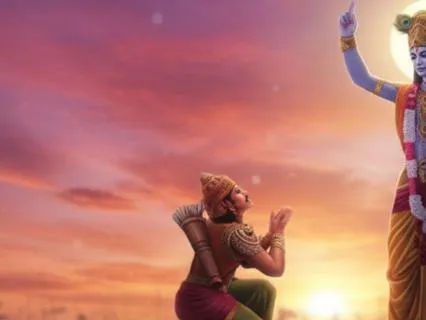
So we are reading from the Bhagavad Gita.
Today we are reading chapter 2 verse 36.
So for anyone who maybe hasn't been here for a little while.
Arjuna and Krishna are on the battlefield.
Krishna is still trying to find a way to help Arjuna to engage in what lies before him.
On the physical level,
It is a battlefield.
A civil war of good versus evil kind of thing.
But internally.
That civil war is on the battlefield of Kurukshetra.
The battle of the heart or the field of engagement of the heart.
And essentially it's like these two And I don't like to use the word warring sides.
But sometimes it feels like that.
You know there's this side of you that really wants to make change or that really wants to achieve something and then there's this other side that seems to win all the time,
Especially if we're tired or we're going through difficult times.
And so I don't like using that kind of terminology.
But sometimes it's helpful.
Sometimes it's helpful to.
.
.
Almost take it that seriously.
There are aspects inside of us that seem to pull us back.
You know,
It's true,
Yeah.
Krishna's done a lot of different,
He's taken a lot of different tacts.
One was,
Don't you understand that we can't die anyway,
That we are immortal and we are eternal and all that kind of thing.
And right now he's sort of playing with Arjuna's mind.
Ego a little bit on the surface.
So I'm just gonna back up a little bit to verse 33.
So Krishna says,
But if you refuse the call to a righteous war,
And shrink from what duty and honor dictate.
You will bring down ruin on your head.
Decent men for all time.
We'll talk about your disgrace and disgrace for a man of honor.
Is a fate far worse than death.
These great heroes will think that fear has driven you from battle.
All those who once esteemed you.
Will think of you with contempt.
And here's the verse we're going to look at today.
And your enemies will sneer and mock you.
The mighty Arjuna,
That brave man,
He slunk from the field like a dog.
What deeper shame can there be?
We're going to hear a couple other interpretations here.
This is Paramahansa Yogananda.
Thy foes will speak contemptuously.
Words improper to utter.
Maligning thy powers.
What could be more painful than this?
Then Maharishi Mahesh Yogi's version is Your enemies will speak many ill words of you.
And will deride your strength.
What greater pain is this?
Why do you think Krishna is saying this to Arjuna.
I mean,
On the surface,
It certainly sounds like he's just simply shaming him.
People are gonna make fun of you.
Think of what they're going to say.
But why else might he be saying this?
I feel like he is echoing Arjuna as thoughts.
Yes.
100%.
Our ego will throw every excuse at us about why we should stay asleep.
Mm-hmm In connection to the last verse,
The enemy within is the worst.
Right?
He's trying to teach Arjuna new lessons.
Exactly.
And so this verse definitely carries on from the last verse.
Where he says,
These great heroes will think that fear has driven you from battle.
All those who once esteemed you will think of you with contempt.
And so the next verse takes it a little bit further and actually says,
What they will say.
Kind of focuses on the words or the communication,
Not just what they think.
And your enemies will sneer and mock you.
So the first kind of the umbrella of this.
Verse.
Is the idea that if someone else says something about us.
The only way it can hurt us.
As if there's some part of us that is afraid they might be right.
That it must echo something inside of us.
You know,
If someone yells at me,
You know,
Your purple hair is stupid.
It doesn't land on me.
I just think,
Oh,
Well.
I don't know where they're coming from,
But.
.
.
Whatever they see.
Has nothing to do with me.
So if someone insults us,
If it actually is an insult,
Some people are mean.
Right?
Some people just say mean things.
You know,
That hurt people hurt people.
And it may not be nice when someone says mean things,
And we might wish that,
Wow,
I really.
.
.
I wish they were nicer.
I wish I could have a nicer relationship with them.
Right?
So sometimes it's not that because they said it,
It's inside of us.
But if it hurts.
.
.
If we take it inside and we chew on it.
It's a clue.
That there's some kind of seed inside.
And it's not a character flaw.
It could have been there for.
Lifetimes.
It could have been something very subtle we heard as a child.
Or watched in a movie.
Or Who knows?
So it's just something,
It's just a clue.
You know,
I.
.
.
I've been on a healing journey myself,
All about,
You know.
Healing like a 30-year anemia journey.
And it's,
As I play in various modalities,
Things come up like,
Oh,
Well,
It's a sign of.
Self.
Not self-hatred,
But thinking less of yourself.
And it's hard to hear that.
And it's sometimes even harder to go inside of it to try to find the root of it.
But it's a worthy question.
So today we're gonna look at three big aspects.
Of where these voices come from.
The first one is a word that a lot of you will know,
And it's samskara.
Samskara.
This is a Sanskrit word that essentially is It's almost like a rut.
Or a groove or a pattern.
And the idea is that every time we do something,
It's like we etch this pattern into our soul or into our samskara,
Into the records of our soul.
So every time.
We do something joyful.
We create a little line in the sand or a little line in the earth.
And when we do something joyful again,
We deepen that line.
And when we do something joyful again,
We deepen that line.
And so then all of a sudden,
If you're going along through life,
It's kind of easy to fall into that and maybe do something joyful.
Similarly,
Every time we get angry and lash out.
We create a little etching.
And then we do it again.
And it gets deeper.
And then we do it again,
And it gets deeper.
So then all of a sudden something goes.
Something becomes difficult in life and it's easy to fall into that.
And get angry again.
That is what a samskara is.
And the theory is that these not only become deeply embedded in this life,
But these are the sum screws from all of our soul's journey.
So again,
It's interesting.
2.
Really deeply look at that and say,
When I hear someone say something and it hurts me,
Like,
Deeply?
To really Hold that gently.
Because it may come from a time that we don't even understand.
Maybe we stayed in a situation too long.
But maybe we have deep patterns.
Of not being able to leave from other lifetimes.
Who knows what they are?
Maybe,
You know,
I'm a dyed-in-the-wool people pleaser.
You know,
I'm extremely concerned what other people think all the time.
It is a perpetual onion that I am unpeeling,
Or that I'm peeling all the time.
But who knows where that came from?
You know,
I mean,
But it's just a case of just.
Holding it gently.
And allowing the peelings to come off and allowing the lessons to come.
Come in and.
.
.
Inform my soul today.
You know,
We just gently shift things.
So very often,
When we want to change,
We can fall into these old patterns very easily.
And these are the samskaras.
So when we choose,
So what we're talking about here is Arjuna needs to actually fight for his kingdom.
The kingdom of his soul.
He wants to live his Dharma.
He wants to live his true path.
His edifying path,
The path where he gets to create and do new things.
This is what he wants.
And just as he's about to do it,
Some little voice in the back says,
I don't know about that.
And it's like he's fallen into a samskara of old.
That is this really the right thing I don't know we should be doing you know and so it's just something to be aware of inside of us.
Am I struggling in this moment simply out of habit?
Almost unconscious habit that I don't even notice that I've done it until afterwards and I'm suffering.
You know for me I will push myself so hard.
Especially in work especially that's what i mean last week There was a million things going on in my life.
Plus,
I just spent every waking moment working on the manuscript for my new book.
I mean every waking moment.
I would wake up at 5.
30 in the morning,
Pour a coffee,
And just get working on it because I told my editor I would have it to her by the end of the month.
And I totally burned out.
And I do this all the time.
And it's okay,
It's just,
It's something I'm playing with,
I'm journeying through,
Right?
It's a habit.
And so it actually takes a lot of effort for me.
To say.
Katrina.
Just rest.
Go lie in the sunshine.
Go for a walk.
Read a book.
Binge watch a show with your daughter.
But it takes effort to not fall in to that old sum scrap.
Some scrubia personality traits.
Could be,
For sure.
I've never heard anybody talk about it,
But.
.
.
I think the question would become whether we believe a personality trait is like part of our DNA.
You know,
Like your eyes,
Eye color or something.
Whereas some scroll we can change.
Right?
We can actually shift a samskara.
How do we do it?
By taking different actions.
By creating a new groove.
Right?
That's how we change.
We don't change a psalm script just by thinking about it.
For me,
If I tend to overwork,
The only thing to do is create a deeper samskara of self-care.
That's how it works.
We just keep creating etchings.
The question is.
.
.
What are we etching today?
What new pattern are we building today?
So that's the first one.
Just the sun's grace.
The second one.
They call them Indrias.
And these are our senses.
Touch,
Sight,
Hearing,
Taste,
Smell.
Paramahansa Yogananda sees these senses like.
Unruly rebels.
They're always grabbing you and taking you off path.
This is a classic yogic perspective on the senses.
Because The Bhagavad Gita,
Paramahansa Yogananda,
People like that,
They're part of what they call the Raja Yoga.
Lineage.
You know some people are in the hatha yoga or karma yoga or bhakti yoga or jnani yoga.
And some are Raja yogis and Raja yogis Enlightenment comes from a meditative path.
It comes from going inside,
Hearing this clear voice,
Hearing this silence,
And merging with the divine.
So to hear,
To understand that within,
To listen to what we're talking about within that context.
Our senses are hugely distracting.
And one of the reasons is that they say in the yogic world that These indriyas,
They are.
.
.
They're like our survival.
Our senses aren't necessarily bad,
But they are survivals.
And so if there's something to eat and I'm hungry,
I must eat it.
And if you push back on that,
If you try to stop me from eating,
I'm going to become an unruly rebel.
Don't you stand in the way of me and my food.
Don't you stand in the way of me and my pleasure.
Don't you stand in the way of what I wanna see.
Don't stand in the way of me and we become really like,
Hey.
And you can feel this,
Right?
If you've ever tried to change your diet,
If you've ever tried to even do anything differently when it comes to the senses.
Wow,
It's suddenly,
It's like the body suddenly goes into revolt and it's like,
No,
I must have the chocolate or I will die.
It's kind of this big,
Big deal.
And it's weird.
And within the context of the Bhagavad Gita,
This is where he's talking about those hundred evil cousins that suddenly rise up and they suddenly have all this power over you.
And so in the yogic perspective,
The idea,
How do we overcome this?
Through breath.
Through pranayama.
Through controlling the senses,
Pratyahara,
Withdrawing all the senses into self.
And kind of living this very yogic path.
So first of all.
If that's your game,
If that works for you,
If you really Align with that yogic world That is genius.
That is the path.
Because there's no right answer.
There's never a right answer.
Except for you.
And so for me.
.
.
I.
.
.
In my deepest soul,
I believe I am tantric.
It's the tantric path that really calls to me.
And the tantric path sees the senses as something very different.
The tantric path sees the senses as simply being part of Shakti.
And Shakti being the manifest reality,
Not the feminine,
Or it is the feminine,
But not women.
And so in Tantra you have Shiva which is pure consciousness and Shakti which is that pure consciousness embodied.
And so suddenly,
So what happens in our life?
In our modern world,
We get very caught up in our brains.
We get very caught up in what we think we should be doing,
What the neighbors think,
What other people say we should be,
All these things,
You know,
What we think we should be doing.
We create plans,
We create all these things that say,
I'm going to do this,
I'm going to do this,
I'm going to do this.
None of this has anything to do with our physical reality.
We may make plans for ourselves.
That don't even take into consideration that we're tired.
That were burnt out.
We may make plans to stay on the couch for the next month.
But we're not listening to our body that actually really needs to move or really needs to drink more water or whatever.
We have a disconnection from Shakti.
We have a disconnection from our feminine.
And so suddenly,
What happens when we're disconnected from our feminine,
From our body?
It rebels.
Not because it's evil.
But because it's disconnected,
Because it's not being heard.
If we don't listen to our inner child that is crying for attention,
That is crying to be heard,
That is crying to be witnessed,
It will rise in other twisted ways until we finally slow down and pay attention to what our soul's path is.
So now imagine this.
We try to make a change.
And our senses seem to be rebelling.
They seem to be kind of at odds with each other.
The Tantric path says,
Listen.
Dive in.
What is the root of this hunger?
What is the root of the discontent?
And so instead of seeing this as a war with the hundred cousins.
It's actually a question of diving in to the dysfunction,
Into the disconnection.
And healing it.
Bringing them all back into the family.
Which is interesting.
This perspective I'm sharing is not a classic yogic perspective.
And it's not a classic perspective of the Gita.
But it's a very interesting tantric perspective to say,
Because sometimes we've talked about that here,
Right?
That we don't like the fighting aspect.
Why do we have to fight ourselves?
Why does it have to be a war?
But we have to take it seriously enough to dive in and the tantric path isn't necessarily the easiest path.
It's sometimes hard to dive into the hunger.
Without simply just satiating it.
To be able to go.
What is really like.
.
.
I remember years ago.
It was actually when I turned 30,
So it was 26 years ago.
I went on a diet called the Weigh Down Workshop.
And it was a spiritually,
Religiously based weight loss program.
And one of the teachings in it was,
When you eat,
You're either filling one of two organs.
You're either actually hungry and you're filling your stomach.
Or you're filling your heart.
And every time you went to eat,
You had to ask yourself.
Am I feeling my stomach?
Or am I filling my heart?
And it's a very interesting discernment.
And this is sort of the journey of the tantric,
It says.
What is underneath?
This hunger.
What is underneath this desire.
Let's dive into it.
So that we can integrate it.
But we still have to slow down enough to kind of notice that this hunger is pulling me off my path.
And in this case,
The hunger could be simply wanting to be accepted by others,
Or being seen as a great warrior,
Or being seen as living out your duty and doing what you're supposed to be doing.
The last topic or the last concept that's really interesting.
They call it couriot.
And Korea is.
The hesitation that happens when we need to make a choice.
So you know when you're sort of at the brink of something,
You want to make a different choice.
Maybe you're about to have that hard conversation with someone,
And all of a sudden you're plagued with doubt.
I don't know.
I really should do it,
But I don't know.
What if this happens?
I don't know.
But what if this?
But I don't know.
I should.
I don't know.
So-and-so says I should,
But that person says I shouldn't,
And I don't even know if I can handle it.
That sort of back and forth,
Back and forth,
That's courier.
Paramahansa Yogananda considers this like a parasite of our psychic energy.
And when you think of it.
How often this going back and forth and back and forth is absolutely exhausting.
In the yogic world,
They talk about energy channels,
The pranic body,
The energy channels that the prana runs through.
And there's a central channel,
The shushumna,
That goes through the center from the root all the way up to the crown of your head.
Then on the left and the right you have the Ida and Pingala who weave together like that caduceus of the snake going up,
You know,
The scepter.
What they say is that when we have clear thoughts,
Energy is running through the central channel.
We are single-pointed.
You know that.
The power of staying on one topic,
The power of doing one task uninterrupted.
It allows an incredible clarity.
My teacher used to say that as long as you stay focused on one thing,
You will never get tired.
It's only when we start to focus on multiple things.
Or allow other thoughts to come in that we actually get tired.
And so Couriot says that as soon as we start doing this oscillation,
The thought patterns are no longer in the shushmana but they're in the ida and the pingala and they're bouncing back and forth and back and forth and back and forth and this is going on nothing is actually happening This isn't resolving anything.
You know,
Have you ever had that?
That,
You know,
When you're doing this whole hesitation,
I don't know,
I don't know,
We get nowhere.
It just goes back and forth and becomes exhausting.
This is seen as a leak in the system.
This couriot.
It's a dangerous thing because it's slowly draining our energy so that we don't actually get to do what we want to do.
And these,
Of course,
Are the voices that he's talking about.
Your enemies will sneer and mock you.
These are the voices.
I don't know.
Should you?
Well,
What are they going to think?
Oh,
I don't know.
People are going to think that you're weak.
People are going to do this.
People are going to think you're rude.
People are going to think you're whatever.
What are people going to think?
All that stuff.
What's interesting is.
.
.
I was really going down a tantric perspective today.
In the tantric world,
They don't see it as this kind of evil oscillation.
They actually see it as what they call spandex.
Sponda is.
The divine vibration of life.
That all things are part of this amazing vibration,
Oscillation that gives life passion.
So now imagine we perceive that.
Imagine you're about to do something.
Maybe you're about to apply for a new job or start a new job or leave a relationship or start a relationship or embark on a new journey or have a hard conversation or whatever and you feel this kind of energy going back and forth and back and forth inside of us.
A bit of a Gupta,
Who is a.
.
.
Great tantric.
He used to say,
That it isn't the going back and forth that causes suffering.
It's that we label it as fear or anxiety.
It's the label that actually gets us into trouble.
Because what's really happening is that It's like static energy.
Is now in motion.
Because it wants to be kinetic energy.
It wants to do something.
It wants to take action.
And it's building and building and building and building so that we can get out of an old orbit.
So that we can get out of one of those samskaras.
That's what this energy is,
It's the energy of life.
But we mislabel it.
As anxiety.
And I'm not talking about all anxieties or anything.
I'm talking about we're about to make a change,
We're about to do something,
And the energy starts to build inside of us.
What do we call it inside?
Do we label it as fear?
I must be afraid.
Do we figure,
Oh,
I'm feeling so much anxiety about this?
Or am I feeling excitement?
Is the pressure building.
What do you default to when all that energy starts to build inside of you?
What is your default?
And it's not right or wrong,
It's just an awareness.
Or what would you love to feel?
What would you love to reframe it as?
What would help you in those moments?
You know,
Is this your inner power rising to make change?
Is it your inner power rising to find a new solution?
I know for me,
When I start to have a lot of stuff going on inside,
I need to talk to somebody.
I need to talk to one of my kids or a friend or my partner or somebody,
And then I'll,
What you call,
You know,
Verbally process.
And they'll say,
How are you doing,
Katrina?
And I'll say,
Well,
Blah,
Blah,
Blah,
Blah,
Blah,
Blah,
Blah,
Blah,
Blah,
Blah,
Blah,
Blah,
Blah,
Blah.
And all this energy comes out.
But in the process of all of that,
I start to hear truth.
And I start to find solutions.
And it's almost like as soon as I can find a solution that I can take action on,
All that energy has a focus and now an action and now I can do something with it.
And now the energy is like that energy of takeoff.
You know,
When you're on a plane,
It's my favorite part of flying is when you're sitting there and the plane starts to go out,
You know,
Starts to head down the runway and it's building,
Building up speed,
Building up speed.
And there's this moment where it kind of just lifts.
Oh,
That's my favorite moment.
I consider it as anxiety and would love to change that to excitement.
Energy upon starting something new.
Sponda makes me feel like I'm on the right path.
I sometimes feel the energy flowing up and down my spine.
I feel it as frustration,
Anxiety,
All the back and forth can be exhausting.
Totally.
Listening to this,
It seems like a gear getting stuck or flips and we can go nowhere.
This is amazing.
I feel if I can be more aware of it,
I can spend less time there.
Exactly.
And so.
.
.
Question is,
Does tantra yoga help get out of that more quickly?
So Tantra basically says as a philosophy,
Yoga in this case isn't hatha,
It's not a physical yoga.
The yoga is engaging with it.
And the number one thing we do is drop the label.
Drop the label completely.
And just feel what it is.
Because as soon as we label it,
We're going to miss important pieces.
Because if we feel it,
We're going to,
And this is what Tantra says,
The other thing about Tantra.
Is to truly understand that it is a spiritual path.
And what that means is you're not in it alone.
So you first sort of sit inside yourself and part of the tantric path.
In the Gita.
Is connecting with your divine self.
Because that is the truth.
It's your reality.
You are a divine being.
You are an eternal.
Energy.
Manifest here on Earth.
So part of the tantric path isn't just diving into the sensations.
It's also doing it with the inner knowledge that I am diving into this.
Because I want to resolve it.
But I know that I am not.
This emotion.
I am not just.
This suffering human.
I am a divine being incarnate here on earth and I know this sounds really I don't know,
Maybe it sounds weird to some people.
But it's really important.
So then,
As soon as we dissolve the label,
And we dive into it with a kind of faith.
And practices that support you.
Maybe a practice that really supports you is sitting in silence.
Just sitting in meditation.
Maybe it's sitting in the sunshine,
Walking in nature,
Talking to a friend.
Watching the night sky.
We the tantric path is very you know many of you were a part of the radiant sutras and if you weren't we have a playlist here on insight timer which helps us connect with that divine self inside So all of a sudden,
Imagine.
Imagine the difference.
Feel this inside of yourself.
Let's just close our eyes for a minute.
And let's just breathe deeply.
And feel this energy flowing from your root where you're sitting all the way up your spine.
Into the crown.
And feel yourself connected to the whole universe.
And in that place.
Imagine how you feel when a challenge arises.
And that oscillation begins inside,
That energy starts to pulse and it starts to move and you're not sure what to do and we're not going to give it a label.
But we're gonna feel it from that moment.
Divine self.
And you're gonna breathe even deeper.
And you're gonna bring more life to it.
And you're gonna ask questions.
What is this telling me?
What do I need to know here?
What action can I take?
Where am I being guided?
And it's like that energy is the life force inside of us.
That's alive.
Right?
A lot of our world asks us to be very passive.
That everybody else has the power.
Everybody else gets to decide.
Whether I'm okay or not.
It's not true.
It's us.
We decide.
Everybody else,
They're just players on our chessboard.
And we need to put it all into perspective.
So that when that.
You know,
Couriot happens.
That we can recognize it as a vibration.
As static energy moving into kinetic energy.
And then we can also look at our situation and say,
What's stopping me from taking action?
What keeps slipping me into neutral?
Why do I feel I can't take action on this?
Because this is often why things turn into pain or they turn into anxiety.
That for some reason we don't feel like we are able to make the choices we need to make.
And we're kind of then stuck in a place.
But this is the journey.
To go down through the breadcrumbs.
Where does this stuck feeling come from?
Where is the Sanskrit inside of me that says,
You can't act,
You have to hide.
You have no power.
Where is that from?
And again.
It's all healable right here,
Right?
In this very moment,
This is the only power moment.
Right now.
Every single one of us here.
Is alive.
And has the power of choice.
And can make those choices.
And if we don't think so,
Again,
We have to look back in.
Is it a samskara?
Is it some weird pattern of hesitation?
Do I have labels inside of me that I'm putting on top?
What is it?
Well,
Thank you all so much for being here.
If you're new,
We have a group called Tantra Love and Connection with Katrina Boss.
Thank you guys so much.
Hope you have a wonderful day.