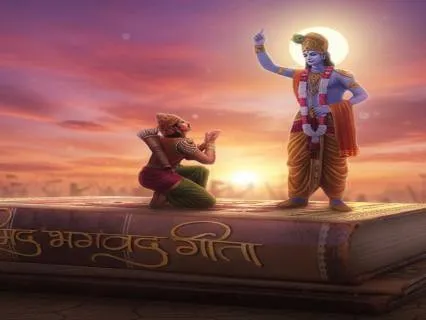
So the Bhagavad Gita is a discussion between Krishna and Arjuna.
Arjuna is the hero.
He is all of us.
He is.
Us in our lives,
In our personality,
In our relationships,
In our spiritual journey.
Krishna in the story is a friend of the family,
Kind of like a Hanai uncle.
But he is also God,
Or your divinity,
Or your highest self,
Your connection to the divine.
And at this point,
They're in the middle of a battlefield.
Where Arjuna sort of in one of those crisis of faiths.
He's supposed to battle,
Which essentially in this case means engage in the battle of the heart.
Engage in whatever it is he's going through in this moment.
And this is often a place where we find ourselves.
You know,
We can find ourselves very lost.
In a really confusing world.
Know for me personally right now I have a million balls in the air but not in a away like I'm so busy.
But in a way of real confusion.
You know,
I'm going through a healing journey with.
Iron and blood and all kinds of things and perimenopause and all the things and it's so interesting because My journey right now is to stay open to whatever the guidance is.
Just listen.
Because we've been trained to live a very specific way or maybe we've been taught that this is right and this is wrong and all that.
And in this state,
I really feel like,
No,
Just be open.
Like,
Listen.
I'm in a massive rewrite of the book I'm writing.
And it's huge.
It's sort of this shift from writing a book that's very based in history to writing a book that's very much based in story.
And again.
Just staying open to it.
And so we're all in some kind of almost liminal space sometimes where We're not quite sure what the next step is.
You know,
And we want to do the right thing.
We want to take the right step.
And it could be something simple.
It could be something in relationship.
It could be something in business.
It could be something in our personal journey.
It could be all kinds of things.
But we're always sort of wondering,
You know,
What's my next step?
And that's Arjuna right now.
But unfortunately,
The steps ahead of him are hard.
He doesn't like it.
He doesn't like the battle.
He doesn't like the two sides.
He doesn't want to hurt anybody.
He doesn't want to take a stand.
And this is what yoga really is,
Not fighting and hurting people,
But yoga is.
Standing in our truth.
And no matter what's going on around us.
No matter who has an opinion about this or that or whatever,
Even no matter what could the possible outcomes be.
That we become frozen in state.
To close our eyes,
Listen within,
Hear our truth,
Act.
That's what yoga really is,
Because that's what connects us to our deepest truth.
And so at this point in the Gita,
Krishna is sharing insights with Arjuna.
Today,
We are looking at Chapter 2,
Verse 40.
So I'm just going to back up and start with verse 38.
Indifferent to gain or loss,
To victory or defeat.
Prepare yourself for the battle.
And do not succumb to sin.
This is philosophy's wisdom.
Now hear the wisdom of yoga.
Armed with this understanding.
You will shatter your karmic bonds.
So we talked about those in the last couple of weeks.
So here's this week.
On this path,
No effort is wasted.
No gain is ever reversed.
Even a little bit of this practice will shelter you from great sorrow.
I'm just going to reread that.
On this path,
No effort is wasted.
No gain is ever reversed.
Even a little bit of this practice will shelter you from great sorrow.
So where does that bring you?
How does that make you feel hearing that?
Or which of the words sort of ring through your mind?
Yoga is action.
Listen to my inner truth and act on it.
It starts like the eight worldly Tibetan phenomena that rule the world.
I really love how it gives us a sense of it being difficult,
The struggle,
But then reminds us.
Even the smallest practice helps.
Similar to the Yoga Sutras.
I really love this sutra.
I find it.
Really relieved.
Beautiful and inspiring.
That life up till now has not been wasted.
I needed to hear that right now.
I see the sorrow all around me and I'm protected from it.
Do this and this and this.
But then it's okay.
If you can only do what you can.
Just do your best is the message I get.
Even a little effort towards spiritual awareness is worthwhile and rewarded.
What might seem like a setback is actually progress in disguise.
Reassuring.
I used to worry a new insight would be lost,
But experientially I know it becomes a part of me.
Even when it seems that all the effort was in vain,
One is still victorious because of the journey it took to get where you are exactly.
In a transaction-based society.
This verse is very soothing.
There is a lesson in everything.
Whatever I am doing.
Is in the right path.
Exactly.
Doesn't that feel awesome?
Baby steps count.
Exactly.
It's so interesting the idea that no effort is wasted.
Healing even if it costs you everything is always the right answer.
You know,
It's interesting.
Just in reference to the final thought there.
The Maharishi Mahesh Yogi.
One of his comments about this particular verse was,
The process having started.
Cannot stop until it has reached its goal.
The process,
Having started,
Cannot stop until it reaches its goal.
And what he's talking about there is that human beings.
Always want happiness.
In our deepest soul.
Are cool.
Is always inner peace.
The state of bliss.
It's kind of like.
.
.
We will always turn towards what makes us feel wonderful and happy inside.
And that's interesting.
So it's kind of like.
.
.
Our natural flow is towards inner bliss.
So once we turn ourselves towards it,
He goes as far as to say,
That it's actually effortless.
That all we have to do is turn our feet towards that.
And all the steps will come.
I just think that's so lovely.
He goes on to say that.
All we have to do is take one step.
And then one step turns into another step.
And then it turns into another step.
He actually talks about stages.
How we're at whatever stage we're in right now.
And then we take action,
Some action,
Even the tiniest action.
And now.
We're at a new stage.
And then we take another action and we're at a new stage.
Exactly that every journey begins with a single step.
And it's interesting because.
.
.
This is in the context of yoga.
And yoga,
Again,
Meaning.
Union with God,
Union with oneness.
Oneness.
What's interesting about oneness,
Like when you really,
If you,
Let's close our eyes for a minute.
What does oneness feel like inside of you?
Or even wholeness.
What does that feel like inside?
Stillness.
Coming home.
Comfort.
Like being a child again.
Expansive.
Peaceful connection.
Omnipotent Thank you.
I wonder that often,
I really don't know.
What's beautiful about this is that Yoga the union of the physical and the divine.
Is your inner feeling of oneness.
It's so simple.
And all that means is that with every breath,
With every step,
We simply try to act.
In accordance with our inner truth.
That's it.
It's that simple.
It's not an external ritual.
Like even when they say the practice of yoga.
This is what they're saying.
Honor your truth.
In everything and it doesn't have to be some big existential Lesson It could simply be having a conversation with someone and saying,
You know,
I'd like to look at this.
From another angle as well.
It's small things,
It's the tiniest,
Like just think of that.
So in this sutra,
It says,
On this path,
No effort is wasted.
No gain is ever reversed.
So now let's say one of our challenges in life,
One of the things that keeps us from our wholeness or our oneness.
Is that we don't want to upset anybody.
That's real.
It's epigenetics.
Its ancestral trauma.
It's thousands of lifetimes where staying quiet meant safety.
So now we find ourselves here in the 21st century,
Not in those particular situations.
And we're having conversations with people we love,
Family,
Intimate partners.
And we find ourselves not always speaking our truth.
And again,
When I say speak my truth,
I don't mean here's what I think of you.
I mean.
.
.
Not even allowing your voice to be in the room.
So let's say you have a new.
.
.
Partner.
And they're upset about something.
And your default.
Which is not your oneness.
Is to simply go along with it.
Maybe this is something your family did.
Maybe this is something a parent did and they said.
You know,
You gotta pick your battles.
You know,
Sometimes it's best just to stay quiet and let it blow over.
And these are,
I mean,
These are things that I heard.
That's why I'm saying them.
And you can do it for a little while.
And then something happens.
Maybe you get sick.
Or maybe you start to struggle with depression or anxiety.
And something has to change.
And this is where.
.
.
In the Gita,
It would say,
You must engage,
You must practice yoga,
You must practice oneness.
And so what it means in that moment is your partner's like,
Oh,
I don't know.
And you know,
Maybe we should just do this.
And it doesn't sit with you.
So you take a deep breath.
You sit sit still and you look at them and you say I have some other thoughts.
That I'd like to talk about.
What if that's it?
What if that's all you said?
It's the smallest thing.
But maybe for the first time.
In an intimate relationship.
You said,
I would like to contribute to this conversation.
When in the hard times,
Like for me,
On a personal note.
I can be very,
Very opinionated in the world.
I love a good soapbox.
And I will argue with anybody about just about anything.
If given the opportunity and the desire.
But for some reason in intimate relationships.
I have old patterns of people pleasing.
When things are good,
I'm pretty easy to just share my piece,
Say what I need to say.
But when things get hard,
And even if my partner,
It doesn't matter whether it was my ex-husband or my current partner or other men,
All they have to do is just.
.
.
Sigh a certain way or hold their jaw a certain way.
And suddenly I just fold like a cheap shirt.
And I just disappear from the conversation.
In fact,
I'll even apologize for even bringing up the thing that was bothering me to begin with.
And it's only in the last couple years.
That I've actually been able to say.
I can't live with this inside of me.
I can't continue like this.
I can't.
In fact,
I don't actually even want to be in a relationship.
If I can't have this oneness inside of me.
If I have to lie in any way in order to be in this relationship,
I would much rather be alone.
And that was a very interesting place for me to be when I entered.
My relationship that I'm in right now,
Four years ago.
Because that's where I was,
And so suddenly.
.
.
All of our conversations were this interesting journey of How do I stay in my wholeness?
And still be in a relationship.
And it was fascinating.
And luckily,
He also wanted to experience that wholeness himself.
And so they were hard conversations,
But they were kind.
But that tiny act,
Whatever it is,
In this case,
I'm talking about speaking up,
Which is hard for a lot of people.
But that one time.
Is not wasted,
Even if the conversation didn't go the way I wanted.
It doesn't even matter whether you like,
Quote,
Win or lose the conversation or whether even it was resolved.
You did it.
You opened a door.
You spoke up.
In a moment that you wouldn't have spoken up previously.
This is huge.
And this is what the sutra is saying.
That effort is not lost regardless of the outcome.
And once you've stepped through that door,
You don't step backwards,
Even if.
The next time it happens,
You don't speak up out of fear.
Doesn't matter.
You are still one step further than you were before.
It doesn't mean you always act like that,
But you cannot go backwards.
I love that.
I think that's fantastic that no matter what,
We're always walking forwards,
Even if to the outside world it looks like,
Oh well.
I guess I screwed up.
I guess I did it again.
I guess I acted the way I always act.
Nope,
Because you were in a different place when you did it.
And it's really neat because.
The outside world that we live in kind of measures everything according to external success.
For example,
If If I start building a house.
And I put the frame up.
But I don't finish the house.
The house is not finished.
And eventually the rain and everything will destroy it.
There's something in the outside world that says you have to finish the job.
You have to complete it,
Otherwise it's not a success.
It's not like that.
In the spiritual world.
It's not like that in our heart.
It's not like that in our journey to oneness,
Our journey to wholeness.
Every single effort.
Is money in the bank.
And it never gets taken out.
And it's interesting,
Too,
Because Do you ever wonder whether or not You know,
You can kind of have one difficult experience.
And you maybe learn something from it.
Maybe you learn like three things,
Let's say.
And then all of a sudden you go into another relationship or another job or another experience.
Or even another health crisis,
Or who knows what we're going through.
And it seems to be even harder than the one before.
You think.
Am I going backwards?
How come it doesn't seem from the outside that I'm getting ahead?
But what if you graduated to another stage?
And so now more is being asked of you.
Because you're a little bit bigger now.
So now.
You have a bigger challenge.
And you get to grow in different ways.
I just think it's really,
Really.
.
.
Really cool.
I'm going to read.
Paramahansa Yogananda's version of this sutra.
He's much wordier.
In this path of yoga action,
There is no loss of the unfinished effort for realization.
Nor is there creation of contrary efforts.
Even a tiny bit of this real religion.
Protects one from great fear.
This is the real religion that he's talking about.
The real journey within.
The real journey of merging.
With our true selves.
No one can measure that.
Nothing.
And you can't tell from the outside,
Either.
Nobody can.
And sometimes we have to sit back and just know that about our journey.
And often we can.
But we have to say.
Okay,
Well,
When I think of where I was 10 years ago,
Wow!
I really have come a long way.
Or when I think of where my consciousness was 20 years ago,
Or what I was afraid of,
Or how I acted.
Wow.
I really have changed.
I really would make different choices,
Knowing what I know now.
It really is true that the very fact that I turned my toes towards a different goal,
I really did walk towards that.
I couldn't tell you exactly how I got here.
But I did it.
How cool is that?
Who is that last rendition you read written by?
Paramahansa Yogananda.
It's interesting,
Too,
That in the outside world which we've been trained by.
We've sort of been trained.
To celebrate short-term goals like We did this thing or I won this money or I got this new job or I I lost 30 pounds You know like this is amazing And we celebrate these short-term goals,
Even if they don't stay.
Even if we did something.
Radical to make it happens.
So let's say we wanted to lose weight.
And so we,
I don't know,
Took a pile of cool supplements and did a bunch of things and really restricted our diet and whatever.
And we lost all this weight and we're like,
Yeah,
I did it.
And that's cool,
Nothing wrong with that.
Except we didn't make the changes that stick it out for the longterm.
I remember I used to run with a very cool guy.
He was actually a medical doctor,
But he really,
He had the whole field of holistic medicine behind him.
It was very,
Very interesting.
He and I ran for a time.
He taught me how to run barefoot,
How to run in ways that were really healthy for your body,
That wouldn't end up with wrecked knees and backs and shin problems,
You know,
All these issues.
And he used to say that,
I want to train so that I'm still running when I'm 100.
If you're training,
If you're doing any kind of physical training.
How would you change your training so that you're still running or doing that?
For sport when you're 100 years old.
It's different.
So that's what's different about here.
Is that Every tiny thing you do,
Every five minutes you sit in meditation,
Takes you.
One step further.
Permanently.
In the long game.
Isn't that crazy?
So in yoga we often We talk about having a sadhana.
Sadhana means daily personal practice.
And it's a personal practice that takes you closer to God,
That takes you closer to oneness.
It isn't just doing your favorite yoga postures.
It's not just doing your favorite yoga kriya.
It's not just doing your favorite thing that you love to do.
It's something that's challenging.
That helps you connect with oneness.
And so for a lot of people,
Creating a sadhana is hard because very often it's an hour of yoga or an hour kriya or,
Oh,
You should sit for an hour of meditation,
You know,
Kind of thing.
But what's really cool is you could create a micro-sadhana.
You could say.
.
.
I am going to sit in meditation every day for five minutes.
I'm going to close my eyes.
And I'm going to breathe deeply.
For five minutes.
And I don't mean,
You know,
We're on Insight Timer and there's all kinds of beautiful guided meditations and all like very beautiful and guided meditations have a place.
They have a beautiful place when we need to regulate our emotions,
To feel an inner calm.
But they aren't necessarily bringing us closer to God.
They're not necessarily taking us closer to our inner oneness.
Because we're being taken on a journey by someone else.
In someone else's car.
Sadhna is well it could be a guided meditation especially in the beginning Thank you,
They're great for the beginner journey.
And I mean that not in a negative way.
I mean that in a positive way.
Everybody's got to start somewhere.
We're all beginners at some point in anything new.
And guided meditations are genius.
For that beginning state so that we actually feel something different inside.
But if you were to create a 5-minute Sadhna.
Every day,
You did it.
My recommendation.
Is to sit,
It could be on a chair,
It could be sitting on the floor,
Whatever's comfortable,
Has to be comfortable.
And breathe.
Close your eyes.
Release the rest of the world.
And breathe.
The Wonderful Thing.
The second line of this verse is.
.
.
Kind of like you can't do anything wrong.
In Paramahansa's version.
He says.
In this path of yoga action.
There is no loss of the unfinished effort for realization.
Nor is their creation of contrary efforts.
So the cool thing about that is.
.
.
Even if you sit for five minutes.
And you are completely and utterly distracted.
Your mind won't stop.
Your heart won't stop racing.
You're completely annoyed because the neighbors just started cutting their lawn and here you are trying to do your five minutes and the dog started barking and this and that.
But you did it.
You sat for five minutes.
You set a beautiful timer.
And you sat for five minutes.
Even if that was the state of your being,
That counts.
That's a step towards oneness.
Like you don't have to be good at it.
It's all a step.
It's almost like we have to know that.
In order to relax into the practice.
Because then all of a sudden,
Anything we do is good.
It doesn't matter.
This is the hard thing with the way the West understands yoga.
That unless you're a.
.
.
Hyperflexible rubber person,
You can't do yoga.
Or unless you've been living in a monastery for 20 years and you can't sit and meditate for two hours.
You can't do yoga.
But none of that's actually yoga.
That's all like some weird Hollywood.
External perception.
Of the yogic path.
Like none of it's true.
So let's say,
For example,
You leave this class and you're like,
You know what?
I'm going to do a five-minute yoga practice every day.
I'm going to meditate.
I'm going to put my thing in the corner,
And I'm going to do it every day for five minutes.
And so then after this class.
You go and you do it.
You sit down and you sit quietly and you close your eyes and you breathe deeply and you do everything that you've ever remembered.
And you're like,
This was awesome.
And I'm going to do it tomorrow.
So I'm going to put a timer on my phone and every day at one o'clock.
I'm going to sit down for five minutes,
Just five minutes.
And you do it tomorrow.
And you're like,
Yes,
Yes,
I'm on a streak.
Feeling great!
And then the next day,
Your timer goes off at one o'clock and you're like,
Yes,
Right on.
And then the next day,
Your timer goes off.
But you're stuck in traffic.
And you think,
Oh.
Okay,
That's okay,
It's okay.
I'll do it when I get home.
That's okay.
But then you get home and you found out that the cat threw up all over the living room.
And so you've got to go and clean that up.
And then you've got to go make supper.
And then this has to happen all of a sudden.
And then the next day comes and you realize,
Oh,
I didn't do my five minutes.
Ugh.
Right?
Like this is life in the world.
Out in the outside world,
In the external success world,
They would say,
You broke your streak.
Now you have to start at zero.
Not true.
Because you did three days.
You have three days of money in the bank.
Three days you did.
Five minutes.
And you're amazing.
And you can restart it anytime you want.
Or you can start a different practice and you can say,
You know what?
I'm going to sit down and I'm going to journal.
And I'm going to automatic rate.
I love automatic rating.
This is when you sit down with a journal.
And you just rate.
Whatever comes into your mind,
Just let it all out.
Doesn't matter if it's nonsense,
Doesn't matter if it's swearing,
Doesn't matter what it is,
You're just writing.
And you say,
You know what,
I'm gonna do this every day for.
.
.
10 minutes.
There's a beautiful program called the artist's way.
Thanks,
Kathleen.
And basically one of her practices is you get up in the morning and you do three pages.
Of automatic rating.
She calls them morning pages.
Three pages is a lot when you first wake up.
You just wake up and you just open your book and you just write.
Nonsense.
Oh my gosh,
I had such a horrible sleep last night.
I probably shouldn't have eaten that pizza.
I don't know what I want to do today.
I'm still kind of mad at that person.
I don't know.
Oh,
It's going to rain.
I don't know if I want it to rain.
And you just,
You just write.
And it seems like nonsense.
But her whole point is,
I believe,
With the morning pages,
Is it helps you get out of the blocks that are holding you back from creativity.
And whether you're an artist or not,
It doesn't matter,
But it's the creative blocks of life.
How do I want to create this day?
Cause this day is mine.
I get to do whatever I want.
So you might say,
I'm going to sit down and I'm going to,
Every morning,
I'm going to automatic write one page.
I don't even care if it's nonsense,
Just one page.
And this becomes your sadhana.
Because what are you doing?
You're basically writing your inner thoughts.
Making them manifest.
Like,
How cool is that?
There's another,
I think it actually also was Maharishi Mahesh,
He said,
Yoga is the path of spiritual action where concept is turned into realization.
Yoga is the path of spiritual action.
Where concept is turned into realization.
What does that mean to you?
I can tell you what I think it means.
But I didn't write it,
So it's open to interpretation.
Like for me,
It means there's something about having an idea in our minds.
But then once we do it.
.
.
It becomes real.
Action.
Yes.
Can I read it again?
Sure.
Yoga is the path of spiritual action.
Where concept is turned into realization.
Do you ever feel like that?
Like you can read all the books in the world about.
.
.
Like say even something like people pleasing.
Or.
Getting fit,
Getting physically healthy.
You can read all the books and do all the things.
Then one day,
Like then it's just a concept.
But the yoga of action says,
I'm going to take action in the direction of my path,
Of my desire,
Of my interest.
And now it becomes real.
Now this concept starts to weave itself into my life.
It starts to actually become part of my being.
Now suddenly sitting down and meditating for five minutes every day.
Why wouldn't I?
Oh,
I've got five minutes to wait for the train?
Genius.
I'm going to close my eyes.
It just becomes part of our life.
And if someone says like,
How does meditation help you?
It's not a concept.
It's a life thing.
How does it change your life,
You know,
Walking every day?
Oh,
You know what?
I just make sure that I at least walk around the block every day.
Gets me outside.
In all kinds of weather just grounds me.
It just makes me feel so good.
It's not a concept.
I'm not preaching that I think everyone else should do it.
I'm saying Here's what I do,
And wow,
Does it ever make a difference in my life.
Yoga is not meant to be this all high and mighty thing.
It's just about how to live a wonderful,
Happy life.
That's all it is.
I like using mantras accompanying my breath work while meditating.
They help keep my monkey mind still.
Am I defeating my own purpose?
I've also learned not to condemn myself if I miss a yoga class or my own personal morning movement exercises.
No,
The key is.
.
.
That if you feel called,
To chant a mantra.
Then it's right.
There's no one on the earth that can tell you what your personal practice should be.
No one.
It's all about what's going on inside of you right now.
And if at this point you're feeling called,
To chant a mantra while you meditate?
Then there are forces at work far beyond anything we understand.
And we happily do it.
And you might do that for years.
And who knows,
Like mantras are interesting depending on what the mantra is.
Because mantras of Sanskrit,
Gurbukhi,
Gurbani,
All these languages.
You don't even have to know what the mantra means.
But the sound of the mantra affects the human body.
It affects the body even if we don't know what it means.
So if you,
Something like.
.
.
Ananda.
Ananda means bliss,
Peace in Sanskrit.
If I sat and I chanted.
Ananda.
Ananda.
Ananda.
Ananda.
My body would experience peace.
There's something really interesting about trusting our inner guru.
Our inner teacher.
Because we've been so conditioned that other people know what's best for us.
Other people are smarter.
Other people are more enlightened.
But nobody can connect with our inner journey.
Nobody knows what we need next.
It's kind of like imagine that every single one of us is climbing a mountain.
But the landscape inside each one of us is different.
So at one point in my journey,
Inner journey,
Maybe the best thing for me?
Is silence.
That's what I need in this moment.
But maybe someone else on their inner journey.
There's a creek in front of them.
And they actually need to do something to get over that creak.
And maybe.
It's a mantra.
Maybe it's ecstatic dancing.
Maybe it's silence.
Maybe it's walking around the block every day.
But the key is.
It has to come from you.
It can't be a should.
Like it cannot be a should.
If you think to yourself,
I really should sit for five minutes,
Don't do it.
I really should walk around the block.
Don't do it.
If you really should sit and journal,
Then that is not your truth.
That is not your guru speaking.
Gurus do not speak in shoulds.
Because shoulds come from outside.
They come from books,
They come from teachers,
They come from others.
This has to come from you.
This is where you're sitting quietly.
And you ask yourself.
What?
Would really make me happy every day.
And I mean,
Obviously we're not going to turn to addictions.
My first flippant answer is,
Well,
Chocolate would make me happy every day.
Well,
A million dollars would make me happy every day.
Oh,
Well,
Not having to work would make me happy every day.
Like,
That's not what we're talking about.
We're not talking about the outer world.
We're talking about my inner truth in every single one of us.
Is a divine being incarnate here on earth,
Every one of us,
No matter how much we might think that we're off path or whatever you want to call that.
Or maybe we've screwed up or we're in a hard place in our life or whatever.
Doesn't matter,
Like there's no levels.
Every single one of us has this spark.
Did you know?
That in our heart,
And for anyone here with a medical background,
You might have to make fun of the way I'm going to describe this.
There is something called um.
.
.
It's like a sinoatrial valve or something like that.
And this is basically the spark plug of your heart.
This is your heartbeat.
Buh,
Buh.
Do you know that scientists have no idea where that pulse comes from?
They have no idea where the heart is.
Pumping.
Comes from.
I think we know where it comes from.
If you have a spark.
In your heart right now going This is the divine spark.
This is God.
This is your divinity.
This is your connection to the divine quantum field.
So if you have this.
In your heart.
Then you have a guru.
Then you have inner wisdom.
Like imagine every time you feel your heartbeat,
Like if you put your hand over your heart and you feel that heartbeat or you feel your pulses,
Your pulse on your neck or your wrist or wherever you feel it.
This is your connection.
And you just know that you.
You have that connection and there's no one else to tell you what your next step is.
The divine rhythm of the universe in our hearts.
All right,
Just to close up here,
I'm going to just reread Chapter 2,
Verse 40.
On this path,
No effort is wasted.
No gain is ever reversed.
Even a little of this practice.
Will shelter you from great sorrow.
It's interesting,
You know,
When you think of what they mean by great sorrow.
Paramahansa Yogananda would teach that the great sorrow of human existence is spiritual amnesia.
That we forget.
Who we are.
So and that's where even a little practice.
Helps us remember who we are.
Every tiny thing we do that connects us to God,
To oneness,
To ourself,
To our truth.
Is wonderful.
What is a little practice?
A little practice is anything that brings you closer to truth,
That brings you closer to happiness,
To bliss.
And again,
It's a spiritual practice.
So it could be meditation,
Yoga,
Reading,
Writing.
Walking,
Buddhists love walking meditations.
Conscious of every footfall,
Breathing deeply,
Feeling the sun.
So I would love to know.
What you would love to take away from this.
Class today.
Words or a practice or anything like that.
Is straying from our source.
Imagine that,
That no matter what,
You always just get a little nudge back towards source.
Trust the path Just do it.
I'd also love to know,
If you close your eyes right now and you ask yourself,
What would one micro practice be that I would love to add to my day?
What would it be?
However much or as little is okay,
Keep going step by step.
The sutra name,
Please.
And I'm taking away doing what I feel I want to do rather than should.
So today it's chapter two,
Verse 40.
Of the Parkevite kit.
It was a wonderful class.
Love the spark plug,
Our connection to our soul.
I love that you never lose what you've gained.
Divine connection is just one breath away.
Silence.
Automatic writing.
Self-esteem,
Safety,
And the impetus to keep going.
Confidence that when I don't have time or the feels for my hour meditation I have money in reserve.
Be the water,
Not the rock.
Ask self.
What is the next tiny step?
Just hearing that we all have that spark.
Increased journaling.
Listen to my heart.
Thich Nhat Hanh says to walk as if the feet are kissing the earth.
That every bit counts.
Micropractice can be to stop and listen.
One step forward,
Two steps backwards doesn't apply anymore.
Even a step backwards is a step forward.
In the larger scheme of things.
I love that the mountain is different for each of us so that the climb will look different for each of us.
Listen within.
My micro-practice is gratitude to myself for acknowledging I am on a path.
Thank you for this connection.
I love every breath I get to take.
Ready for my morning walk in nature.
Oh beautiful.
Thank you,
Everybody.
This was so wonderful.
I hope you have a wonderful day.
See you guys later.