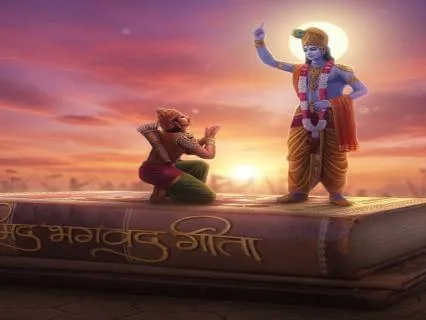
We are reading from the Bhagavad Gita and this book specifically,
This is Stephen Mitchell's version,
But there are many,
Many beautiful versions of the Bhagavad Gita.
If you have one that you love or one that it's all good,
You don't need to have this version to follow.
I just love Stephen Mitchell and it's kind of where I like to begin.
But any version is wonderful.
Today we are looking at chapter 2,
Verse 31.
And up until this point,
Krishna has been talking a lot about changing how Arjuna understands life and death and all that.
But here we're actually beginning a whole new discussion.
So for anyone who's new,
This story takes place on a battlefield in the middle of a much greater story called the Mahabharata.
Arjuna is the hero.
Arjuna is you and me.
The battlefield,
It's almost like a civil war.
It's like everyone Arjuna knows.
Family,
Friends,
Teachers,
Everybody is on the battlefield and they have split down the center defending whoever they feel indebted to or whoever they feel like they must honor.
And Arjuna,
He is in the middle and he is a great warrior.
And Arjuna is one of five brothers.
And now these brothers are actually the rightful successors to the king.
Their father was the correct brother to go and become the king,
But he died when the boys were very young.
And his blind brother,
Dhristarastra,
He became king instead.
And this is very significant that his brother was blind.
And the brother had a hundred sons.
And in the battle,
In this story,
The hundred sons represent all the things that keep us bound to suffering in life.
All the aspects of us that keep us attached to,
Well,
Attached to anything.
But it could be fears,
Self-worth issues,
Things we learn from our parents,
Things we learn from society,
Everything that's inside of us that confuses us and keeps us from living our true dharma.
Now here we talk about the difference between say karma and dharma.
There's a million ways of describing karma or dharma.
So I'm just going to describe to you my perspective on karma.
But understand there's many,
Many different ways of understanding it.
Let's imagine that each one of us is a soul.
The soul is an aspect of the divine,
And this soul is living various lives.
So we go into a life in a particular body,
And we have experiences.
Maybe we were hurt in that experience,
So we developed a callus,
Or we developed a defense inside of us so we'll never be hurt again.
And then maybe we had another experience and we developed another aspect of our personality.
And this continued.
You know,
We live that lifetime,
The soul goes on to another life,
And then the soul goes on to another life.
So these are called samskaras,
They are called all kinds of things,
But these are like imprints on that soul that we are going to continue to live out as we try to resolve them.
And this is why in life we often find ourselves in repeating patterns.
We might experience it within one lifetime.
Even if you don't believe in reincarnation,
You know,
It's not important,
But you might have already watched yourself have these recurring patterns.
Maybe you always tend to find a similar kind of partner that's very controlling,
Or very needy,
Or very manipulative.
Or maybe you always tend to find yourself in a certain kind of job,
Where you are disempowered,
Or empowered,
Or whatever.
Or maybe you have certain illnesses that all seem to be walking this very similar pattern.
These can be considered karmic loops as the soul is learning.
Because even as we repeat these loops in a lifetime between right now,
Between whenever you were born,
And this day in your life.
I know for me,
I was,
You know,
I had a boyfriend in high school,
And I had a boyfriend in university.
I learned a little bit between each one.
And then I got married when I was 23.
And I was married for 20 years.
And I learned a lot about relationships and myself in there.
And I also made a lot of assumptions.
And then after that marriage ended,
I continued to date very similar men.
Until one day I realized that the only thing that was similar amongst all these relationships was me.
I was the only common denominator in all of these relationships.
I was living out a pattern,
Just with different faces,
Different people.
This is interesting.
But we can live in this kind of unconscious state,
Even if we're very aware,
And we're going to talk about this in our sutra today.
And then all of a sudden you have the realization.
And all of a sudden that circle becomes a straight line.
And you don't repeat it any longer.
And you start walking forward.
At that point,
We begin to live our dharma.
We begin to live our soul's purpose.
And we are no longer ruled unconsciously by these karmic patterns or these samskara imprints of past lives or past experiences.
And you know,
We don't really understand any of this.
Maybe these past lives that I'm talking about,
Or these imprints,
Are actually ancestral memory.
Maybe these are epigenetic imprints from my mother and my grandmother.
So even as I'm saying this,
To deeply understand,
It doesn't actually matter the philosophy,
Because all of it is beyond our actual understanding.
These are only helpful maps,
If they help us heal.
So within the battlefield,
On the right side,
And I'm going to say right,
Meaning righteous,
True,
You can call it good and evil if you want.
But to understand on the right side,
We have Arjuna and his four brothers.
And they are all of your dharmic gifts.
They are your courage.
They are your hope.
They are your insight.
They are your knowledge.
Every one of us has this inside of us.
On the opposing side of the battlefield,
Which is called Kurukshetra,
Which is the battlefield of the heart,
This is your inner spiritual battlefield.
On the opposing side are the hundred cousins,
The hundred brothers of the men's uncle.
And they represent everything that pulls us back into those painful cycles.
That's what they represent.
And this is the true battle that Arjuna is in right now,
Where he has driven out into the center of the battlefield and looked all around.
But all around he sees people he knows.
That's what these challenging aspects of our psyche feel like.
Why is it so hard to change?
Because we've been living with these habits,
Challenges,
Issues our whole lives,
And maybe before,
Or maybe our family before,
Maybe our fathers,
Our mothers,
Our grandfathers,
Our grandmothers,
To deeply understand that the reason change is hard is because we don't want to let go of these because they almost feel like friends.
And this is where Arjuna is.
He's in the center of the battlefield.
Krishna is his charioteer,
His beloved uncle,
Family friend,
But also Lord,
Also our highest self.
So we begin a new aspect of Krishna and Arjuna's journey.
I'm going to go back two stanzas because he's been talking about how your Self,
Your capital S Self,
Is eternal.
Some perceive it directly in all of its awesomeness.
Others speak of it with wonder.
Others hear of it and never know it.
This Self who dwells in the body is inviolable forever.
Therefore,
You have no cause to grieve for any being,
Arjuna.
Here is our verse.
Know what your duty is and do it without hesitation.
For a warrior,
There is nothing better than a battle that duty enjoins.
I'm going to read Paramahansa Yogananda's version of that.
Even from the point of view of thine own dharma,
One's rightful duty,
Thou shouldest not inwardly oscillate.
There is nothing more propitious for a Kshatriya than a righteous battle.
Now,
This is a very confusing series of verses.
And so we have to talk about the caste system for a moment in India.
Because the Kshatriya is the second level of the caste system.
So in India,
If you don't know,
There is a caste or a class system that was installed 5,
000 years ago by the Aryans.
And whether it originally was intended to be a way of simply organizing society into various roles,
That is one theory.
But regardless of how it began,
It became one of the cruelest ways of organizing people that still exists today.
Where there is the Brahmin caste at the top,
The priests.
And according to the caste system,
These people are the closest to God.
Because the system became a system of purity.
That depending on where you were born into the caste system,
Was determined by your past.
And depending on which caste,
Which family you were born into,
Told the world how pure you were,
And how important you were before God.
This is horrific.
And this is one of the number one criticisms of the Bhagavad Gita by many great teachers.
Because the belief is that the Bhagavad Gita is simply all about making sure the caste system is in line.
Now there are also amazing teachers who saw the whole thing as an internal metaphor of spiritual growth.
And that is where we are coming from.
Just to be clear.
Because in the caste system,
The top are the Brahmins.
Second,
Kshatriya.
These are the warrior,
The rulers,
Who were actually ruled by the priests,
But they're sort of the faces of the rulers.
This is the caste that Arjuna was born into.
That's why Krishna is saying,
You must fight.
It is your dharma.
You were born into the warrior caste.
You have to fight.
So what I'm saying here,
And to be very clear,
Is we are not talking about,
We are not justifying the caste system in any way.
We are going to have a different conversation about this.
But I want to share this with you.
Because we're studying the Bhagavad Gita.
And the scholars,
The philosophers,
The teachers are very split on this.
So I just want you to be able to develop your own perspective on this.
Below the Kshatriya are the Vaishya,
And they would be considered sort of the business people of the world kind of thing.
Below that are the Shudras.
And the Shudras are menial labor.
They are treated very poorly.
Because of course,
They now are believed to be so,
So impure.
And then of course,
Beyond that,
They have the untouchables or the Dalits.
And so just to,
I don't want to make this whole session about the caste system.
But in no way,
How we're going to interpret this justifies this system in any way.
Because it's still to this day causes a lot of suffering.
So all of this aside,
I want to talk about that.
And I wanted to describe those.
Because we're going to specifically talk about how Paramahansa Yogananda interprets this text,
This very sensitive text.
Because essentially,
What he's saying is you must fight because you were born into the Kshatriya caste.
This is your dharma,
This is your duty.
And of course,
So this can be very,
Very much misinterpreted.
Just so you know,
Because you might not know this,
Because I didn't know this before I was doing my research.
Gautama Siddhartha,
The Buddha was also born into the Kshatriya caste.
And because he was so against the caste system,
And he was so against this idea of sorting people based on birth and this kind of random system.
This was what caused him to go into his journey and eventually sit under the tree and have his awakening.
And that was the birth of Buddhism.
Because it was actually against this system.
Jainism grew out of this,
Sikhism grew out of this pushback.
So just so you know,
A lot of amazing things came out of people who pushed back,
Who were even born into the higher castes,
Like Arjuna,
Or like the Buddha.
So just so you know,
Interesting things.
Did Arjuna enter into this journey with a revenge intention?
So when he saw grandfathers and cousins,
He began to feel confused because of the original intention of revenge.
It wasn't revenge in any way.
As the story goes,
The kingdom was supposed to go to Arjuna's father,
But he died.
So then it should have gone to Arjuna's oldest brother.
But in the meantime,
The blind uncle had taken over the kingdom,
Theoretically,
Until Arjuna and his brothers were old enough to rule.
And unfortunately,
The blind uncle and his hundred sons were extremely cruel.
And they were terrible leaders.
And they actually tricked,
This is a lot of the stories out of the great Mahabharata epic,
They tricked the brothers out of the kingdom over and over again,
Sending them into exile,
Trying to kill them,
Doing all these horrible things.
And in the meantime,
Imagine a kingdom,
Imagine you,
You,
Your inner kingdom,
Ruled by your lowest base instincts,
Ruled by your fears,
Ruled by habit,
Custom,
Inherited pain,
Anguish.
Needless to say,
The kingdom was in ruin.
This battle was the brothers taking their kingdom back.
But because the current king was still the uncle,
And the head,
His head brother,
His head son,
Who was particularly evil,
Many of their friends and family,
Their duty was to the king.
And that's why they were on that side.
And so it wasn't a revenge at all.
He was simply reclaiming their rightful kingdom.
So thank you for asking.
Because Paramahansa Yogananda's perspective on this is that this caste system,
Or the varna system,
Or however we want to understand,
There's a lot of different names for different stages of this system.
Essentially,
Each one of us can live at a particular level.
And again,
I want to doubly say I am not equating this with the current caste system or anyone in those castes.
This is just an inner journey within each of us.
Okay.
So according to Paramahansa Yogananda,
If we are living in a shudra state of mind,
Inside each of us,
So the shudra is,
Imagine there's four levels inside of us.
If we live at the lowest level of our consciousness,
We are ruled by habits,
Addictions,
Attachments.
We're quite unconscious.
We might be hard workers.
We are good people.
But we are blind spiritually to what's going on.
We are blind to what's possible within us.
We are basically living completely unconsciously,
Driven by all of those unconscious aspects of who we are.
It's all about fulfilling our needs,
Fulfilling whatever it is we need.
And lots of us live in that state.
Or lots of us have times that we live in that state.
And to really realize that as much as we're sort of looking at this like a ladder,
It's very spirally.
We might have times,
It doesn't matter how enlightened or how many realizations we may have had,
There might be times that we're actually afraid for our life.
And we are basically just,
You know what,
I'm just gathering the resources to survive.
I'm not thinking about anything else.
So that's sort of what Paramahansa Yogananda considers the shudra state,
Or that lower state when we feel very distant from God or consciousness.
The next level,
The vaisya,
This is when we started to realize that,
Hey,
These habits,
They shouldn't be our masters.
Maybe we should make them our servants.
You know,
Maybe these habits and things,
We can use them,
But they shouldn't be driving the boat.
And we start to feel a little courageous,
Right?
We start to feel like,
You know what,
I'm not a slave to this world.
I'm going to go out and I'm going to create stuff.
And I'm going to have a great job.
And I'm going to have a big house.
And I'm going to have three cars.
And I'm going to become a CEO.
And I'm going to be the greatest influencer ever seen.
I'm going to do this thing.
And our whole life becomes about manipulating the outside world in some way for our benefit.
And to also deeply understand that none of these stages are right or wrong.
It's just reality.
Where am I right now?
Is my life driven by external success?
Is my inner worth driven by other people's perception of me?
If so,
We might be at that second stage of a spiritual journey.
Now,
Above that is the Kshatriya stage,
The warrior stage.
And now this is the stage which all of us here are either in,
Or dabbling in,
Or returning to.
This is the path of the spiritual journey.
We're not driven by our habits unconsciously.
We can achieve what we need to in the world,
You know,
Maybe all that.
Maybe we still have to pay rent,
Obviously,
And do whatever we've got to do.
But we've now started to realize that there is an inner journey as well.
There is an inner journey that has nothing to do with success.
And it has nothing to do with even whether I have shelter.
That inner spiritual journey we can have,
Whether we have a million dollars in the bank,
Or we can't pay our rent next month.
To deeply understand that these aren't levels of accomplishment in life.
It's almost like they are levels that we may no longer relate to,
That maybe we just aren't concerned so much about external success.
But we still may have external success,
Or we may not have external success.
But it just doesn't have,
We have no attachment to it anymore.
Arjuna is in the warrior phase of his spiritual journey.
He is on the battlefield in his own soul.
He is looking at grandfathers who carry the lineage of his ancestors.
And in this case,
We're not talking about the good stuff.
We're talking about the hang-ups.
We're talking about the traumas.
We're talking about whatever happened in our home country when we were invaded,
And we were hurt,
And we were brutalized.
And the pain we carry inside of us that still affects us today.
We're standing in the battlefield of our heart,
Looking at that side of all the aspects of our being that slow us down.
All the time.
This morning I was wanting to do my yoga.
I do kundalini yoga.
But the truth is I didn't want to.
I had the idea in my head that,
Ah well,
It's because I'm so kapha,
Which is an Ayurvedic constitution.
And I'm thinking,
You know what,
I'll bet kapha people shouldn't even do yoga in the morning.
So I decided to go on chat GPT and say,
When should people with a kapha constitution do their yoga?
And I was quite sure it should be later in the day.
It was very clear that kapha people should absolutely be doing their yoga first thing in the morning.
But because you're so kapha,
You don't want to.
But when you don't want to is exactly when you should be doing it.
And I was laughing,
Because of course,
That's my opposition.
Those are the evil cousins on the other side of my consciousness,
Convincing me that you don't really want to do the yoga.
Come on,
Katrina,
Why don't we just relax?
Why don't we just pour a coffee?
Don't you feel like that?
Really?
This is why Arjuna must battle.
This is why Arjuna must stand strong.
He must protect the castle.
He must protect your true path.
This is our journey.
We already know this stuff.
We've read the books,
We've taken the courses,
We've listened to the teachers,
We've done this stuff.
But now the battle is just inside.
Nobody else can make us do the yoga.
Nobody else can help us look at those old patterns,
Those old karmic patterns,
The ancestral patterns.
No one else can do it except us.
But a lot of us feel like that.
We feel like Arjuna.
Imagine,
Let's say you have a health issue.
Maybe you have a difficult relationship.
Maybe you struggle with finances.
Who knows what what's going on in our life?
It's very easy to feel overwhelmed.
It's easy to feel overwhelmed with the task at hand.
But what's really overwhelming are our thoughts.
The thoughts that tell us that we can't do it,
That we shouldn't do it.
Let's just do what we did yesterday.
Let's just stay in what we know.
Wouldn't you rather be comfortable?
You don't want to do that anyway.
Aren't you a little tired?
You didn't get a great sleep last night.
You can't meditate.
You can't do that.
You're not as good as other people.
You know what?
If other people could do.
.
.
You know what I'm saying?
This is the battle of the spiritual warrior,
Is to sit quietly and recognize it.
Do we have to dance with it?
Sure we do.
And we need to do whatever we need to do because their time is done.
They don't get to rule the kingdom any longer.
Just imagine you are the kingdom.
Who's ruling it?
Who's driving the boat?
The hundred cousins?
Or you?
Your highest self?
What life do we really want to live?
You know,
For me,
I know that there is something,
There's an amazing way to live here that is right in line with who I am.
And this is what's really important,
Is your dharma,
Your journey,
Is exactly who you are.
This isn't something you have to develop.
This isn't something you need to learn.
This isn't a skill you need to acquire.
It is exactly who you are right now.
And this is really interesting because one of the things that Krishna says to Arjuna is,
He doesn't say,
You need to be a better person.
Because of course,
The next level up is the Brahman state,
Where I am living in this total communion with God.
I am walking my talk.
I am living from an inspired place.
Krishna doesn't say,
Start living from an inspired place.
Join with God.
Live that.
He doesn't say that.
He says,
Live where you are.
Right now,
You are in a warrior phase.
You can't skip this step.
You must do the work.
You must stand your ground.
You must stand in your truth.
And this is interesting when you really think about that in all of our lives.
What does the warrior phase of our spiritual awakening look like?
It might be standing in our truth when it costs us.
It might cost us a relationship or a job.
It might cost us something.
But there's something inside of us that knows that other way isn't my path any longer.
I have to walk in my truth.
It could be having a hard conversation because you really want to be honest.
And again,
In no way is this a violent thing where you are laying your judgment on someone.
That's violent.
I am 56 years old.
My partner is 63.
We've been together for four years.
We've both had our own spiritual journeys.
We've both been married collectively for 43 years.
Collectively,
We have seven children.
We came together at a very aware time of our life.
So we have this blessing of a relationship where we both really want to get to the bottom of whatever's going on.
And we resolve issues all the time.
But do you know that every other day something else comes up?
Some little thing.
Most of the time it has nothing to do with us.
It is some weird pain from childhood.
It's some weird pain from our parents,
Our grandparents.
And both of us,
Both of us are people pleasers.
Both of us want the other person to be okay.
Both of us are afraid of losing the other.
And so it's a very interesting thing that when a tete-a-tete happens or someone's triggered,
At least one of us,
Maybe both of us,
Has to have a moment where we close our eyes,
We breathe deeply,
And we tell the truth.
And we say,
That really hurt my feelings.
I don't know why it hurt my feelings so much.
I don't know where this comes from.
I don't know why I'm so triggered.
But there's something really powerful about telling that truth versus just shutting down and when they ask if you're okay,
Saying,
I'm fine,
I'm just working through something.
And to actually be honest,
This is a really interesting journey in that warrior state to be able to say,
I don't know why I have to stand in my truth in this moment.
I don't even know where it's going to go.
I don't know what the outcome of this conversation is going to be,
But I trust that this is the path.
It's not violent,
But it is strong.
And it's rooted in something other than just,
I want what I want,
I want to control you,
All that kind of thing,
Right?
It's beyond all that.
We're actually just being honest because that's what we're here to do.
We're here to live our truth.
We're here to live our satya.
But how often do we just want to fall asleep because it feels too hard?
It feels too hard to be honest.
It feels too hard to risk something because Arjuna's battle isn't easy.
You know what I mean?
Like it's hard,
But this is all of our journey.
And the beautiful thing is,
So what does Krishna say?
You must fight.
This is your dharma.
This is your journey right now.
And so the key is one of the big takeaways for all of us is no matter where we are on this journey,
And we're all in some blended part of this.
It's not so clear.
We're not like,
Oh,
Thank goodness I'm not in that first level,
Or I'm not in that second.
It's not like that.
Our soul rolls through these all the time.
But the key is whatever is in front of you right now,
That's the journey.
It doesn't matter what it is.
Whatever it is,
Just right now,
One step,
That's all we have to take.
We 100% do not have to live in a Brahmanic state right now.
We do not have to live in an enlightened state.
In fact,
It doesn't work like that.
Because even if we have a moment of awakening,
It can happen.
100%.
You're walking along,
And all of a sudden,
You realize something,
And you go like,
Wow,
I get it.
And literally,
Just the world makes sense for a moment,
And you're quite sure your life will be different forever and ever and ever.
But the reality is we still have to integrate this into our lives.
We have fears,
Patterns,
Ancestral stuff.
We have family.
We have connections.
We have jobs.
We're a part of community.
Then the journey becomes sorting all that out.
Years ago,
In 1999,
I was very sick.
I had breast lumps.
This is the topic of my first book.
I met my first spiritual teacher.
He guided me.
I had a miraculous healing.
And afterwards,
I truly lived in a nirvanic state for a few days.
It was this loving,
Endless,
Infinite state.
And then,
I slowly wove myself back into life.
And all the old things started rising again.
But I didn't go backwards.
They often say that we cycle like a spiral.
We have to revisit and heal.
We can't just leave stuff.
It's kind of like,
Imagine you have a house.
Like,
I remember when I was married,
I married a dairy farmer.
And so,
I lived in the middle of nowhere with this man.
We had children.
We bought the farm the day my daughter was born.
Life was insane.
We worked 16,
17,
18-hour days with the baby strapped to our backs.
It was just the two of us on this 200-acre dairy farm.
They were long,
Long hours.
Needless to say,
The house just became a pigsty.
I couldn't keep ahead of everything.
I couldn't keep ahead of,
We were also transitioning the farm to organic.
So,
I also was a real idealist.
Everything had to be organic.
We had to grow all of our own food.
So,
I had a huge garden.
We had,
I mean,
It's one of the challenges of being an idealist.
Needless to say,
The house just went to pot.
I could never keep up with anything.
Now,
Let's just imagine,
Like,
Luckily,
A friend came in who cleaned houses,
And we started swapping things,
And we slowly found our way out of the insanity.
But what if I hadn't?
What if the house just continued to amass stuff and garbage in the corners,
And stuff over there,
And stuff in the closets?
And maybe I ran out of room,
And so I had to take all that stuff and put it in storage.
And then,
All of a sudden,
That,
And suddenly,
One day,
I wake up,
And I've got 14 storage units,
A house full of stuff.
And then,
One day,
I have an awakening,
A realization.
Do I just walk away from the house?
Leave my husband and kids to clean it all up?
That's not how life works.
We now have a new realization.
We now have a new awareness.
And we walk through the house,
And we walk through the storage units of our consciousness.
We sort it out with a new awareness.
Do we get caught in the corner,
Lost in memories sometimes?
Sure,
We do.
Do we get caught,
Lost in old patterns sometimes?
Yep.
Is it the same as the first time?
No.
It's different.
But that's what we do.
This is what Arjun is going through.
He's had awarenesses.
He's realized things.
He's had the trainings.
He knows what's right and wrong.
He knows what he's meant to be doing.
And whatever the path is right now,
He just has to take the next step.
And that's all of us.
All of us in this spiritual warrior path.
I'm just going to reread this.
So Krishna says,
Know what your duty is,
And do it without hesitation.
For a warrior,
There is nothing better than a battle that duty enjoins.
There is nothing better than a situation that allows us to walk our true path.
I would love to know what you're thinking right now,
Or what you're taking away from this,
Or what emotions are flowing through you.
Or if you have any questions.
I'm inspired.
That's awesome.
Your words couldn't fit my experience in this moment any better.
It's just what I needed today in this moment.
Thank you so much.
You brought me so much light into my situation.
Awesome,
Man.
So allow where you are.
This is the place of most benefit for now.
So do Arjuna's cousins have to walk their truth in order to learn?
They really just represent something in Arjuna's consciousness.
Just like other people in our lives,
There may be people in our lives that are really difficult,
But they are just like the cousins.
It's not about them.
What they need to do in their life is their journey.
The only interesting thing for us is how does this change my inner self?
How does this change my journey?
How does interacting with them shift me to a different place?
What does interacting with them ask of me so that I am in true alignment?
I'm not stuck.
I'm processing and moving forward.
Totally cat.
I love this,
Especially that the Buddhist leaders fought the caste system.
Why does it still exist?
It is a 5,
000-year-old system,
But a lot of people are out of it.
I am encouraged to continue my warrior journey.
I'm looking forward to and a little apprehensive to observe my patterns this week.
Thank you.
Wonderful,
Katie.
I just had surgery,
And in the recovery room,
I had so much sadness come up.
I allowed it to move,
Flow,
And express itself,
But I feel it's still there.
What is my responsibility to this heartache?
Any insights,
Katrina?
Oh,
You know what?
I had a similar.
.
.
I didn't have a similar experience.
I was doing my yoga yesterday,
And all of a sudden,
I had this memory come up of surgeries I'd had when my children were born.
And all of a sudden,
It's like the trauma of the surgeries became first and foremost in my mind.
And I'm lying on the floor in Shavasana,
Crying,
Kind of for the trauma of my body.
I just was like,
Wow,
You were cut into for my uterus and all that.
And no matter how thankful I am that I was able to survive the births of my children,
No matter how thankful I am that my children are healthy,
Happy people today,
I had to lie and just allow that grief.
And my recommendation is to don't push it.
Don't push past it.
Just lie with it.
Whatever it is,
Just honor it.
Journal about it.
Cry with it.
And it will pass.
But it's like that inner child that just needs to be heard,
Just needs to be honored.
Emotions are good.
They just need to be processed.
Well,
Thank you,
Everybody.
Thank you for being here.
I hope you have a wonderful week.
We'll see you guys later.