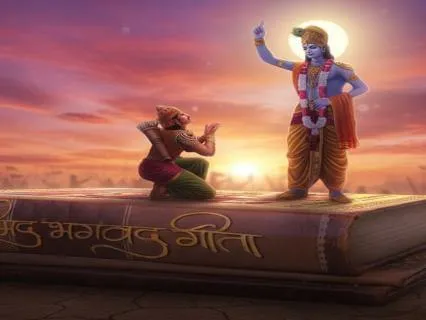
So today we are looking at chapter 2 verses 26 and 27 of the Bhagavad Gita.
I'm going to just back up a little in our talk or in our reading here.
Just a little bit.
In the previous weeks we were looking at the nature of the eternal soul.
Krishna and Arjuna are on the battlefield and Krishna is still slumped in the in the chariot.
He's still,
No matter,
Like Krishna has said a bunch of things in hope of reframing Arjuna's struggle,
But Arjuna still isn't coming out of his struggle.
And so Krishna is saying,
Your soul was never born.
Coming to be,
It never will not be.
Birthless,
Primordial,
It does not die when the body dies.
Knowing that it is eternal,
Unborn,
Beyond destruction,
How could you ever kill and whom could you kill,
Arjuna?
Just as you throw out used clothes and put on other clothes,
New ones,
The self discards its used bodies and puts on others that are new.
The sharpest sword will not pierce it.
The hottest flame will not singe it.
Water will not make it moist.
Wind will not cause it to wither.
It cannot be pierced or singed,
Moistened or withered.
It is vast,
Perfect and all-pervading,
Calm,
Immovable,
Timeless.
It is called the inconceivable,
The unmanifest,
The unchanging.
If you understand it this way,
You have no reason for your sorrow.
So here are the two verses we're going to look at today.
Even if you think that the self is perpetually born and perpetually dies,
Even then,
Arjuna,
You have no reason for your sorrow.
Death is certain for the born,
For the dead,
Rebirth is certain.
Since both cannot be avoided,
You have no reason for your sorrow.
Okay,
I'm going to reread those last two.
Even if you think that the self is perpetually born and perpetually dies,
Even then,
Arjuna,
You have no reason for your sorrow.
Death is certain for the born,
For the dead,
Rebirth is certain.
Since both cannot be avoided,
You have no reason for your sorrow.
I'm going to read Paramahansa Yogananda's version of these.
But if thou dost imagine this soul incessantly to be born and to die,
Even in that case,
O Arjuna,
Thou shouldest not grieve for it.
For that which is born must die,
And that which is dead must be born again.
Why then shouldest thou grieve about the unavoidable?
Where does that take you?
You know,
Are there thoughts that rise,
Positive or negative,
Or emotions?
How does that leave you feeling,
Hearing that?
At peace,
It's never the end.
We go with the flow,
That everything is cyclical.
A peaceful feeling.
That just helped me with grieving my mother.
I know it's okay.
The feeling of being held.
Birth,
Death,
Rebirth,
Cycle,
Sa,
Ta,
Na,
Ma.
This is a popular mantra in kundalini yoga.
This is a very interesting perspective that Krishna is now bringing us.
Up until this point,
In the previous stanzas,
He's focusing on the quality of the eternal soul.
It's kind of like he's saying,
Don't worry about all the changes.
Don't worry about it.
You are an eternal soul.
You don't die.
Nothing can change you.
This physical body,
Whatever.
It's just changing all the time.
It doesn't matter.
Essentially,
That's the previous stanzas.
But it's not working.
Arjuna is still just slumped in the chariot.
Krishna decides to change his tune.
He says,
All right,
Okay.
Let's forget the eternal self.
Let's just forget that.
Maybe that's too much right now.
Maybe we're too emotional right now for transcendental concepts.
And he says,
Okay,
Let's forget that.
And he's saying,
So let's say you simply believe that a body is born and the body dies.
Maybe that's it.
That's what you believe.
Does being upset about it change anything?
Does this grieving that you're doing change this?
And it sounds kind of cold,
Right?
It sounds cold.
But there's something,
And there's a word that he uses in Sanskrit that it means inevitability.
And it's one of the great challenges in life.
Because there are a lot of things in life that are inevitable.
They're going to happen.
It's almost part of being alive.
The very fact that I get to live,
I get to play in this physical body as Katrina Boss here in Canada,
Hanging out with you guys,
The very fact that I get to be here means one day this Katrina Boss will not be here.
It's actually part of the design.
It's part of being human.
It's not an error.
One day,
The fact that I will die is not an error.
It's part of the whole creation.
You ever seen movies where there's like a vampire or there's somebody who became immortal for some reason?
And suddenly,
Life doesn't have the same meaning.
There's an ambivalence towards a lot of things because it's like,
I've seen this stuff come and go so many times.
I've been alive for thousands of years.
Like there's an ambivalence towards life.
So what if instead,
Us coming to earth was with purpose,
But what made life powerful,
What gave us the emotional attachment and journey that we're taking is because birth and death go together.
What if that's what brings life meaning?
What if that's what brings the individual moments of our life meaning?
There is something so powerful to realizing that death isn't a mistake,
That it's a natural progression to rebirth.
Because that's the second part of this.
That's part of verse 27.
Death is certain for the born and for the dead,
Rebirth is certain.
And the funny thing is,
We see this in life all the time.
We are here in Canada,
We're coming into spring.
We're coming into the time of rebirth.
And we watched,
I mean,
In Canada,
We have very extreme seasons.
It's not the same everywhere in the world.
But the difference between spring and winter are radical.
But we watch this all the time.
We watch a tree die and slowly become part of the earth and then become new life.
The idea of birth and death and death and rebirth is part of our day to day life when we focus on nature.
But there's something weird that happens with this frontal cortex that we have as humans,
This prefrontal cortex,
That I believe we're just still figuring out how to use.
It's sort of like we're babes when it comes to understanding the power of this frontal cortex.
Because in an ideal world,
This frontal cortex allows us to learn interesting things.
It allows us to figure out things and say,
Oh,
Let's contemplate this.
It allows us to sit here and have this philosophical conversation.
It allows us all to connect together.
It allows us to have imagination,
To sit and think,
Hmm,
What would I like to do today?
What kind of life would I like to create?
What's possible beyond my current situation?
Where can I expand into?
This is the power of the frontal cortex.
But somewhere along the line,
And I don't know where,
Weird questions started getting inserted into that frontal cortex.
Like,
Why would this happen?
And the funny thing is about why would this happen?
Or why me?
Or why them?
Or why,
Why,
Why,
Why?
It's a trap.
There's no answer.
Not to the big questions in life.
If you have a car and you did something weird and it stalled,
You can ask,
Why did it stall?
And you can piece it back and go,
Ah,
I did something weird with the clutch.
Hmm,
I see.
Now I can know I don't have to do that with the clutch and I won't stall my car.
You can tell how unknowledgeable I am about cars.
But that's not the way it is with being human.
We're not that simple.
We're not a car.
Well,
I don't even think we exist in only three dimensions.
I think this being that we all are,
We are so multidimensional.
We can't even fathom all the different fields of energy and thought and memory and karma and samskaras and ancestral lineage and epigenetics.
And we are absolute walking miracles.
Like the fact that we're all here having a conversation is amazing.
But asking a question like why is an impossible question.
But this is where we get caught up and this is where Arjuna is caught up.
Well,
Why does this have to happen?
I can't,
You know,
And what about this?
And what about this?
And Krishna is trying to say,
Okay,
I accept your fear.
I accept your worst case scenario.
I accept that you are frozen in time because your thoughts are just going wild with your emotions right now.
Okay,
So let's say that this happens.
How does you worrying about it change anything?
How does you slumped in the chariot here change that inevitable thing?
And this is a really interesting thing in our day-to-day life.
Like when we think of really being able to discern between the inevitable and the changeable in our lives.
How much energy do we spend stressed out about inevitable things?
Inevitable things might be the passage of time.
It could be aging.
It could be a project due date.
It could be other people's actions.
It could be all kinds of things.
But these are inevitable.
You know how that person acts.
Well,
That's who they are.
That's how they've always acted.
It's inevitable.
What's changeable is how we prepare for something,
How we respond to something,
How we process this something.
Do we learn anything from it?
It's like the difference between trying to control something that is uncontrollable and navigating life as it is.
And this is,
Again,
There's something funny that's happened,
I believe,
In this frontal cortex that makes us think that if we change our thinking,
That we can change reality.
That somehow if I just think hard enough about it or I worry about it,
I will stop aging or this inevitable thing will not come to pass.
Like it's a funny thing.
It's almost like arrogance.
It's a curious thing.
Whereas the joy of humility,
The absolute joy and power of humility is when we recognize the inevitable.
And we look at it and say,
Huh,
I don't know how long I have in this relationship.
I don't know whether I'm going to get that job.
I don't know how long I'm going to stay in this job.
I don't know because all things that are born die at some point or change.
So what if we just accepted the inevitable things?
And it's interesting that we even think that there is an option to not accept the inevitable.
It's actually a very,
Very illogical and dangerous thing to think that we can not accept the inevitable.
It'd be something like,
Like I think of something like someone planning an outdoor wedding,
Which sounds like an amazing idea and you are praying hard for great weather.
And what if it rains?
What if you wake up in the morning and it's raining?
Well,
In this moment,
There's nothing we can do about it.
It's raining.
And this is the point where Krishna and Arjuna are at.
He's like,
If you sit in the corner,
Angry that it's raining,
You're not going to get married.
The emotions that you are having by banging up against this brick wall that is not moving isn't helping anybody.
It's destroying you.
It's ruining your day.
It's ruining everyone's day.
It's not helpful.
So what can we do?
And that's the power.
When we accept the inevitable,
Now we can release the emotional charge and say,
So what's my next step?
How would I like this day to go now?
What are my options?
Let's gather the troops.
What can we do?
Can you imagine living like that?
That you can easily shift and you can say,
Okay,
First you have to sort out what's inevitable and what isn't.
What do I have control over and what don't I?
Okay.
It is that serenity prayer,
Right?
Which I can't,
It's now left my mind.
Grant me the ability to accept the things that I cannot change,
The courage to change the things I can,
And the intelligence to know the difference,
Something like that.
True serenity.
And it's not a powerless state.
It's not a weak state.
It's wisdom.
This is the wisdom of being human.
It's the adult state.
It's the evolved state of being.
Imagine walking through life like that.
This is it.
So this is one of the big,
Big takeaways from this chapter.
Let's go back to the wedding scenario.
Up until this point,
You know,
Let's say the bride is just distraught about the rain,
Just distraught about it.
And their friends are saying,
There's bigger things to worry about,
But look who you get to marry.
Isn't this great?
And they're doing all this philosophical stuff,
Right?
And the bride is just not having it.
Like,
And then finally someone says,
Okay,
Look enough.
We're not coddling you anymore.
I know you're not going to rise out of this.
So what are we going to do?
What's the next plan?
What's plan B?
And this is really interesting.
So here is where the masculine and the feminine within us dance.
Because if you imagine the masculine,
So in Tantra,
For example,
Right?
Oneness is when Shiva-Shakti are one.
When our masculine and feminine within,
This has nothing to do with gender,
Our masculine and feminine within are dancing.
Okay.
And then they split off in Tantra and you have this Shiva consciousness up here,
The masculine,
You have this feminine Shakti down here.
And life is this amazing dance between the masculine and feminine.
But one of the biggest difficulties in our society is that the masculine and feminine got separated and the masculine started to dominate the feminine in all aspects,
Which is a whole other conversation,
Which you guys know I love.
What happens with this separation is very often when we get into these high emotional states,
We get lost.
We drown in our emotions,
The emotions of grief,
Sadness,
Frustration,
Anger,
Fear,
All these emotions,
We get so caught up in them and they truly are so overwhelming.
Like I know that like,
Let's say something happens that's really upsetting for me.
I am very aware that when I fully feel those emotions,
I cannot think straight.
They absolutely flood out my ability to think.
And they've seen this in the brain.
And this is where the limbic system gets super charged.
And it essentially takes all the energy and the whole frontal cortex just is disconnected.
So you can't remember your big plans,
You can't remember the plan,
Like what you wanted to do.
You just can't remember because you're so lost in emotion.
One of the real challenges is that we need to bring back healthy masculine.
But because we've had so much negative masculine inside of us,
The critic,
The commander,
The one with the whip,
You know,
That's like,
You shouldn't feel like that.
What's wrong with you?
Why are you being so weak?
Why are you never like,
And we learn this,
Maybe from our family of origin,
Maybe from school,
Maybe from church,
Maybe from who knows where we learned it.
And we internalized it.
So when we want to feel emotional,
We like put up the wall of China between us and our masculine because you know what,
I'm upset.
I don't want to hear it.
I don't want to hear it.
But there is a healthy masculine.
And the healthy masculine is logic.
So here is what Krishna is doing.
Krishna is coming in as our healthy masculine and saying,
I see you.
I hear you.
And I understand that highfalutin thoughts are not helpful.
But bottom line,
Here's the deal.
What you have to do is inevitable.
There is no choice.
So how do you want to walk through it?
There's so much peace in that.
It's like an illusion that we can just keep fighting.
How do positive affirmations fit into this and manifestation?
It's interesting.
It's a really,
Really good question.
Now,
I believe that positive affirmations can be very,
Very helpful.
For example,
One of my favorite positive affirmations is there's all the time in the world to do what I want to do.
Because whenever I'm feeling limited by time,
I become very contracted and then I can't even do what it is I want to do.
Sometimes if I get in a real black and white thinking,
It's either this or that,
Then I get stalled.
But as soon as I start to think,
There's 100 ways to do this right Katrina.
It opens me up.
So when a positive affirmation expands what's possible in life,
I think they're really,
Really healthy.
Where they're not healthy is when they shield us from reality.
It's like if someone is sick,
And someone's always saying,
Oh,
Don't worry,
They'll be fine.
Don't worry,
They'll be fine.
I understand why we say that.
But there's a weird disconnect with that.
Because suddenly you just end up this weird uber positive person.
I remember when my mom was dying.
For anyone who's new,
My mom died over 30 years ago when I was 25.
And I remember sitting at her bedside.
And people wouldn't talk to her like a real person.
Because everyone was so busy trying to be positive.
But she wanted people to be real.
And you don't have to be negative.
But she wanted someone to who is real to talk to.
And I don't think in our society,
We're taught how to be real.
Like somehow that being real is negative.
And I think this is where like Simon Sinek,
He had this beautiful analogy between the difference between being positive and being optimistic.
And being positive negates reality.
It's like,
Maybe you're in an abusive relationship,
And you're trying to be positive.
Well,
You shouldn't be being positive.
You should be angry.
You should be rising up.
You should be having,
You should have your defenses up so that change can be made.
So that maybe your partner gets help.
So that you get help.
So that the situation changes.
The last thing you should do is be positive when change is needed.
That's bypassing.
It's really important.
Whereas being optimistic says,
No matter what's going on,
Something good will come of this.
I'm going to learn something.
Maybe I'll reconnect with someone I've never connected with before.
That's optimism,
But it doesn't change the reality of what's happening.
So I think it's a really interesting discussion about positive affirmations.
Because in our society,
We have been disconnected from the life-death cycle.
It's interesting in Clarissa Pinkola Estes,
Is that how you say her name?
Who wrote Women Who Run With the Wolves.
She calls it the life-death-life cycle.
She doesn't call it the life-death cycle.
She calls it the life-death-life cycle.
And I love that.
Because it allows change.
It allows us to move with life.
And we don't have to be afraid of death.
We don't have to be afraid.
And I don't mean just death of the physical body.
I mean death of a relationship.
Death of a job.
Death of a situation.
Death of maybe even living in a town and changing.
It could be all kinds of things.
It could even be becoming a parent.
The death of the single life.
Or the other end of the spectrum,
The death of the parenting life and the onset of being empty nesters or individuals again or whatever.
We're too disconnected from that.
And it's very unhealthy.
Like it doesn't do us any good to not be connected to that.
So I grew up in Toronto.
I went to university.
I made a friend who had a hot brother.
And I married him.
And he was a farmer in the middle of nowhere.
So this city girl married a dairy farmer.
And that's where my children were raised.
And the one thing on farms is you are constantly embroiled in the life-death-life cycle.
Every day you see death.
You see life.
You see birth.
You see everything all the time.
You see it in the fields.
You see it in the barn.
You see it everywhere.
And it's very interesting because my kids have a very interesting perspective.
Like my daughter,
For example,
She works,
She's 28.
She works at a vet clinic.
And I don't,
She has a better perspective on all of this than I do.
Because working in a vet clinic is really hard.
Because you're surrounded by pain and difficulty and fear.
And it's hard.
But she has this deep knowing inside of her that I don't even think is conscious.
Even when they hired her,
They said,
It's really wonderful when we have farm kids that end up working in the vet clinic.
Not that they're callous or cold,
But they don't have this struggle that a lot of people who are raised away from the life-death-life cycle have.
This distance from it,
This fear of it.
Because the problem is,
As soon as we're afraid of it,
We freeze.
That's the problem.
In the vet clinic,
They need someone who's not going to freeze.
Again,
It doesn't mean that people who work in vet clinics love animals.
But we need to actually allow life to be life.
And it's just,
It's a fascinating thing.
Sounds like my mother has stage four kidney disease and everyone's in denial.
So sorry,
Lisa.
Right?
It's the same thing.
It's like,
Denial doesn't help.
And it's,
It's a funny thing that somewhere inside of us,
Denial feels like safety.
That if I stay in denial about this,
This quote comes to mind when thinking about manifesting versus worrying.
Worrying is like praying for something you don't want.
Totally.
My son is getting married in a state park at sunset with no plan B.
How can I prepare them?
You know what?
So William and I just finished watching all the Dharma and Gregs.
Dharma and Greg was a TV show back in the 90s.
And I loved it.
It was just this little half hour TV show.
And Dharma is,
She was raised a hippie,
Homeschooled,
The whole thing.
Her parents are hippie ultimate.
And she married Greg,
The lawyer coming from this very,
Very posh golf country club kind of folk.
And the parents are super extreme on both sides.
It's a really,
Really fun show.
And it always gives me the most interesting context.
That left-brained country club folk.
Everything has to go perfectly or else it's a loss.
Otherwise,
It didn't go right.
We failed.
It was horrible.
And they just sort of obsess about it.
And in the show,
Of course,
They make it very extreme.
But what was wild about the Dharma's side of things is,
So I'm trying to picture this for your son,
Mika.
And they're getting married in the state park,
And it starts to rain.
Well,
What if they just did the whole wedding in the rain?
And everybody's makeup's flowing down their face and all their hair is stuck to their heads?
Or maybe they're all like jammed under trees,
And everyone's soaking wet.
Like,
What if it's the wedding that no one ever forgets?
Like,
What if it's just awesome,
Even in the pouring rain?
Or maybe everybody runs to the nearest McDonald's,
And they all jam in the McDonald's,
And they end up getting married to the McDonald's.
Like,
What if it just doesn't matter?
And the great thing is,
There's a high chance that the weather will be fine.
I think,
Honestly,
I mean,
I was young when I got married.
I was 23,
And I probably would have been devastated if things didn't go my way.
But today,
Let's say William and I decided to get married.
We decided to do it out in a park somewhere.
And we just sort of said to our guests,
You know what,
There's no plan B.
If it's raining,
Bring raincoats,
Bring umbrellas.
We're just gonna wing it.
One way or the other,
It would be unforgettable.
And again,
I'm not saying it's the right idea.
I'm not saying don't get a tent.
I'm not saying don't have a plan B.
But if we don't,
You know,
I'm gonna re-read this.
So Krishna says,
Even if you think that the self is perpetually born and perpetually dies,
Even then,
Arjuna,
You have no reason for your sorrow.
Death is certain for the born,
For the dead,
Rebirth is certain.
Since both cannot be avoided,
You have no reason for your sorrow.
I would love to know what you take away from this.
Personally,
I love the idea of sorting out the things in my life,
Or the aspects of my life that are,
Some are inevitable,
And some are changeable.
And to truly have peace with that which is inevitable and enjoy the moments in the meantime.
But I would love to know where you guys are at.
I had the blessing to know when mom was moving to her next cycle of her life,
I was not told she was in this stage as she laid in the hospital bed.
But when I realized I started thanking her for being my mom,
I played her favorite music,
Held her hand and kissed all over her face.
This was something I was prepared and not prepared for.
That's beautiful.
The concept is rather freeing.
You mentioned denial earlier.
Denial can feel like safety and also like hope,
No doubt.
Arjuna feels like there is a reason for his sorrow.
So Krishna is denying Arjuna's feelings.
It's a really interesting point,
Lesley,
Because I totally hear you.
But do you know the difference between when something happens and it makes you really sad?
But then when something happens,
And it immobilizes you.
Okay,
So what happens in the mind is something can happen and you can feel an emotion.
You can feel sad,
You can feel angry,
You can feel grief,
You can feel all kinds of things.
If we were in a healthy state,
That emotion,
We would feel the emotion for all that it's worth and then we would allow it to pass.
We would allow that emotion to finish and then we would go on to the next like a child.
But what happens is the mind gets in there and it starts to philosophize.
Why did this happen to me?
How can I ever do this?
I don't think I can do this.
There's no way out.
And the mind starts to make things up to keep the emotion alive.
And this is where we end up stuck in life,
Stuck in relationships,
Depressed,
Unable to move forward.
We just don't feel like there's any options.
But the reality is we have gotten stuck and those emotions,
They're not real in the same way those first emotions were.
To me,
I call them secondary emotions because they're now coming as a result of thinking.
They're coming as a result of circular thought.
We're just stuck in a cycle that are creating these endless thoughts.
Those emotions are dangerous.
Those secondary emotions coming from perpetual thought or philosophy or dogma,
Those are dangerous because they feel like real emotions.
But they're almost like the juice of drama.
And that's where a good friend will sit with us when we're struggling.
And they listen and they listen and they listen and they hold you and they let you cry and you do everything you need to do.
And eventually,
Who knows how long that takes?
That friend sits down and says,
Now you have to snap out of it.
And hear those words,
Snap out of it.
You have to come out now.
You have to stop this.
You are no longer responding to what happened.
You are now living in a fictional endless loop that you're never going to get out of if your mind,
If your brain isn't allowed in to allow the passage of time.
I think it's very important to be able to discern between the two.
And that's what Krishna's doing.
He's like,
Okay,
Enough now.
Now we have to go forward.
Thank you for mentioning it,
Leslie.
It's so important.
It's so important.
So thank you everyone for being here.
I hope you have a wonderful week and we'll see you next Monday.