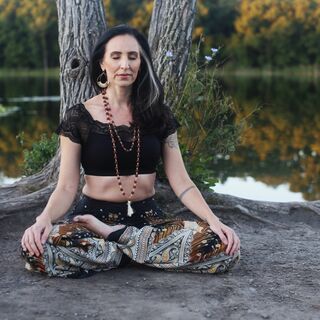
This technique is called Kaya-Sthira,
Which can translate to mean complete steadiness.
It can be used as a preliminary practice to a longer meditation,
Or anytime the body or mind are restless.
It can be especially supportive during times when facing uncertain life circumstances or change.
It's best performed in a seated posture with a spine tall.
So elevate your hips on a cushion so that the hip bones are slightly higher than the kneecaps,
Or sit in a chair with your feet flat on the floor.
Whichever posture you choose,
Rest your palms on your lap and close your eyes.
Attempt to float the roof of the mouth right over the base of the spine.
Then lengthen the space between those two points.
Take a few moments to adjust,
And then relax into a comfortable stillness.
It's important that you take a few moments to get really comfortable,
Because once we begin the practice,
It's imperative that you don't move even the slightest bit.
Don't scratch or fidget.
Try not to even swallow if you can help it.
It's important to remember while we practice Kaya-Sthira,
That you're not holding the body still because you're tense in any way.
You're holding the body still because you're so comfortable,
You're so steady,
That there's simply no need to move.
Sometimes it's helpful to anchor your mind in what the yogis call the root of the body.
For men this is at the perineum,
And for women the tip of the cervix,
Or where the cervix would be.
It's thought that when you anchor your mind in the root,
The root will anchor your mind and help to steady the body.
Once the body is still and you feel the steadiness at the root,
Become aware of your breath gently flowing in and out.
The only thing that is moving is the body's response to the inhalation and exhalation.
You may become aware of sound or things that are moving in the environment around you.
It's true that the world continues to turn even as you sit very still.
But as you relax and breathe to and from the calm steady center of yourself,
It's as if all of that activity out there doesn't distract you,
It doesn't move you.
It's like you're sitting at the center hub of the wheel,
Letting the world turn around you,
But you remain at the calm steady center of awareness.
You may notice that thoughts arise in the landscape of the mind.
Just allow those thoughts to quickly dissipate on your smooth steady inhalation and exhalation.
Again,
As we practice kayasthira,
We practice not getting involved in the movement of the external world or even the movement of the mind or the internal world.
We hold it all in awareness while we breathe to and from the calm steady center.
The more regularly you practice kayasthira,
The longer you'll be able to sit in stillness.
If you need to move or adjust,
It's fine to do that,
But then attempt to return to complete steadiness again,
Allowing your senses and thoughts to come into awareness and then dissipate again on the breath,
All the while holding the body completely steady.
When you feel complete in this technique or that you have achieved some level of steadiness,
You may like to move into another meditation practice,
Or you can simply lower your chin,
Bring your palms together at the heart,
And take a moment of gratitude before moving on with your day.
This completes the practice of kayasthira.
Om Tat Sat.
Namaste.