Welcome.
I'm Janice Martirano from the Institute for Mindful Leadership.
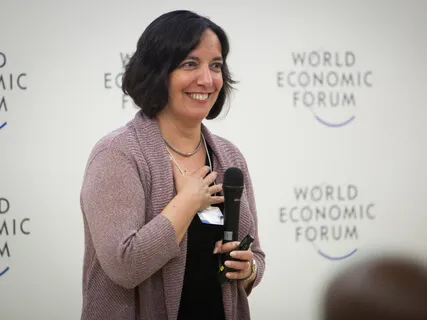
And today I'd like to share with you my experience when I was honored with an invitation to bring mindful leadership teachings to the World Economic Forum in Davos,
Switzerland.
Although I have worked with leaders from all sectors of society who try to keep the big picture in mind,
Even as they set their organization's immediate goals,
Nowhere is the desire to see the big picture and to influence it in a positive way more apparent than at the World Economic Forum.
For one week each year,
The picturesque mountain town of Davos in southwestern Switzerland becomes a meeting place like no other as it welcomes this annual event.
Influential people from every sector of the world community make the trip by plane,
Train and bus to gather in the snowy Alps in January for several days of talking and making connections.
It's a conversation about how to change the world.
In the halls of the Congress Center and in meeting rooms in the town's hotels,
Groups gather to speak candidly about major issues and opportunities evolving in our world.
In workshops and idea labs,
At lunches and dinners,
In the hallways and on the shuttle buses,
These conversations and debates almost always occur out of the range of the eyes and ears of the media.
The fact that media are restricted to certain plenary sessions and participants are instructed not to attribute statements to people by name when they talk later about a session or conversation fosters candid interactions.
It can also cultivate an environment where courageous leadership can flourish.
It's an environment that reminds us of the big picture,
The fact that we are all in this together.
Among the participants are prime ministers,
Kings,
Princesses,
Industry leaders,
Artists,
Social entrepreneurs,
Nonprofit leaders,
Musicians,
Academics,
Scientists,
As well as a group of selected young leaders.
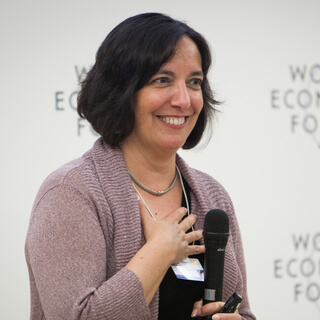
I was honored to be invited to the meeting to share my work in one of the forum's workshops and to guide a morning meditation session,
The first ever offered at Davos.
Preparing for this workshop was a journey that will forever stay with me as I came face to face with the old adage,
Be careful what you wish for.
On the one hand,
There could be no greater opportunity to bring mindfulness training to leaders who could make a difference,
Who could have a very big ripple effect.
On the other hand,
I'd be offering a workshop dedicated to mindful leadership at a time when mindfulness was known mainly as a training to reduce stress or manage health problems,
But only beginning to be known as a critical mind training for leaders.
It was entirely possible,
Perhaps probable,
That training the mind to cultivate a leader's capability to focus,
To see clearly,
To be more creative,
And to embody compassion would be such an unusual idea that few would choose to attend.
Even so,
I knew that mindful leadership training was a critical piece of a person's development as a leader,
So I was fully committed to the opportunity.
When the organizers asked me how I would like to offer the workshop,
I quickly decided that it would be important to have enough time for multiple experiences of the mindful leadership training itself,
Not just an abstract overview.
I didn't want to simply describe the mind training that cultivates focus,
Clarity,
Creativity,
And compassion.
I wanted to offer the opportunity to try it and to engage in some dialogue.
I also wanted a co-presenter who works directly with the neuroscience of mindfulness.
Enter Professor Mark Williams,
Director of the Oxford Mindfulness Center and a professor of clinical psychology at Oxford.
I was honored to be co-presenting with Mark,
An expert in his field.
While I spoke about mindful leadership training and workplace research,
Mark shared some of the neuroscience research that explores how the mind's capacity for seeing clearly and making good decision can be adversely affected by the complexity of modern daily living.
The Mindful Leadership Experience workshop was scheduled on the morning of the first day of the forum.
Offering it early in the forum would allow those touched by the practice to participate in the morning meditation sessions scheduled in subsequent days.
Mark and I arrived early the morning of the workshop and helped the forum staff set up a semicircle of 25 chairs.
Now all we needed to do was wait and see if anyone would show up.
The doors were finally opened and a steady stream of people began to fill the semicircle.
Soon every seat was taken and the staff began to bring in more chairs.
Eventually the room held nearly 70 people and the staff had to close the session.
We later would run into people who told us they were turned away at the door.
So much for no one being interested in how to train the mind.
As the workshop began,
I was struck by who was gathered before Mark and me.
I looked into the faces of those who had come to explore something new and saw a definition of the big picture that I'd never understood so clearly before.
Represented in the room was the very definition of diversity from every imaginable point of view.
Age,
Religion,
Race,
Ethnicity,
Gender,
And more.
These were people with backgrounds and responsibilities that span the spectrum of human endeavor.
From artists to entrepreneur to publishers,
Economists and royalty.
We were all there to learn about and experience mind training that would,
Among other things,
Teach us to feel and to be more connected to our own wisdom,
To those around us,
And to the world in which we all live and lead.
Never had the universal appeal of mindful leadership training been more apparent,
And I found myself taking a moment to just breathe in the experience.
The workshop unfolded as I showed people the diagram that details the fundamentals of leadership excellence.
I spoke about the ways meditation practice and purposeful pauses cultivate and strengthen those fundamentals.
Mark presented cognitive neuroscience research and spoke about the impact of a chaotic world on our ability to make the best decisions and to see things clearly.
Then I spoke about how the Institute for Mindful Leadership had been bringing this training into organizations from all around the world.
Along the way,
We paused to practice meditation,
We paused to explore a reflection on leadership excellence in the 21st century,
And we paused to engage in open dialogue.
The group was bright,
Warm,
And curious.
As with every group of leaders I've ever taught,
The common challenge of leading in the 21st century soon became evident.
Among the most prevalent challenges participants identified was the recognition that we are over scheduled and constantly distracted,
Leaving no space for us to find the most skillful ways to guide or initiate changes.
We multitask even though some part of us knows that so much is lost when we do.
Even when we get things done,
We don't find the time and space to acknowledge the accomplishment,
To debrief with our teams,
And to learn from any mistakes.
There is an adequate space to lead,
Not only in the way we want to lead,
But in the way we need to lead to make a real difference in how we address organizational and global challenges that we face today.
Mindful leadership training is not a nice to have.
It is,
In the 21st century,
Simply a must have.