So if sitting,
Exploring that pivot of the hips going back and forward with the pelvis playing with the furthest you can go back and furthest you can push forward and then finding that center.
Slowly coming to the center and when you find that center you'll feel a lengthening in the spine quite naturally.
You don't have to stay fixed in this through the meditation.
You can always come back to this move into the pelvis once you find yourself slouching to come to that net natural center.
Feet flat on the floor,
Hands on your knees.
So this is the position if you're sitting.
If you're lying down,
Hands palm upwards on your side,
By your side,
Lying by your side.
Legs uncrossed,
Letting your feet just fall to the side.
And if you're lying,
Noticing that space under the lower back.
And experimenting just as you are when you're sitting with centering yourself by moving the pelvis up and down.
Here's this word centering.
The metaphor I like to use for that is like a tube.
It has lots of different sections along the spine down to the feet.
So centering is when we align those tubes so that this energy tends to congregate in the mind as a clear path down into the body.
Of course the mind can't think its way into making this tube align.
Maybe something the body's own intelligence can find.
And it does that by just moving the pelvis until you feel it.
And then the energy that gathers in the head like water can flow down with your attention into the body.
And of course wherever our attention is,
Energy goes.
So we can aid this by focusing on that contact with the ground through our feet.
If we're sitting,
The bum on the chair as well or the cushion.
Even if we're lying,
Just feeling the ground beneath us.
Okay.
When we're present in the body,
Our attention quite naturally kind of lights on the breath without changing the breath at all.
Simply noticing that breathing is happening.
And we can notice this at the nostrils.
But if we're present in the body,
If our energy has dropped,
Flowed down in through the tube into this torso,
Feels natural to focus on the rise and fall of the abdomen.
The attention resting on the rise and fall of the abdomen.
And the stage is set now for us to go a little bit further.
Go a little deeper into this experience of being human.
But you can always return to this breath whenever the drama gets too intense.
So in this little play,
We're going to bring this human experience centre stage,
But we can always return to the seats,
To this seat,
To this breath.
Should the intensity of the play become beyond what we are comfortable with or able to sit with?
Of course,
Sitting in the audience,
If you like,
To this drama doesn't stop the drama,
But perhaps if we can come back to this seat,
To this breath,
It produces a distance so that whatever drama we encounter is not as involving or overpowering.
And what might this drama be?
Well,
It's all there in the body and wherever we notice discomfort.
And there's one particular place where I would like to focus on in this practice,
And that's the solar plexus,
Which is the usual place,
I would say,
For this little ball of anxiety to reside.
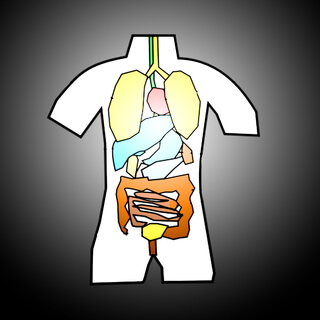
The solar plexus being at the bottom of the ribs,
The centre,
Your stomach.
Or perhaps the small intestine.
And on a physical,
Biological level,
These two parts of the body are most responsible for checking what you let in,
What you take in of the outer world.
We think of our skin as the greatest surface area exposed to the outside world,
But in actual fact,
It's our stomach and our small intestine and our colon has far more surface area exposed to the outside world.
So this is a greater interface with what we experience of the outside world than our skin.
And while we are accustomed to thinking of our skin as being the boundary of where our eye ends and the world begins,
This is not how we encounter our digestive system,
It's inside us,
It's part of us.
So it's deeply intimate,
Deeply felt.
In the solar plexus,
This is the meeting point between our inner world and our outer world.
Of course,
The breath is a taking in of the air,
But we don't have much choice around that.
But we believe we are choosing what we take in through our mouths.
So at this point,
The solar plexus is more connected to the mind and to the belief that we choose things and decide how to negotiate,
How to interact with the outer world.
And the solar plexus keeps the score.
So I'll let your attention rest on this small ball of anxiety in the solar plexus.
Now we're assuming that there is one for you.
There's a continuum of degrees of tension that you might feel in that place.
There are different levels,
Different decibels of communication.
Maybe it's a whisper.
Maybe it's screaming with pain.
Or anything in between.
Can you hear me now?
.
.
So the idea here is not to try and change what we feel there,
Not debate our experience,
Simply to rest in that experience.
And that can be particularly difficult with this part of the body because anxiety,
Tension in the solar plexus is all about resisting.
It's all about rejecting the present moment.
It's all about disgust with what is.
So when we bring our attention to this part of the body,
To this small ball of anxiety in our solar plexus,
Then we're visiting the front line.
And if you're at war with your reality,
It's a battlefield.
When I say your reality very purposefully,
Because your experience depends on your outlook.
And that outlook extends to how we perceive this little ball of anxiety as well.
.
.
So we're going to take this little ball of anxiety on a little journey in the body.
Just as the journey of mindfulness is from the head to the heart.
Learning the energy that so focused on thoughts come down to the heart center.
We're going to take this little ball of anxiety from the solar plexus down to what's called the lower tanteine,
Which is a point just below the belly button.
And it's going to transform from this,
Whatever you visualize this ball to be,
Use the word ball,
But it might be a different shape or color for you.
As we breathe out,
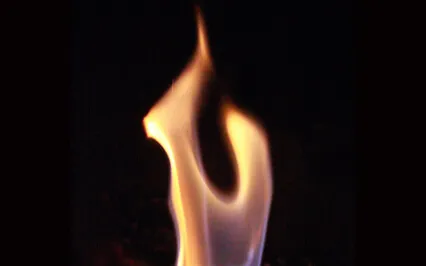
We're going to imagine it moving down to the lower tanteine below the belly button and becoming a pilot light.
Small flame.
Below the belly button.
If you imagine the little ball of anxiety.
In the solar plexus transforming as it falls down into a small flame below the belly button.
.
You can use the metaphor of a fire,
A boiler.
And the chimney is on fire.
Well,
The smoke in the chimney is called to light,
And that's why there's pain there in the solar plexus because the fire is in the wrong place.
The hearth,
The place where it's safe for the flame to burn is in this place just below the belly button.
Tanteine.
This is where we can dance with life from our center.
If we call the solar plexus the stomach and the lower tanteine below the belly button as our belly.
Then the belly is where the fire burns safely.
Where we can interact with the outer world smoothly flowing without the need for thinking.
Without anxiety.
So whenever we notice this little ball of anxiety burning in our stomach.
Can use the breath.
To take it on this journey back down to the hearth to the lower tanteine to the flame.
And watch carefully the quality of your attention that you use to guide this little ball of anxiety down to the tanteine.
It's not a forcing it.
It's a gentle guiding like guiding a blind person across the road or an elderly person across the road.
They simply wandered off into thinking that they control the world and or had control over what is.
You got lost in thoughts.
Gently guiding this burning.
This comfort down to the hearth to the lower tanteine.
Now bringing all the fragments of ourselves.
The solar plexus desperately tries to unite.
By thinking.
Bringing them all to the hearth to the fire.
In the bed.
That there's a puzzle.
Or something.
Something to do before we can arrive or be happy.
All the illusions that create the anxiety.
Dissipate the light of this flame in the belly.
During the day,
Whenever you feel worry.
And it manifests in the belly and the solar plexus sorry,
As the ball of anxiety.
Simply breathe,
Breathe down.
Gently guided down to the tanteine.
To the truth of the matter,
Which is that there is no separation.
So every time.
Notice this little ball of anxiety is an opportunity.
A reminder.
A reminder to remember ourselves.
And our true nature.
An individual at war with circumstances.
We can gather all the fragments of ourselves and bring.
This ball of anxiety down.
To the lower tanteine to sit.
And half.
And the metal ball of the moon is a As you go about your day,
See that,
See if your actions can spread.
Spring from this place in the body,
The lower tantrum.
It's below the belly button,
The lower belly.
When you notice your breathing,
See if you can breathe from this place.
Even if there's no movement down there in relation to the breath,
We can imagine that this is where the breath is coming from,
Just as opera singers do.
And while there might still be pain in the solar plexus,
In the gut,
Each time it's an opportunity to remember to bring that pain down to the hearth of the lower tantrum.
And when you're ready,
Stretching,
Moving toes and fingers.
And in your own time,
Opening your eyes.