Hi,
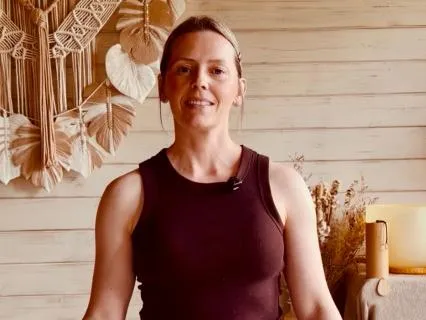
I'm Rebecca.
In this video,
I will be guiding you through a series of active and passive stretches and movements to help to release tension in the neck and also increase flexibility and mobility.
If you have any injuries of the neck,
It is strongly advised that you seek advice from a physiotherapist or any other medical professional.
Associated with your care before continuing with this practice.
It's a really good sequence of exercises if you sit at a desk all day or if you feel like your neck is quite tight and tense in the mornings maybe or you've had a really long day and you just want to connect with the breath and release those tensions that we often sort of gather up through the day.
Maybe you are in rehab from a neck injury and this should help to facilitate that but again just making sure that you do seek that advice before go ahead.
So to get started we will need to be in a comfortable seated position.
You will see that I am raised up on a bolster so you can either sit on a cushion,
You can sit directly on the floor,
However you want to sit where you can lengthen the spine.
The shoulders should feel at ease and soft away from the ears.
We really don't want to be really feeling like we're holding on to keep the spine straight.
We want it to be nice and effortless almost.
So we're just engaging the right muscles to keep the spine nice and long.
So we should have complete free movement of the shoulders,
Of the head and the neck,
Still maintaining that nice strong posture.
Don't worry if you can't find a comfortable seat and don't think it has to be picture perfect in a yoga pose.
It definitely doesn't.
As long as you are comfortable,
That is the main thing.
Thing.
And if you would prefer to do this practice standing then that is also okay.
So you can just stand with the feet about hip width apart,
Soften the shoulders,
Lengthen through the spine.
We do this by drawing the crown of the head up towards the ceiling and the tailbone down towards the earth.
You can imagine that lengthening all the way up the spine and then we can already feel like the neck is starting to release little bits of tension and we can start to feel that the neck will seem a little bit longer because the shoulders aren't hunched up here.
So once you've found your place We're going to start to turn inwards for a moment just to find that focus and be present in the moment.
We don't ever want to rush through these intricate stretches because then we're risking injury.
We want to focus on arriving in the present moment,
Letting go of any distractions and arriving in the body.
So I invite you now to either close down the eyes or soften the gaze.
You can find a focal point.
This Adrishti in yoga.
So you can find something to focus on to keep you mindful and present.
The palms can face down in a gesture of grounding,
Alternatively they can face up in a gesture of receiving.
Let's take five full deep breaths into the belly and the chest,
Full expansion,
Full release on the exhale.
Once you've taken your five full breaths,
No rush,
We'll blink the eyes open,
Mainly so you can see me.
We're going to start to bring some movement in now through the neck.
So we'll start with,
Rather than thinking of these movements as a stretch,
I always say in my classes,
The first few rounds,
We just think of them as a movement.
So it's just mobility.
We're not forcing the body to do anything and creating any resistance.
And we don't want that stretch reflex where the body has that way of sort of pushing you back.
We're just thinking about moving.
Okay.
So we're going to move the head first in a rotation.
Want you to do is just look to the left so you'll mirror me And you're just going to turn the head,
It's a rotation through the neck.
And that's all we're going to do.
We're not moving the shoulders.
We're just moving the head as if you're looking at something over to the left but you can't move the upper body.
We'll hold for one more breath.
And then we're slowly bringing the head back to centre.
The next exhale is going to take you over to the opposite side,
Looking over to the right.
See how it feels,
Usually one side will feel different if there's a little bit more tension in certain areas.
One more full breath.
Slowly coming back to centre.
So just this small movement,
It seems so simple,
But how often do we move the head in this way?
How often do we rotate the head fully to its full range of motion?
We often just turn like this through the upper body.
So it's a really nice way of just connecting with the body through those movements and noticing where you're holding tension,
Where you may not have noticed before.
We're going to stay with that same movement but we're going to bring in some breath work.
We're also going to bring in some eye movements which will help us to go further into the movement and you will be amazed by how much this improves the stretching.
So we'll do a movement to begin with and then I'll guide you when we're going to change that movement into an active stretch.
Long breath in in a neutral position on the exhale we're going to rotate over to the left When you do this,
We're going to follow with the gaze,
So we want the eyes to look behind.
As if you're trying to look at something behind you.
Without turning the body.
Notice what happens in the neck,
It will go slightly further without much effort.
And we're going to hold here for three long,
Slow breaths.
On an exhale in your own time we're going to slowly move the head back to centre.
And we're never forcing anything,
We're just inviting the body to move in this way.
Long breath in at centre,
On the exhale we're taking it over to the right.
So turning the head first,
Then follow with the gaze,
Nice wide eyes,
Looking behind.
Holding for three long,
Deep breaths.
When you're ready,
On a breath out,
We're slowly coming back to centre.
Already you're going to be feeling a lot better in the neck.
So notice how it feels.
When we release the neck,
Quite often we release a lot of tension in the shoulders as well.
You'll see.
We're now going to do the same movement,
One breath,
One movement.
Let's see if we can make it more of a stretch this time.
So without forcing anything,
We're going to try and just push a little bit further,
But we use the breath out that invites softness into the body.
So we then get to go into a bit of a deeper stretch.
So long breath in at centre.
On the exhale,
Rotate the head,
Follow with the gaze.
Long breath out,
Keep going.
Inhale coming back to centre.
On the exhale we're taking it over to the opposite side.
Same movement again,
Follow with the gaze.
Full breath out,
Nice stretch.
Inhaling,
Coming back to centre.
We're going to do the same again three times.
You go in your own time,
At your own steady pace.
No rush,
No pressure.
Notice how each time you're going to go a little bit further.
Two more full rounds.
When you're ready arriving back at centre,
How do you feel?
I sometimes get little cracks and pops even further down the spine.
So just checking in,
Notice how things feel.
Remember,
We still want to lengthen through the spine.
So don't let that upper back get lazy.
Don't let the shoulders hunch.
We're staying with that nice long spine.
This really helps with these movements.
We're now going to go into the side of the neck.
So we're going to stretch the sides of the neck and this is going to take us into the shoulders.
So we're going to start with the left side once again,
Breathing in at centre.
On the exhale,
We're going to draw the ear down to the shoulder.
So we're not tilting the head forward,
We're keeping the head upright and we're just going to tilt it so the ear,
If it was able to,
Would be touching the shoulder.
So we're going to start to feel,
Even just with using the weight of the head to guide the stretch,
We're going to notice a deep stretch happening through the side of the neck.
So let's just hang out here for a few more breaths just to notice how it's feeling.
Maybe you've already noticed a little bit of tension.
If anything is ever painful,
Please just release the stretch or the movement,
Come back to that neutral place.
Maybe give it another try,
But very gently.
If it's not working for you,
Then that's absolutely fine.
Don't force anything.
Pain is the body's signal to you.
To just have a little check in.
This might not be the right movement for you today.
We'll take one more breath here.
And slowly coming back up to centre.
So if you were to look in a mirror now you would notice that the right shoulder has dropped down because we've released the tension in this side of the neck.
We're going to go over to the opposite side on an out breath when you're ready,
Slowly tilting the head.
Checking in,
Noticing how it feels,
Staying with the breath.
Enjoying that release of those little pockets of tension.
We'll hold for two more long breaths here.
Again,
It's a movement,
It's not a stretch,
We're not forcing anything.
Some physio exercises encourage you to place the hand on the head and pull the head down.
We're not doing that today.
We're going slow and steady.
And we're just letting the body have that opportunity to release the tension.
We're going to come back up nice and slowly.
That was probably longer than two breaths,
But it happens.
From here,
We're going to do the same again.
One breath,
One movement like we did with the rotation.
So we inhale at center.
On the exhale,
We're going to drop the head down.
Full breath out.
Inhale back up to centre.
On the exhale drop the head down,
Opposite side.
Breathing in back to centre,
This time let's see if on the exhale there's a little bit more space.
To call it a stretch so we'll go a little bit further see what happens.
Long breath in,
Back to centre.
Long breath out.
Opposite side If it feels particularly tense on one side,
Feel free to hang out for a few breaths before coming back up to centre.
Keep going in your own time,
At your own pace.
Long breath in at centre,
Long breath out to feel into the stretch.
We'll go for a few more rounds.
Once both sides are equal,
We'll meet back in a neutral place.
No rush to arrive here.
Once you've arrived at your center,
We're going to just check in again,
Lengthening through the spine,
Shoulders are nice and soft away from the ears.
Maybe just checking with the hands and the wrists,
Just making sure there's no tension being held in any areas where we don't need to hold tension.
So rather than moving through the movements and stretches really quickly,
We just go nice and slowly because this is where we get real results.
We've got that zone where there's no injury no red zone for injury we stay in the yellow zone.
So a little check-in once everything feels okay and neutral and again anything that doesn't feel right you can just come out maybe take a few little stretches then come back in see how it feels.
Your body,
Your practice,
You know what's best for you.
We'll move on to the next movement.
So this time we're going to start going into the back of the neck.
So we're going to bring the chin down towards the chest.
How it feels through the back of the neck.
If it feels quite tight just come back up,
Have a little breather,
Go back down on a long breath out nice and slowly.
I'm going to keep my head up for this one just so you can hear what I'm saying.
So when you have your chin down towards the chest we're going to hold there for a few breaths Think of it as a movement not a stretch.
It will be a stretch just by default but we're not forcing anything.
When you're ready after a few breaths We're going to bring the head back up.
Noticing how it feels.
Then on an exhale we're going to look up to the sky so the chin comes up.
And here we can actually push the chin out so we get a stretch down the front of the neck and into the throat area like this.
Taking a few breaths with the head up as if you're looking up to the sky.
We're not tilting the head all the way back.
Few more breaths there if it feels okay.
Whenever you're ready,
We'll meet back in a neutral place,
No rush to get there,
Just taking your time.
And we'll invite in.
The sequence with the breath work where we breathe in at centre,
Exhale,
Chin comes down.
Inhale,
Bring in the head back up.
Exhale,
Look up to the sky.
Inhale back to centre.
Exhale,
Looking down.
Keep going in your own time,
At your own pace.
One breath,
One movement.
Each time you go into the movement,
You might go a little bit further,
So the body's starting to open up now,
The fascia's releasing,
The muscles are softening,
We're letting go of those tensions that have been building up through the day or through the night.
So as this happens and the body starts to soften,
You'll naturally go into those stretches.
So it's an active stretch,
But if we hold for a few breaths in each of the positions,
It becomes more of a passive stretch.
So we'll go for a few more rounds and again just making sure that it's equal.
When you've arrived at centre.
Whenever you're ready to release that sequence,
Just a mini sequence.
Then we'll come back to centre,
Checking,
Few breaths,
Maybe noticing how the breath just feels a little bit freer,
It's not as tight up in the chest as it was before.
And then we're going to take a really nice active stretch where we do a full circle through the head.
So we're going to do ear to shoulder.
Then we're going to start to bring the head down and round.
All the way around.
So then we come ear to shoulder on the opposite side.
If it feels okay,
We're going to take it back very gently,
Slowly,
Mindfully.
And then we've got a full circle.
We're going to do the same again in the opposite direction.
So we take it back.
Then all the way down and round.
Meeting back,
Ear to shoulder,
Head comes back to centre.
The alternative,
If it doesn't feel right to look back,
Because it is a very sensitive area,
The cervical spine,
The back of the neck,
It can feel quite sensitive,
Especially if you're not used to doing these movements.
So if it doesn't feel right,
You do a semi-circle,
Ear to shoulder,
Round and down.
Over to the other side and then taking it back round.
If you're doing a full circle we're going to take it the opposite way so ear to shoulder opposite side Then we take the chin down and round.
Ear to shoulder opposite side,
Then we take it all the way back and down.
After the full circle we're going to reverse it so we take it all the way back.
Down and round.
Ear to shoulder,
Then coming back up.
Did you breathe or did you hold your breath?
We want to make sure that we keep breathing.
So if we're doing unusual things with the body and we're concentrating,
You'll notice that sometimes you hold your breath.
So just making sure that the breath feels nice and free.
Long breaths in,
Long breaths out.
So now check in,
How do you feel in your neck?
My neck feels about two inches longer and my shoulders definitely feel a lot freer.
Look out for the video for shoulder release.
And I will see you soon.
Thank you.