A few years ago now,
I did an experiment where instead of listening with the intent to respond,
I would just listen and allow them space to go deeper.
And so when they told me a story,
I would just listen and let them elaborate and go on and skip from one topic to the next.
I wouldn't interrupt to say,
Oh,
I understand,
Or,
Oh,
I've been there.
I would just let them continue.
And even after they stopped speaking,
I would take 3 deep breaths.
And often,
At the end of those three deep breaths,
They would continue with their story.
I would still not be.
.
.
Expected to respond,
They were still talking.
And this practice was something that was born of a more internal practice that I had been doing,
Which was listening to myself.
Listening to my body,
Into my heart,
Into my own thoughts,
Letting them just be and like finding the end of the stream of thought or listening to my emotions and allowing them to move through me.
And I firmly believe that.
The practice of listening internally was what made it possible for me to hold space and listen to people externally.
And the most amazing thing was that my family and friends felt a noticeable difference in my attention to them and in my relationship with them.
They felt like they were really being heard by me.
And I think that.
Our meditation practice today is going to be a practice of Listening.
Because we need to build up that practice internally.
We need to be able to listen.
To ourselves and.
.
.
Everything that's going on inside of us at any given moment in order to show up and listen better to the people in our lives.
And so this practice is going to be a practice of listening.
Not to respond,
But listening to understand and holding space for whatever's going on inside of us internally so that we can show up better for ourselves and show up better for the people in our lives.
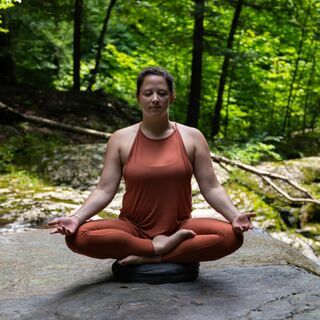
And so we'll begin by just taking a moment to find a comfortable position.
It can be seated,
Standing,
Or laying down.
And as you find a comfortable position,
Taking a little bit of intuitive movement.
Just to settle your physical body.
And when you're ready,
Just finding some stillness.
And just briefly as you begin to settle into a comfortable place.
Find length in your spine.
Extend up through the top of the head and down through the tailbone.
Making space between each vertebrae.
And then after you've found your limit,
Found all the link that you can find,
Just release any tightness or holding in your muscles.
And allow yourself to lean back and into your spine.
Just trust it to hold you upright.
To maintain that length in its own natural way.
And if you haven't already,
You can just gently close your eyes or take a soft gaze.
And allow your palms to be open in your lap or out to the sides.
And the gesture of receptivity.
And as we just gently.
Begin to tune into the breath.
And go inward.
Just take a moment to allow your whole body to soften.
Soften your face and your jaw.
Soften your neck and your throat.
Allow your arms to be heavy.
Hands and fingers are soft and open.
Soften across the chest.
And as you bring your attention to your chest,
Just notice your heartbeat.
That steady pulsing rhythm.
Allow your attention to drop down to your belly.
And release any holding in your belly.
Let it be soft and take up space.
And really allow your breath to move freely through your chest and into your belly.
With each breath,
Just creating a little bit more space and ease and softness.
Throughout the body.
Soften your hips.
And down your legs.
Soften all the way down.
Tops,
Your feet.
Bottoms of your feet.
Soften your toes.
Soft through the whole body.
And then once again,
Begin to bring your full attention to your breath.
Following your rhythm.
With the inhale and the exhale.
And I think that All listening.
Whether that's the internal listening or the listening that we do with others.
Begins from a place like this.
Place of softness.
Of allowing.
And so just allow yourself.
To breathe.
Become aware of.
The voices.
In your body right now.
The voice of your mind.
And all the thoughts.
That are coming up.
That one's the easiest probably for most of us to hear.
A lot of us have a constant stream of thoughts moving through the mind at any given point.
And maybe you've noticed,
But.
.
.
A lot of those thoughts tend to be contradictory.
We think about when we need to get up.
In the morning.
And then we think about why we do or do not want to do that.
We think that we need to eat something for lunch,
And hey,
That leftover thing sounds good.
But actually maybe a salad would be better.
We think about our past.
How things used to be.
In our future and how we'd like them to be.
And in all of this contradiction,
It might feel like.
.
.
We need to find some common ground.
We need to mediate between the two opposing thoughts within our mind or choose one or choose the other.
And realistically,
In order for us to move through our day,
We do kind of have to choose.
There's also value.
And listening.
And allowing all of the opposing thoughts to play out.
The one that wants us.
To eat a certain way and the one that wants us to be healthier.
The one that wants to focus on the past and the one that wants to focus on the future.
And as you sit and breathe here,
I'd like you to just allow all of the thoughts that are moving through your mind.
Just allow them to play out.
And instead of trying to direct your thoughts in any specific way,
Just get curious about their rhythm and their flow and where they take you.
And we're not going to just let our thoughts run rampant and get lost.
But just consciously for a moment.
Following their flow.
And using the rhythm of your breath.
Ground you in this moment.
So if ever you feel like you're getting pulled down a rabbit hole,
Just come back to the rhythm of your breath.
And allow your thoughts.
To just be what they are.
Notice if your thoughts tend to be more focused in the future or in the past.
Notice how often.
Your thoughts contradict each other.
Notice what happens.
And you don't try to hold on to any one thought.
But like a breath,
Just allow it to flow in.
And back out.
Continue listening.
To your own internal.
Narration.
And we'll just add.
One more layer.
To the listening.
So allowing everything that's in your mind to just be.
Maybe begin to notice how your body reacts.
To your thoughts.
And you don't have to be in constant awareness with both your thoughts and your body,
But Maybe follow the train of future thoughts.
And you notice that you feel lighter.
Or you think about something that happened.
Yesterday,
The day before,
And you notice your body feels heavier,
More tired.
Maybe you're tightening in a certain place.
Maybe you're forgetting to breathe.
Maybe you're breathing deeper.
Listening.
To both your thoughts.
And your physical sensation reaction to those thoughts.
You you you.
When you first start.
Practice of listening to understand.
Versus listening to respond.
Can take a lot of doing.
You might have to actively prevent yourself.
From responding.
Like me practicing listening to my friends and The first few times I had to actually hold back.
Words.
And remind myself that I wasn't listening to respond right now.
And often it feels like if we don't respond,
We're going to miss our chance,
Miss our opportunity.
But in reality listening and holding space.
It actually creates more room.
And in the space.
Your thoughts can develop,
Your ideas can change.
And maybe by the time it comes to respond.
You'll respond completely differently.
And the same is true for our internal world.
We might think.
.
.
In the wake of a thought that we don't want to be having,
We should.
Try to get rid of it.
Or change it.
Or immediately contradict it with something better.
But I'm asking.
In the interest of practicing in the interest of experimenting.
That maybe instead you just leave space for that thought.
To move through.
To expand,
To say all it needs to say.
To hear it out.
In its fullest extent.
Give it three seconds pause to make sure it's done.
And then,
Only then.
To respond.
And respond in a way that.
.
.
Deepens your understanding.
Not responding in judgment.
Or in anger or in fear.
But in the interest of.
Getting to know yourself a little bit better.
And so as we come to the end of our meditation today,
Your homework should you choose to accept it.
To practice listening.
Both internally to your own thoughts and their contradictions.
And externally to the people in your world.
Practice listening to understand.
To leave space between your thoughts.
And when you respond,
Respond from understanding.
Gently begin to deepen your breath.
And being to notice the noise in your environment.
Sounds near and far.
Notice the press of the chair or the floor against your body.
And where you are in your space in relation to a wall.
Into a window.
Take a few deeper breaths as you wiggle your fingers and your toes,
Your wrists,
Your ankles.
And then when you're ready,
Just gently open your eyes.
And come back.
Thank you so much for being here today.
My name is Emma,
And hopefully we will practice again together soon.
Bye for now.