Welcome to My Little Corner of the World.
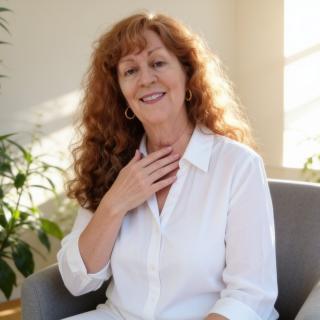
My name is Diana,
And today we're going to go over grounded breathing.
Breathing is a really important component of somatic tapping.
So let's go over the type that we'll be using.
For all of the tapping that we do,
We'll use what's called grounded breathing.
We start with breathing to center ourselves and to feel relaxed wherever we're at.
You can use tapping anywhere.
It doesn't have to be in a chair.
You could be on your bed or even in a swimming pool,
Relaxing against the edge.
But wherever you are,
I need you to settle into that space.
Breathing helps to do that.
There are many different styles of breathing.
And you may find one style more effective for you than another.
It's okay to change things up.
When I mentioned style of breathing,
Some people think,
Well,
Breathing is just breathing.
But really there are different types.
Holding your breath for a count,
Or breathing rapidly and pausing.
And there are many other variations.
People have different ways of using the breath to relax the body.
We're going to be using grounded breathing.
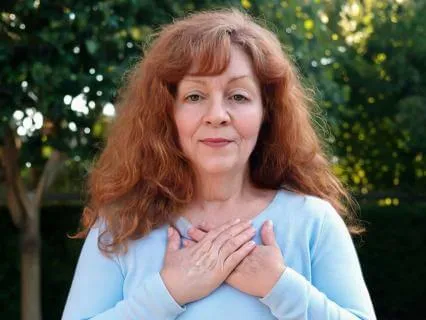
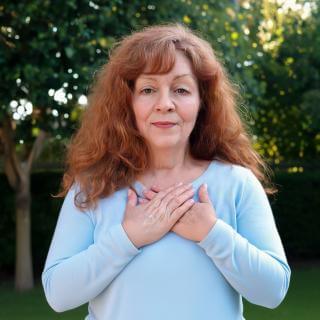
You can either put your arms down by your side,
Or this is what I like to do.
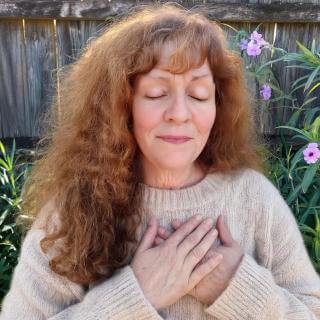
I place them crossed over my heart.
My hands are over my heart.
This is called heart-centered breathing.
The idea is that we have energy running through our body all of the time.
We actually do have an electrical system in our body and our heart uses that system to beat.
That energy is moving through us constantly.
And by placing our hands against our chest,
We are redirecting some of that energy back into the body.
I don't know that it's been proven exactly how it works.
But it's very relaxing.
So give it a try.
There's also a physical reason deep breathing helps us to relax.
Running through the body is something called the vagus nerve.
This nerve plays a big role in shifting us out of a stressed state and into a calmer state.
Deep,
Slow breathing stimulates the vagus nerve,
Which is part of why it has such a calming effect.
Interestingly,
Singing and humming stimulate it too,
Which is why humming a tune or singing along to music can feel so soothing.
So breath isn't just a mental trick to distract us.
There's a real physical mechanism behind why it helps us relax.
Let's put our hands over our chest and take a deep breath in.
Hold it for a few seconds and slowly release.
Take another deep breath in.
Hold it.
And slowly release.
And we'll take one more deep breath in.
All the way to the very bottom of your ribs.
Hold it and slowly release.
This breathing sequence is how we'll start each tapping practice,
Whether it's this one or the others that I'll show you.
Then as we move through the different tapping points,
We'll breathe at each point too.
A deep breath in and release.
One thing you'll notice from doing this breathing regularly alongside the tapping is that your lung capacity may start to expand.
Years ago,
I did a general health screening at a university where I was working.
And as part of this screening,
They measured lung capacity using a breathing test.
By that point,
I'd been using tapping for about 10 years.
The nurse monitoring the test asked if I was a long distance runner or swimmer.
I said no.
I don't do either one of those.
She told me that my lung capacity measured at 110%,
Which was much higher than average.
And she said,
Whatever I was doing,
I should keep doing it.
I told her it was part of a relaxation practice that I use regularly to breathe deeply.
And she said,
Well,
That must be it.
Keep doing the deep breathing.
So breathing is really important.
If you prefer a different style,
Go ahead and use what works for you.
But breathing is part of this somatic tapping process.
Heart-centered breathing and the breathing after each tapping point.
Will be on all of my practice sessions.
There's more to explore.
Join me in learning the tapping points next.