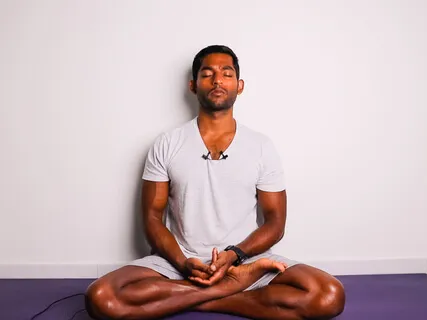
Namaste and a very warm welcome to all of you in this daily live meditation session with me,
Dehansi.
We're going through yoga sutras of Patanjali,
So my salutations to this sacred knowledge of yoga,
My salutations to Patanjali for bringing this knowledge to us and to this opportunity for us to use this knowledge and come out of the prism of our own mind.
Yes,
Our mind is the prism that we live in all the time.
It is the most obvious and the most non-obvious prism that we are always in,
But we never see it.
It's right in front of our eyes,
It's right there,
But we not only see it,
We choose to ignore it and we live in the prism all the time,
Suffering,
Wanting to have freedom,
Wanting to come out of it,
But not knowing how to come out of it and thereby forgetting that we are living in this prism and pointing at different things,
Different causes of our suffering,
Of our misery,
Not really finding why are we suffering.
Patanjali at this stage of his teaching the yoga sutras is now going to pose challenges to what we think,
How we think the world works,
How we think our mind works,
And the very fundamental,
The very foundation of our mind which is reasoning.
When we are caught up in reasoning,
We are caught up in our own minds way of looking at things and we never see things as the way they are.
So you have to understand what is this reasoning that we are constantly caught up in.
You have to catch your reasoning red-handed and see what is this reasoning.
When we are experiencing things,
We are constantly reasoning them out with logic and with our own rationals,
With our own reasoning.
And Patanjali is saying that go beyond this reasoning.
Why is he saying that go beyond the reasoning?
Because this reasoning,
If you observe the process of reasoning,
What you are essentially doing is there are dots,
There are facts,
And you are connecting them linearly.
You are connecting each of the dots with some logic,
Some learned logic,
Some learned reasoning,
And you learn to move in the space,
In this space of awareness that we have,
In this space of experience that we have only with reasoning.
We move from one dot to the other with reasoning,
With logic,
If there is a reason,
If there is a logic,
Or we create our own reason,
Our own logic,
We move in the space and there is a movement of awareness,
There is a movement of mind.
So much so,
And this learning that we have established for ourselves of always reasoning out everything that we experience,
We only are able to move with the reason,
And we miss the picture,
We miss the obvious.
Mooli Shah and his wife,
They were on a camping trip,
They were on top of a mountain,
In the night they had good dinner for themselves,
Had a bottle of wine and slept.
After a few hours,
The wife woke up Mooli Shah and said,
Mooli,
What do you see?
Mooli looked up and said,
I see millions of stars.
The wife said,
What do you deduce out of that?
Mooli said,
Astronomically,
I see there are millions of stars,
So there must be millions of galaxies,
There must be millions of planets,
There must be several other life forms existing in this universe.
Astrologically,
I see that Jupiter is in the Leo,
So I see those who have Leo's sun sign,
They will have positive good times coming up in the next days.
Chronologically,
I see that right now it must be close to 3 o'clock in the night,
Check your watch,
It must be close to 3 o'clock.
Meteorologically,
I see that the sky is clear,
So perhaps tomorrow we'll have a very good day.
Theologically,
I see so many stars,
Millions of stars created by God,
God must be great and we are so small as compared to God.
Then he turned towards the wife and said,
What do you see?
She said,
For a moment she was silent,
Listening to all these logical reasoning explanations.
She said to Mooli,
You idiot,
Do you see that someone stole her tent?
When you are caught in reasoning,
When you are caught in the learned logic,
You miss the obvious.
You may miss the obvious also in your own life.
So what Patanjali is encouraging is to drop the reasoning,
Is to see the process of reasoning,
Is to see that reasoning is a very simple way of connecting the dots.
And the truth may either lie in not connecting the dots,
Or may lie in connecting the dots in multidimensional ways which are not just linear logic or linear reasoning.
He has prepared us with meditation,
With insight,
All this time in his previous sutras to come to this point,
To appreciate and observe that our reasoning falls short of truth.
And while we are learning samadhi,
While we are learning to put our mind at rest,
To bring our concentration,
Our awareness to one point,
To one object,
That's where he brings in this insight that now look that even reasoning is not good enough.
Reasoning is not only not showing you the truth,
But it is actually creating the confusion.
Let us go through these sutras in Patanjali's own words and then we will meditate upon them as well.
Patanjali says,
What that means is,
Sound,
Meaning and resulting knowledge being mixed up is samadhi with reasoning.
Here he is also pointing at those yogis who are putting all the concentration,
Who are making an effort towards samadhi and have this state where the samadhi is there,
The concentration is there,
But it is with reason.
So he is saying that the confusion that you may have even after you have attained samadhi is because of reasoning.
So while your concentration is still with reasoning,
You may be confused about things,
You may still are judging everything,
You may still are interpreting things.
For example,
If you are meditating with the technique that I am all,
I am this whole universe,
I am this whole,
Every atom,
Every piece of this universe,
I am everything because I am universal consciousness.
If this is how you are reaching to samadhi,
There are several other ways how you reach to samadhi,
You still are approaching this with the logic,
With the reasoning,
You still have convinced yourself and with that conviction,
With that reasoning,
You are approaching samadhi.
And that may lead to confusion,
That may lead you to actually start believing in something that is not true,
It may lead you to always be dependent on that reason for the meditation,
For the samadhi,
For your awareness to be one pointed.
So Patanjali is clearly stating in his sutras that when the samadhi is with the reason,
There is still confusion,
Don't take what you see,
What you understand as granted as truth,
You have to go beyond the reason.
This samadhi which is with the reason is called Savitarka Samadhi in Patanjali and there is another samadhi which is Nirvitarka,
So the opposite of it.
One is with the object,
With the reasoning,
The other one is without the object,
Without the reasoning.
Yesterday I described the movement of yoga which is to move from the randomness in the mind to one pointed object and then to move from object to objectlessness.
And now we will use this movement for upcoming sutras for understanding what Patanjali has to say about these different types of samadhis and let go one by one of these obstacles that are coming in the way of us and the truth,
The reality,
The self-knowledge.
Which is first obstacle or first thing that you have to let go once you have samadhi,
Once the meditation is slowly building up,
Is to let go of the reasoning.
Is to let go of this entire process where you are constantly still in reasoning,
In logical thinking,
In figuring things out,
In asserting that that's what you see is the truth,
What is right,
What is wrong.
Wait,
Wait for these logics,
These reasonings to settle and the truth to rise above on its own in your consciousness.
Regarding Nirvitarka Samadhi,
Patanjali says,
The Samadhi without reasoning comes when the memory is purified or devoid of qualities expressing only the meaning.
What that means is when the memory is purified,
What Patanjali constantly refers to as what comes in the way is your own memory.
What is memory?
Your own learnings,
Your own logic,
Your own knowledge,
Your past that you have been carrying,
All the mountain of logic that you carry on yourself,
The reasoning that you always carry with you.
Put that aside,
Move into Nirvitarka Samadhi from Savitarka Samadhi.
From the randomness of the mind to one-pointedness of the mind,
See,
Observe your reasoning,
The process and move beyond that reasoning,
Beyond all those past memories that you have been carrying.
So that when you see,
Your eyes have that clarity to see through things and not only see what you want to see,
What your logic,
What your reasoning is trying to see,
Which is always of the past.
Let us in this meditative silence for the next minutes observe this process of reasoning.
When we will observe our mind,
We will see that we are constantly,
The awareness of the situation is constantly being reasoned out,
Constantly being interpreted.
First of all,
Observe that,
Watch that,
Because in that watching,
In that observing,
There is the way out.
By just simply watching,
Observing,
You see that this logic,
This reasoning falls short and your awareness can move beyond that.
Your awareness can expand beyond the logic,
You can leave the logic and the reasoning behind and be in complete silent awareness of what is.
Let us bring this into our experience.
Close your eyes.
Take a posture that is comfortable for you for the next minutes with your back straight.
The posture allowing stillness of the body,
Not having constant urges to move.
Take a nice deep breath.
Inhale from the nose.
And also exhale from the nose.
Allow your breath to flow naturally.
Make sure there are no irregularities in your breath.
As the breath flows in,
And out naturally,
Your body settles more,
Freeing up your awareness to move inwards.
Observe your mind.
Exhale from the nose.
With every breath,
More and more awareness towards your mind.
And silently observing the mind.
In particular,
Observe that your mind is moving constantly in reason,
In interpretation.
Don't try to change anything.
With every breath,
Remain more and more silent and aware of your mind.
Exhale from the nose.
Exhale from the nose.
As you observe the mind,
The mind settles.
Continue observing silently.
Notice,
Observe that this constant interpretation in the mind has boundaries.
It limits your awareness.
It holds your awareness.
Exhale from the nose.
Notice,
Observe,
Watch.
This space beyond these boundaries of interpretation,
Of reasoning of the mind.
And let your awareness expand in that space.
Awareness expanding beyond the boundaries.
In all directions.
Stay in that expanded,
Open awareness.
Maintaining centeredness,
Stillness,
And awareness beyond the grip of your mind.
Exhale from the nose.
Exhale from the nose.
If you wish to continue in this meditative awareness,
In this silence,
Let everything go.
Remain aware and silent as long as you like.
Hold very gently and slowly.
You may open your eyes,
Maintaining this stillness,
Centeredness,
And awareness.
I will see you tomorrow at 7am Central European Time.
Namaste.