Well,
Hello everyone.
This is Deb Blum here,
And today I want to talk about the journey of aging,
Of getting older.
I want to really set us up to hold the truth of what we really feel,
The fear and the grief and the loss,
Without being swallowed by it.
Because I think there is a way to acknowledge the real and very,
Very human ache of getting older,
Of watching our bodies change,
Of facing uncertain futures,
Without letting that become the whole story of the rest of our lives.
You've probably heard this before,
But I want to talk about the both and.
And I think that that's the doorway that allows us to enter and move through to create the most alive,
Vibrant,
Fully ours lives,
The second half of our lives.
And maybe for some of us,
It's the final third of our lives.
Wherever you are,
Welcome.
When it comes to aging,
And this could be anything,
It could be receiving a scary diagnosis,
Or it could be noticing your body and your mind aren't the same as they used to be.
It could be going through changes like perimenopause or menopause.
I have seen that there are essentially two paths that people walk.
I'm sure there's many more than two paths,
But let's just talk about these possibilities for ourselves.
One is resistance.
I think it's a really common thing to see people walking the path of resistance.
I've certainly seen it in people that I've watched that aged and then subsequently died.
It's this sense of holding on really tight to who we were before that we're so focused on what we could do or how we looked or how we felt.
And on this path,
It's like everything that we can no longer do,
Every loss becomes evidence almost as if life betrayed us.
And the litany grows longer as we get older.
I used to be able to do this thing.
Things were different.
I feel so ripped off.
Why can't I do this anymore?
Who am I if I can't do these things?
And then many of you have probably seen this maybe with your parents or an aunt or a grandparent or a friend.
The ailments become the center of the conversation.
It's almost like the organizing principle of their lives is all about everything that's going wrong,
Everything that they've lost,
All the bad things about aging.
And many people just say,
Well,
This is just the way it is.
This is what aging is.
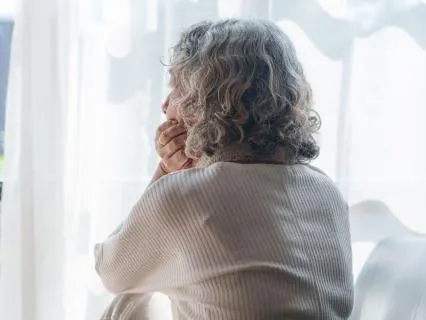
And then slowly what happens is their world shrinks.
It's as if the walls are closing in on them.
I've seen that they literally do become less social.
They become more sedentary.
Their world becomes about things they can control or things that feel easy to fill in the gaps of what they can no longer do,
Like sitting in a recliner and watching TV.
Then there's the second path.
It's definitely not easier,
But it is absolutely richer.
And it belongs to the people who it doesn't matter what's going on.
Real limitations in the face of pain and disease,
A body that just won't cooperate with them,
Tremendous loss oftentimes,
Joint pain.
You've probably seen this one too.
They find a way to stay open,
To adapt,
To even ask the question,
Given what is true right now,
What is still possible?
I want to give you an example of something very near and dear to my heart,
But I'm going to change the story a little bit.
Think of a woman who can no longer walk as far as she used to.
And unfortunately,
It means that she can't do some of the things that she did before.
She can't go with her friends to the flea market,
Or she can't even go to the mall anymore because she doesn't trust herself.
She doesn't trust that she's strong enough or balanced enough.
And she faces a choice.
She can either just stop moving altogether or do those tiny little short walks that she is comfortable doing,
Which then accelerates the very loss that she's afraid of.
It also keeps her from being with her friends and doing social things.
And we know that maintaining a social life and our connections as we get older is incredibly important for our health and well-being and our happiness.
And in my case,
The person I knew didn't ask this question,
But she could ask the question,
What if I got a walker?
Would I be able to go further?
Would I be able to sit on my walker's seat and take a rest every once in a while,
But I'd still be able to do the things that I love to do?
What if I can let this be different,
Not somehow less or problematic?
This is what we call a growth mindset.
It's adapting to challenges and changes.
We know that by doing this,
We improve our life.
We know it.
We've seen it.
It's been studied.
The research proves it.
And we're not talking about something like toxic positivity or pretending things aren't a problem.
That's not at all what we're doing here.
It's really a willingness to keep growing as life changes.
Because if there's one thing we know,
Change is inevitable.
The problem with aging is that it feels like the changes are robbing us from something,
When in actuality,
It's inviting us somewhere.
It's inviting us to realize we are more than our productivity.
We are even more than our physical bodies.
We are more than what we can do.
We are more than what we thought we were.
To me,
It's an invitation to expand into more of who we are.
And it's actually a beautiful rite of passage,
Moving away from what does life expect from me,
Toward what does my soul want from me?
What am I here for?
Who am I beyond all the doing and the performing and the success and the litany of things that we have done?
Now let me go back to the first path,
To the cost of retreating.
What worries me so much about this isn't just the suffering,
Though there is real suffering in that path.
There's isolation,
There's regret,
There's guilt,
There's a sense of feeling like we're never enough.
We question our worth.
We get more grumpy.
I want to talk about what I already talked about before,
About the isolation.
Because when we retreat into our pain and we make it our entire story,
When we focus only on what we're losing,
We slowly lose the thing that nourishes us the most.
Connection.
Either we withdraw,
Feeling like we have nothing left to offer,
Which is totally not true,
Or we do stay in rooms with other people,
But we fill them up with so much pain and negativity that people,
Even the people who love us dearly,
Begin to drift away.
Maybe they're there physically,
But the connection starts to dissipate.
It gets diminished.
And then what happens is we feel even more alone.
What we actually have to offer,
It doesn't diminish with age.
It deepens and it expands.
Maybe you can't remember what happened yesterday,
But you do remember stories from 40 years ago that nobody else can tell.
Maybe you have the softest,
Most present hug in the room.
Maybe it's your love and your depth and your joy,
As well as your hard-won wisdom that is the thing that a young person needs to hear more than anything else that they'll encounter today.
Viktor Frankl,
Who endured circumstances many of us could never even fathom,
Came to the understanding that you can take almost anything away from a person.
Their home,
Their freedom,
Frankly,
Even the people they love.
But you cannot take away the way that they choose to meet what happens to them,
The way that they choose to think about what's happening to them.
The capacity for them to choose.
The way that we can orient ourselves toward meaning,
Even in the most difficult times,
Even in suffering.
And I want to emphasize that's what we're talking about here in aging.
Aging and illness and loss,
They will steal some things from us,
But they can't steal the way that we choose to make meaning of it,
The way that we navigate it.
That's your choice.
That's your choice.
That is a choice.
It may not feel like a choice,
But it is a choice.
I do want to just make one gentle note here,
Because I do work with people in the dementia prevention space.
When there is cognitive decline,
The part of us that allows for this kind of conscious reorientation of our thinking,
It does become compromised.
So this conversation here is about those of us who still have access to that choice.
And most of us here in this moment still do.
So let's be honest about the journey of aging.
It is really a time of loss,
A time of grieving what was.
And I'm not here to negate your experience or to tell you that your experience isn't true and real.
I actually feel the opposite.
Your experience is deeply worthy of your acknowledgement and of your attention and of your care.
But there is a really big difference between honoring our experience and being endlessly narrated by it.
There's a difference between feeling our feelings and constructing an identity around them.
Most of us think that we're feeling our feelings when we're complaining about it,
When we're talking about the stories.
But actually,
Underneath what we complain about,
Underneath all that frustration,
The complaining,
The anger,
Any of the stories about,
Like,
This shouldn't be happening,
There's usually something more tender.
Something that deserves and needs to be seen.
This is loss.
This is the real and the very layered,
Legitimate loss.
The loss of the body we used to live in,
Perhaps the loss of the person we thought we'd become.
Loss of the life that we imagined.
Loss of the people who were supposed to still be here.
Loss of the future that we thought we had locked in.
Loss of the things that we could do.
When I had my kids,
I understood something almost immediately as soon as they were born,
Which was that having them meant letting them go.
That baby who had been held inside of me,
Where it felt like they were mine,
And that I could keep them safe somehow when they were inside of me.
When they were out in the world,
I had to start to let them go.
Let them become who they were going to become.
And every single day of raising them into adulthood,
Where we are now,
It's an ongoing act of letting go.
Of releasing them into who they are,
Not who I imagined them to be.
To notice my fear and let go of the grip that it had on me,
So that I could allow them to experiment.
To be in the world.
Will our own lives ask the same of us?
We have to be able to let go of who we were in order to become who we are.
We have to let go of what was,
So that we can be present to what is right now.
We must let go of the story that we have gripped so tightly about who we should be,
About how our body should feel,
What our life is supposed to look like,
So that we can be free enough to actually live the life that's in front of us.
This life right here,
And the life that's continuing to happen.
This is grief work,
And it's real work,
And I would encourage you to not skip this part of aging.
It is a transition,
And transitions often require grieving.
Now once we've done some of that grieving,
Once we've sat with the loss,
And we've let it really be seen by us,
There's another layer of work to do.
We have to look honestly at our stories.
Every day we tell ourselves stories about what things mean,
And remember we have a choice.
Viktor Frankl implores us to see that we have a choice about the meaning that we make of our lives,
Of a situation.
Perhaps we look out the window and it's raining again,
And our story in our head is that it shouldn't be.
Perhaps as a young child,
You loved the rain,
You loved putting on your rain boots,
And running in the rain,
But now you have a story,
It shouldn't be raining,
It should always be sunny.
As our eyes get worse,
Our story is,
Everything's falling apart.
When our kids don't call us,
The story is,
Nobody cares about me anymore.
When our body aches,
We tell ourselves the story,
That this is only going to get worse.
Now these stories,
They feel like facts,
They feel like we're just absorbing the truth,
But actually they are interpretations,
And that's right,
They're a choice.
They're just one option of things we could be thinking about as it relates to the thing that's happening in our body or in our lives.
Now that's not to say that the pain isn't real,
That's not to say that your disappointment about the kids that didn't call isn't real,
But you can feel the pain,
But you can also choose what you're going to do with it.
You can choose how you're going to think about it.
You can choose to come into acceptance of it.
You can feel disappointment and still show up with kindness to yourself and to others.
You can feel and carry grief around with you and notice joy in the same afternoon,
Maybe even in the same moment,
Because so often we are in the midst of grief and loss and joy and absolute awe.
This is the both and,
And we can either immerse ourselves in absolutes and rights and wrongs and that this is just the way I think,
Or we can recognize the both and.
I have a question I want to offer you,
Actually two questions.
The first one is right in this very moment,
If you fast forward to the end of your life and you look back at it right now,
Would you regret it?
And what would you regret?
And I invite you to sit with that for a moment,
Perhaps write it down,
Journal about it later,
But let's just take one breath for one moment right now and see what comes up.
And then I have another question,
But I want to tell you why I asked this question,
Because when I look back after my kids grew up and moved out,
I would answer the first question and I would say,
No regrets.
I have no regrets,
Truly.
I loved being a mother.
I thought I did a pretty good job as being a mom,
Not perfect,
But that's okay.
I didn't expect that from myself anymore.
But when I asked myself this question,
The answer was different.
This question is,
If you lived exactly as you are now and nothing changed,
And then you fast forward to the end of your life,
What would that feel like?
Would you have regrets then?
I know for me that if I looked at the next,
Say,
Three decades,
I knew the answer was different.
I would have regretted it.
It inspired me to take more responsibility for my life,
To be more intentional,
To show up differently.
The question didn't let me stay comfortable,
Kind of pushed me in another direction.
So let me just pause for one second and I'm going to ask you the question again,
The second one.
If you lived exactly as you do now and nothing changed,
And you fast forward to the end of your life,
What would that feel like?
Would you have regrets?
The first question can sometimes let us off the hook a little bit.
We look back and we feel okay.
We're like,
Yeah,
I feel good about my life.
Maybe not,
But it can.
But the second question asks us something a little bit harder.
Like,
What am I still the author of in my life?
It asks us to take responsibility,
Not even so much for the past,
But for what comes next.
It makes us look at our lives and say,
Where am I not being brave enough?
What is it that I know I want to feel or do or experience that I haven't yet?
And here's what I know to be true.
It's never too late.
I know it might feel hard to believe that,
And it might feel like the grooves are too deep,
Like people would be too shocked if you showed up differently.
I can't do that.
I'm always the grumpy one.
I can't be the one that's laughing and lighthearted.
Like,
You're too set in your ways.
You're too tired.
You're too far along.
But one thing I have learned from my 83-year-old father is that you literally can teach an old dog new tricks.
You can choose to think differently.
You can get curious where you used to close off.
You can reach out where maybe in the past you would have retreated out of fear or discomfort.
Even my dad has learned the art of self-love.
Yeah,
It's uncomfortable at first and might feel unfamiliar and even a little strange,
But that discomfort is not something you're doing wrong.
It's a sign you're doing something new and different,
That we're pushing outside of our comfort zone,
The familiar zone,
And you are allowed to do something new.
I don't know if you need permission,
But here's your permission to do something new at any age and in any season of your life.
And I also want to remind you of one other really important thing.
You have never stopped having something to give.
Maybe it looks different than it used to.
Maybe it's a slower,
Softer,
Quieter gift.
Maybe it's that story instead of something that you do.
Maybe it is that hug instead of the grand gesture.
But as long as you have breath,
You have something to give.
The second half of our lives is not a diminishment.
I know our society makes it seem like it is.
It makes it seem like we're invisible,
That we are unworthy,
That we have nothing to offer.
But that is not true,
And it is upon each of us to stand in our own power and to claim it.
This is a time of deepening and expanding.
It's filled with more complexity and more texture,
More layers than anything that came before,
Because you have lived.
You have lost.
You have loved and lost.
You have shown up.
You've fallen short.
You've kept going.
You have perspective that the younger generations don't have.
You have experiences and stories to tell.
So yes,
Feel the grief and honor the loss.
Acknowledge the fear.
Let it be real,
And let it be seen by yourself.
And also,
Hold it alongside the joy.
Notice the joy.
Make a special concerted effort to notice the joy.
Feel pride.
Yes,
Feel disappointment,
But look back at your life and recount all the beautiful,
Amazing things.
Not so that you can recount all the losses,
But you can have pride for everything that you have accomplished.
You have earned the right to rest.
So hold that loss alongside all the blessings,
Because that holding,
The capacity to carry the full weight of your human life without being crushed by it,
That's wisdom.
That is a strong sense of strength and power.
And that is you.
So today,
I'm inviting you to try one thing.
Not to fix anything,
Not to be different than you are right now in this moment.
Just to get curious about the stories that you're telling yourself and other people,
And also about the feelings underneath them,
About anything that you might be holding onto so tight that's keeping you from being in the present moment,
Where your life is actually happening right now.
So you don't need permission to be here exactly as you are,
But if you think you do,
I'm granting it now.
You don't need permission to change.
I promise you can do it.
You're exactly who you're supposed to be,
And you're also still becoming.
I want you to realize something about you.
You are loved for who you are,
Not what you do.
And if there is ever a more important time to remember that,
That is when we are in our second halves of our lives,
So we can let go of being a human doing and lean into being a human being.
So remember,
You're exactly where you're supposed to be,
And who you're supposed to be,
And you are still becoming.
I invite you to acknowledge that to yourself,
And reveal that to the world,
To the people that love you.
Let other people know that you are relevant,
You are worthy,
And you are here.