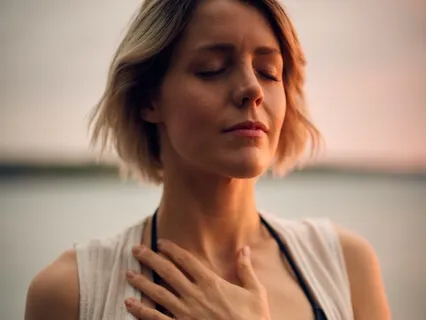
In this guided meditation,
I will lead you through a thorough examination of the breath.
The breath is the most widely used meditation support throughout all of the world's meditation practice traditions.
What is meant by the term meditation support is some aspect of experience that one can return one's attention to again and again.
The reason that the breath is so widely used is because it has a number of special properties.
Firstly,
Everyone has one.
Secondly,
It's always around.
Thirdly,
It's always occurring in the present moment.
Fourthly,
It can be done either consciously or subconsciously.
And fifthly,
Just for fun,
If we stop doing it,
We die.
Another example of a meditation support is a candle flame.
When we compare this meditation support to the breath,
We can see that the breath is simply more practical in order to meditate on a candle flame.
One must first have a candle and then something to light it with.
One must have the right conditions of environment,
Meaning if it's windy or raining,
The candle option becomes impractical.
But as I said,
The breath is always around.
We don't need anything to make it happen.
And it doesn't care what the weather's doing.
So by this explanation,
We see the value of the breath as a meditation support.
And these points alone are the value.
The breath is not magical.
Sitting down and breathing for long periods of time does not bring about enlightenment.
There is more to the story.
Meditation with the breath as the primary focus is usually placed in the category of what is called calm abiding practice.
It's here that the term one pointedness of mind comes from.
But there is a danger here.
One pointedness of mind does not allow for much investigation of one's experience.
One pointedness of mind keeps us firmly on this side of practice known as calm abiding,
But makes it impossible for us to investigate our experience and work within that second category of practice,
Insight.
Insight is the fruit of practice.
Insight is what brings about the cessation of dissatisfaction.
And we must be careful not to mistake a trance-like state of one pointedness of mind as the cessation of suffering.
Why?
Well,
Imagine you develop tremendous skill in bringing about one pointedness of mind.
Imagine that you're able to focus on the breath exclusively,
Easily,
Consistently,
And at will.
This is likely to be a pleasant experience for the reason that the mind will not be off in the past or the future,
Creating all kinds of dissatisfaction.
However,
When you're sitting practices over and you open your eyes,
All of your dissatisfactions are ready to come and bite you in the ass.
If you practice one pointedness of mind exclusively,
You will not learn how to deal with dissatisfaction as it arises.
Now,
This may make it sound as though insight practice is to be prioritized.
However,
Without some degree of skill in calm abiding practice,
It's very difficult indeed to practice insight.
So we develop both together.
As we work with the breath as our meditation support,
We cannot help but examine it,
Investigate it,
Explore it.
We do not need to suppress these observations in favor of one pointedness of mind.
We can simply work towards this condition of calm abiding,
Using the breath as our meditation support,
And enjoying any observations that arise naturally during practice.
So let's begin with three deep breaths,
As deep as we can.
In and out at your own pace.
In and out at your own pace.
Now you will likely have an impression of the condition of the mind as you breathe in.
Breathed in and out three times deeply.
Was the mind focused exclusively on the breath?
Or was there some movement in the mind?
Beware the trap of berating yourself for not having exclusive attention to the meditation support.
This tendency to berate is strongly conditioned in us.
This is of no value here.
Whatever you noticed about the mind was made possible by our use of the breath as our meditation support.
By setting ourselves a sporting challenge,
If you like,
Of paying attention to the breath.
We are enabled in seeing what the mind is doing.
Let's now try 10 in and out breaths of a normal depth.
One time in and one time out counts as one breath.
Let's take up that sporting challenge of paying attention to the breath and see what happens with curiosity.
Let's take up that sporting challenge of paying attention to the breath.
Let's take up that sporting challenge of paying attention to the breath.
Let's take up that sporting challenge of paying attention to the breath.
Let's take up that sporting challenge of paying attention to the breath.
Let's take up that sporting challenge of paying attention to the breath.
Do not be concerned if you're not yet finished.
Do not be concerned if you finished sooner than I began to speak.
It's possible to breathe in so many different ways.
And so I recommend that whatever guided practice you're listening to go at your own pace.
Now as we breathed 10 times,
Again you probably had a sense of what was happening in the mind.
Perhaps you forgot about the exercise altogether.
Perhaps you noticed coarse or fine distractions arising in the mind.
Perhaps you were able to focus on the breath exclusively.
Regardless,
It's the noticing that has the real value.
And so here we have a perfect demonstration of how practicing calm abiding,
Working with the breath,
Enables insight practice.
By working with the breath,
We were able to investigate the mind.
I encourage you to work with this recording until you feel you have a sense of how to continue this practice for yourself.
Once you do,
You can use this practice anywhere,
Anytime.
Practicing in this way,
We cultivate calm abiding.
Abiding in what?
The present moment.
In doing this,
We enable ourselves to investigate.
To investigate what's happening right now in our direct experience.
When we do this,
Insight occurs.
Insight into how things really are.
And the more we understand and accept things as they really are,
The less we suffer.
May we all be free of suffering.