Welcome to week one of the Art and Science of Human Flourishing class.
As you are aware,
Engaging in contemplative practices is a major pillar of this class,
And this meditation today serves as a foundational practice that we will continue to build on throughout the semester.
One of the biggest challenges we come across when we start to meditate,
Or put our attention on anything for a period of time for that matter,
Is staying present on the task at hand and not getting caught up in a variety of distractions that could range from thoughts about the future,
Worrying,
Ruminating about the past,
Daydreaming,
Or lost in the running commentary that our minds create about whatever we're experiencing.
Being able to be aware,
Focused,
Present,
And hold our concentration at will on an object forms the foundation of flourishing in all dimensions of life experience,
Ranging from personal relationships to professional careers.
In order to increase our ability to be present and concentrated,
We need to practice finding an anchor for our wandering attention,
And to train ourselves during the course of a meditation practice to remember to return to it over and over again with a patient and non-judgmental attitude.
Now the most commonly used anchor is the breath,
As the breath is always there whether you are conscious of it or not,
And the sensation of the breath is relatively easy to access.
To use your breath as your anchor,
Just breathe naturally.
Become aware of the experience of breathing and allow your attention to go to the place that the sensation of breathing is the strongest.
Some people find this to be in their nostrils,
Feeling the air entering and leaving the body.
Others like to focus on the rise and fall of the belly or the chest,
While others like to anchor their attention on other bodily sensations associated with the rise and fall of the in and out breath.
There is no right or wrong place,
Only what feels most natural for you.
Now some people find that they feel more grounded by using their body as their anchor,
Particularly at the points of contact between their body and the floor,
Like your feet or legs,
Or the points of contact between your body and the mat,
The chair,
The bench,
Or the cushion underneath you.
Others find that the sensation of their heart beating works best.
If you happen to be outdoors,
Nature can also provide anchors that connect your body with external elements,
Such as the sun shining on your skin,
Or the cool breeze touching your skin.
And additionally,
The sounds in your environment can also be used as anchors.
When indoors,
You may find that the steady sound of a clock ticking or the hum of the air conditioning or heater work for you.
Or if you are outdoors in a natural environment,
You may like to focus on listening to the sounds of birds,
Insects,
The wind,
Or even a body of water.
When using a sound,
It's best to find something that is reasonably constant,
So that it will be there again and again when you return to it.
Now you may find that on different days or on different circumstances,
You prefer one anchor over the other.
Or you may find that once you've chosen your anchor,
That it just works for you and it becomes a staple of your practice.
It doesn't really matter which anchor you choose,
As long as it serves as a reminder to return to the present moment.
We all wander off in thought during meditation,
And the anchor is there to bring us back to the present moment again and again.
When your mind waters off,
It doesn't matter for how long,
Once you notice this,
It's as if you've woken up in the present.
And when this happens,
Return to your anchor and to the experience of the meditation.
Now we'll begin our guided practice.
Begin by finding a stable and comfortable position for your body.
If you are seated in a chair,
Sit upright with your back straight but not stiff,
And your feet planted on the ground underneath you.
If you are seated on a cushion,
Gently cross your ankles or place one foot in front of the other and allow your knees to rest gently as you sit towards the end of your cushion with your spine straight but not stiff.
No matter what position you are in,
Allow your shoulders to be at ease.
Relax the muscles in your face and rest your hands intentionally either on your thighs or together in the center of your lap.
If you feel comfortable,
You can close your eyes or keep them partially open so that light is present but you're not focused on anything in the outer world.
Decide now on what you would like to choose as your anchor.
Will it be your breath,
Your body,
Or the sounds around you?
Make an intention now in your mind that for the next five minutes you will set your attention on your chosen anchor.
Remember now that your baseline state of mind is wandering,
So don't be surprised when those strong mind-wandering forces take you away from your anchor.
Your job in this exercise is to steadily keep your attention on your anchor,
But when it does inevitably get pulled away from your chosen anchor,
Bring it back,
Avoiding getting caught in additional thinking,
Judging yourself,
Or even commenting on the exercise.
Just notice when you are distracted and bring your mind back,
Even if this continually happens moment after moment.
Begin now and focus your attention on your anchor and keeping your posture steady and content for the next five minutes.
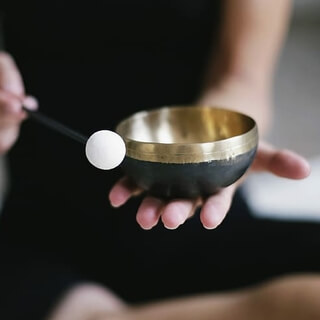
We will begin with three sounds of the bell and allow your mind to rest fully on the sound of the bell from the beginning,
Middle,
And end.
Coming to the kiln of subtraction.
Now either connect with your breath,
Your bodily sensations or the sounds in the environment.
Keeping your mind anchored on these objects again and again and again,
Moment after moment.
And remember that you're not alone.
And remember that your mind getting lost in thought is a totally normal experience.
Just notice when this happens and return back to your anger.
And remember that you're not alone.
Remember to be patient and to avoid judging yourself if your mind gets lost in thought.
Keep your mind steadily on your anger,
The rise and fall of your breath,
The sensations in your body or the sounds in your environment.
And remember to be patient and to avoid judging yourself if your mind gets lost in thought.
And remember to be patient and to avoid judging yourself if your mind gets lost in thought.
Now when you're ready,
You can slowly start to open your eyes,
Begin to reawaken your body to subtle movement,
Stretching gently or massaging your feet if you're seated on a cushion.
Begin to prepare to proceed into the rest of your day.
And remember that you can return to this exercise at any moment throughout your day in an informal practice of stopping and paying attention to your anger of your breath or your body or your sounds,
Just finding that moment to be fully present with your body and your mind.
Thank you for practicing.