Understanding Organic Body Awareness Hello,
I'm Chris Walsh.
We're just going to be looking at the concept of Organic Body Awareness.
Body awareness is central to practicing mindfulness.
When done in an organic way,
It is much easier to persist with this practice and to become more skillful with it.
So let's now explore how organic body awareness works.
You may have noticed that when it comes to awareness of our bodies,
That most of us have dark zones,
Areas of which we are largely unaware.
For example,
It may be relatively easy for you to be aware of a sensation in the big toe of a right foot.
However,
It is usually much more difficult to be aware of a sensation in the second and third toes of the same foot.
That is what I would call a dark zone.
Another sensation many people have difficulty feeling is the sensation of a breath moving into the back.
In fact,
There are many sensations in the body that we are largely unaware of.
As you practice body awareness with mindfulness,
These dark zones and unfelt sensations gradually come into clearer awareness.
In fact,
As the organic body awareness develops increasing subtlety of body awareness,
We begin to be able to feel the toes in detail.
And the breath into the back in a precise manner.
This is not trivial.
As awareness of body sensations is much more helpful than you might imagine.
The most obvious benefit is improvement in physical function.
Both use of the toes and use of the back involve unconscious contraction of postural muscles.
These muscles also contract and relax in an automatic,
Unconscious way when we are doing well-rehearsed activities,
Such as walking or running.
These patterns of muscle contraction and relaxation are what athletes call muscle memory.
This is a significant aspect of what is referred to in the mindfulness literature as automatic pilot.
Unfortunately,
Automatic POD is often not programmed in the most efficient way.
This can happen for a variety of reasons including past injuries.
Muscles often contract around injured areas to protect the site of injury.
Once the injury has resolved,
The muscles often stay somewhat contracted indefinitely.
Once the injury has resolved,
The muscles often stay somewhat contracted indefinitely.
Whatever the cause of inappropriate programming of Automatic Pilot.
This can be undone by bringing subtle,
Non-judgmental awareness into the affected area.
This effectively gives a more accurate biofeedback to the part of a brain controlling the movement.
This will usually result in the nervous system reprogramming this movement to make it more efficient.
For example,
As we become more aware of the sensations in the toes,
It is quite common for the balance to improve.
As we become more aware of the movement in the back,
With the breathing.
It is quite common that unnecessary tension held in the muscles there dissolves,
And spinal posture and flexibility both improve.
The subtle sensations of our body.
Is also important for driving our behaviors.
This is most obvious when we become aware of the body sensations associated with our emotions.
For example,
Anxiety or fear often causes quite unpleasant body sensations such as knots in the stomach or tightening in the chest.
Often,
Without even being aware of these sensations,
We behave in ways that are designed to make those very sensations go away.
Because of the complex nature of the human mind,
These automatic reactions are not always adaptive in a good way.
For example,
You could avoid attending to your tax return because it makes you anxious.
When you decide to do something else,
The unpleasant feelings in your body associated with thinking about the tax are likely to dissipate.
This reinforces your avoidant behavior.
Which could ultimately end up in your problems with the tax department becoming worse.
On the positive side of a ledger,
We often rely on the unconscious feelings in our body to help us to make difficult decisions.
So when we say we make a decision based on gut feeling,
We are often talking literally about our physical experience without actually realizing it.
There is a therapy called focusing that makes specific use of this feeling.
In that therapy,
They call the body feeling associated with a useful insight or a good decision,
They describe it as a felt shift.
When we become more conscious of these sorts of feelings,
We can relate more intelligently to them and use them more skillfully.
An essential part of this is learning to sit with our body feelings without being reactive.
This is part of what we mean by the term non-judgmental awareness.
Of course,
It is easier to do this when the feelings we are experiencing are not overwhelming.
We get plenty of practice with this when we are doing the organic body scan.
Because our awareness becomes more and more subtle,
Many of the feelings that we experience are of low intensity and therefore easy to tolerate.
Moreover,
With the increasing subtlety of our perception,
It is easy to see that our body sensations are constantly changing.
This makes it easier for us to let go of the impulse to fix things.
If our sensations are fluid and changing constantly,
We don't have to try and change something that is unpleasant.
And there is no point in trying to hold on to something that is pleasant.
Instead,
We can witness our body experiences and just enjoy the ride.
As we learn to enjoy the ride,
We actually find ourselves relating to our experience in a compassionate way and with a loving curiosity.
Which is similar to the way a loving mother relates to her baby.
Regardless of whether the baby is happy or sad.
The loving mother remains interested in her baby and derives joy from the interaction.
Similarly,
With this mindful awareness of the body,
We can learn to enjoy the process of discovery regardless of how pleasant or unpleasant the sensations might be.
This creates a deep integration within the brain that develops a healthy sense of personal and social self.
This,
In turn,
Gives us greater steadiness,
Creativity and compassion.
Organic body awareness practices are powerful tools in this process of training our perception.
The archetypal organic body awareness practice is the organic body scan.
The traditional body scan goes through the body centimetre by centimetre,
Usually starting at the feet and moving up the body towards the head.
It is not related to the body's natural patterns of perception and therefore progress can be slow and tedious.
With this approach,
Practitioners often struggle with sleepiness and boredom,
And are more likely to give up before they get real benefit.
The organic body scan,
In contrast,
Relies on the body's natural physiological patterns of perception.
These patterns rely on moving from sensations that are easy to feel,
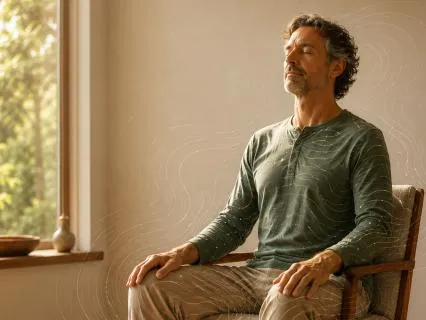
Such as the pressure of a back against the back of a chair,
Into sensations that are sequentially more and more subtle.
In this case,
Once we feel the pressure of the back against the back of a chair,
It is relatively easy to feel that pressure change as you breathe in and out.
And breathe out.
You might give yourself a moment to notice that right now.
From there,
It is possible to feel the edges of your contact with the back.
Movement and physical contact make awareness of a body part much easier.
Organic body awareness practices take full advantage of this simple fact.
So it is easier to stay awake.
And the subtlety of your awareness develops more easily and more quickly.
This practice is inherently more rewarding and more interesting.
To help you stay awake,
The first body scan practice will be narrated for someone sitting in a chair.
The second will be narrated for someone lying on the floor,
Which is the more traditional position.
If you still struggle with sleepiness,
You can try doing the practice with your eyes open.
Or doing it at a time of the day when you would normally be very awake.
If it is still difficult to stay awake,
You might want to start with some of the shorter body awareness practices which focus on body awareness through movement.
These practices also help you to bring mindfulness more fully into your day-to-day life.
So as you practice the organic body scan over and over,
You can enjoy getting to know your body better.
The consequent improved functioning of a musculoskeletal system,
And a healthier relationship that will develop with your impulses and emotions.
As you progress,
You can develop your own body awareness practices,
Which can be relatively brief moments of mindfulness,
Such as noticing what you do with your breath as you stand up from a chair.
Do you breathe in?
Do you breathe out?
Or is it some combination of the two?
Or perhaps you just hold your breath.
You can also do longer practices that are self-guided.
You can simply explore how the breath moves into different parts of a body.
As you do this,
You can learn to pay attention in exquisite detail to sensations in particular regions of a body,
Or notice patterns of sensations that course through the body.
For example,
As your awareness develops,
It is quite common to feel currents of pleasant tingles moving down your limbs or up the back of your head.
In the meantime.
.
.
The accompanying organic body awareness practices,
Including the body scan,
Are a great way to get started.