Hush,
Give aim.
Adonai.
Shalom.
Welcome to the Torah of Awakening Jewish Meditation podcast.
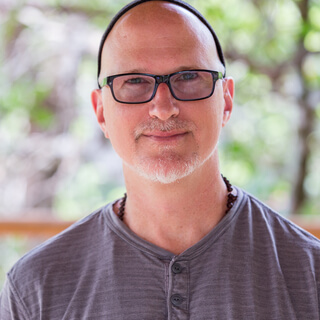
I'm Rabbi Brian Yosef Schachter-Brooks.
Psychologically speaking,
Most of our lives are spent oriented toward the future,
Even if we're not aware of it.
As we go through our days,
Nearly all our activities are aimed at producing some result in the future.
And whether we're aiming at the next moment,
The next week,
Or 10 years from now,
The psychology is essentially the same.
We're motivated to act for the sake of some future fulfillment.
And of course,
That's fine and necessary.
But there's also something we can do which is its own fulfillment.
In other words,
The fulfillment that we're aiming for is not in the future,
But is in the act itself.
And not only is this something you can do at practically any moment,
But the fulfillment that you'll feel is at a much deeper level than anything we seek to accomplish in time.
And by deeper,
I mean that it relates directly to our sense of purpose and reason for being.
And it's incredibly simple.
What is this incredibly simple thing?
That's what we're exploring in this episode on Parshat Beha'alotcha.
We'll look at the inner hints in the text,
And then we'll put them into practice with a guided meditation on the Hebrew letter gimel,
Which represents that sense of wholeness we can find not in some imagined future,
But in the present moment.
Enjoy.
Okay,
This is the verse we're looking at.
It's the opening verse from Parshat Beha'alotcha.
This is Hashem talking to Moses,
Telling him to tell Aaron,
His brother.
And the root of this word,
Beha'alotcha,
Actually doesn't mean kindle or to light a fire.
It means to elevate,
To raise up,
Hinting at what happens physically when you light a flame and the flames are pointing upward.
And then Rashi comments on this from an idea that comes from a Midrash,
Midrash Tanchuma.
When you raise up or kindle the lamps.
And he asks,
Why was the section of the menorah juxtaposed to the section of the princes?
And the princes as a reference to the end of the last parasha,
Parashat Naso,
When they were dedicating or inaugurating the mishkan,
The portable temple that they had there in the wilderness,
They were turning it on,
So to speak,
With a very fancy ceremony.
And at the end of the ceremony,
There were princes that came from all 12 tribes,
Except for the tribe of Aaron,
Except for the tribe of the Levites,
Who were the caretakers of the Mishkan.
They were not involved with this.
But all the other princes came and they brought a series of gifts.
And so Rashi's commentary is beginning with a question,
Why is this section about the menorah and Aaron right next to this section?
About the princes.
And then he answers,
Because when Aaron saw the dedication of the princes,
His mind weakened.
And this is an idiom.
It doesn't really mean that his brain became weak.
It means that he became discouraged.
He became frustrated.
He felt bad.
Because he had not been with them in the dedication.
He wasn't included.
Not him and not his tribe.
Then HaShem says to him,
Trying to console him,
The Holy Blessed One said to him,
Yours is greater than theirs.
Kindle and make good the lamps.
Okay.
So what is this talking about?
On the surface level,
On the Peshat level,
Aaron just feels left out.
He's asking,
He's asking,
Why couldn't I participate in that ceremony?
And Hashem is consoling him.
Don't worry.
What you do in lighting of the lamps is even greater than what they were doing.
But on a deeper level,
Where does this greatness come from?
What does it mean your greatness is better than their greatness?
The hint here is that the greatness that is His,
And not just His,
But this applies to every person,
Each and every one of us,
The greatness that we are becomes visible,
Becomes something that we can know experientially.
That is when we are able to extract ourselves from comparing ourselves to others.
To look outward for validation and learn how to feel into the actual experience of being,
When we make that shift from looking and comparing and judging and seeing ourselves against the backdrop of our mental judgments,
Then it doesn't automatically make us see our inner greatness but it at least makes it possible.
How does it become possible?
There is a hint in this earlier verse from Parsha Tetzaveh,
Which is also about the menorah,
And it's an instruction about bringing the oil of olives for lighting the lamps.
It says,
You should instruct the children of Israel to bring oil of olives and so on and so forth.
But at the end of it,
This is the important part,
Now again,
On the surface,
The continuous kindling of the lamps means that the menorah had to be ignited every day.
And so there's no comparison really between the inauguration of the Mishkan,
Which happened only one time,
Even though it was a fantastic ceremony,
And maybe Aram was a little jealous of that.
Job was to do something continuously from then on.
The lamps had to be ignited again and again.
And there is a profound metaphor here for how consciousness works.
There is an inner greatness,
An inner goodness,
An inner wholeness,
An inner arrivedness,
An abundance that doesn't depend on the world of the senses.
It's a function of what we are at the deepest level,
Because whatever experience arises,
Whatever we perceive,
Whatever we think,
Whatever we feel,
Whatever we do,
All of it is arising within this wholeness.
And so therefore,
Because it's something that's so constant,
It's very easy to ignore.
It's easily eclipsed by all the different things arising in our experience that we tend to focus on.
And so in order to become aware,
Of it,
We have to bring our attention to attention itself.
Bring our awareness to the fact that we are aware and make that little subtle shift from involvement with our thoughts and the drama of life into the perceiving of what's going on,
Which includes the drama of life.
We perceive the drama.
Ah,
There's that thought,
There's that feeling,
There is this activity,
There is that person and doing this,
All of it has a certain energy,
A certain gravity that we can either become absorbed into,
Become involved with.
And in doing so,
We live through the experience of insufficiency.
We live through the experience of lack of wholeness to the degree that we become absorbed and involved in the drama of life.
But as soon as we make that shift,
To noticing the noticing.
And not just noticing the noticing,
But doing the activity of noticing on purpose can make a subtle shift into reframing what we're here to do.
What are we doing here in this life?
Okay,
We're doing whatever task it is that's at hand in the moment,
But what's the deeper purpose?
What's the deeper intention?
As soon as we make that deeper purpose to be the presence with this moment,
Then that quality of presence starts to become available to us.
There's a goodness and a wholeness that has no comparison.
There's nothing like it in the world of time and drama and all of our human endeavors.
It's there,
It's right there.
It's right there,
But it's very easy to obscure,
And so we have to return to it again and again.
And this is the igniting of the ner tamid,
That is,
Continuously,
Again and again,
Lighting that light of consciousness.
And this is also hinted at by that opening word,
Beha'alotcha,
When you kindle,
Meaning when you raise up,
Meaning,
When you elevate your consciousness,
The consciousness that we have right now,
It's always there.
If the consciousness wasn't there,
There wouldn't be anything else there.
And yet it's kind of just in the background of all the drama and activity of life.
But what happens when we make the consciousness the foreground?
When we make paying attention,
When we make being present the main activity,
Then something else becomes visible.
And this is the inner goodness of consciousness.
The goodness of being itself.
Ume Thivetane wrote,
You make good the light.
You make good the light.
Our consciousness is already there.
How do we make it good?
Meaning,
Not make it good,
But plug into the experience,
The perception of the goodness.
How do we come to receive the gift of this goodness?
We do it by paying attention on purpose.
We do it by becoming present.
And this inner greatness,
This inner gedola is represented by the Hebrew letter gimel.
Pointing to this quality of inner abundance of overflowingness,
Sufficiency,
Goodness.
And when we wake up to this,
When we wake up out of the dream of insufficiency,
The dream that there's something that needs to happen in order for us to get there,
In order for us to be complete and recognize the inner wholeness that is already there,
Then we also awaken our sovereignty.
We have this supreme sovereignty which is a gift,
A divine gift,
Gadol HaShem,
This divine greatness.
Shalom Asani Aved,
That does not make me a slave.
We don't have to be a slave to what happens.
We can be the presence with what happens.
We can be the consciousness that embraces beingness moment to moment.
Gadol HaShem Sheh Lo Esani Aved.
And so let's chant the Kavanah for Gimel.
On a long out-breath,
I am overflowing,
I am whole,
I am abundance.
I am overflowing.
I am whole.
I am abundance.
One more time.
Chanting and feeling the vibrations of the words in the body.
Don't worry about whether you're on key or not.
Let your voice open to these words,
Open to this abundance.
Chanting.
I am overflowing.
I am whole.
I am abundance.
Gadol HaShem,
The Divine,
Imparts to us this greatness.
Shelo Asani Aved.
We are not slaves to our experience.
We are sovereign over our ability to become present and to receive the gift and goodness of this presence,
To kindle the lights of consciousness,
To elevate consciousness.
G-d-o-H-a-S-h-a-m Sh-e-lo-ah-sa-ni-ah-ver G-d-o-H-a-S-h-a-m shelo asaniya haved.
Gadol Hashem.
Shalom Asaniyavid Gadol.
Hashem Shelo Asaniyave.
G-d-O,
Ha-Shem,
Sheh-Lo Asan-Ni-Yav-Ed Gadol HaShem Shelo Hasaniyaven.
Gadol Hashem.
Sh'lo asani aved gadol ha'shem.
Shelo Asani Ha'ah and preparing for meditation,
Bringing your body into a comfortable but alert position,
Letting your back be relatively straight.
As if a cord is pulling the top of your head up towards the heavens.
Relaxing excess tension,
And taking an attitude of generous,
Loving offering of your attention.
Bringing your right hand to your heart.
Giving of your presence,
Giving of your loving,
Generous offering,
Overflowing.
Overflowing abundance of presence with l'cha deep breath in L'chaim and bringing your left hand to your belly.
Offering this awareness downward into the inner space of your body,
Filling your belly with consciousness,
Permeating your organs,
Bringing gratitude and healing to all the cells of your organs.
And flowing down from there.
Awareness moving down your legs,
Flowing all the way down to your feet.
Feeling down into the floor,
Into the earth below,
The presence of this planet,
Supporting supporting this temple of consciousness that is our body.
Awareness rising up from your belly,
Chest,
Upper back,
Shoulders and neck.
Releasing any excess tension,
Awareness flowing down through your arms,
Down through your hands and fingers,
Connecting back to your heart and belly.
Feeling deeply into the sensation of the flow of your breathing.
Each breath.
A kiss from the divine,
Each breath enlivening,
Giving this gift of life.
And awareness flowing upward into your face.
Facial muscles,
Brain and nervous system bringing little smile to your lips,
Being the loving benevolent indwelling presence,
Life in the body and affirming.
Naase,
On a long out breath,
Deep breath in.
Naase.
And bringing your right hand up from your heart to lightly touch your forehead as the awareness filling your body shines outwards into the space around you.
Coming to rest on the sounds vibrating in the air.
Everything inhabiting the space around you,
The objects,
The beings,
Walls,
What are beyond the walls,
Whatever is there in your space.
And recognizing that all of the world as it appears to you is appearing inside the field of consciousness.
This field has no boundary,
No border,
No shape.
It's just a vast,
Bright radiance.
And your inner thoughts and feelings,
Your inner world also appearing in the same field.
One experience.
One tapestry of richness in this moment.
And who are you in all of this?
Are you not the field?
Are you not the openness?
The radiant space of consciousness itself.
And affirming vanishmaan,
A long out-breath.
Deep breath in Venishma Kissing your fingers,
Relaxing your hands.
Ribbono Shelo Lam.
Bless us to meditate deeply and powerfully.
Bless us to receive this gift that you give,
This gift of being.
And this opportunity to recognize,
To wake up to this inner goodness,
This inner abundance ever available and yet easily obscured.
Reveal it,
Hashem,
In this moment as we chant,
Atahu,
Atahu,
You who are not separate from anything or anyone,
You who are not separate from this awareness,
We are Atahu.
Atiyahu Atiyahi.
You are the divine.
You are existence.
You are reality.
You are being.
Atahu.
Atahu.
Atyaho Atyahe ATAHU Atahu.
A-T-Y-A-O Aadhyayi Atahu.
Ataru Atyaho Atyahi Ataho Atau Atau Atai Atau Atau Atahu,
Resting in the silent repetition.
Atahu,
Everywhere we turn we come upon being,
This consciousness that turns.
Is itself not separate from this divine reality.
TAHU.
.
.
Coming into silent meditation.
Amen.
And coming back from the stillness,
Bringing some movement to your body,
Taking a nice stretch.
Rabbana Shalom.
May we be grounded in this inner goodness,
This inner vastness,
This inner abundance that is actually the quality of consciousness that we are.
If we would just remember to do that activity of presence,
Whatever else it is we're doing at the same time,
Together with all of it being that presence.
Being that consciousness.
That inner goodness.
Oseh shalom b'mromav,
Hu ya'aseh shalom oleinu,
Ve'al kol Yisrael,
Ve'al kol Yoshevei tevel,
V'imru.
Amen.
Shalom.
I hope you've enjoyed this Torah of Awakening.
I'm Rabbi Brian Yosef Schachter-Brooks.
Until next time,
All blessings.