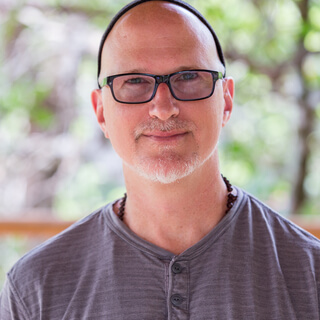
Welcome to this special Passover episode of the Torah of Awakening podcast exploring the deeper potentials of consciousness through Jewish meditation,
Kabbalah,
And Hasidism through an integral lens.
Integral means recognizing that we need to integrate traditional wisdom that comes to us from the past with new insights and new worldviews that are constantly emerging.
I'm your host Rabbi Brian Yosef Schakter-Brooks.
In this episode we'll look at the festival of Pesach as a map for inner liberation and how to achieve it.
We'll then see how it's reflected in the Torah reading Parshat Tzav by Yikra Leviticus 6.
1 through 8.
36,
As well as the Sphira of Chochmah on the Tree of Life.
We'll then move into guided meditation,
A Hebrew chant for Chochmah,
And quiet meditation with soft piano music.
You can pause the recording at that point to meditate in silence without the piano if you like.
Before we begin,
I'd be so grateful for your support by giving a good rating,
Leaving a review,
And joining the Torah of Awakening group so I can let you know about live events here on Insight Timer along with other updates.
And now,
On with the episode.
Enjoy.
As we approach Pesach,
The festival of liberation,
Let us look first at this verse with which the Torah sets up the Passover story.
V'ya'avidu mitzrayim et b'nei Yisra'el b'farech,
Egypt enslaved the children of Israel with crushing servitude.
Shemot,
Exodus 1.
13.
One question we might ask about this verse is,
Why does it need to emphasize that slavery,
Avdut,
Is farech,
Crushing servitude?
Why is it not enough to simply say slavery since we already know that slavery is crushing servitude?
To understand,
There are three hints in the verse.
But first,
There is a teaching from Rabbi Simcha Bunim on a different verse,
Shemot,
Exodus 6.
6,
That can shed some light on this.
V'hotzeiti etchem mitachat sivlot mitzrayim,
I will bring you out from underneath the burdens of Egypt.
Rabbi Bunim expounded,
Why is it that the word sivlot,
Burdens,
Is used here rather than avdut,
Bondage?
Why doesn't it just say avdut?
Why does it instead say sivlot,
Which means burdens?
It is because Israel had grown accustomed to bondage.
When God saw that they no longer felt what was happening to them,
God increased their suffering,
Causing the avdut to become sivlot,
The bondage to become a felt burden.
Only then could the desire for freedom be born and redemption from bondage begin.
Now we can see why both the words are used in our opening verse,
V'yaavidu,
Enslaved,
And pharech,
Crushing labor,
Because the state of being in bondage had to first be felt as crushing before there could be the motivation to do the work to get free.
Why is this important?
Because this is not just a story of literal slavery from 3500 years ago.
It is a story about our own inner state right now.
Ordinarily,
Our inner state tends to be one of avdut,
Of bondage or slavery,
Not to an external oppressor,
But to our own thoughts and feelings.
The problem is,
We don't notice it.
Not because we don't suffer.
We do.
We have plenty to kvetch about,
Plenty to complain about,
Plenty to judge.
But rather because we don't look to our inner state as the source of our suffering.
Instead,
We focus on the many real external problems,
Problems that we need to address for sure,
But that are not ultimately the source of our inner avdut.
But to recognize this,
The avdut has to become pharekh.
Inner bondage must be felt as a burden,
And this is the aim of meditation.
We can see this in the meaning of the word pharekh,
The root of which means to break apart or fracture,
Hinting that when we are enslaved by our thoughts and feelings,
There is a fracturing of reality itself as it appears in our consciousness.
Let's do an experiment.
Consider,
In this moment,
Everything is as it is.
Aha!
Relax the mind.
Relax the momentum.
Consider it right now.
Everything is as it is.
And your consciousness right now is meeting whatever is appearing within it.
Your sensations,
Your feelings,
Your perception of what is around you,
Feelings in your body,
Whatever thoughts are arising,
And so on.
As long as consciousness simply meets what is without resistance,
Notice there is a wholeness to everything.
The feeling tone of this moment is one of wholeness,
Isness as it isness.
But,
When something unpleasant arises,
Whether external or internal,
It doesn't matter,
Because all experiences arise as perceptions within your field of consciousness,
There is a tendency to contract and resist the unpleasantness.
That's the first hint in the verse,
The word pharekh,
The tearing apart of reality,
Because now there's me over here resisting that over there,
Even though the over there is an impression in my own consciousness.
It is in fact a form of my own consciousness.
This move from wholeness to an opposing position,
To me over here resisting that over there,
Implies a kind of contraction,
Because now,
Rather than simply being the space of awareness within which all experience happens,
You become a finite entity,
A me resisting that.
And this brings us to the second hint in our verse,
The word mitsrayim.
Mitsrayim means Egypt,
But it comes from the root sar,
Which means narrow,
Probably because Egypt was built along the narrow Nile River.
But metaphorically,
It means that to be a mitsrayim is to be in a narrow state.
The native and full spaciousness of your consciousness gets contracted into a fixed point of view,
The limited me called ego.
And what is the basic activity of ego?
Ego tries to control things in order to recover the wholeness it lost.
That's the basic hallmark of ego,
That feeling of incompleteness,
And with it the impulse to change things in order to be okay.
But that egoic feeling of incompleteness comes from the contraction into a mitsrayim state that happens spontaneously in reaction to pharech,
That is reactive suffering that breaks apart the wholeness of the moment.
And this brings us to the third hint in the verse,
Vayavidu,
Which means enslaved.
The arising of suffering,
Represented by pharech,
Which causes the contraction into ego,
Represented by mitsrayim,
Is obviously not something we consciously choose,
It seems to just happen to us.
Vayavidu mitsrayim et b'nei Yisrael,
Egypt enslaved the children of Israel.
In other words,
Give yourself a break,
We don't do it on purpose.
That contraction just seems to grab us and enslave us against our will.
And yet on a deeper level,
Yavidu is a form of the word avodah,
Which means work or service not in the negative sense of slavery,
But in the positive sense of prayer and meditation,
That is spiritual practice.
The hint here is that the experience of suffering and the spiritual bondage that comes from it has a purpose,
And that is to motivate us toward avodah,
Toward a path of liberation.
Because it's only from experiencing and getting caught in all kinds of spiritual bondage,
And then finding your way out of the bondage,
That you can grow in the spiritual sense.
A baby in the womb is already whole and one with all being,
But it's not liberated because there's no appreciation of the wholeness.
In order to know liberation,
You first have to taste bondage.
The danger of course is that the experience of bondage,
However it manifests for us,
Can seduce us into a negative attitude and we become resigned to our stuckness.
This is so common.
I might even venture to say that this is the state of most adults.
That's why the Passover Haggadah quotes the Torah verse,
That you remember you're going out from Egypt all the days of your life.
This verse urges us to constantly remember that our basic nature is freedom,
Reminding ourselves every day and even every night.
As Ben Zoma interprets in the Haggadah,
All of the days of your life means nights as well.
So how do we do this?
The practice for remembering the going out from Egypt in the day and the night is the chanting of the Shema,
Which affirms God as the unity behind all being,
So that we may consciously and intentionally receive the fullness of the moment as it is,
And in doing so,
Recover our essential wholeness.
Again and again,
We get pulled into the pharech,
That involuntary suffering of contracting into the egoic Mitzrayim state,
But if we remember that Hashem echad,
That reality is one,
We can relax the inner contraction and find our way back into harmony with the moment.
There is a hint in our parasha,
Parashat Tzav.
It says that the priest should take the mincha,
The grain offering or gift offering of grain,
As karata ladonai,
And burn its remembrance on the altar as a pleasing fragrance to the divine.
Now the image of burning has two main aspects.
On one hand,
Fire creates light and warmth,
Which are necessary and pleasurable.
On the other hand,
Fire burns and destroys.
It can be dangerous and painful.
In other words,
Fire is a metaphor for life itself,
Beautiful,
Pleasurable,
And also incredibly painful at times.
But if you offer your attention unconditionally to whatever is present,
Your awareness will burn on the altar of the present moment.
Your connection to this moment in the face of both pleasure and pain is like a pleasing aroma.
Bringing the remembrance of the divine oneness from which everything arises and into which everything disappears eventually.
This oneness of reality is mirrored in the microcosm of our own consciousness,
Represented by the sphera of chokhmah,
The boundless open space of awareness within which all thought,
All feeling,
All creative intelligence arises and disappears.
So this dimension of our being,
The space from which all experience emerges,
Arises,
And falls back,
Represented by the sphera of chokhmah,
Is the deepest level of who we are.
It's also the source of creativity,
Of insight,
Of newness,
Of freedom,
Of getting unstuck.
Imagining a different way,
Imagining a new path instead of falling into and being stuck in old patterns.
And so we can affirm together with the words,
I am imagining,
I am creative,
I am spaciousness.
Let's chant,
Letting the words vibrate in the body.
Let's chant the words one more time now that you're used to it.
And our chokhmah chant from Psalm 111.
Reshit chokhmah yirat Hashem,
The beginning of transcendent spacious consciousness,
Is awe of existence,
The miracle of the moment.
Wise understanding comes to all who practice this.
Praises to that,
That mystery.
That nameless one that we name anyway.
Remembering to feel the vibrations of the words in your body.
Let the chant itself bring you into greater spaciousness,
Prayerfulness,
And presence.
And preparing for meditation,
Checking your body to be comfortable,
Unencumbered,
But also alert.
Bringing forth an attitude of generous offering,
Offering your attention,
Your presence from the heart.
Bringing your right hand to your heart,
Offering attention unconditionally with deep breath in.
And bringing left hand to your belly.
Awareness dropping down into your body.
Relaxing the movement of the thinking mind,
Bringing your attention downward.
Awareness permeating your organs,
In your belly,
In your torso.
Awareness flowing down,
Down through your legs,
Down to your feet,
Your ankles,
Your toes.
Awareness rising up.
Chest,
Upper back,
Shoulders,
And neck.
Relaxing any excess tension there.
Arms,
Hands,
And fingers.
Taking a nice,
Deep,
Conscious breath.
Allowing the sensation of the flow of breathing to draw you down deeper into the body.
Rising up,
Face,
Facial muscles,
Brain,
And nervous system.
Bringing a little smile to your lips.
Lifting into a smile to express this basic benevolence.
Loving presence in the temple of the body.
And affirming with na'ase.
A deep breath in.
And bringing right hand to lightly touch forehead as awareness opens up into the space around you.
Aware of the room,
The feel of the room,
The objects,
Shapes,
Light,
Sounds vibrating in the air.
And knowing that you are the open space of consciousness within which it's all appearing.
Outer world,
Inner world,
All happening within this space.
And you are this space.
V'nishma.
Deep breath in.
Bless our practice.
Help us to remember moment to moment.
To return to our focus of resting awareness in the vibration of the tefilah.
Atyahu.
Atyahu.
You who are not separate from anything we encounter.
You who are not separate from this sentience,
This awareness that we are.
Atyahu.
You are reality.
You are the divine.
Atyahu.
Resting in Atyahu.
Giving the body a stretch.
Atyahu.
And closing the meditation,
Bringing your right hand to your heart,
Offering your attention with lecha.
Deep breath in.
Into your belly,
Feeling awareness,
Consciously inhabiting the inner space of your body.
And bringing right hand to your forehead,
Opening to the space around you,
Being the open space of awareness itself.
V'nishma.
And in this auspicious time of Pesach,
Festival of liberation,
In this month of spring,
May we be inspired to bring more attention and perhaps self-discipline,
Perhaps consistency to our practice in order to open up that recognition of ourselves as the space of awareness from which new options arise,
From which creativity arises,
To take the path that will lead us beyond whatever the present Mitzrayim is.
V'alko Yisrael,
V'alko Yoshvei Tevel,
V'imru.
Amen.
I hope you've enjoyed this podcast and that it enriches your Passover experience.
If you have,
You can help support by giving a good rating,
Leaving a review,
And joining the Torah of Awakening group so I can let you know about live events here on Insight Timer along with other updates.
Until next time,
All blessings.