If we can be the presence that beholds the distraction,
That beholds the darkness,
That beholds the depression,
Whatever it is.
Then we can recognize that it actually has no power over us at all because that awareness is infinitely more powerful.
Than anything that can distract us.
And so in this sense.
.
.
It's true.
The barrier,
The obstacle actually is the path.
Hush,
Give a name.
I don't know Welcome to the Torah of Awakening Jewish Meditation podcast.
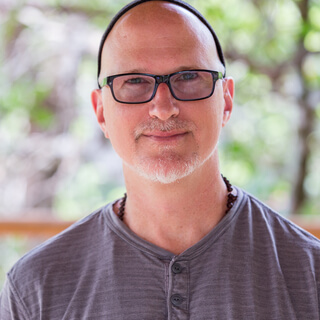
I'm Rabbi Brian Yosef Schachter-Brooks.
Spiritual awakening can be a radically different experience of yourself and your relationship to life.
Whether you've tasted it in the past and you yearn to get back to it,
Or you've never fully tasted it but you think you want it,
The tendency is to see things that are painful,
Stressful,
Or even sensual and desirable,
All as obstacles to that transcendent spaciousness and inner freedom that we call enlightenment.
But this way of thinking is actually what keeps you stuck.
The truth is that whatever obstacle is in front of you is itself your portal to the eternal if you know how to unlock it.
That's what we'll explore in Parshat Pinchas,
Followed by a guided meditation on the Hebrew letter Kuf,
Which represents that transcendent holiness just on the other side of the world link.
Coming today to Parshat Pinchas.
Parshat Pinchas begins in the aftermath of the incident at the end of the last Parsha,
Parshat Balak,
In which the Israelites are seduced into an idolatrous orgy.
What happens is the Moabite and Midianite women begin tempting the Israelite men and enticing them to worship the idol Baal Peor,
Causing a plague to break out among the Israelites.
When Zimri,
An Israelite chieftain,
Publicly brings Cosbi,
A Midianite princess,
Into his tent,
Pinchas kills them both,
Bringing the plague to an end.
Then,
At the beginning of this parasha,
HaShem ironically rewards Pinchas for his retribution by giving him what's called the covenant of peace.
Okay,
So the natural question is.
.
.
What is this covenant of peace?
That is given to someone who just committed violence.
What is this about?
So here's our verse talking about that.
Pinchas ben Eleazar ben Aharon,
Hakohen.
So Pinchas the son of Eleazar,
The son of Aaron the priest.
Has turned back my wrath from the children of Israel by avenging my vengeance among them.
So that I did not destroy the children of Israel in my vengeance.
Or a more,
You should say,
Hineni.
Behold,
Check it out.
Noten lo et briti shalom.
I grant him my covenant of peace.
So.
Across the centuries.
Many commentators have wondered about this,
This strange irony of this little piece of Torah.
This is Rashi's answer.
He says something just very simple.
Okay,
That doesn't really explain it.
Then he explains it.
So it's just like a person who shows gratitude and friendliness to one who has done them kindness.
So the use of the word peace here is really just an expression of gratitude.
It's not meant to be ironic or in contrast to the violence because Pinchas did something that helped Hashem not be violent himself.
Self,
HaShem's self.
Ahaf kan,
Pei rei shlo haKadosh Baruch Hu,
Shalom otav.
And so he expressed his peaceful feelings to Pinchas.
So that's Rashi's answer.
Now,
Ibn Ezra.
Is concerned with something else here.
He's concerned first with what's the meaning of B'riti Shalom,
Because you could read that,
We've been translating it as covenant of peace,
But the word of is not 100% determined,
Because B'riti Shalom could mean my covenant is peace.
The implication of the word of,
He feels like he first has to prove that.
So he says,
What does that mean?
My covenant.
Breach shalom.
It means of peace.
And this is like Kemo Kisachah Elohim,
Where it says in Psalm 45,
Your throne Elohim.
So in that case,
Obviously it doesn't mean that your throne is God.
The throne isn't God.
Obviously it means the throne of God.
So he's giving that as an example.
And then he says,
There are many such examples.
Examples,
The raw beam cane,
Where you have.
.
.
You have two words like this and the word of is implied.
Okay.
So he's just talking about the words,
But then it says,
It's meaning is that Pinchas should not fear the brothers of Zimri.
So the idea here is that if Pinchas kills Zimri,
Which he did,
Then maybe the brothers would come along and try to kill him.
And so the meaning of the covenant of peace in this case is just that Pinchas is going to have peace.
He's not,
He's going to be safe from the retribution.
Distribution of the brothers and that's it.
Okay,
So let's look though at a deeper level of what's going on here.
So have you ever felt clear in your intention for something and you're moving forward with it and you're approaching success and you're feeling good about yourself because you've done things in time to bring you closer to the fruit of of your intention,
Whatever it is.
And then when you get close,
Something comes along and really thwarts you getting across the finish line.
Maybe just take a moment to think about that.
Has that ever happened to you?
It could be just a distraction,
Like,
Eh,
I'll get to that later because this other thing is enticing me right now.
Or it could be something a little darker.
It could be a kind of depression or a self-doubt.
Who am I to really accomplish such and such?
This happens.
So to me,
This is what the story is really about.
Because what's going on,
The Israelites are on the bank of the Jordan.
They're just about to enter into the promised land.
And now they're going to do another.
Golden calf in a sense.
They're going to worship an idol and have an orgy.
It's not exactly congruent with what they're about to do.
It's like they get totally seduced or sidetracked this huge obstacle comes into view.
So how do we deal with such things?
What's the key?
To overcoming.
These powerful forces,
Whether they seem to be external or an internal mood,
And remain rooted in and carry out what our deeper intention is.
And this could be spiritual,
Or it could just be any kind of mundane intention.
It's the same dynamic,
Actually.
So there's a wonderful Talmudic passage I want to show you.
So this is from Sukkah 52a.
Okay,
So what is the Yetzir Hara?
That's a word for the obstacles,
The adversary,
The thing that seems to distract us,
Hold us back,
Convince us that we can't do it,
We're not worthy,
Or we're just too lighthearted about it,
Or we're giving up on our intentions.
Past seem like a high mountain.
So the implication here is that they feel wonderful that they were able to climb such a high mountain and they were able to overcome the obstacles.
But the wicked,
People who are not so able to do that.
They will appear like a hair's breadth.
They're just like a little tiny hair that ensnared them.
How could I have been ensnared by such a tiny hair?
And both of them,
These and those,
Will weep.
And so they're weeping for different reasons,
Right?
Because the Tzaddikim are weeping for joy and gratitude that they were able to overcome this Yetzir Hara.
And the Rishaim are weeping because,
Oh,
How could we have been ensnared by such a tiny little thing?
So it's interesting.
You have these different kinds of imagery for what it means to weep.
To overcome obstacles in this passage,
It starts out that the Holy One is slaughtering the Yetzir Hara.
So that's kind of like the Pinchas image.
It's like a violent image.
He's slaughtering it before them.
But then when the Tzaddikim and the Rishayim see what the Yetzir Hara is,
It's really not a violent image at all.
It's like a tall mountain that you overcome because you have intention,
Because you work towards your goal.
And on the other hand,
It's also has no power at all.
So what does this mean that on one hand you have to work,
But on the other hand,
You have to know that it cannot overcome you.
The idea here is that there are these two vital things we need,
And that is intention or will and consciousness.
We have to have the will to not be distracted,
To not be seduced by something either positive or negative,
And to be able to stay the course and walk the path,
Walk that holy path,
If it's a spiritual intention we're talking about.
So talking specifically about spirituality,
We can get seduced by darkness,
We can get distracted by things that we want or things we're trying to avoid.
And yet that if we're able to have the will then we can overcome it,
Because really it's just like a hair.
It's like nothing,
Actually,
If we can recognize that.
And so that's where we have to apply our will first.
Our will is not,
First of all,
Applied to particular things we have to do,
But rather just applying our will to being consciousness.
If we can be the presence that beholds the distraction,
That beholds the darkness,
That beholds the depression,
Whatever it is.
Then we can recognize that it actually has no power over us at all because that awareness is infinitely more powerful.
Than anything that can distract us.
And so in this sense,
It's true.
The barrier,
The obstacle actually is the path.
It's so normal and so usual that if we have a taste,
If we have that tom of spirituality,
We know what it's like to experience being as a state of expansive inner freedom.
As a state of connectedness with the underlying beingness or presence.
Or divine.
Light,
Divine radiance,
Divine life that is,
That everything is literally pregnant with.
If we know that,
Then when we experience the opposite of that,
We tend to think of that as like a barrier,
Like we've been thrown out of heaven.
We've been thrown down into some kind of.
.
.
Hellish or semi-hellish.
Experience.
And so we want to get out of that.
We want to get back to that freedom,
That spaciousness,
That peace.
That's totally natural.
But the key is to remember that when we're thrown out,
When we find ourself in that less than holy space,
That that's actually,
That's the task.
That's not something we want to get away from.
That's something we want to work with.
That's the way that we develop.
Our will and our consciousness,
Because the consciousness that beholds it and experiences it,
That itself reveals to us what the holiness is,
What the sacred is.
It's inherent in the consciousness,
But the consciousness can't be very strong.
It can't kind of hold up to things unless we practice with those barriers.
So the obstacle is the path.
This is the key.
And in this month of Tammuz,
Which is associated with this letter Kuf,
The letter Kuf has this meaning of recognizing the sacred in that which we don't normally think of as sacred,
The ordinary,
The mundane.
For me,
This month of Tammuz is the beginning.
It's in this month and a few days where we begin the three weeks,
Which is really a descent into presence with mourning and presence with suffering,
With Tisha B'Av,
And so the meaning of it,
Of finding the holiness through and with the barrier,
Through and with the obstacle,
Is very powerful at this time.
We can begin to practice this.
Deeper meaning of the letter KUF,
Recognition of the sacred and the ordinary by bringing our attention into the reality of our experience right now.
Whether or not we're experiencing an obstacle,
Maybe you're in heaven right now.
Or maybe you're experiencing something else.
Whether it's.
.
.
Anxiety or whether it's an inner darkness,
Whether it's sadness,
Whether it's reluctance,
Whether it's a Just a simple lack of confidence.
And your ability to connect with,
Embody,
And.
.
.
Realize.
The sacred dimension of being.
Just be with that as it is because it's the being with it.
The refusal to be taken somewhere else in your mind.
And to bring your attention to the reality of the moment.
That's the climbing of the mountain.
This mountain is here for you to ascend.
In a very real sense.
The task that is given to us in the moment.
Is a kind of Mount Sinai.
If we climb the mountain.
And paradoxically by being.
With the experience of the moment,
Though it seems like it may be in a low valley.
That being with is naturally an ascension and naturally climbing the mountain.
Why?
Because by doing so we come to identify.
With that spaciousness.
Just as if we're on a mountain,
We can see everything that is below.
From that spaciousness,
We have this.
Wide view in which everything appears in this space,
Which we could also call the holy.
And so.
Let's chant together the kavana for the letter kuf.
Let her coof the sanctification of the ordinary.
And so identifying with this sanctity,
I am sanctifying.
I am holy.
I am holiness.
I am sanctifying I AM HOLY I am holiness.
The embodiment of this letter,
Kuf,
Embodying this letter by bringing palms together up over the top of your head and bowing your head so as to create the shape of the letter KUF.
And chanting the Kavana.
I am sanctifying I AM HOLY I am holy now.
And our chant.
For this letter KOOF.
Kadesh et shimcha be'olamecha,
Whatever is arising in the world of experience in time.
May it be revealed as the source and the path to sanctification,
To holiness,
To this sacred quality.
Kaddish et shimcha be'olam Uhhh.
.
.
Kaddish et shimcha be'olam mecha Kaddish et shimcha Be'olamecha ha'in,
Ha'in,
Ha'in,
Ha'in,
Ha'in,
Kadesh Shabbat shimcha.
Be'olamecha.
Hai dai dai dai,
Kadesh et shimcha be'olam.
May I?
Kadesh et shimcha be'olam.
Mecha kadesh et shimcha.
Oh,
The man Ayn,
Ayn,
Ayn,
Ayn,
Kadesh.
Shabbat shimcha.
Be'olamecha.
Ay,
Ay,
Ay,
Singing one more time.
Kadesh et shimcha be'ola.
You Kadesh et shimcha be'olam.
Mecha kadesh et shimcha.
Be'olamecha ha'inay,
Na'inay,
Na'inay,
Kadesh et Shimcha Be'olamecha and preparing for meditation,
Bringing some attention to your body.
Letting yourself be in a comfortable,
Alert,
And unencumbered position,
Letting your hands be free.
Relaxed in your lap or however is comfortable.
And bringing forth an attitude of generously giving your attention.
To the fullness of however your experience is arising right now.
They cough.
The sanctification comes from the attention itself.
From bringing that wholehearted,
Generous,
Loving presence to whatever is arising.
Not wishing for something different,
Being the loving presence behind it all?
And expressing this offering with Lecha on the long out-breath,
Deep breath in.
Lecha!
I'm and bringing your left hand to your belly.
Drawing your attention,
Your awareness and presence down into your belly.
Awareness like light,
Luminescent,
Filling your belly with light,
Permeating your organs,
Bringing healing and gratitude to your body.
Awareness flowing down,
Down through your legs,
All the way down through to your feet.
Extending that awareness down through the floor into the earth.
Connecting with the earth below.
And awareness rising up into your chest.
Upper back,
Shoulders,
And neck.
Spilling down arms and hands and fingers,
Connecting back to your heart and belly.
Presence with the body.
Bringing your attention more deeply into the flow of your breathing.
Rising up face,
Facial muscles,
Brain and nervous system.
Bringing little smile to your lips.
Being that loving,
Holy presence,
Life in the body.
Now I say,
Deep breath in.
Namaste.
And bringing your right hand up to lightly touch your forehead as awareness shines out into the space around you.
Falling on the objects,
The walls,
The light,
The sounds.
And recognizing.
At the world as it appears around,
About,
Beyond the body.
As well as the inner world of thoughts and feelings are all appearing.
Within the space of consciousness.
This space doesn't resist any of it.
Effortlessly becoming the shape of whatever is arising,
Whatever is perceived.
And yet also ultimately.
.
.
And infinitely larger than any of it.
Vast without border or boundary.
And you are this vastness.
Vinish ma,
Deep breath in.
Venishma.
Kissing your fingers,
Relaxing your hands.
Rabono shel olam.
Bless our practice together today.
Bless our efforts.
At realizing our essence as holiness as we rest the mind and also bring back the mind again and again when it wanders.
Not worrying about the wandering,
Just coming back.
Atahu,
Atahu,
You who are not separate from anything,
You who are not separate from this awareness that I am.
Atahu,
You are existence,
Being,
You are Hashem,
You are the divine.
Atyahu,
Atyahi.
Atahu.
Time.
Yahoo Achyayi.
Atchaa Ho!
Atahu.
Ājā ho Aadhyayi Aadhyayu Atau.
At yah ho!
Ātyāhi ātahau Satyam.
Aadhyayi Atahu,
Atahu Atau.
Resting in the palace of the vibration of this Te Fila Atau.
Repeating silently in the mind as we come into silent meditation.
Amen.
Coming back from the stillness.
Bringing some movement to your body.
Taking a nice stretch.
May this quality of kedusha,
Of holiness,
Be alive,
Accessible,
And integrated into the way we operate,
That we may come to see moment to moment that whatever it is we're doing,
Whatever it is we are dealing with,
Whatever it is we are working with,
That that is our path in the moment,
That the attention we give it and the intention we have to be where we are brings forth that quality and allows us to climb that mountain again and again.
Higher and higher.
O say shalom Bimra Mav.
Hu ya'asei shalom aleinu,
Ve'hakol Yisrael,
Ve'hakol Yoshevei tevel,
Vi'imru.
Amen.
Shalom.
I hope you've enjoyed this Torah of Awakening.
I'm Rabbi Brian Yosef Schachter-Brooks.
Until next time,
All blessings.