Hashkiveinu Adonai Eloheinu In the Torah portion Parshat Truma,
There is a simple and practical message about how to heal emotional pain and trauma.
Hashem says,
Ve'asu li migdash v'shachanti b'tocham,
Make for me a sanctuary,
A sacred space,
And I shall dwell among them.
So,
Already in the literal meaning of the verse,
There's a hint.
It should say,
Make me a sanctuary and I will dwell within it,
Not them.
This anomaly in the text is hinting at a deeper level,
That if we make a sacred space within ourselves,
The divine presence dwells within that space.
But,
What does that really mean?
So,
In order to create an inner space,
You need to first bring awareness to whatever mental noise and emotional pain are cluttering up that space.
The awareness transmutes the clutter.
And,
What is awareness?
Is it not the consciousness of reality itself,
Waking up in the universe through your nervous system?
And,
Isn't another word for that,
God?
In this episode of the Torah of Awakening Jewish Meditation podcast,
We'll first look at the Parsha on the literal level for context,
And then we'll dive into its deeper meaning as a manual for using your awareness,
Otherwise known as divine presence,
For healing emotional pain.
We'll then get a taste with a guided meditation based on the Hebrew letter Kuf.
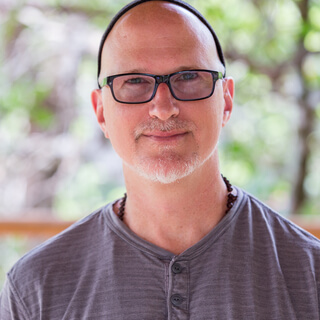
I'm Rabbi Brian Yosef Schachter-Brooks.
Enjoy.
Okay,
So this week's portion is called Parshat Terumah.
Terumah means,
Literally means portion.
And,
Here's what's happening on the literal level before we go into the more esoteric underlying meaning.
The Parsha opens with Hashem calling upon the children of Israel,
Who are,
By the way,
Stationed at Mount Sinai.
They're all camped out at the mountain.
And,
He asks them to contribute 13 materials toward the building of the Mikdash.
Mikdash is the sanctuary,
Also called the tabernacle in English.
And,
He asks them to contribute gold,
Silver,
And copper,
Blue,
Purple,
And red dyed wool,
Flax,
Goat hair,
Animal skins,
Wood,
Olive oil,
Spices,
And gems.
Then,
On Mount Sinai,
Moses is given detailed instructions on how to construct this sanctuary so that it could be readily dismantled,
Transported,
And reassembled as the people journeyed through the desert.
Within the sanctuary's innermost chamber,
Behind a woven curtain,
The ark containing the tablets of testimony engraved with the Aseret Hadib Rot,
The Ten Commandments would be housed,
Otherwise known as the Ark of the Covenant.
Upon the ark's cover would be two winged kiruvim.
Kiruvim is sometimes put in English as cherubim,
Which became an English word for angels,
But it comes from the Hebrew kiruvim,
And they are to be hammered out of pure gold.
In the outer chamber would be the seven-branched menorah,
And the table upon which the lechem panim,
Or showbread,
Was arranged.
That's a thing where they would put out bread as part of the ceremonial offerings that would be happening there.
This bread would be displayed.
The sanctuary's three walls would be fitted together from 48 upright wooden boards,
Each of which was overlaid with gold and held up by a pair of silver foundation sockets.
The roof would be formed of three layers of coverings,
Tapestries of multicolored wool and linen,
A covering made of goat hair,
A covering of ram and tahash skins,
And we don't really know what tahash means.
It's some kind of creature.
Across the front of the sanctuary would be an embroidered screen held up by five posts.
Surrounding the sanctuary and copper-plated altar in front of it would be an enclosure of linen hangings supported by 60 wooden posts with silver hooks and trimmings and reinforced by copper stakes.
And this is the famous and very beautiful verse that we'll be looking at.
This is God's instruction that they make a sanctuary.
It says,
So betokham can mean among them,
But it can also mean within them,
Hinting at both the literal and metaphorical levels of meaning,
Both the actual sanctuary and making ourselves into a sanctuary.
So that the divine presence is dwelling within us.
So what does that mean and exactly how do we do that?
The Hasidic Rebbe,
Rabbi Moshe of Kobrin of mid-19th century Belarus,
Answers this question in his teaching on an earlier passage in which Hashem speaks to Moses from the burning bush,
Shemot 3.
5.
Hashem says to Moses,
And Rabbi Moshe comments on the verse,
Admat kodesh hu,
The place upon which you stand is holy earth.
That is,
The place upon which you find yourself is holy,
For there is no aspect of human life within which we cannot find the holiness of the divine everywhere and at all times.
So what does it mean to remove that which comes between you and your experience of the world?
It can really only mean one thing,
And that is the movement of our minds,
Our thoughts and feelings,
Which form a kind of covering through which we experience the world.
That's what it means to remove the covering because we are constantly interacting with the world and with life through this mediation,
Through this covering,
Through this screen that distorts what we're actually experiencing.
This dropping away of mental movement is,
Of course,
Called meditation.
And in this verse,
The world is called Hamakom,
Which literally means the place.
And in Hebrew,
Hamakom is itself a divine name,
Revealing that the underlying identity of reality is God.
They're not two separate things.
So if we want to connect with the underlying divinity of everything,
We need to make ourselves into sanctuaries of presence,
Which brings us back to our verse from the Parsha.
The word mikdash,
Sanctuary,
Comes from the root.
You can see here,
Kuf,
Dalit,
Shin,
Kadosh,
Which means holy or sacred.
The actual meaning of kadosh is separate,
But not in the ordinary sense of separate.
In the case of a troubled relationship,
The word separate connotes distance,
Disconnectedness,
Alienation.
But kadosh is the opposite.
In a Jewish wedding ceremony,
We hear the words,
Atmikudeshet li,
You are holy to me.
The betrothed couple becomes separate because they are each other's most intimate and therefore separate from all other less intimate relationships.
So the separateness of kadosh points not to something that is distant,
But most central.
It points not to alienation,
But to the deepest connection.
V'shachanti betocham,
And I will dwell among or within them.
The mikdash is the place that the divine quality of kadosh dwells and communes with the Israelites,
As it says,
V'shachanti,
I will dwell.
The root of v'shachanti,
Shin,
Kaf,
Nun,
Is also found in the other word for the sanctuary,
Mishkan,
As well as the word for the Divine Presence itself,
Shechina.
And what is the main function of the mishkan for the Israelites?
The children of Israel came to the mishkan and later to the temple in Jerusalem to heal their separation from the divine.
Separation,
Not in the kadosh sense,
But in the ordinary sense of the word.
They brought their fruit,
Their grain,
And their animals to be offered on the fiery altar in order to heal the disconnectedness and alienation caused by their own misdeeds.
The word for a sacrificial offering is korban,
From the root kuf,
Resh,
Bet,
Karov,
Which means not sacrifice,
But nearness,
Closeness,
Intimacy.
So where was this mikdash placed?
Was it separate from the camp,
Off at a distance,
So that you would have your ordinary life and then you would go make a pilgrimage out to the mikdash?
No,
Not at all.
It was in the very center of the camp.
And within the very center of the mikdash was the most holy,
The kadosh kadoshim,
What's called the holy of holies,
The center of the center.
This representation of the sacred in space and architecture is not merely ritual magic from the past.
It is a pointer to the true sanctuary of presence within your own life.
There can be only one center of your life.
Take that in for a minute.
There can be only one center of your life.
What is that center?
The center is the one place that life is actually being lived.
This moment.
You're never separate from this moment.
And yet,
Are you truly dwelling within it?
Let them make for me a sanctuary,
And I will dwell within them.
There is a real divine call.
It calls to all of us right now.
It calls to us equally in pain and in joy,
In excitement and in boredom.
It says,
Come to the center.
Come to the center.
Come to this moment.
Build me a sanctuary.
How do we build it?
The essence of the sanctuary is not the structure,
But the space within the structure.
The structure is already there as your body,
Your mind,
Your heart.
They become a sanctuary the moment you allow there to be space.
Meaning relaxing the movement of the mind and becoming present.
The space completes the structure.
Come into that space.
Come into your body.
Come into the flow of breathing.
Come into the fullness of this moment.
Bring your core bond to the altar.
What does that mean,
Bring your core bond to the altar?
It means what are you experiencing?
What's the reality,
The truth of this moment for you?
Is there pain?
Is there fear?
Is there regret?
Is there embarrassment?
Bring it.
Bring it all.
Let the fire upon the altar of the present moment burn away the separation.
If it hurts,
Let it.
The pain is only temporary,
I promise you.
And it gives way to the sacred.
Because from within the space of attention and allowing yourself to feel whatever needs to be felt,
There is the power of transmutation.
The energy of separation and pain becomes the energy of love.
And from this love there is the possibility of external healing as well.
The healing that happens between people through deeds of love.
In fact,
The sages taught that it is for the sake of love that the universe has come into being.
And when we do acts of chesed,
Acts of loving kindness to one another,
We make the world into a sanctuary,
Into a home for the divine.
That is our tremendous potential.
To uncover this fundamental quality of sacredness,
First within ourselves through presence,
Through meditation,
And second toward others through our words and deeds.
This is the path of the Hebrew letter Kuf,
Which begins the word Kadosh,
Sacred or holy,
Pointing to our potential to realize the divinity of this moment,
Which is to say,
Be the divinity of this moment through presence.
So let's invoke this power of presence in the letter Kuf with the affirmation,
The Kavanah,
I am sanctifying,
I am holy,
I am holiness.
We'll chant it on long out breaths.
And you can also aid this kinesthetically by taking the shape of the letter Kuf,
Entering into the Kuf pose,
Which is palms together and bowing the head and bringing your palms to the crown of your head,
Bending your head downward a little bit as if in prayer and bringing the palms together at the crown of the head and chanting together for the letter Kuf,
Kadesh et Shimcha,
Sanctify your name,
Beolamecha,
In your universe.
So what does that mean?
The name is how we bring our mind to become aware of something.
When we name it,
We can focus on it.
It's like giving a form to a formless experience.
And so to sanctify it means to recognize and appreciate the sanctity,
To dwell in that experience of holiness while we live and interact,
While we bring ourselves to this world,
To this universe moment by moment.
And it's a prayer because we get the power to do this as a divine gift.
And so we ask,
Relaxed but not completely relaxed,
Letting go of excess tension,
Tension that we tend to hold without even being aware of it,
But having a little bit of tension to keep your back straight,
Your head aligned with heaven.
Meditation is so deeply relaxing,
But it's not total relaxation.
Total relaxation would be falling asleep,
Lying down.
But with meditation,
We are paying attention,
Paying attention,
Bringing awareness to connect with what is arising in the field of awareness.
And so we begin by offering our attention from the heart as a gift,
An offering of love,
With lecha,
A long out-breath,
Deep breath in,
And bringing your left hand also to your belly,
Feeling awareness dropping down into your belly.
Awareness like light permeating your organs,
Bringing gratitude and healing.
Awareness flowing down from your belly through your legs,
Through your feet,
Down into the floor,
Down into the earth,
The holy,
Sacred earth.
Awareness rising up,
Upper back,
Chest,
Shoulders,
And neck,
Releasing any excess tension from there.
Flowing down arms and hands and fingers,
Connecting back with your heart and belly.
Bringing your attention more deeply into the sensation of the flow of breathing,
Letting your breathing become a little more deep,
A bit more slow.
Attention rising up,
Face and facial muscles,
Brain and nervous system,
Bringing a little smile to your lips,
Being the joyful,
Loving,
Indwelling presence in the body.
If you don't happen to be feeling joyful right now,
That's fine.
It's the same as the affirmations.
It's not saying you are that.
It's planting the seed for that arising.
That's the meaning of the affirmation.
It's really like a prayer to ourselves.
And so affirming this body connection with na'ase,
Deep breath in,
And bringing right hand to lightly touch your forehead as awareness opens out into the space around you.
Aware of the sounds in the air,
Aware of the feel of the room,
The light,
The dark,
The objects,
And recognizing that the space around you is just like the space that you are,
The space of awareness within which your experience of the room and the outer world and the experience of thoughts and feelings in the inner world are arising.
All experience is one experience in this vast space,
And you are the space at the bottom of it all,
Or at the top of it all,
However you want to think of it.
You are this field of awareness,
Vast,
Boundless,
And free.
Deep breath in,
And kissing your fingers,
Relaxing your hands.
Rabbono shel olam.
Help us to dive deeply into this spaciousness,
Letting the mind rest in the tefillah,
Which is simply the recognition of the one reality.
Atahu,
Atahu.
You who are not separate from anything or anyone,
You who are not separate from this awareness that we are.
You are Hashem,
You are the divine.
Atahu.
Bringing some movement to your body,
Taking a nice stretch.
May this quality of sanctity,
Of holiness,
Recognition of the sacred be alive within us.
May we draw forth on it to bring our korban,
Our offerings of all that we are,
Including the pain,
Including whatever emotional hurt is there,
Whatever trauma might be there.
Bring it to the altar.
It will be transmuted through this power of presence.
Oseh shalom b'mromav hu yahaseh.
Shalom aleinu v'al ko yisrael v'al ko yoshvei tevel v'imru.
Amen.
Shalom.
I hope you've enjoyed this Torah of Awakening.
I'm Rabbi Brian Yosef Schachter-Brooks.
Until next time,
All blessings.